
Researched and drafted with AI assistance · reviewed and edited by Jason D. Keys
Listen
The Forced Seller: How the Same Mechanism Destroys Wealth in Portfolios and Careers
Read in Jason D. Keys' synthesized voice
Narrated in the author’s synthesized voice, generated with AI from a recording of his own. The words are his; the delivery is machine-rendered.
Download (15.6 MB)The principle, and the question this essay asks
Article 37's July 2026 revision generalized what had originally been a narrow claim — that individual trading positions benefit from defined exit strategies — into a broader structural principle: the universal failure mode in wealth destruction is not holding the wrong asset, but being forced to sell the right one at the wrong moment. Leverage, illiquidity, and an unavoidable liquidity need are, that revision argued, the three conditions that jointly produce this outcome, and removing any single one of the three is usually sufficient to prevent it. Article 42, the first installment of this series, gave that claim its sharpest empirical test yet: a saver who held a 15 percent gold allocation from 1980 and capitulated near the 1999 trough — a year or so before an eleven-year ascent that carried gold from roughly $252 to a September 2011 peak near $1,895 — converted a temporary underperformance into a permanent, realized loss, precisely because the position was not held under conditions that made it possible to survive the pain of the preceding two decades.
This essay asks a question the prior two installments did not fully address: is this principle specific to financial assets, or does it generalize to the other dominant asset this catalog has identified — human capital, which Article 37's revision argued is, for most of a working life, more valuable than any financial position a saver might hold? The question matters because if the forced-seller mechanism applies only to portfolios, the framework has two separate and only loosely related principles (protect your financial positions from forced liquidation; also, separately, human capital is valuable). 1 If the mechanism applies identically to careers, the framework has a single unifying discipline that governs the management of every asset a saver holds, financial or otherwise, and the practical implications sharpen considerably.
The answer this essay develops, using academic literatures that do not cite each other and were not developed with any intention of being compared, is that the mechanism is identical, and the empirical magnitude of the resulting discount is close enough between the two domains that describing them as parallel understates the finding: it would be more accurate to say they are the same phenomenon, observed independently in two different markets, by two different sets of researchers, using two entirely different datasets, decades apart.
The financial evidence — what forced liquidation actually costs
The academic literature on forced-sale discounts is more extensive and more rigorously quantified than the framework's prior treatment of "never be a forced seller" drew upon, and the actual figures deserve to replace the qualitative warning with a specific, sourced range.
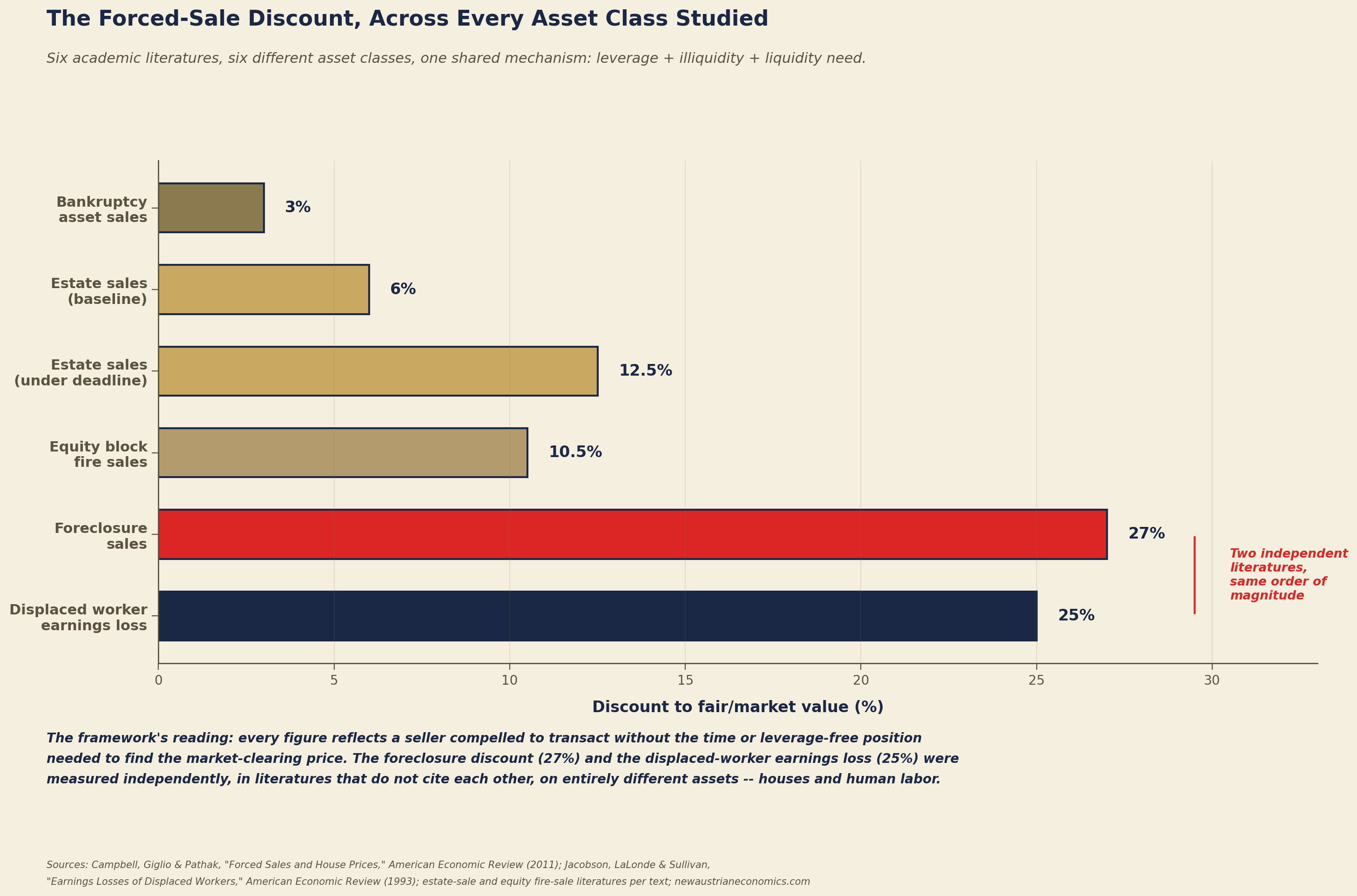
Foreclosure sales. John Y. Campbell, Stefano Giglio, and Parag Pathak's "Forced Sales and House Prices," in the American Economic Review 101(5) (2011), using two decades of transaction data covering every house sale in Massachusetts, found that homes sold through foreclosure transact at an average discount of 27 percent relative to the fair market value of comparable non-distressed properties. 2 This is not a modest or contested figure within the subsequent literature; while some studies using different methodologies (appraisal-fixed-effects approaches that control more precisely for property condition) find smaller discounts attributable specifically to distress-sale stigma — single-digit rather than double-digit, though the framework could not locate a specific published range — even these more conservative estimates confirm a real, substantial, and specifically forced-sale-attributable gap between what a foreclosed property sells for and what the same property would fetch on an ordinary timeline with an ordinary seller.
Estate sales following sudden death. The same Massachusetts paper also measured sales occurring close in time to a seller's death or bankruptcy, and found the discount on those milder forms of compulsion in a band of roughly 3 to 7 percent — around 5 to 7 percent where death was the trigger, and around 3 percent where bankruptcy was. 3 A genuinely separate literature isolates the effect of the deadline itself: Steffen Andersen and Kasper Meisner Nielsen, in Management Science, examined 6,329 Danish estate sales in which beneficiaries were required to settle within twelve months of a sudden death, and found no discount at all for sales completed well before the deadline and a discount of approximately 12.5 percent for sales completed shortly before it. 3 The compulsion, not the bereavement, is what costs money.
Equity fire sales. Financial-asset fire sales show the identical pattern at a magnitude of their own. Serdar Dinc, Isil Erel, and Rose Liao, in the Journal of Financial Economics (2017), examined 638 sales of minority equity stakes and found an industry-adjusted distressed-sale discount of approximately 8 percent, measured over a four-week window and controlling for the liquidity of the shares sold — against roughly 4 percent for forced stock sales by mutual funds, where transaction prices are not observable. 4 The discount scales with the difficulty of finding a willing buyer within the seller's available timeframe, exactly as the theory predicts. Valuation-industry practice, reflecting this body of research in aggregate, commonly estimates "forced liquidation value" at 70 percent or less of fair market value across asset types generally — a rule of thumb rather than a research finding, and offered here as one. 1
The common mechanism. These findings come from three papers rather than five literatures — the Massachusetts study alone supplies the foreclosure, death, and bankruptcy figures — but across the asset classes and triggering events they cover, each identifies the same three ingredients: a seller who cannot wait for a normal marketing period (illiquidity, in the sense that the asset cannot be converted to cash on the seller's preferred timeline without accepting a worse price), a seller who is compelled to transact regardless of price (the liquidity need — debt service, court deadline, margin call, family settlement), and, in most of the specific cases studied, a seller who took on some form of leveraged or fixed obligation earlier that created the present compulsion (a mortgage that could not be serviced, a margin loan that triggered a call, an estate tax deadline). Remove any one of the three — genuine patience to wait for a normal sale, a seller under no external compulsion to transact on a specific date, or the absence of the leveraged obligation that created the compulsion in the first place — and the discount does not materialize, because an unforced sale at a time and price of the seller's choosing simply is a market-value transaction by definition. This is precisely Article 37's generalized Principle Nine, now given a specific, multi-study, cross-asset-class evidentiary base the original formulation did not have.
The three conditions, precisely
Before extending the principle to human capital, the three conditions this essay has identified deserve to be stated with enough precision that their generalization is not merely metaphorical. 5
Leverage is any fixed, non-negotiable obligation whose servicing does not depend on the current market value or current income-generating capacity of the underlying asset. A mortgage payment is due regardless of whether the house's value has fallen. A margin call is triggered regardless of whether the position's eventual value will recover. Leverage converts a paper loss (an asset's market value falling below what was paid for it) into a forcing function (a payment obligation that must be met from some source, on a schedule the asset holder does not control).
Illiquidity is the inability to convert an asset to cash within a timeframe shorter than the timeframe over which its price is likely to be depressed. A house cannot ordinarily be sold, marketed, and closed in under thirty to sixty days without accepting a below-market price; a thinly traded equity block cannot be sold at scale without moving the price against the seller; physical gold requires locating a buyer and, in some jurisdictions, waiting periods or verification steps that a paper claim does not. Illiquidity is not a fixed property of an asset class in isolation; it is a property of the asset relative to the specific timeframe the seller has available, which is why the same asset (gold, a house, an equity stake) can be liquid in ordinary circumstances and effectively illiquid under duress.
Liquidity need is the actual, dated requirement to convert some asset to cash — a debt payment coming due, a legal deadline, a margin call, a genuine emergency expense with no other funding source. Absent an actual liquidity need, illiquidity and leverage are both dormant; a leveraged, illiquid position held by someone with no pressing need to realize cash from it is simply a position, not yet a forced sale.
The critical structural fact, and the one this essay's generalization depends on, is that all three conditions must be present simultaneously to produce the forced-sale discount. A highly leveraged position held by someone with abundant liquid reserves elsewhere is not at risk of forced sale, because the liquidity need can be met from the reserves rather than from selling the leveraged position. An illiquid position held with no leverage and no pressing need is simply a long-term holding, not a forced sale waiting to happen. A genuine liquidity need affecting someone holding only liquid, unleveraged assets is met by ordinary conversion at fair value, with no discount at all. The discount specifically and only appears at the intersection of all three, which means the defense against it is any single intervention that removes one of the three conditions — it does not require eliminating all three simultaneously, which is a materially easier and more actionable discipline than it might first appear.
The generalization — human capital and the identical mechanism
Louis Jacobson, Robert LaLonde, and Daniel Sullivan's "Earnings Losses of Displaced Workers," in the American Economic Review 83(4) (1993), used an administrative dataset then newly available from the state of Pennsylvania, combining individual workers' quarterly earnings histories with information about their employing firms' financial distress, and followed workers who left declining firms between 1980 and 1986 after at least six years of tenure. It found that high-tenure workers who separate from financially distressed firms experience long-term earnings losses averaging 25 percent per year — a loss that begins to appear even before the actual separation occurs, is not confined to a handful of industries, remains substantial even for workers who find new employment in similar firms and industries, and shows little sign of ever fully closing even several years after displacement. 5 The finding has been independently replicated across multiple decades, states, and economic conditions. Marta Lachowska, Alexandre Mas, and Stephen Woodbury, studying Washington State workers displaced in the 2007-2009 recession, report losses of about 16 percent five years out and observe directly that these are similar in magnitude to those found for Pennsylvania in the 1980s, for Connecticut in 2000-2001, and for the United States nationally across 1980-2005. 6 The estimates across this literature fall in a 15-to-30-percent range, with figures near 25 percent recurring in studies conducted decades apart on entirely different populations. 5
The structural parallel to the foreclosure literature is not merely thematic; it is mechanistic, condition by condition. Leverage, in the career context, is the set of fixed financial obligations — a mortgage, dependents' expenses, debt service — that must be met on a schedule regardless of the displaced worker's current earning capacity, creating exactly the forcing function that a mortgage payment creates for a distressed homeowner. Illiquidity, in the career context, is the degree to which a worker's specific skill set is narrow, specialized, and non-transferable to alternative employers or industries — a highly specific skill is, in the labor market, exactly analogous to a thinly traded security or an idiosyncratic property that cannot be quickly sold to the full universe of potential buyers, requiring either a long search for the rare employer who values that specific skill, or acceptance of a worse offer from the more numerous employers who do not. Liquidity need is the displacement event itself — the job loss, sudden and often outside the worker's control — which creates the same urgent, dated pressure to transact (accept some job, at some wage, on some timeline) that a margin call or a probate deadline creates in the financial cases.
This catalog's Article 31 developed the specific historical and theoretical apparatus for understanding how the illiquidity condition can be created or worsened for a worker's specific skill: David Ricardo's reversal in "On Machinery," the chapter he added to the third edition of the Principles of Political Economy and Taxation in 1821, in which he abandoned his earlier optimism and demonstrated in detail how the introduction of machinery could permanently reduce the demand for a specific category of labor without any compensating increase elsewhere in the same market. 7 The Distribution Question series (Articles 38-40) documented the empirical scale of this dynamic in the current AI-driven cycle: Goldman Sachs's estimate that roughly 2.5 percent of United States employment is exposed on current use cases, rising to 6 or 7 percent under wide adoption; the Harvard Business Review's survey of a thousand global executives finding that layoffs have been executed in anticipation of AI's potential rather than in response to its demonstrated performance; and Oxford Economics's assessment that evidence of AI-driven job losses remains patchy, and that AI is frequently cited as the reason for reductions actually driven by weak demand or prior over-hiring. 8 Read together with this essay's findings, these figures describe the specific mechanism by which a worker's skill can move from liquid (broadly demanded, many potential buyers) to illiquid (narrowly demanded, few potential buyers) within a compressed timeframe — precisely the condition that, combined with leverage and an eventual displacement event, produces the 25 percent earnings-loss discount the labor economics literature has documented across four decades. 5
Why this convergence is not a coincidence dressed as one
A skeptical reading of this essay's central comparison might object that a 27 percent housing discount and a 25 percent earnings discount are simply two numbers that happen to be close, in two literatures that measure entirely different things, and that treating this as a meaningful convergence risks the kind of numerological pattern-matching the framework has elsewhere been careful to avoid. 5 This objection deserves to be engaged directly rather than waved aside, because the framework's own standards, developed across this catalog, require exactly this scrutiny.
The response is that the convergence is not being offered as evidence that 25 and 27 are mystically related numbers; it is being offered as evidence that a shared mechanism — the three-condition structure developed above — produces discounts of a broadly similar order of magnitude when it operates on genuinely different underlying assets, because the mechanism itself, not the specific asset class, is what determines the rough scale of the discount. Bankruptcy-triggered house sales (around 3 percent), estate sales (5 to 7 percent generally, 12.5 percent against a deadline), and minority equity stake sales (around 8 percent) are also governed by the identical three-condition mechanism, and they produce meaningfully different discounts from both the foreclosure and displaced-worker figures — because the specific severity of illiquidity, the specific tightness of the timeline, and the specific depth of the leverage involved differ across these cases in ways the underlying research carefully documents. 4 The claim this essay makes is narrower and more defensible than "25 equals 27": it is that housing and labor are, among the cases surveyed in this essay, the two markets in which illiquidity is most severe (a house takes weeks to properly market; a specific narrow skill set may have very few alternative buyers at all) and in which the triggering liquidity need is typically least within the seller's control (foreclosure and job loss are both frequently involuntary, unlike a voluntary decision to liquidate an equity stake), which is precisely the combination of conditions the underlying three-factor mechanism predicts should produce the largest discounts of the cases studied — and the empirical figures bear this prediction out.
The defense — identical in structure, applied to two different assets
The practical response to this essay's finding is not a new principle but the explicit recognition that Article 37's Principle Nine and Principle Eleven were always the same discipline, misleadingly presented as two separate recommendations.
Reducing leverage applies identically to both domains. In the financial case, this means limiting fixed debt service and contractual obligations to a level that does not require selling any specific position on any specific schedule. In the career case, this means the same discipline applied to household finances specifically: fixed obligations (mortgage size, dependent expenses, debt service) sized conservatively enough relative to income that a period of unemployment or underemployment does not force acceptance of the first available offer regardless of its quality — the career-management equivalent of not buying a house at the very top of one's borrowing capacity.
Reducing illiquidity applies with a specific and important asymmetry between the two domains. In the financial case, illiquidity is addressed by holding a genuine mix of liquid and illiquid assets, so that a liquidity need can be met from the liquid portion without forcing a sale of the illiquid one. In the career case, the analogous discipline is maintaining skill breadth and adjacent-skill transferability rather than allowing one's entire earning capacity to depend on a single, narrow, potentially automatable specialization — not abandoning deep expertise, which remains valuable, but deliberately cultivating the capacity to redeploy that expertise into adjacent applications if the specific, narrow application it was built for is disrupted. A worker whose skill has several plausible alternative markets is, in the labor-market sense, more liquid than a worker whose skill has exactly one.
Managing the liquidity-need trigger is the hardest of the three to control directly in either domain, since neither a market crash nor a layoff announcement is, in the specific moment, within the asset holder's control. But both domains share an identical indirect defense: maintaining sufficient reserves — cash reserves in the financial case, an active professional network and current market visibility in the career case — that the arrival of the triggering event does not immediately compel a transaction on the worst available terms. A financial reserve of adequate size converts "I must sell this position today" into "I can wait for a better price." A maintained professional network and current skill visibility converts "I must accept whatever offer arrives first" into "I can wait for a better offer," which is the labor-market equivalent of the same defense, achieving the same effect through a different specific mechanism appropriate to the different asset.

A worked illustration — the same three conditions, two different savers
Consider two hypothetical workers, identical in profession, income, and skill, differing only in how their financial and career lives are structured, to make the three-condition framework concrete rather than abstract.
Both are forty-year-old software engineers earning $180,000 annually, with fifteen years of experience concentrated in a specific enterprise software platform that a large AI-driven automation wave — of exactly the kind the Distribution Question series documented — has begun to displace across their specific industry niche, though not yet in adjacent niches that use overlapping but distinct skills.
Worker A carries a mortgage sized to the maximum their income qualified for, consumes essentially their full monthly income across housing, two car payments, and family expenses, holds no meaningful cash reserve beyond one month of expenses, has spent the past decade deepening expertise in the single specific platform without maintaining active familiarity with adjacent tools or industries, and has let their professional network atrophy to former colleagues at their current employer. When Worker A's role is eliminated, all three conditions this essay has developed are present simultaneously: leverage (the fixed mortgage and car payments continue regardless of income), illiquidity (the specific platform expertise has few alternative buyers in the specific moment the broader industry is also displacing that skill), and an acute liquidity need (one month of reserves against an income interruption of unknown duration). Worker A, per the Jacobson-LaLonde-Sullivan literature this essay has developed, should expect to accept a position at a meaningfully reduced wage, likely outside their specific specialization, within a matter of weeks — not because their underlying skill and experience became less valuable in some abstract sense, but because the three conditions this essay has identified compelled a transaction on the first available terms rather than the market-clearing ones.
Worker B, with identical income, identical years of experience, and identical exposure to the same displacing technology, has instead maintained a mortgage sized to roughly 60 percent of their maximum qualifying amount, holds twelve months of expenses in liquid reserve specifically because Article 37's original cash-for-liquidity principle was followed rather than treated as generic advice, has spent evenings and weekends over the preceding several years maintaining working familiarity with two adjacent platforms that solve related but distinct problems, and has continued attending industry conferences and maintaining an active professional network independent of their current employer. When Worker B's role is eliminated, none of the three conditions is fully present: leverage is modest relative to income, meaning the household's actual cash-flow requirement during a transition is far below the prior salary; illiquidity is reduced, because the maintained adjacent skills mean several distinct market segments, not one, are potential buyers of Worker B's labor; and the liquidity need, while real, is not acute, because twelve months of reserves converts "I must accept an offer within weeks" into "I can wait for the right offer for most of a year if necessary." Worker B, on the same body of research this essay has developed, should expect a meaningfully smaller earnings discount, a faster path to a comparable or superior role, and very possibly no persistent earnings loss at all. That last expectation is an extrapolation from the mechanism rather than a documented subgroup finding: the displaced-worker literature stratifies by tenure, industry and local labor-market conditions, not by leverage and liquid reserves, so it cannot be cited for the specific case of a worker who fails to present all three forcing conditions.
The two workers did not differ in talent, effort, or the underlying quality of their specific expertise, and neither was in a position to prevent the industry-wide displacement of their specific platform specialization — that displacement was, in both cases, outside their individual control, exactly as a housing-market downturn is outside an individual homeowner's control. What differed was whether the three conditions this essay has developed were allowed to compound at the moment the displacement arrived. This is the specific, concrete sense in which Article 37's Principle Nine and Principle Eleven converge: Worker B's advantage was not a smarter portfolio allocation or a better financial instrument. It was the same discipline — avoiding the simultaneous presence of leverage, illiquidity, and an urgent liquidity need — applied with equal seriousness to a career as to a brokerage account.
The framework's synthesis — closing the initial series arc
This installment closes the three-part arc this series opened to address the sharpest external critique this catalog has received. Article 42 established that the framework's recommended hedge could survive scrutiny once sized to a demonstrated, tolerable worst-case cost rather than asserted as a fixed percentage — the calibration problem is real, and disciplined bounded position sizing, not false precision about timing, is the honest response. Article 43 established that the framework's theoretical diagnosis of unsound money does not, by itself, identify a single universal empirical hedge — different collapse mechanisms require different defenses, and the framework's apparatus, properly and narrowly applied, already explains why. This installment establishes that the single most actionable discipline available to a saver — never allow leverage, illiquidity, and an urgent liquidity need to coincide — is not a portfolio-management technique with a separate, looser analogy to career management. It is one discipline, evidenced with comparable rigor in two independent academic literatures, applicable with identical force to every asset a saver holds, financial or human.
The three installments together do not produce a simpler framework than the one Article 37 originally offered; if anything, they produce a more demanding one, because each installment replaced an asserted claim with an evidenced and more conditional one. What they produce instead is a framework that has been tested against its own strongest available critique and has, in each case, either survived with a stronger evidentiary foundation than it started with, or been corrected where the evidence did not support the original claim. That is the standard this series was established to meet, and the standard the framework intends to continue applying as new critiques, new data, and new historical evidence become available.
This is the third and closing installment of the initial Stress-Testing the Framework series arc, following Article 42 (the calibration problem) and Article 43 (testing the diagnosis against the historical record of collapse). The series remains open for future installments as new critiques of the framework's prior conclusions warrant the same evidentiary treatment.
Sources
Footnotes
-
American Society of Appraisers, forced-liquidation value convention. https://www.appraisers.org/ — The "forced liquidation value at 70 percent or less of fair market value" convention is an appraisal rule of thumb rather than a research finding, and is offered in the text as one. ↩ ↩2
-
Campbell, John Y., Stefano Giglio and Parag A. Pathak. "Forced Sales and House Prices." American Economic Review 101(5), August 2011, 2108–31. https://www.aeaweb.org/articles?id=10.1257/aer.101.5.2108 — Every house transaction in Massachusetts over two decades. Foreclosure discounts average 27 percent; forced sales generally transact at 3 to 7 percent discounts, death at the upper end and bankruptcy at the lower. ↩
-
Andersen, Steffen and Kasper Meisner Nielsen. "Fire Sales and House Prices: Evidence from Estate Sales Due to Sudden Death." Management Science. https://pubsonline.informs.org/doi/10.1287/mnsc.2015.2292 — 6,329 Danish estate sales requiring settlement within twelve months of a sudden death: no discount well before the deadline, 12.5 percent shortly before it. ↩ ↩2
-
Dinc, Serdar, Isil Erel and Rose C. Liao. "Fire Sale Discount: Evidence from the Sale of Minority Equity Stakes." Journal of Financial Economics 125(3), 2017, 475–90. https://www.sciencedirect.com/science/article/abs/pii/S0304405X17301265 — 638 minority equity sales at a 3.7 percent median stake; industry-adjusted distressed-sale discount of approximately 8 percent over four weeks, against roughly 4 percent estimated for forced mutual-fund stock sales. ↩ ↩2
-
Jacobson, Louis S., Robert J. LaLonde and Daniel G. Sullivan. "Earnings Losses of Displaced Workers." American Economic Review 83(4), 1993, 685–709 — Pennsylvania administrative records for workers leaving declining firms 1980–86 after at least six years' tenure: long-term losses averaging 25 percent a year, beginning before separation, not confined to a few sectors, and large even for those finding new jobs at similar firms. ↩ ↩2 ↩3 ↩4 ↩5
-
Lachowska, Marta, Alexandre Mas and Stephen A. Woodbury, on Washington State workers displaced in the 2007–09 recession: earnings roughly 16 percent below comparison groups five years on, about 45 percent of the shortfall from reduced hours and 55 percent from lower wages. The authors note similar magnitudes for Pennsylvania in the 1980s, Connecticut in 2000–01, and the United States nationally across 1980–2005 — the three replications this essay relies on. ↩
-
Ricardo, David. "On Machinery," chapter 31, added to the third edition of On the Principles of Political Economy and Taxation, 1821. https://www.econlib.org/library/Ricardo/ricP.html ↩
-
Goldman Sachs Research, on US labor-market exposure: approximately 2.5 percent of employment at risk on current use cases, rising to 6–7 percent under wide adoption. Harvard Business Review, on a late-2025 survey of 1,006 global executives finding firms reduced headcount or slowed hiring in expectation of AI-driven automation rather than in response to demonstrated capability. Oxford Economics, "Evidence of an AI-driven shakeup of job markets is patchy" — firms do not appear to be replacing workers with AI at scale, and AI is frequently cited for reductions driven by weak demand or prior over-hiring. ↩
Related essays
The Derivative Arrived First: SpaceX, the Inverted Pyramid, and What the Market Actually Watches
On June 12, 2026, Space Exploration Technologies Corporation began trading on the Nasdaq under the ticker SPCX, completing the largest initial public offering in the history of capital markets — $85.7 billion raised after the overallotment, against a previous global record of $29 billion. One trading session later, on June 15, ten leveraged and inverse SPCX products began trading at once — four of them bearish, including the Leverage Shares 2x Short SPCX Daily ETF on the Cboe, offering investors a negative-two-times daily leveraged short position on a company that had been public for a single session. Within the week there were eleven, from seven fund families. The short fund obtains its exposure not by borrowing and selling actual shares but through total return swaps — contracts that reference the share price without ever touching a share. SpaceX reported its first quarter as a public company on August 4, eight weeks later. For that entire interval, an investor could hold a leveraged short position, synthesized through derivatives, on a company that had never reported a quarter as a public entity. This essay uses that specific, dated simultaneity as the cleanest available evidence for a structural argument this catalog has been developing since Article 1: that the layer of claims built atop productive assets has not merely grown larger than the assets themselves, but now arrives first. It develops the size hierarchy that almost no one states plainly — $846 trillion in outstanding over-the-counter derivatives notional against roughly $161 trillion in global debt securities and roughly $158 trillion in global equity market capitalization — engages honestly the strongest objection to using notional as a measure, examines why a $2.1 trillion company is structurally ineligible for the index that defines 'the market,' and extends Article 44's forced-seller framework to a product category that engineers forced selling into its own operating mechanism. The framework holds no position in any security discussed and makes no recommendation regarding any of them.
Navigating the Substitute Layer: A Framework for Personal Savings in the Absence of Sound Money
The saver in 2026 faces a problem that the pre-1971 saver did not face and that most contemporary financial advice does not seriously engage: the unit of account itself depreciates. Cash held over time loses purchasing power. Debt-denominated instruments (bonds, money market funds, savings accounts) accrue nominal returns that may or may not exceed the depreciation. Equity instruments (stocks, mutual funds, ETFs) provide claims on future corporate earnings that must be discounted for both time preference and monetary depreciation. Real estate imposes illiquidity and transaction costs while providing quasi-monetary exposure to housing services. Precious metals — the historical form of money, and money in the precise sense the framework has developed across Articles 5, 30, and 33 — provide the closest available substitute for a monetary unit whose purchasing power is preserved across time. This essay is the framework applied to the individual saver's question of how to allocate financial capital under substrate conditions that have persisted since the collapse of the Bretton Woods system on August 15, 1971 and that show no near-term signs of resolution. It addresses the mechanics of 401(k) plans, the Rule of 72 and its inflation application, the personal-experience insight of the mutual fund industry as viewed from inside, the case for the self-directed Solo 401(k) via limited liability company structure, the framework's reading of hard-asset diversification, the technical trading approach articulated by Chris Vermeulen in his 'Asset Revesting' framework, and the framework's synthesis of principles for personal savings navigation. Revised in July 2026 following substantive critical engagement, this version adds four analytical extensions: the argument that the 401(k) wrapper itself, independent of its underlying holdings, is a substitute-layer instrument in the framework's precise sense; a new 'Custody Depth' score measuring how many institutional counterparties stand between a saver and a given asset; the case that human capital, not portfolio allocation, is the dominant asset for most of a working life; and a jurisdictional axis of diversification orthogonal to asset class. It closes with two explicit limitations the framework had not previously confronted: the calibration problem of sizing and timing a hedge against a risk of unknown timing, and the gap between the theoretical diagnosis of unsound money and the separate empirical question of what actually preserves wealth through collapse. It is not investment advice. It is analytical framework applied to a specific class of individual decisions. The reader must translate these principles into their own circumstances, which the framework cannot assess and does not attempt to.