
Researched and drafted with AI assistance · reviewed and edited by Jason D. Keys
What Article 37 said, and what it missed
Article 37 of this catalog, published in July 2026 and revised later that month, made a specific recommendation to savers: hold a meaningful percentage of savings in physical monetary metals, and hold them either in direct personal possession or in fully-allocated custody outside the fractional-reserve banking system. The revision introduced a measurement device called the Custody Depth score — an ordinal count, from zero to five, of the institutional counterparties standing between a saver and unencumbered control of an underlying asset. Physical gold in the saver's own safe scored zero. Allocated bullion storage in the saver's name at a specialty vaulting firm scored one. A commodity-backed ETF held inside an employer-sponsored 401(k) scored five.
The same article recommended the self-directed Solo 401(k) as the institutional vehicle through which a self-employed saver could hold physical precious metals with the tax advantages of a retirement account, noting that specialty administrators enable investment in asset classes that mainstream brokerage accounts do not offer.
Both recommendations were correct as far as they went. Neither was complete, and the gap between them is the subject of this essay.
The Custody Depth score measured intermediation. It counted institutions. What it did not measure — and what the framework did not adequately distinguish — is that a saver holding metal through a custodian faces two structurally different risks that the score collapsed into one. The first is that the custodian becomes insolvent. The second is that the custodian is dishonest. Allocated storage addresses the first comprehensively and the second not at all, and the difference between those two statements is the difference between a saver who recovers his metal from a bankruptcy proceeding and a saver who opens a box and finds a slip of paper.
This is the fourth installment of Stress-Testing the Framework, a series established to apply the same evidentiary standard to this catalog's own conclusions that it applies elsewhere. The prior three installments corrected the framework's hedge-sizing guidance, its conflation of monetary theory with empirical wealth preservation, and its treatment of forced selling. This one corrects a measurement device the framework itself invented, using a case that concluded in a federal courtroom fourteen months ago.
The bailment structure, and why it genuinely works
Before examining what allocated storage fails to protect against, the framework should state clearly what it does protect against, because that protection is real, legally robust, and empirically demonstrated.
Allocated storage is a bailment. Under common law, a bailment is an arrangement in which goods are delivered into the custody of another party without any transfer of ownership. The bailee holds; the bailor owns. Applied to precious metals, this means that specific bars or coins — identified by serial number, weight, and assay mark — are recorded as belonging to a named client and held on that client's behalf. The London Bullion Market Association's guidance to the precious metals market is explicit that under such an arrangement the custodian has no right to use, lend, lease, or otherwise deal with the metal. 1
The consequences of this structure at the moment of institutional failure are precise and favorable. Because the client holds legal title to identified property rather than a contractual claim against the custodian, the metal does not form part of the custodian's bankruptcy estate. Creditors of a failed vault operator cannot reach it. The protection is rooted in property law rather than contract law, which is why allocated custody has long been the standard used by central banks, sovereign wealth funds, and institutional holders.
The contrast with unallocated storage sharpens the point. An unallocated holder does not own specific bars; he holds an undivided claim against a pool the custodian owns and may lend, lease, or trade. That claim sits on the custodian's balance sheet as a liability. At insolvency, the unallocated holder is an unsecured creditor standing in line with bondholders and trade suppliers, hoping for a fiat settlement. The economics of the two arrangements reflect this exactly: allocated storage typically costs between 0.5 and 1.5 percent of value annually, because the custodian earns nothing from metal it is forbidden to touch, while unallocated storage is frequently offered at no charge at all, because the custodian can lease the metal and earn yield on it. 1 The unallocated holder is not receiving free storage. He is paying for it by assuming counterparty risk, and the fee he does not pay is the premium on that risk.
The empirical demonstration came in September 2008. Lehman Brothers held precious metals positions for clients under both structures. Clients whose metal was allocated — registered in their name at a vault — were unaffected by the bankruptcy. Clients holding unallocated credits against Lehman's balance sheet became unsecured creditors in the proceeding. The distinction that had existed on paper for centuries became operational overnight, and it worked as the legal theory said it would.
A more recent structural shift reinforced the same lesson from an unexpected direction. The Basel III net stable funding ratio, which took effect in the European Union in June 2021 and in the United Kingdom from January 2022, assigned an 85 percent required stable funding factor to precious metals held on a bank's balance sheet — a substantial cost, and one that falls on unallocated positions because those are the ones that sit there. 2 Bullion banks responded by encouraging and in some cases requiring clients to convert unallocated holdings into allocated accounts. For the bank, the conversion moved metal off the balance sheet and outside the funding calculation. For the client, the same step replaced an unsecured creditor exposure with a title-and-bailment position. Regulatory capital pressure, applied for reasons having nothing to do with client protection, pushed the industry toward the arrangement that protects clients better.
So the framework's original recommendation was not wrong about the structure. Allocated custody is meaningfully safer than unallocated custody, for reasons that are legally sound and have been tested in an actual bankruptcy. The error was in what the framework assumed the structure guarantees.
First State Depository
Robert Leroy Higgins, of West Chester, Pennsylvania, spent more than four decades as a trader in precious metals. He owned and operated First State Depository Company LLC in Wilmington, Delaware, alongside an affiliated business, Argent Asset Group, engaged in buying, selling, and leasing precious metals. At its peak First State held over $100 million in customer assets, principally gold and silver bars and coins. 3
Approximately 2,100 customers stored metal at the facility in individually labeled boxes, an arrangement functionally equivalent to bank safe deposit boxes and marketed as segregated storage. 4 Delaware, one of a handful of states imposing no retail sales tax, hosts several precious metals depository businesses, and prospective clients were directed to First State on lists of depositories supplied by retirement planners and precious metals promoters. As the Philadelphia Inquirer reported in its coverage of the case, many of those customers were retirees who had been persuaded to include precious metals in their IRA or 401(k) accounts.
They were, in other words, doing precisely what Article 37 of this catalog recommended.
Over a period of at least a decade, Higgins misappropriated customer metal to pay business debts and finance personal expenses, including two timeshares in Hawaii and foreign travel, while underreporting his income on federal tax returns. The Commodity Futures Trading Commission brought its case against First State, Argent and Higgins on a court order signed September 29, 2022, initially alleging misappropriation of at least $7 million from roughly 200 customers — a figure that grew by more than an order of magnitude as the count proceeded, ending in a July 2023 consent order for $112.7 million in restitution and a $33 million civil penalty. 5 A court-appointed receiver, Kelly Crawford, took control of the facility, arriving with United States marshals and a judge's order, and retained the accounting firm Baker Tilly to conduct a physical count against records indicating roughly $140 million in gold and silver. 6
Much of it was not there. Roughly $64 million was recovered from nearly a thousand boxes, leaving some $76 million unaccounted for. 3 Some boxes were empty; some held silver where the records listed gold; some held paper IOUs. More than 1,000 customer accounts were missing precious metals. The receiver's operations at the depleted facility concluded on November 30, 2023.
A federal jury convicted Higgins on October 24, 2024, after an eight-day trial, deliberating less than four hours before returning guilty verdicts on every count of mail fraud, wire fraud and tax evasion against him. On June 17, 2025, United States District Judge Maryellen Noreika sentenced him to sixty-five years in federal prison, the statutory maximum, and ordered $76.5 million in restitution. 3 Prosecutors established theft of at least $76 million; the United States Attorney's statement noted that by the end of the scheme over $50 million in customer metal was gone and that in some instances victims lost their entire life savings. 3 Industry sources have characterized it as the largest theft from a precious metals depository in United States history.
The detail that matters most for this framework's purposes appears in a single sentence of the Inquirer's reporting, attributed to Delaware state officials: unlike other Delaware precious metals depositories associated with banks, First State was not regulated as a financial institution and was not subject to close examination.
Those 2,100 customers held allocated positions. 4 Their metal was individually identified and boxed in their names. The bailment structure applied to them in full. Under the legal theory developed in the previous section, they held title to specific property that no creditor of First State could reach — and that theory was correct. It simply had nothing to operate on, because the property to which they held title had been carried out of the building years earlier.
The pattern
First State is the largest case but not an isolated one, and the surrounding pattern establishes that the risk is structural rather than a single bad actor.
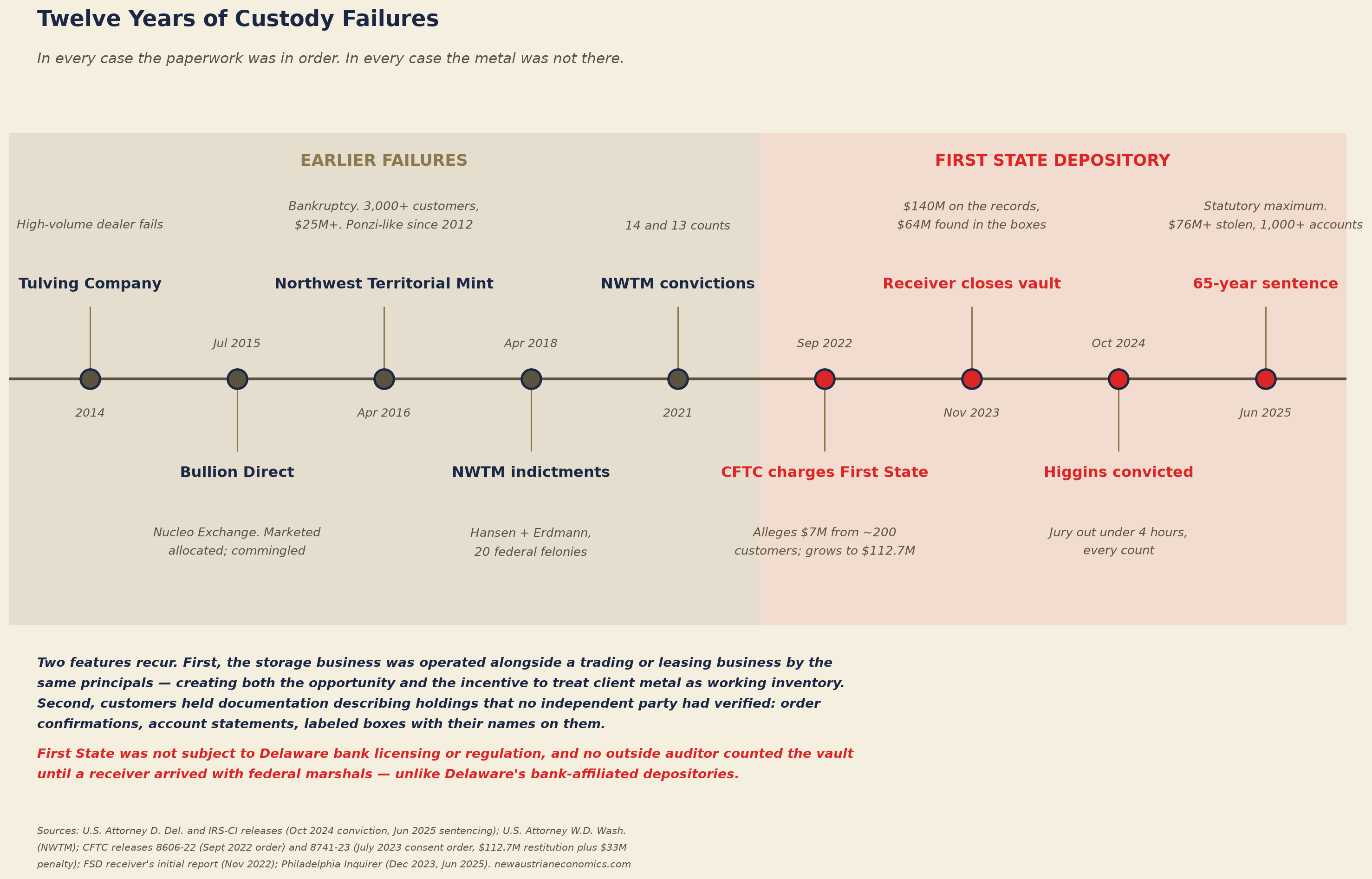
Northwest Territorial Mint, of Federal Way and Auburn, Washington, operated both a custom minting business and a bullion business encompassing the sale, purchase, exchange, storage, and leasing of precious metals. 7 The company declared bankruptcy on April 1, 2016. Federal prosecutors subsequently established that between 2009 and 2017, president and chief executive Bernard Ross Hansen and vault manager Diane Renee Erdmann defrauded more than 3,000 customers of over $25 million, lying about delivery timelines, diverting customer funds to business expansion and personal expenses, and — by at least 2012 — operating a Ponzi-like structure in which new customer money was used to satisfy older customer claims because the company lacked sufficient assets to fulfill orders. 7 Both were indicted in April 2018 on twenty federal felonies and convicted in 2021, Hansen on fourteen counts and Erdmann on thirteen.
Bullion Direct, of Austin, Texas, filed for bankruptcy on July 20, 2015. 8 Clients bought, sold, and stored precious metals through its proprietary Nucleo Exchange, and storage was offered at no charge. The company's marketing described the storage as allocated and "not pool metal"; its terms of service described the same holding as an undivided share of a fungible lot which Bullion Direct "may use or act as if it were the owner of." The inventory was commingled, and by the end there was roughly $635,000 of metal against claims of some $25 million — about three cents of metal for every dollar supposedly stored. Chief executive Charles McAllister was sentenced to ten years and ordered to pay $16.2 million in restitution.
The Tulving Company, a high-volume low-premium dealer, failed in 2014. 9
Two features recur across these cases. The first is that the storage business was operated alongside a trading or leasing business by the same principals, creating both the opportunity and the incentive to treat client metal as working inventory. The second is that in each instance customers received documentation describing holdings that no independent party had verified. Northwest Territorial Mint's customers had order confirmations. Bullion Direct's customers had account statements describing allocated positions. First State's customers had labeled boxes with their names on them. In every case the paperwork was in order and the metal was not.
The distinction, stated formally
The framework can now state the correction precisely. 4
A saver holding metal through any custodian faces two risks that require entirely different defenses:
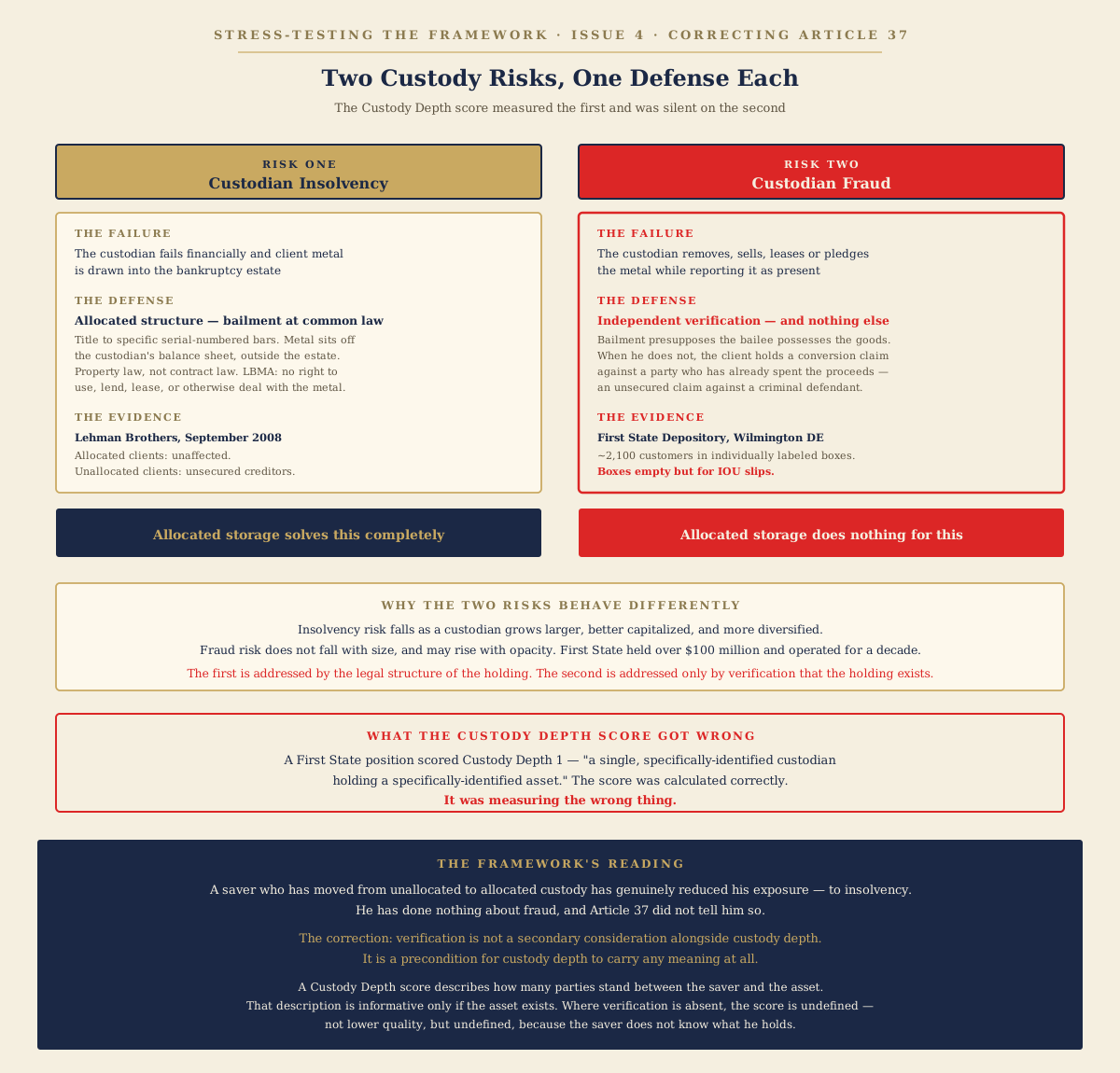
Insolvency risk is the risk that the custodian fails financially and the saver's metal is drawn into the resulting estate to satisfy the custodian's creditors. Allocated storage addresses this comprehensively. The bailment structure places the metal outside the estate as a matter of property law; the client's title is superior to any creditor's claim; and the mechanism has been tested in a major bankruptcy and performed as designed. Against this risk, the framework's original Custody Depth analysis was sound, and a saver who moves from unallocated to allocated custody has genuinely and substantially reduced his exposure.
Fraud risk is the risk that the custodian removes, sells, leases, or pledges the metal while continuing to report it as present. Allocated storage addresses this not at all. The entire legal apparatus of bailment operates on the premise that the bailee possesses the goods. When the bailee does not possess the goods, the bailor holds a claim for conversion against a party who has already spent the proceeds — which is to say, he holds an unsecured claim against a criminal defendant, and the recovery prospects are those of any tort victim pursuing an insolvent tortfeasor. First State's customers ended in materially the same position as unallocated holders would have, despite having paid for and legally held the superior arrangement.
The two risks are not merely different in kind; they are inversely correlated with the qualities that make a custodian attractive on other grounds. Insolvency risk falls as a custodian becomes larger, better capitalized, and more diversified. Fraud risk does not fall with size and may rise with opacity — First State held over $100 million and operated for a decade. 3 And critically, the defenses differ: insolvency risk is addressed by the legal structure of the holding, while fraud risk is addressed only by verification that the holding physically exists.
The Custody Depth score, as Article 37 published it, measured legal structure and intermediation. It did not measure verification. A saver applying it faithfully would have scored a First State position at Custody Depth 1 — a single, specifically-identified custodian holding a specifically-identified asset — and would have been precisely wrong, not because the score was miscalculated but because the score measured the wrong thing.
McNulty, and the arrangement the law forecloses
The natural response to everything above is that a saver should simply hold the metal himself. Custody Depth zero eliminates fraud risk entirely, because there is no custodian to defraud anyone. Article 37 identified personal possession as the framework's baseline for exactly this reason.
For metal held inside a retirement account, federal law forecloses that option, and the framework failed to state this clearly when it recommended the self-directed Solo 401(k) as a vehicle for physical metals.
Internal Revenue Code section 408(m)(3)(B) excludes bullion of specified fineness from the collectibles that an individual retirement account may not hold, but only "if such bullion is in the physical possession of a trustee described under subsection (a)" — a bank or an approved nonbank trustee. 10 The decision that settled the practical question did not, in the end, turn on that phrase.
In McNulty v. Commissioner, 157 T.C. No. 10 (2021), Donna McNulty established a self-directed IRA with Kingdom Trust as custodian, and that IRA became the sole member of a single-member limited liability company, Green Hill Holdings. Both McNultys were appointed its managers. Green Hill bought 320 one-ounce American Eagle gold coins for $374,000 in 2015 and 2,000 one-ounce American Eagle silver coins for $37,380 in 2016, and the coins were shipped to the McNultys' residence and kept in a safe. 11 Their argument was structural: the LLC, not the taxpayer personally, owned and possessed the coins.
The Tax Court rejected it, but not on the ground usually reported. It declined to look through the entity — noting that the circuit to which the case was appealable has rejected substance-over-form recharacterization of an IRA's investment — and resolved instead on possession and control, holding that Mrs. McNulty had taxable distributions when she received physical custody of the coins "irrespective of her status as Green Hill's manager," because "IRA owners cannot have unfettered command over the IRA assets without tax consequences." The distribution was measured at the cost of the coins, not at the balance of the account, and the Commissioner determined income tax deficiencies of $250,558 for 2015 and $18,094 for 2016 together with accuracy-related penalties under section 6662(a). 11 No early-distribution addition to tax was at issue. Mr. McNulty, who had directed his own IRA into coins and a condominium through a separate LLC, conceded that he had received distributions and contested only the penalties.
The self-directed IRA attorney Mat Sorensen, author of The Self-Directed IRA Handbook, states the resulting rule plainly: personal storage of metals owned by an IRA is not permitted, and an IRA-owned LLC is subject to the same storage rules as the IRA itself. No court has upheld a home storage arrangement. Thiessen v. Commissioner, 146 T.C. 100 (2016), reaches the same destination by a different route — there the taxpayers personally guaranteed a loan to a corporation their IRAs owned, which the court held to be a prohibited extension of credit under section 4975 and therefore a deemed distribution of the entire account. The two cases together mark out the boundary: the IRA owner may neither take the assets into his own hands nor put his own credit behind them.
Assemble this with the preceding sections and the structural trap becomes visible:
- The framework recommends holding physical monetary metals, with personal possession as the ideal because it eliminates counterparty exposure entirely.
- The framework recommends the self-directed Solo 401(k) as the vehicle through which a self-employed saver can hold metals with tax advantages.
- Federal tax law prohibits personal possession of metals held inside that vehicle, on penalty of full distribution treatment.
- The mandated alternative is depository custody, which is precisely the arrangement that failed at First State.
The tax advantage and the custody control are not independently selectable. Choosing the first forecloses the second, by operation of law, and the framework recommended both without noting that they conflict. A saver who wanted the framework's ideal custody arrangement and the framework's recommended tax vehicle was being told to do two things that cannot both be done.
What "IRS-approved" actually certifies
A further clarification is warranted, because the phrase that appears throughout the precious metals IRA industry is systematically misread by the people it is marketed to.
"IRS-approved depository" does not mean that the Internal Revenue Service has examined the depository's books, verified its inventory, assessed its solvency, or vouched for the integrity of its principals. Section 408(m)(3)(B) establishes a category — a bank, or an entity that has qualified as a nonbank trustee under the applicable regulations — and the approval is of the trustee's eligibility to serve in that capacity. It is a tax-code classification, not a prudential examination. The Internal Revenue Service is a revenue agency; it does not conduct safety-and-soundness supervision of vaults.
The regulatory gap this creates is exactly what Delaware state officials described in the First State case. Depositories affiliated with banks are regulated as financial institutions and subject to examination. Independent depositories, structured as ordinary limited liability companies, generally are not. Both may appear on the same list of storage options supplied by an IRA administrator or a metals dealer, and both may be described with the same phrase.
Voices within the industry have said so directly. Doug Davis, director of the Anti-Counterfeiting Educational Foundation, commenting on the First State case, said simply that "depositories ought to be regulated by the state they are located in," noting that Texas had legislated a state-regulated bullion depository in 2015. David Crenshaw, executive director of the National Coin and Bullion Association, said of operators like Higgins that "they are a thorn in our side." Neither remark suggests the gap has been closed.
Verification as a precondition
Reputable depositories do something specific that First State did not, and identifying it precisely gives the framework a usable replacement for the measurement device this essay has dismantled.
The practice is independent third-party audit: an outside firm physically counting bars, checking serial numbers against records, and reconciling total holdings against the sum of client entitlements. Industry sources identify major accounting firms performing this function, with reputable facilities conducting audits at least annually and in some cases quarterly, and publishing results to account holders. The associated documentation is a bar list or weight list — an itemization of specific serial-numbered bars attributable to a specific client, which an unallocated position by definition cannot produce and which a fraudulent allocated position cannot produce truthfully under an outside count.
Alongside audit, several structural credentials distinguish custodians in ways that bear directly on fraud risk. Exchange licensing — designation as a NYMEX or COMEX licensed depository, or CME Group licensing for contract settlement — subjects a vault to the operational requirements and inspection regime of a futures exchange. Membership in the London Bullion Market Association carries the Good Delivery standards. And a small number of custodians operate under securities regulation: Brink's is a NYMEX and COMEX licensed depository, an LBMA member, and an SEC-reporting public company, and in February 2014 the staff of the Securities and Exchange Commission granted it no-action relief permitting it to hold a registered investment company's precious metals notwithstanding that it is not a bank — the custody standard that applies to registered funds. 12 Staff relief is not Commission approval, and the distinction is worth keeping straight, but the letter exists and the arrangement it blesses is examined.
Contrast that stack of overlapping supervisory relationships with a privately held Delaware limited liability company that no regulator examined and no outside auditor counted, and the difference is not a matter of degree. It is the difference between an arrangement in which several independent parties would have to fail simultaneously for metal to go missing undetected for a decade, and an arrangement in which one man's word was the only control.
This yields the correction:
Verification is not a secondary consideration alongside custody depth. It is a precondition for custody depth to carry any meaning at all.
A Custody Depth score describes how many parties stand between the saver and the asset. That description is informative only if the asset exists. Where verification is absent, the score is not merely lower-quality information; it is undefined, because the saver does not know what he holds. First State's customers had a nominal Custody Depth of 1 and an actual position of zero metal. The score was not wrong about the number of intermediaries. It was answering a question that had been rendered meaningless by the failure of a prior condition the framework had not specified.
Custody Depth, revised
The framework therefore replaces the single-axis score published in Article 37 with a two-stage assessment in which the first stage gates the second.
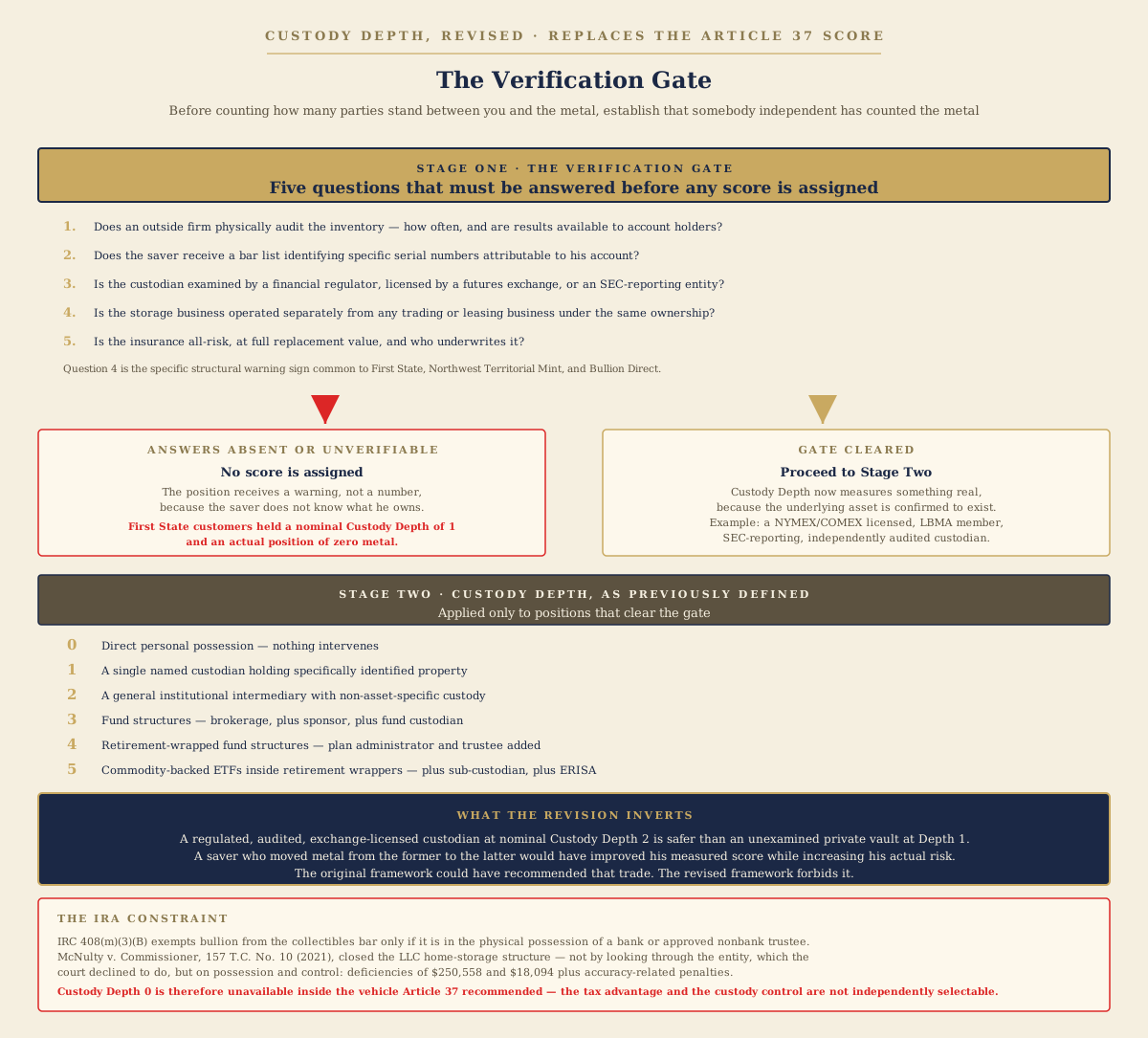
Stage one — the verification gate. Before assigning any custody score, establish whether the holding is independently verified. The relevant questions are specific and answerable: Does an outside firm physically audit the inventory, how often, and are results made available to account holders? Does the saver receive a bar list identifying specific serial numbers? Is the custodian subject to examination by a financial regulator, or licensed by a futures exchange, or an SEC-reporting entity? Is the storage business operated separately from any trading or leasing business under the same ownership — the structural feature common to First State, Northwest Territorial Mint, and Bullion Direct?
Where the answers are absent or unverifiable, the position does not receive a custody score. It receives a warning, because the saver does not know what he owns.
Stage two — custody depth, as previously defined, applied only to positions that clear the gate. Direct personal possession at zero; a single named custodian holding specifically identified property at one; a general institutional intermediary at two; fund structures at three; retirement-wrapped fund structures at four; commodity-backed exchange-traded products inside retirement wrappers at five.
The practical effect of the revision is to invert several comparisons the original score got backward. A position at Brink's — which on a naive intermediation count sits at Custody Depth 1 or 2, no better than a small private vault — is substantially safer than the small private vault, because the verification gate distinguishes them and the original score did not. Conversely, a saver who moved metal from a regulated, audited, exchange-licensed custodian to an unexamined private depository in order to reduce a nominal Custody Depth score from 2 to 1 would have increased his actual risk while improving his measured position. The original framework could have recommended that trade. The revised framework forbids it.
What this means practically
The framework does not conclude from any of the foregoing that savers should avoid precious metals in retirement accounts, and it declines the reflexive maximalist reading that personal possession is simply superior.
Personal possession eliminates fraud risk absolutely, because there is no custodian. It introduces theft risk, loss risk, and insurance difficulty, and it forfeits the tax treatment that a retirement vehicle provides. Depository custody inverts each of these. The honest framing is a genuine tradeoff rather than a ranking, and it maps onto the threat-model structure developed in Article 43 of this catalog: a saver concerned primarily about currency debasement while remaining in place is well served by either arrangement, while a saver concerned about sudden displacement is served only by the portable one, and a saver concerned about counterparty fraud specifically should weight personal possession more heavily than the tax arithmetic alone would suggest.
What the framework does conclude, and states as the operative revision to Article 37:
First, the two custody risks must be assessed separately. Allocated structure defeats insolvency risk. Only verification defeats fraud risk. A saver who has addressed the first and not the second has addressed roughly half of his exposure while believing he has addressed all of it.
Second, the verification questions listed above should be asked of any depository before metal is sent, and the answers should be documented rather than assumed from marketing language. The specific structural warning sign across every case in this essay is a storage business operated by principals who also trade or lease metal.
Third, savers should understand that placing metal inside an IRA or Solo 401(k) is a decision to accept depository custody, because federal law admits no alternative. That is not an argument against doing it. It is an argument for knowing that the tax advantage was purchased with custody control, and for pricing the depository selection accordingly rather than treating it as an administrative detail.
Fourth, and following from the third, a saver holding meaningful metal exposure has a reason the framework did not previously articulate to split the holding across both arrangements — a portion inside the tax-advantaged vehicle at a rigorously verified custodian, and a portion held personally outside any retirement account. The split is not a hedge against price. It is a hedge against the specific failure mode that this essay has documented, in which a saver who did everything the framework recommended opened a box and found a piece of paper.
The framework's synthesis
This catalog has argued across forty-six installments that the substitute layer — the accumulated apparatus of claims standing between savers and productive assets — is the central fact of the present monetary environment, and it has recommended physical metals specifically as the escape from that apparatus. Article 37's Custody Depth score was built to measure how completely a given holding escapes it.
The correction this essay makes is that the framework, in constructing that measurement, reproduced in miniature the error it spends most of its length diagnosing elsewhere. It treated a documented legal claim as equivalent to the underlying asset. A First State customer's labeled box, his account statement, and his allocated-storage agreement were all perfectly valid instruments describing metal that was not there — which is, structurally, the identical relationship this catalog has documented between paper gold and physical gold in Article 34, between a Treasury coupon and the taxation that services it in Article 45, and between a leveraged ETF share and the company it references in Article 46.
The framework recommended physical possession precisely because a claim is not a thing. It then built a scoring system that, applied to a fraudulent custodian, could not tell the difference. That is the error, and the correction is the verification gate: before counting how many parties stand between you and the metal, establish that somebody independent has counted the metal.
This is the fourth installment of Stress-Testing the Framework, following Article 42 (the calibration problem), Article 43 (testing the diagnosis against the historical record of collapse), and Article 44 (the forced-seller mechanism). Article 37 has been amended to carry a forward reference to this correction. The series remains open for further installments as additional gaps in the framework's prior conclusions are identified.
Sources
Footnotes
-
London Bullion Market Association, The OTC Guide, "Precious Metal Accounts" — for the allocated/unallocated distinction and the LBMA's own characterisation of an unallocated holder as, in legal terms, an unsecured creditor of the institution. Allocated storage fees of roughly 0.5 to 1.5 percent of value annually, against unallocated storage frequently offered at no charge because the pool may be lent or leased, are the industry's standard published terms. ↩ ↩2
-
World Gold Council, "Basel III and the Gold Market" — for the 85 percent required stable funding factor applied to gold held on a bank's balance sheet under the net stable funding ratio, and the narrow clearing-member exemption the UK regulator subsequently introduced. ↩
-
United States Attorney for the District of Delaware and IRS Criminal Investigation, "Precious metals depository owner sentenced to 65 years in federal prison for $76 million fraud scheme", 17 June 2025 — the 65-year statutory maximum before Judge Maryellen Noreika, over $100 million in customer assets, at least $76 million stolen, over 1,000 customer accounts missing metal, and the two Hawaii timeshares. Conviction on every count of mail fraud, wire fraud and tax evasion followed an eight-day trial and under four hours of deliberation on 24 October 2024. ↩ ↩2 ↩3 ↩4 ↩5
-
Philadelphia Inquirer, "Federal investigation is looking for at least $75 million in missing silver and gold from a Delaware warehouse", 28 December 2023 — for the approximately 2,100 customers, the many retirees holding IRA or 401(k) accounts, roughly $140 million on the records against about $64 million recovered from nearly a thousand boxes, the boxes holding paper IOUs, the 30 November conclusion of the receiver's operations, the Delaware Department of State's statement that First State was not subject to Delaware bank licensing or regulation law, and the quoted remarks of Doug Davis and David Crenshaw. ↩ ↩2 ↩3
-
Commodity Futures Trading Commission, release 8606-22 (court order signed 29 September 2022), naming Argent Asset Group, First State Depository and Higgins and alleging misappropriation of at least $7 million from approximately 200 customers; and release 8741-23, 3 July 2023, the consent order for $112.7 million in restitution and a $33 million civil monetary penalty. ↩
-
Receiver Kelly Crawford, initial report, 29 November 2022 — for the retention of Baker Tilly to conduct a physical count and audit, the layout of the premises at 100 Todds Lane, customer holdings held in boxes identified by account number, and the several hundred IRA customers administered through New Direction. ↩
-
United States Attorney, Western District of Washington. https://www.justice.gov/usao-wdwa — United States Attorney for the Western District of Washington, on Northwest Territorial Mint — bankruptcy 1 April 2016, more than 3,000 customers and over $25 million, a Ponzi-like structure by at least 2012, and the 30 July 2021 convictions of Bernard Ross Hansen on fourteen counts and Diane Renee Erdmann on thirteen. ↩ ↩2
-
On Bullion Direct: the 20 July 2015 Chapter 11 petition in the Western District of Texas; the Nucleo Exchange platform; marketing describing storage as allocated and "not pool metal" against terms of service describing an undivided share of a fungible lot the company "may use or act as if it were the owner of"; roughly $635,000 of metal against claims of some $25 million; and the ten-year sentence and $16.2 million restitution order against chief executive Charles McAllister. ↩
-
The Tulving Company bankruptcy record, Central District of California. https://www.justice.gov/ — The Tulving Company ceased trading in March 2014 owing roughly a thousand customers some $40 million. ↩
-
Internal Revenue Code section 408(m)(3)(B); Treasury Regulation section 1.408-2(e). https://www.law.cornell.edu/uscode/text/26/408 — Trustee requirements, including the "adequate vault" and permanent-record provisions the McNulty court quoted. ↩
-
McNulty v. Commissioner, 157 T.C. No. 10, 18 November 2021, Docket No. 1377-19 (Goeke, J.) — a full Tax Court opinion, not a memorandum. Green Hill Holdings, LLC was formed 24 August 2015 as a single-member LLC whose sole initial member was Mrs. ↩ ↩2
-
Securities and Exchange Commission, Division of Investment Management, no-action letter to The Brink's Company, 11 February 2014 — granting relief under section 17(f) of the Investment Company Act of 1940 to permit custody of a registered investment company's precious metals notwithstanding that Brink's is not a bank. ↩
Related essays
Contingent Actions: What a Unified Ledger Changes About a Power That Already Exists
A recurring claim in hard-money commentary holds that the next liquidity event will be used to impose central bank digital currency and to seize bank deposits through bail-in. This essay examines the documentary record and finds the claim mistaken in its structure while resting on facts that are almost entirely accurate. Bail-in is not a proposal. It has been European Union law since the Bank Recovery and Resolution Directive, under which bail-in of at least eight percent of total liabilities and own funds is a precondition for accessing the Single Resolution Fund, and under which the Single Resolution Board defines bail-inable deposits as all deposits other than covered deposits below one hundred thousand euros. The Board's own working paper concluded that under the existing creditor hierarchy, deposit guarantee schemes would rarely be able to support resolution without bailing in depositors. Nothing needs to be imposed, because the authority has existed for a decade. What the European Union did in 2026 runs contrary to the fear rather than confirming it: the Crisis Management and Deposit Insurance package, in force since May 10, 2026 and applying from May 2028, is designed specifically to let deposit guarantee funds bridge the gap so that banks can be resolved without bailing in their depositors — while simultaneously lowering the public interest assessment threshold, which expands the population of institutions routed into resolution at all. Two variables moved in opposite directions and almost no commentary has noted both. The essay then turns to the Bank for International Settlements proposal for a unified ledger, published in its 2023 Annual Economic Report and extended in 2025, which would place central bank digital currency, tokenized deposits, and tokenized assets on a single programmable platform. The framework's contribution is to identify what such an architecture would and would not change. It would not create the authority to convert a depositor's claim, because that authority exists. It would change the latency — the interval between a resolution decision and its execution, and the operational friction that currently bounds it. That friction was designed by no one and protects no one deliberately, but it functions as a constraint, and a programmable settlement layer removes it.
Navigating the Substitute Layer: A Framework for Personal Savings in the Absence of Sound Money
The saver in 2026 faces a problem that the pre-1971 saver did not face and that most contemporary financial advice does not seriously engage: the unit of account itself depreciates. Cash held over time loses purchasing power. Debt-denominated instruments (bonds, money market funds, savings accounts) accrue nominal returns that may or may not exceed the depreciation. Equity instruments (stocks, mutual funds, ETFs) provide claims on future corporate earnings that must be discounted for both time preference and monetary depreciation. Real estate imposes illiquidity and transaction costs while providing quasi-monetary exposure to housing services. Precious metals — the historical form of money, and money in the precise sense the framework has developed across Articles 5, 30, and 33 — provide the closest available substitute for a monetary unit whose purchasing power is preserved across time. This essay is the framework applied to the individual saver's question of how to allocate financial capital under substrate conditions that have persisted since the collapse of the Bretton Woods system on August 15, 1971 and that show no near-term signs of resolution. It addresses the mechanics of 401(k) plans, the Rule of 72 and its inflation application, the personal-experience insight of the mutual fund industry as viewed from inside, the case for the self-directed Solo 401(k) via limited liability company structure, the framework's reading of hard-asset diversification, the technical trading approach articulated by Chris Vermeulen in his 'Asset Revesting' framework, and the framework's synthesis of principles for personal savings navigation. Revised in July 2026 following substantive critical engagement, this version adds four analytical extensions: the argument that the 401(k) wrapper itself, independent of its underlying holdings, is a substitute-layer instrument in the framework's precise sense; a new 'Custody Depth' score measuring how many institutional counterparties stand between a saver and a given asset; the case that human capital, not portfolio allocation, is the dominant asset for most of a working life; and a jurisdictional axis of diversification orthogonal to asset class. It closes with two explicit limitations the framework had not previously confronted: the calibration problem of sizing and timing a hedge against a risk of unknown timing, and the gap between the theoretical diagnosis of unsound money and the separate empirical question of what actually preserves wealth through collapse. It is not investment advice. It is analytical framework applied to a specific class of individual decisions. The reader must translate these principles into their own circumstances, which the framework cannot assess and does not attempt to.