Researched and drafted with AI assistance · reviewed and edited by Jason D. Keys
Four steps, none of which you choose
On August 14, 2026, Daniel Oliver of Myrmikan Capital published a research letter titled "AI Debt Failure Will Prompt Another Wave of Fed Bailouts." 1 It is the most thoroughly documented account in print of a specific institutional question that has received almost no public attention: by what path does the paycheck of an ordinary American worker end up financing a data center in Ohio?
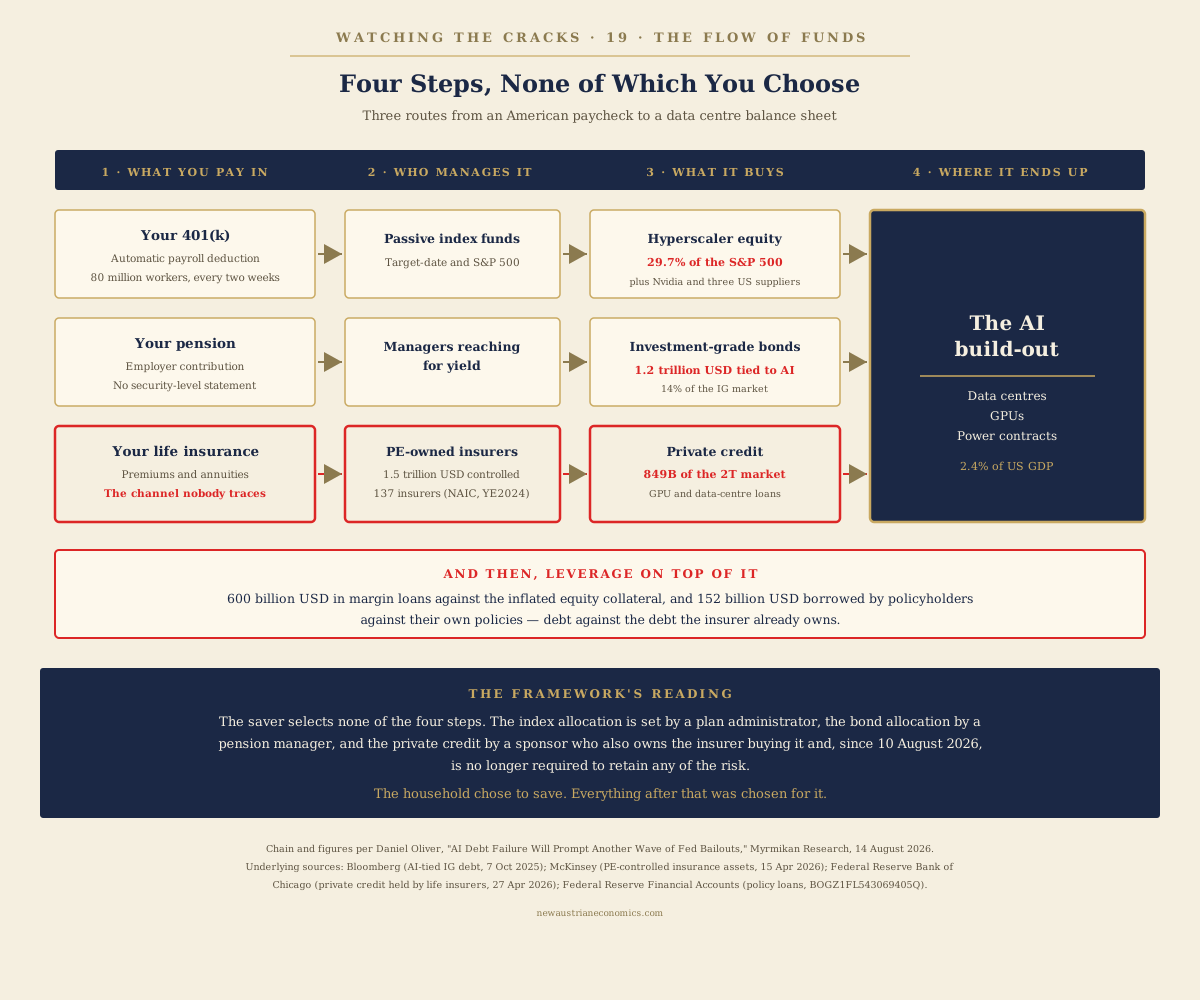
Oliver traces three channels, and the defining feature of all three is that the saver selects none of them.
The first is equity. The four hyperscalers — Amazon, Microsoft, Google, and Oracle — together with Meta, plus Nvidia and its three United States suppliers, now constitute 29.7 percent of the S&P 500 by Oliver's calculation. 1 Eighty million working Americans purchase that index every two weeks through automatic payroll deduction into retirement accounts, in target-date and index funds selected by a plan administrator rather than by the participant.
The second is investment-grade credit. Bloomberg reported in October 2025 that the volume of debt tied to artificial intelligence had reached $1.2 trillion, making it the largest sector of the investment-grade market at 14 percent of the JPMorgan US Liquid Index, ahead of United States banks at 11.7 percent. 2 Pension managers reaching for yield in a market where AI issuance has become a substantial share of new supply hold that paper on behalf of beneficiaries who never see a security-level holding statement.
The third channel is the subject of this essay, and it is the one almost nobody has traced. A life insurance premium, paid to an insurer that is owned or controlled by a private equity firm, is invested in private credit originated by that same private equity firm, secured against graphics processing units and data center leases.
This catalog has engaged similar structures before. Article 37 examined the 401(k) as an institutional artifact whose primary economic benefits flow to the sponsoring employer, the plan administrator, and the fund families, leaving the employee as third-order beneficiary. Article 40 extended that framework to universal distribution proposals. Article 46 documented the layering of claims around the SpaceX listing. What Oliver's letter supplies is the specific, sourced, contemporaneous data for a channel the framework had identified structurally but never quantified.
The essay proceeds by developing Oliver's argument at length and with attribution, then advancing a claim his analysis does not make — one that follows from this catalog's own prior work and that, if correct, means the exposure he documents is worse than he states.
Daniel Oliver and why this framework engages him
Oliver founded Myrmikan Capital in 2009, a fund specializing in micro-capitalized gold and silver mining companies. 3 He graduated from Columbia Law School with honors in 2001, where he served as president of the Federalist Society, practiced corporate law at Simpson Thacher & Bartlett, and subsequently worked for Bearing Capital, a private equity firm in Buenos Aires focused on Latin American commodities. 3 He obtained an MBA from INSEAD in 2005 and serves as president of the Committee for Monetary Research & Education, a non-profit founded in 1970 to promote public understanding of monetary institutions. 3
He works in the same intellectual tradition this catalog occupies. His December 2025 letter develops the operation of the nineteenth-century bill market using the farmer-miller-baker supply chain — the miller endorsing a bill drawn on the baker and paying it to the farmer, who accepts it because the double endorsement has removed credit risk but demands a slight discount for time preference. 4 That is the identical worked example Article 33 of this catalog used to explain the second pillar of Fekete's Golden Triangle. Two writers arriving independently at the same illustration is a reasonable indication of a shared foundation.
The framework engages him for that reason, and disagrees with him at one specific point developed in the closing sections. The disagreement is narrow and the debt is large.
The capture mechanism
The reason private equity firms began buying life insurance companies is a question of fund structure, and Oliver states it precisely. 1
A private equity fund typically has a ten-year term. Each firm must therefore return to market annually to raise a new fund as the prior vintage expires — a permanent fundraising treadmill that constrains how much capital the firm can deploy and how patiently it can deploy it. A life insurance company presents the opposite characteristic. Its liabilities extend decades into the future, and its asset base is continuously replenished by incoming premiums. It is, in the language of the industry, permanent capital.
The economics of ownership, as Oliver describes them, run in three directions simultaneously. The private equity firm earns as owner of the insurance company; it charges the insurance company fees for asset management and related services; and it earns origination fees on the deals the insurance company then buys. The insurance company bears the economic risk while its upside is capped, because what it holds is debt. It also becomes, in Oliver's phrasing, a dumping ground for illiquid assets held in the sponsor's other funds — transferred at mark-to-model prices the sponsor itself determines. 1
The precipitating condition was the post-2008 rate environment. Insurers facing suppressed yields on traditional fixed income had to reach for return, becoming natural buyers of high-yield private debt. The sponsors originating that debt recognized that the most reliable way to force deal flow through insurers was to own them outright. 1
The scale of the resulting shift is documented. Private equity ownership of United States insurers went from near zero in 2009 to $704.3 billion in cash and invested assets across 137 insurers at year-end 2024, on the NAIC Capital Markets Bureau's count — 7.8 percent of all United States insurers' cash and invested assets. 5 The Federal Reserve's May 2026 Financial Stability Report puts total life insurer assets at $11.2 trillion as of the fourth quarter of 2025. 6 A further $300 billion of life insurer assets are held as portfolio companies within private equity funds. 7 McKinsey placed the total private-equity-controlled figure at $1.5 trillion as of the end of 2025. 8
The individual positions, as reported by the Financial Times in February 2026: Apollo has placed $227 billion of its deals into Athene US Life; KKR $163 billion into Global Atlantic; Blackstone $209 billion across Fidelity & Guaranty, Everlake, and Resolution Life; Brookfield $90 billion into American National. 9
And the behavioral difference between captive and independent insurers is measurable. A study cited by Oliver found that 49.5 percent of new investment by private-equity-owned insurers went into privately-placed instruments, against 13.9 percent for independent insurers — and that empirical evidence suggests private-equity-owned insurers purchase identical assets at higher prices when the seller is an affiliate. 10
The aggregate exposure follows. A Federal Reserve Bank of Chicago working paper, revised in April 2026, documents $849 billion of private credit on life insurers' balance sheets in 2024 — 14 percent of those balance sheets, on the paper's own framing. 11 Oliver sets that figure against a private credit universe he puts at approximately $2 trillion, which yields a life insurer share of roughly 42 percent; the ratio is his construction rather than the paper's, and the denominator is not a settled figure. 1 Oliver's inference from this, which the framework regards as sound, is that because these entities hold nearly half the private credit market and are owned and managed by the same sponsors placing the AI debt, they are likely to hold more than a proportional share of it. 1 The market is too opaque to establish this directly, and Oliver says so.
The offshore layer
Two further mechanisms reduce what an outside observer can see.
The first is ratings. Insurance capital charges are lower for higher-rated bonds, which permits greater leverage — an incentive structure Oliver notes is directly analogous to the housing bubble. The Financial Times reported in November 2025 that some of the world's largest asset managers, including Blackstone and Apollo, are now among the most frequent users of ratings from firms beyond the big three. 12 The FT subsequently reported in August 2026 that one private equity sponsor is under investigation for payments of approximately $8 million to the ratings firm Egan-Jones, and that two former Egan-Jones employees have sued alleging they were pressured to inflate ratings to win business. 13
The second is reinsurance, and here the numbers are large. Reinsurance in its original form spreads risk — a marine insurer laying off part of a large contract to another insurer. A reinsurer that is a subsidiary of the ceding insurer inverts that logic entirely. Oliver notes that Apollo-backed Athene US Life has reinsured substantially all of its $200 billion in annuity liabilities to Athene Holding Ltd. in Bermuda. 1 Bloomberg's November 2025 investigation described the advantages of shifting liabilities to a captive reinsurer as "myriad and arcane, including more flexible capital requirements, alternative accounting standards and fewer disclosures." 14
The Bank for International Settlements quantified the trend in October 2025: by 2023, United States life insurers had ceded $2.1 trillion in reserves, up from $500 billion in 2017 — 25 percent of their total assets. 15 Offshore reinsurers accounted for 40 percent of these risks, up from 14 percent in 2017, with some of that activity occurring in jurisdictions with less stringent regulatory frameworks. 15
And on August 10, 2026, Bloomberg reported that the Securities and Exchange Commission had determined that a major subset of data-center securitizations need not carry the disclosures and investor protections that comparable deals require — including risk retention, the rule requiring issuers of asset-backed securities to hold some of the debt so their interests align with investors'. 16
That last item deserves to be stated plainly. The sponsors originating AI debt, placing it into insurers they control, are no longer required to retain any of it.
The four percent
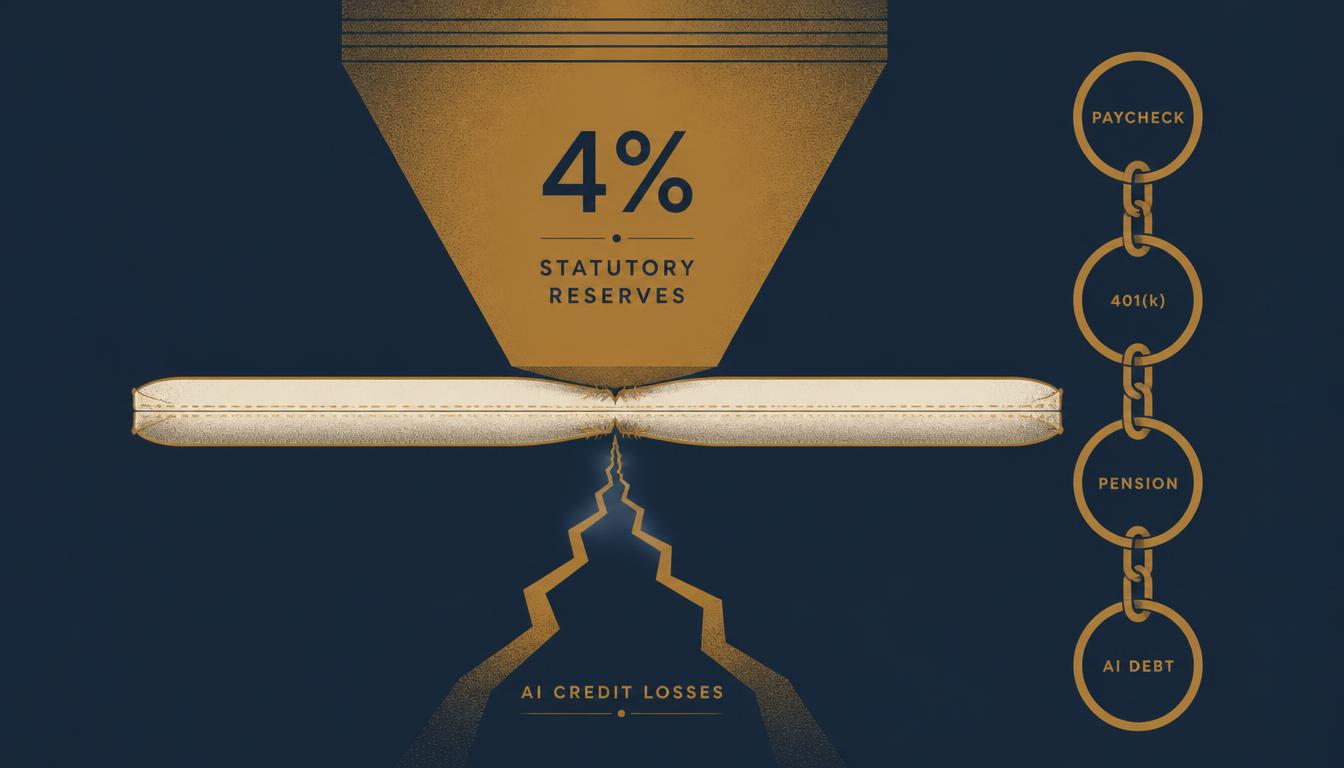
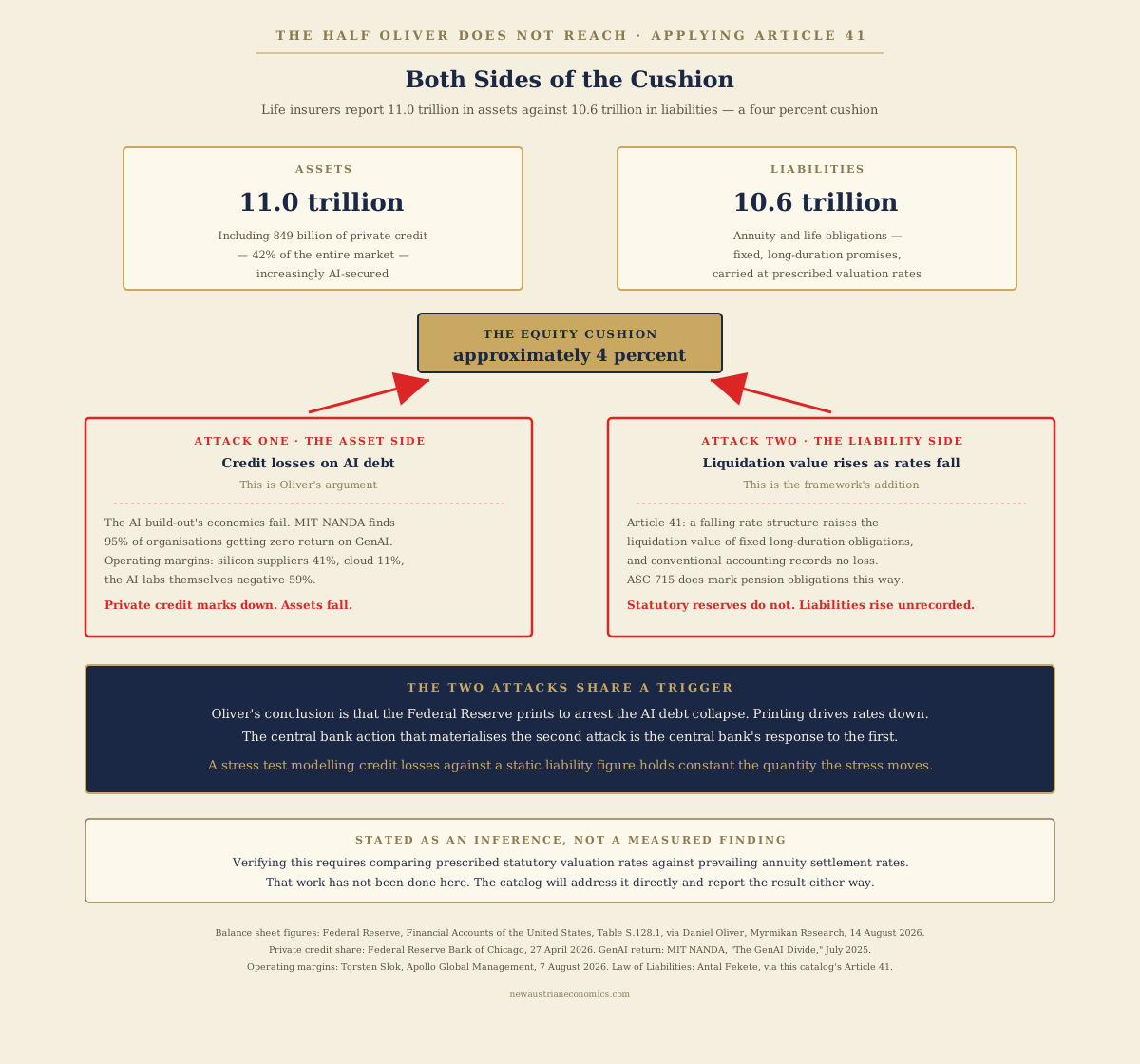
Oliver's central figure comes from the Federal Reserve's Financial Accounts of the United States. Life insurance companies in the United States currently report approximately $11.0 trillion in assets against $10.6 trillion in liabilities — an equity cushion for the entire industry of roughly 4 percent. 17
His argument from that number is that even a small downturn in credit markets pushes the industry toward insolvency, and that the failure will not begin at the largest firms. Apollo's Athene and KKR's Global Atlantic, he writes, "will not be the first to go. They are too large, too careful. But every free-money machine attracts the less capitalized imitator who pushes the model too aggressively and drags down the senior players." 1 His historical analogue is Ralph Cioffi's internal fund at Bear Stearns, which failed in June 2007 — fourteen months before Lehman Brothers collapsed.
He supports this with a passage from Senator Elihu Root's 1913 speech opposing the Federal Reserve Act, which is worth reproducing because it describes a propagation mechanism rather than a moral failing: "finally someone whose judgment was bad, someone whose capacity for business was small, breaks; and as he falls he hits the next brick in the row, and then another, and then another, and down comes the whole structure. That, sir, is no dream. That is the history of every movement of inflation since the world's business began, and it is the history of many a period in our own country." 1
Oliver also identifies the redemption channel, and it is the mechanism by which an insurance problem becomes a systemic one. Policyholders can surrender. Two frictions restrain them: surrender penalties of typically 10 percent, which decline to zero after ten to fifteen years — meaning the oldest and therefore largest accounts face little or no penalty — and the taxation of gains that would otherwise pass to beneficiaries tax-free at death. 1 Neither friction survives a genuine scare. And when policyholders redeem, the insurer must sell what it can, which is its liquid holdings first, leaving those who wait holding a progressively larger share of mark-to-model private credit.
The precedent is documented. Andrew Ross Sorkin reported in March 2009 that AIG held more than 81 million life insurance policies with a face value of $1.9 trillion globally, and that if policyholders had lost faith and rushed to cash them in simultaneously, the entire life insurance industry could have faltered. 18 The state guaranty associations that would absorb such failures generally cover policies only up to approximately $300,000, are funded by assessments on surviving competitors after a collapse rather than before, and typically allow those competitors to recoup the cost through state tax credits — which places the residual burden on the public. 19 Oliver notes that this is structurally worse than the FDIC framework, under which banks contribute in advance and contributions are risk-weighted.
The half Oliver does not reach
Everything above is Oliver's, and the framework accepts it. What follows is the framework's own contribution, and it concerns the denominator of that four percent.
Article 41 of this catalog developed Fekete's Law of Liabilities: the principle, never codified in general accounting standards, that a liability should be carried at its face value at maturity or at its liquidation value — what it would actually cost to extinguish today — whichever is higher. The article's argument was that a falling interest-rate structure raises the liquidation value of fixed long-duration obligations, producing a real economic loss that conventional accounting does not require anyone to record, and that this loss compounded silently across the entire 1981-2020 falling-rate era.
That same article identified the one domain where this principle is codified. Under ASC 715, corporate pension obligations are discounted at rates reflecting current market conditions, recalculated at each measurement date with no smoothing. Which is why the capital destruction became visible there and only there: the aggregate funded status of S&P 1500 pension plans fell from approximately 104 percent at year-end 2007 to approximately 75 percent by year-end 2011, a swing the actuarial literature attributed explicitly to falling discount rates. 1
Now apply that apparatus to a life insurer's balance sheet.
The liabilities constituting Oliver's $10.6 trillion are overwhelmingly annuity and life obligations — fixed, long-duration promises to pay specified amounts at future dates. They are, structurally, the same kind of object as a pension obligation. The difference is in how they are measured. Statutory reserves for life insurers are computed using prescribed valuation interest rates set by regulation, or under principle-based reserving for newer business, rather than by discounting at the rate at which the obligations could actually be settled in the market on the measurement date.
The framework's claim, stated as a claim rather than an established fact: to the extent that statutory valuation rates are prescribed and smoothed rather than market-derived, the mechanism Article 41 identified operates on these liabilities without appearing in the reported figures. A fall in the interest-rate structure raises what it would cost to extinguish those obligations, and the reported $10.6 trillion does not move.
The framework flags that verifying this precisely requires examining specific statutory valuation practice against specific market rates, which this essay has not done and which the catalog will take up separately. The claim is offered as an inference from an established mechanism, not as a measured finding.
But if the inference holds, the consequence is direct: the four percent cushion is measured on the asset side only.
Why the two failures share a trigger
The significance of the preceding section is not that it identifies an additional risk sitting alongside the one Oliver documents. It is that both risks are triggered by the same event, and the event is the one Oliver forecasts.
His conclusion is that Warsh will print. The reasoning is historical and, on the record he assembles, difficult to dispute: Burns intervened for Penn Central in 1970 and Franklin National in 1974; Volcker warned the FOMC in May 1984, during the Continental Illinois failure, that "Continental is probably manageable with difficulty; $40 billion institutions are difficult to manage. Having two or three $40 billion institutions is a horse of a different color. 1 If we have two or three, I don't think we're going to stop at two or three"; 20 Greenspan raised the federal funds rate from 6.5 percent to 8 percent within weeks of taking office in 1987, then returned it to 6.5 percent within two days of the October 19 crash. 1 Oliver's summary is that every chairman arrives with a theory and the market tests it, and that "there is actually only one rule: print or die." 1
Now trace what printing does to a captive insurer.
On the asset side, the AI debt held in the private credit portfolio deteriorates as the build-out's economics fail — which is the entire premise of Oliver's letter, supported by the MIT NANDA finding that 95 percent of organizations are getting zero return on generative AI investment, and by the operating-margin structure Apollo's chief economist documented in August 2026: silicon suppliers at 41 percent, cloud companies at 11 percent, and the AI labs themselves at negative 59 percent. 21 22
On the liability side, the Federal Reserve's response to that deterioration drives rates down, which raises the liquidation value of every fixed annuity obligation on the same balance sheet — by the mechanism Article 41 documented and, per the preceding section, without appearing in the statutory filings.
These are not independent risks that might or might not coincide. The central bank action that materializes the second is the central bank's response to the first. A conventional stress test that models credit losses against a static liability figure will therefore understate the impairment, because it holds constant the quantity that the stress scenario itself moves.
This is the framework's specific addition to Oliver's analysis, and it makes his conclusion stronger rather than weaker.
Leverage on leverage
One further layer sits on top, and Oliver documents it with a chart he titles "Leverage on Leverage."
The inflated market capitalizations of the AI complex provide collateral backing more than $600 billion in margin loans, used either to fund consumption or to fund further stock speculation. 1 And a further $152 billion of consumer debt has been borrowed by life insurance policyholders against their own policies — which is, as Oliver puts it, debt borrowed against the debt owned by the insurance companies, increasingly comprised of illiquid private credit held offshore. 23
Article 46 of this catalog developed the claim-layering structure around the SpaceX listing: a productive enterprise, an equity share representing fractional ownership, a total return swap referencing that share without conveying ownership, and an ETF share representing ownership of a fund holding the swaps. Three claims between the investor and the underlying.
The insurance channel produces a comparable stack by a different route. The data center is the substrate. The private credit instrument is a claim on it. The insurer's general account holds that claim. The policy is a claim on the general account. And the policy loan is a claim against the policy. Four layers, and the household at the end of the chain describes its position as "life insurance."
Where the framework parts from Oliver
Oliver's closing sentence is: "For the rest, gold may not be the only safe haven, but it is certainly the clearest and the simplest and the best." 1
This catalog has spent four installments of a dedicated series examining exactly that recommendation, and the findings qualify it in two specific ways that Oliver's letter does not address.
The calibration problem. Article 42 established that the framework's diagnosis of monetary unsoundness has been continuously true since August 1971 while gold's realized price path has moved in wide multi-decade cycles governed by real interest rates rather than by monetary soundness — a relationship Erb and Harvey measured at approximately negative 0.82 between the ten-year TIPS real yield and the real gold price over 1997-2012, a correlation those authors themselves regard as likely spurious on so short a sample. Gold lost roughly three-quarters of its real value between 1980 and 2000, a drawdown longer than most savers' entire accumulation window, while the case for holding it never weakened. Being correct about Oliver's diagnosis and early on his conclusion produces the same financial outcome as being wrong about both. The hedge has to be sized to a worst case the holder can survive without capitulating, which is a narrower claim than "clearest and simplest and best."
The custody problem. Article 47 examined what happens to that hedge once held. Allocated storage defeats custodian insolvency completely and custodian fraud not at all — a distinction established by the First State Depository case, in which roughly 2,100 customers holding metal in individually labeled boxes, many of them retirees holding through IRA and 401(k) accounts, were found to have boxes containing IOU slips. 1 Robert Leroy Higgins was sentenced in June 2025 to sixty-five years, the statutory maximum. A reader who acts on Oliver's conclusion without addressing custody has moved from one unverified claim to another.
Neither qualification touches his diagnosis. Both concern what a reader should do with it.
What to watch
The redemption data. Oliver's mechanism runs through policyholder surrenders. Surrender activity in the captive-insurer segment specifically is the leading indicator, and it is more informative than credit spreads, because it is the variable that forces liquidation.
Statutory filings versus market rates. The framework's liability-side claim above is an inference requiring verification. The specific work is comparing prescribed valuation rates to prevailing settlement rates for annuity obligations. The catalog will take this up directly, and will report the result whether or not it supports the argument made here.
Any first failure among smaller captives. Oliver's Cioffi analogy predicts that the sequence begins at an undercapitalized imitator rather than at Athene or Global Atlantic, with a substantial lag before the larger institution follows. The identity and timing of a first failure is the cleanest available test of his propagation model.
Whether the SEC's risk-retention exemption is revisited. The August 10 determination removed the requirement that data-center securitization issuers retain exposure. A reversal would be a meaningful signal; continued expansion of the exemption would be a different one.
The framework's reading
Daniel Oliver has documented, with more rigor than anyone else writing publicly, the specific institutional path from an American paycheck to a data center balance sheet, and the specific reason that path terminates in an industry carrying a four percent equity cushion.
What this catalog adds is that the cushion is thinner than the number suggests, because the number is computed against liabilities that are not marked to what it would cost to discharge them — and that the event which would consume the cushion from the asset side is the same event that would enlarge the liabilities against which it is measured.
The household at the end of this chain did not choose the index fund, did not choose the bond allocation, and did not choose the private credit. It chose to save. This catalog has argued across forty-seven prior installments that the substitute layer stands between savers and productive assets and that its central property is the substitution of claims for things. The insurance channel is that argument's most complete instance yet documented: a household holding a claim on a general account holding a claim on a private credit instrument holding a claim on a graphics processor in a building on a Louisiana flood plain — and, in a growing share of cases, holding a loan taken against the first claim in the chain.
Sources
Figures in this essay reach it through Oliver's letter. Where the underlying source has been retrieved and checked directly, the footnote says verified at source. Where it has not, the footnote says what stands behind the figure instead. Three of Oliver's own citations did not survive that check; each is recorded at the relevant note.
Footnotes
-
Oliver, Daniel. "AI Debt Failure Will Prompt Another Wave of Fed Bailouts." Myrmikan Research, 14 August 2026. Myrmikan Capital, LLC. https://www.myrmikan.com/pub/Myrmikan_Research_2026_08_14.pdf — Primary source for this essay. All figures attributed to Oliver in the text are drawn from this letter, which carries its own citations reproduced separately below where the underlying source is identified. ↩ ↩2 ↩3 ↩4 ↩5 ↩6 ↩7 ↩8 ↩9 ↩10 ↩11 ↩12 ↩13 ↩14 ↩15 ↩16 ↩17 ↩18
-
Mutua, Caleb. "At $1.2 Trillion, More High-Grade Debt Now Tied to AI Than Banks." Bloomberg, 7 October 2025, reporting JPMorgan analysis. Cited in Oliver (2026), whose letter dates the article to October 2026 and renders the share as 15 percent; the published article gives 14 percent of the JPMorgan US Liquid Index. ↩
-
Biographical details compiled from: the New Orleans Investment Conference speaker roster, https://neworleansconference.com/; The Moneychanger interview with Daniel Oliver of Myrmikan Research; and Myrmikan Capital LLC, https://myrmikan.com/. ↩ ↩2 ↩3
-
Oliver, Daniel. Myrmikan Research, 15 December 2025. https://www.myrmikan.com/pub/Myrmikan_Research_2025_12_15.pdf ↩
-
Johnson, Jennifer, Jean-Baptiste Carelus and George Lee. "Private Equity-Owned U.S. Insurer Investments Increased at Year-End 2024." NAIC Capital Markets Bureau special report. https://content.naic.org/sites/default/files/capital-markets-pe-owned-ye2024.pdf — Oliver (2026) gives "more than $700 billion in assets across 134 insurers" and cites the Federal Reserve's May 2026 Financial Stability Report, Table 3.1. That table reports sector totals only and carries no private-equity-ownership data; no NAIC count of 134 exists (132 at year-end 2022, 137 at year-end 2023 and 2024, 139 at June 2025). ↩
-
Board of Governors of the Federal Reserve System. Financial Stability Report, May 2026, Table 3.1, "Size of selected sectors of the financial system." https://www.federalreserve.gov/publications/2026-may-financial-stability-report-leverage.htm — ↩
-
Drall, Pranjal and Andrew Granato. "Private Credit's State Backstop: How Private Equity Socializes Risk Through Insurers." 9 August 2026. SSRN abstract 7152239, at 40. Cited in Oliver (2026); the paper is behind an access wall and the page locator could not be checked. ↩
-
Torbey, Henri et al. "Beyond $1 trillion: The next chapter for insurance and private capital." McKinsey & Company, 15 April 2026. Published under the title "Beyond $1 trillion: The next chapter for private capital in insurance." ↩
-
Harris, Lee. "How insurance became the lifeblood of private credit." The Financial Times, 24 February 2026. Cited in Oliver (2026); paywalled, and the four sponsor-level figures could not be checked against it. ↩
-
Drall and Granato (2026), at 45, 47. Cited in Oliver (2026), whose own note reads "Ibid" following a McKinsey citation; the attribution to Drall and Granato follows from the page continuity and is corroborated by The American Prospect, 3 August 2026, which reports the 49.5 percent figure to those authors. ↩
-
Meisenzahl, Ralf, Jackson Overpeck and Andy Polacek. "Life Insurers' Private Credit Investments and Annuity Market Share Capture." Federal Reserve Bank of Chicago Working Paper No. 2025-09, revised 27 April 2026. https://www.chicagofed.org/publications/working-papers/2025/2025-09 — The paper states the $849 billion as 14 percent of life insurers' balance sheets in 2024; the $2 trillion private credit denominator and the resulting 42 percent share are Oliver's. ↩
-
Harris, Lee et al. "The new crop of rating agencies behind the private credit boom." The Financial Times, 10 November 2025. Cited in Oliver (2026); paywalled. ↩
-
Harris, Lee. "Walter insurers paid millions of dollars to credit rating provider Egan-Jones." The Financial Times, 2 August 2026. Cited in Oliver (2026); paywalled. ↩
-
Schoenberg, Tom et al. "The Offshoring of America's Retirement Savings." Bloomberg, 16 November 2025. Cited in Oliver (2026); the quoted phrase is reproduced from the letter. ↩
-
Aquilina, Matteo et al. "The transformation of the life insurance industry: systemic risks and policy challenges." BIS Papers No. 161, Bank for International Settlements, October 2025, §5.2. The paper gives the 2017 offshore share as 14 percent in §5.2 and 15 percent in §2. ↩ ↩2
-
Trapanick, Jack and Scott Carpenter. "SEC Exempts Data-Center Bonds From Key Securitization Rules." Bloomberg, 10 August 2026. For the determination and the risk-retention exemption. ↩
-
Board of Governors of the Federal Reserve System. Financial Accounts of the United States, Table S.128.1. https://www.federalreserve.gov/releases/z1/current/html/S1281_s.htm ↩
-
Sorkin, Andrew Ross. "The Case for Saving A.I.G., by A.I.G." The New York Times, 2 March 2009. Cited in Oliver (2026); the original was not retrievable, but the 81 million policies and $1.9 trillion face value are corroborated in Time, 19 March 2009. ↩
-
Drall and Granato (2026), at 23–24, 28–30, as cited in Oliver (2026). https://www.myrmikan.com/pub/Myrmikan_Research_2026_08_14.pdf — Page locators not independently checked. ↩
-
Federal Open Market Committee Meeting Transcript, 21–22 May 1984, at 41. https://www.federalreserve.gov/monetarypolicy/files/FOMC19840522meeting.pdf ↩
-
Challapally, Aditya, Chris Pease, Ramesh Raskar and Pradyumna Chari. "The GenAI Divide: State of AI in Business 2025." MIT Project NANDA, July 2025. Cited in Oliver (2026). The 95 percent figure is the report's, drawn from 52 executive interviews, 153 survey responses and 300 public deployments; the report counts pilots and deployments rather than organizations, and its methodology has been contested since publication. ↩
-
Slok, Torsten. "In AI, the 41% Depends on the −59%." Apollo Global Management, 7 August 2026. ↩
-
Board of Governors of the Federal Reserve System. Life Insurance Companies; Policy Loans; Asset, Level [BOGZ1FL543069405Q]. Cited in Oliver (2026), who charts the series alongside broker margin loans. Framework cross-references. Article 33 (the Golden Triangle and the real bills mechanism); Article 37 (the 401(k) as institutional artifact; the third-order beneficiary structure); Article 40 (third-order beneficiary analysis extended); Article 41 (Fekete's Law of Liabilities and unrecorded capital destruction from falling rates); Article 42 (the calibration problem; Erb and Harvey on real rates and gold); Article 46 (claim-layering and leveraged product structure); Article 47 (allocated storage, custodian fraud, and the First State Depository case). Note on the liability-side argument. The claim in the section "The half Oliver does not reach" — that statutory valuation practice for life insurance reserves does not capture the liquidation-value mechanism Article 41 describes — is presented in the text as an inference from an established mechanism rather than a measured finding. Verifying it requires comparing prescribed statutory valuation interest rates against prevailing annuity settlement rates, which this essay has not undertaken. ↩
Related essays