Researched and drafted with AI assistance · reviewed and edited by Jason D. Keys
The claim, stated fairly
A recurring proposition in hard-money and monetary-reform commentary runs roughly as follows: the next serious liquidity event will be used as the occasion to introduce central bank digital currency, and depositors will discover that their bank balances can be converted into bank equity without their consent.
This catalog's practice, established in Article 53, is that a claim of this kind deserves the courtesy of evidence rather than the convenience of dismissal. What follows examines the documentary record on both halves.
The finding is unusual. The claim is mistaken in its structure and almost entirely accurate in its facts. Nothing needs to be imposed during a crisis, because the legal authority to convert deposits already exists, has existed for a decade, and has been exercised. The architecture that would make its execution frictionless is published, authored, and dated. And the direction of the most recent European legislation runs contrary to the fear rather than confirming it, in a way that almost no commentary on either side has noted.
What the law actually says
Bail-in is not a proposal or a contingency plan. It is the operative resolution regime of the European Union.
Under the Bank Recovery and Resolution Directive, bail-in of at least eight percent of total liabilities and own funds is a precondition for accessing the Single Resolution Fund. 1 A bank cannot draw on industry-funded resolution money until losses of that magnitude have first been imposed on its shareholders and creditors.
The Single Resolution Board defines the relevant category in its own working paper without euphemism:
"Bail-inable deposits: These are all deposits with the exception of covered deposits. Covered deposits qualify for exclusion from bail-in (Article 44(2)(a) BRRD)." 1
Covered deposits are those protected by the deposit guarantee scheme, generally up to one hundred thousand euros per depositor per institution. Every euro above that threshold sits inside the bail-inable category by statutory definition.
And the Board's own analysis of how this operates in practice contains the finding that ought to be the center of any honest discussion of the subject:
"The main findings indicate that, as per the current creditor hierarchy, the DGS would be rarely able to intervene to support resolution entities falling below the 8 % TLOF without bailing-in deposits." 1
That is the resolution authority stating, in its own working paper series, that the machinery as constituted could rarely reach its own threshold without imposing losses on depositors. The Board also noted that across the banks it supervises and the less significant institutions, bail-in is the prevalent preferred resolution strategy. 1
None of this is contested, hidden, or recent. It is the published design.
What Europe actually did in 2026
Here the record diverges sharply from the expectation, and the framework reports the divergence rather than passing over it.
The Crisis Management and Deposit Insurance package — a revision of the Bank Recovery and Resolution Directive, the Single Resolution Mechanism Regulation, and the Deposit Guarantee Schemes Directive — completed a legislative process that began with a European Commission proposal on April 18, 2023. 2 A political agreement between Council and Parliament was reached on June 25, 2025. 3 The Council formally adopted the package on March 5, 2026; 4 Members of the European Parliament approved it on March 26, 2026; 5 final adoption followed on March 30, 2026; the texts were published in the Official Journal on April 20, 2026; and the new framework entered into force on May 10, 2026, applying from May 2028. 2 6
The reform's explicit purpose with respect to depositors is the opposite of what the fear predicts. The Council's own statement of the agreement describes the mechanism:
"banks with insufficient MREL at the time of resolution can, as a last resort, rely on DGS or resolution funds (or SRF in the Banking Union) to finance their resolution without bailing in their depositors." 3
This is what the legislation calls using deposit guarantee funds to "bridge the gap" — supplementing a failing bank's own loss-absorption buffers so that the eight percent threshold can be reached without reaching deposits. 3 The package also fully harmonizes general depositor preference while retaining the highest priority ranking for covered deposits. 7
The framework states this plainly: the direction of travel on depositor bail-in in the European Union is toward more protection, not less. A commentator who predicted that the 2026 legislation would expand depositor exposure was wrong about its content.
Two variables, moving in opposite directions
But the reform did not only do that, and the second thing it did is rarely mentioned alongside the first.
The package makes resolution "more accessible for smaller and medium-sized banks through a lowered public interest assessment (PIA) threshold." 7 The public interest assessment is the test determining whether a failing bank enters the resolution regime — with its transfer tools, its creditor hierarchy, and its bail-in machinery — or is instead wound up under ordinary national insolvency law. Lowering that threshold means more institutions fall inside the resolution framework.
So two variables moved, and they moved in opposite directions:
- The probability that depositors at a given resolved bank bear losses: reduced, through expanded deposit guarantee scheme funding.
- The population of institutions subject to the resolution framework at all: expanded, through a lower public interest threshold.
Both are true. Commentary sympathetic to the reform reports the first; commentary hostile to it reports something resembling the second. The framework's position is that reporting either alone misrepresents the legislation, and that the combination is the genuinely interesting fact — a regime that will reach more banks while being better equipped to spare their depositors.
Whether that combination is net favorable to a depositor depends on parameters not yet observable, principally how adequately deposit guarantee schemes are funded relative to the losses of the larger population of institutions now eligible for resolution. The framework makes no prediction and notes the question as open.
What the unified ledger actually is
The second half of the claim concerns an architecture, and here too the primary document is public and specific.
In June 2023 the Bank for International Settlements published Chapter III of its Annual Economic Report, titled Blueprint for the future monetary system: improving the old, enabling the new, presented by Hyun Song Shin, the institution's Economic Adviser and Head of Research. 8 9 Its stated key elements:
"The key elements of the blueprint are CBDCs, tokenised deposits and other tokenised claims on financial and real assets. The blueprint envisages these elements being brought together in a new type of financial market infrastructure (FMI) – a 'unified ledger'." 8
The rationale offered is settlement finality: "the full benefits of tokenisation could be harnessed in a unified ledger due to the settlement finality that comes from central bank money residing in the same venue as other claims." 8
The concept was extended in the 2025 Annual Economic Report, whose special chapter The next-generation monetary and financial system described a "trilogy" of tokenized central bank reserves, commercial bank money, and government bonds as "the next logical step to deliver profound change for the financial system." 10
Anyone who has described a proposal to place central bank digital currency, bank deposits, and asset claims on a single programmable platform has been describing a real document. It is not a leaked plan. It was published with a press release calling it "game-changing," accompanied by a video and a podcast. 11
The sentence that matters
Within that blueprint is a passage stating the design benefit in terms the framework regards as the most important text in this entire subject:
"Moreover, by having 'everything in one place', a unified ledger provides a setting in which a broader array of contingent actions can be automatically executed to overcome information and incentive problems. In this way, tokenisation could expand the universe of possible contracting outcomes." 8
And from the accompanying speech: the ledger's data environment "encompasses all the information necessary to incorporate real-world events in any contingent performance of actions." 9
The Bank's illustrative applications are unobjectionable and largely beneficial: securities settlement combining individual steps into one transaction, tokenized deposits with regulatory checks that settle simultaneously in wholesale central bank money, smart-contract trade finance reducing costs for smaller companies, privacy-protected data sharing to extend credit access. 11 Compliance information — transaction parties, geographic attributes, transfer types — can be embedded directly in tokens. 12
The framework does not dispute any of that. Its observation concerns scope rather than intent.
A bail-in is a contingent action. It is a legally defined adjustment to creditor claims, triggered by a determination that an institution is failing or likely to fail, executed according to a hierarchy specified in advance. It is precisely the class of operation that "contingent actions automatically executed" describes, and nothing in the blueprint's framing excludes it.
The framework is not claiming the BIS intends this. It is observing that the described capability is general, that resolution is one of the things it would be general over, and that no one drafting the blueprint would have needed to think about bail-in for that to be true.
Latency, not authority
This is the essay's substantive contribution, and stating it precisely matters.
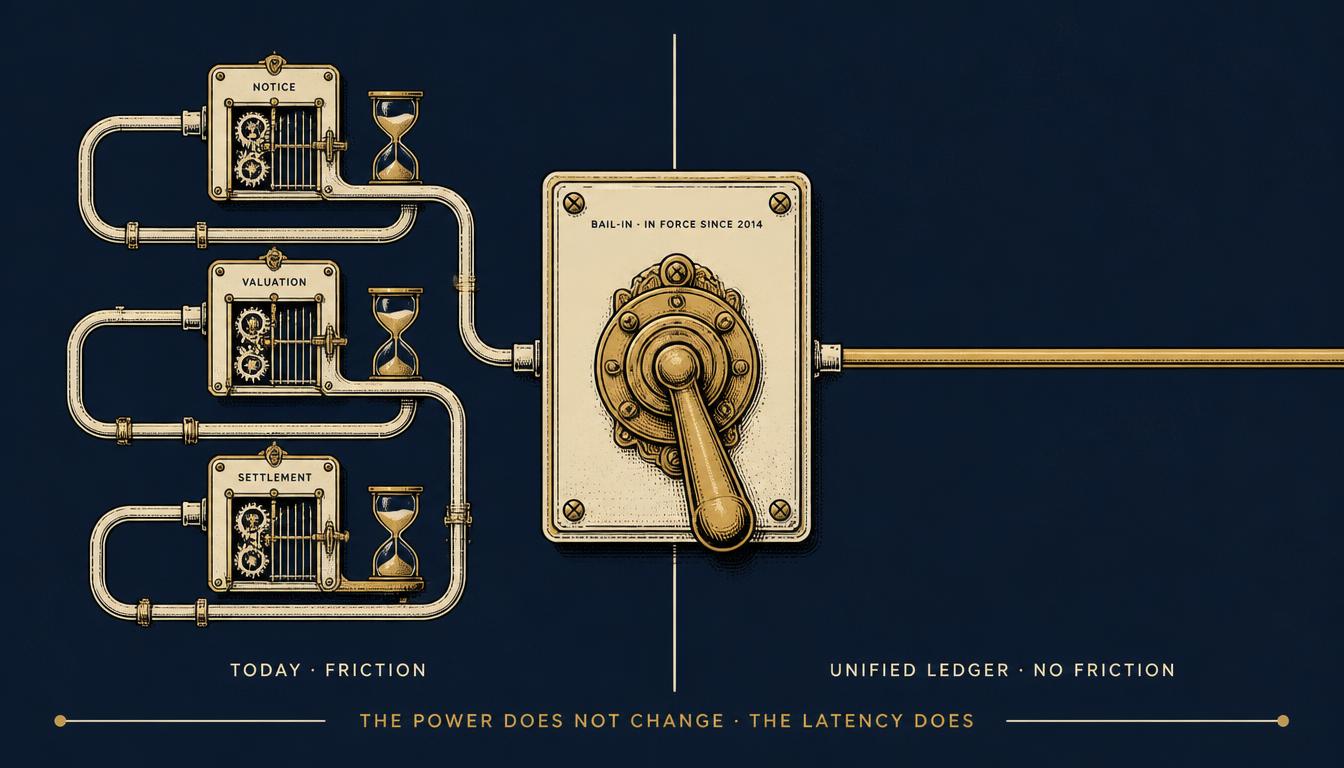
The fear says a unified ledger with central bank digital currency would give authorities the power to take deposits. That is wrong, and it is wrong in a way that has cost the argument its force. The power exists. It is in the Bank Recovery and Resolution Directive. It has a defined threshold of eight percent, a defined scope covering all deposits above the guarantee limit, a defined hierarchy, and — per the Single Resolution Board — status as the prevalent preferred resolution strategy across supervised institutions. 1 It was exercised in Cyprus in 2013, before any central bank digital currency existed anywhere.
What a unified ledger would change is not the authority. It is the latency.
Consider what executing a bail-in requires today. A resolution authority must be convened. A valuation must be performed. The creditor hierarchy must be applied to a specific balance sheet. Instructions must propagate across separate institutional systems, each with its own reconciliation, its own operating hours, its own settlement cycles. The process takes days, and conventionally it is compressed into a weekend because that is the interval during which markets are closed.
That friction was designed by no one. It is an accident of the fact that banking records live in different places and that moving a legal determination through them takes time. It protects no one deliberately.
But it functions as a constraint, and in at least three specific ways.
It bounds scope. An action requiring days of operational work across multiple institutions is practicable for one bank, difficult for several, and near-impossible for many simultaneously.
It creates an interval in which the decision is reviewable. Time between determination and execution is time in which a court can be petitioned, a political process can intervene, or the authority can reverse itself.
It makes the action visible before it completes. A weekend resolution is observable while it is happening. Depositors of other institutions can act on that information.
On a unified ledger where central bank money, tokenized deposits, and tokenized assets share a single programmable venue with settlement finality, a creditor-hierarchy adjustment is not an operational project. It is a state change in the settlement layer. The valuation and the legal determination remain difficult — nothing about tokenization makes an institution easier to value. But the execution collapses from days to the time required to write to a ledger.
The framework's claim, stated as narrowly as it can be: an architecture that reduces execution latency toward zero removes a constraint on the use of an existing power, without anyone having expanded that power and without anyone needing to intend the consequence.
That is a different proposition from the one usually advanced, it is considerably harder to dismiss, and it requires no secrecy. It is the same structural observation Article 53 made about mandated buying: the consequential mechanisms are the ones operating openly, disclosed, for stated reasons that are mostly good.
Two timelines
The framework records the following as documented fact and draws no causal inference from it.
The Crisis Management and Deposit Insurance framework entered into force on May 10, 2026 and applies from May 2028. 6
The digital euro is on a dated track. The European Central Bank's preparation phase ran from November 2023 to October 2025 and closed with a progress report on October 30, 2025, when the Governing Council moved the project to its next phase. 13 The Council adopted a negotiating position in December 2025; the European Parliament voted 420 to 158 in February 2026 to advance the project; and the Economic and Monetary Affairs Committee adopted its detailed position on June 23, 2026 by 43 votes to 14 with one abstention. 14 The call for expression of interest for pilot participants was published March 5, 2026 and closed May 14, 2026, with applicants notified at the end of June 2026; the pilot development phase began in the third quarter of 2026, and a twelve-month operational pilot is scheduled to begin in the second half of 2027. 15 Assuming the Regulation is adopted during 2026, the Eurosystem aims to be ready for potential first issuance during 2029. 13
President Christine Lagarde told the February 2026 Governing Council press conference that it is "vital" to "rapidly adopt" the digital euro, observing that "cash cannot be used for digital payments and its share in day-to-day payments is declining as a result. We therefore need to complement physical cash with its digital equivalent, a digital euro." 14
The reformed resolution framework applies from May 2028. The digital euro pilot runs through 2028 toward potential issuance in 2029.
The framework states explicitly: these are separate workstreams, begun at different times by different institutions for different stated reasons, and the overlap of their implementation windows is not evidence of coordination. It is recorded because it is a fact about the period this catalog is documenting, and because a reader tracking either program should know the other's schedule.
The moment a claim is revealed not to be the thing
The framework's own apparatus gives this subject a formulation the policy literature does not.
Article 47 of this catalog developed the Custody Depth score, which counts institutional counterparties standing between a saver and unencumbered control of an asset. A bank deposit sits at level two: a general institutional intermediary holding a claim that is not asset-specific. Article 45 established, following Fekete, that what functions as money in daily life is frequently a creditor position rather than money in the precise sense — a claim on an institution, whose rank relative to other claims is set by statute.
A bail-in is the moment that distinction becomes operative.
A depositor does not experience a checking balance as a creditor position. The interface presents a number, the number is spendable, and nothing in the daily experience signals that its holder is an unsecured creditor whose priority is determined by Article 44 of a directive. Resolution is the event at which the claim is revealed not to be the thing — at which the number is adjusted according to a hierarchy the holder never read.
This catalog has spent fifty-three prior installments arguing that the substitute layer interposes claims between savers and the assets those claims represent, and that the essential discipline is distinguishing a claim from the thing it names. A bail-in is that distinction arriving as a matter of law, on a schedule not chosen by the holder.
And Menger supplies the contrast with what a unified ledger proposes. His 1892 account describes money emerging from voluntary exchange through the differential saleability of commodities, with no authority selecting it and no design governing it. 16 A unified ledger is the inverse construction: a monetary architecture designed centrally, in which contingent actions are embedded in the instrument itself. Whatever its efficiency merits — and the framework does not dispute them — it is not an emergent institution, and the properties Menger identified as arising from emergence should not be assumed to survive the substitution.
What would falsify this
If the execution-latency argument proves wrong on the technical facts. The claim assumes that a resolution action on a unified ledger executes materially faster than under current arrangements. A demonstration that legal and valuation steps dominate the timeline to the point that settlement-layer speed is irrelevant would substantially weaken the argument. The framework regards this as the most likely point of failure and invites correction from anyone with resolution operations experience.
If deposit guarantee scheme funding proves adequate to the expanded population. The essay's observation that the Crisis Management and Deposit Insurance package expanded the resolution population while reducing depositor exposure leaves open whether the funding scales. Evidence that it does would make the reform straightforwardly favorable to depositors and would render the framework's framing unnecessarily cautious.
If the digital euro regulation excludes programmable contingent actions explicitly. The draft framework already contemplates holding limits and offline functionality. A legislative prohibition on embedding contingent claim adjustments would directly address the concern raised here, and the framework would report that.
What would not falsify it: assurances of intent. The argument concerns capability and constraint, not motive, and statements about what authorities plan to do are not evidence about what an architecture makes possible.
The framework's reading
The claim this essay set out to examine held that a coming crisis would be used to impose a new monetary architecture and to take deposits under cover of emergency.
The record does not support that structure, and the reason is more uncomfortable than the claim. There is no need to impose anything during a crisis. The authority to convert deposits above the guarantee threshold into loss-absorbing capital is a decade old, is documented in a directive available to anyone, was described by the Single Resolution Board as the prevalent preferred strategy, and by that Board's own analysis could rarely be avoided under the creditor hierarchy as it stood. The most recent European legislation moves to reduce depositor exposure while widening the set of institutions the machinery reaches.
And the architecture that would make the power frictionless to exercise was published in an annual report, announced in a press release, and explained in a recorded speech, on the stated grounds that having everything in one place allows a broader array of contingent actions to be automatically executed.
The framework's position, consistent with what it concluded about market manipulation in Article 53: the consequential mechanisms in this system are not concealed. They are published, argued for on their merits, and adopted for reasons that are mostly good. What goes unexamined is not their existence but their scope — and specifically, what a general capability is general over.
A depositor's protection today rests partly on a legal hierarchy and partly on the fact that moving a legal determination through a dozen incompatible systems takes a weekend. The first of those is written down and can be read. The second was never designed, is not defended by anyone, and is exactly the kind of thing an efficiency improvement removes without discussion.
Sources
Note on scope. This essay addresses the European Union framework, where both the resolution regime and the central bank digital currency project are furthest advanced and best documented. The United States operates a distinct regime under Title II of the Dodd-Frank Act, and the framework has not examined it here to the standard applied above; Article 40 of this catalog documented the current United States posture against a retail central bank digital currency. A comparative treatment would require separate research and is not attempted.
Note on the latency argument. The claim that execution latency materially constrains the use of resolution authority is the framework's own inference, developed from the operational description of how resolutions are conducted rather than from any source asserting it. It is the essay's central contribution and also its least externally corroborated claim. The falsification section states what would overturn it.
Framework cross-references. Article 40 (central bank digital currency programmability, including expiration dates, geographic restrictions and merchant category limits; the United States posture); Article 45 (the distinction between money and a creditor claim; Fekete's test); Article 47 (the Custody Depth score and the position of a bank deposit within it); Article 53 (the argument that the consequential mechanisms in modern finance operate openly rather than in concealment).
Footnotes
-
Single Resolution Board. "The Commission Proposal to Reform the EU Bank Crisis Management Framework: A Quantitative Assessment." SRB Working Paper Series No. 3, December 2023. https://www.srb.europa.eu/system/files/media/document/2023-12-15_Working-paper-series-3-CMDI_December-2023_0.pdf — Source for the eight percent total liabilities and own funds threshold as a precondition for accessing the Single Resolution Fund; the definition of bail-inable deposits as "all deposits with the exception of covered deposits," citing Article 44(2)(a) BRRD; the finding that "as per the current creditor hierarchy, the DGS would be rarely able to intervene to support resolution entities falling below the 8 % TLOF without bailing-in deposits"; and the observation that across SRB banks and less significant institutions "there is a prevalence of the use of bail-in as the preferred resolution strategy." ↩ ↩2 ↩3 ↩4 ↩5
-
Clifford Chance. "New EU rules on bank crisis management and deposit insurance." Client briefing, April 2026. https://www.cliffordchance.com/content/dam/cliffordchance/briefings/2026/04/new-eu-rules-on-bank-crisis-management-and-deposit-insurance-part-1.pdf — Source for the adoption of the CMDI package, the statement that most of the new rules apply from May 2028, and the background to the legislative process. ↩ ↩2
-
Council of the European Union / European Parliament joint political agreement on the CMDI framework, 25 June 2025, as reported in "EU legislators agree on bank resolution crisis management and deposit insurance," 26 June 2025. https://ieu-monitoring.com/editorial/eu-legislators-agree-on-bank-resolution-crisis-management-and-deposit-insurance/834048 — Source for the "bridging the gap" mechanism and the quoted statement that "banks with insufficient MREL at the time of resolution can, as a last resort, rely on DGS or resolution funds (or SRF in the Banking Union) to finance their resolution without bailing in their depositors," and for the description of changes to the public interest assessment. ↩ ↩2 ↩3
-
"Council formally adopts CMDI review trilogue agreement." Global Regulation Tomorrow, Norton Rose Fulbright, 5 March 2026. https://www.regulationtomorrow.com/2026/03/council-formally-adopts-cmdi-review-trilogue-agreement/ ↩
-
"MEPs approve CMDI package." Global Regulation Tomorrow, Norton Rose Fulbright, 26 March 2026. https://www.regulationtomorrow.com/2026/03/meps-approve-cmdi-package/ — Source for the European Parliament's approval and the composition of the package (BRRD, SRMR, DGSD). ↩
-
European Commission, Directorate-General for Financial Stability, Financial Services and Capital Markets Union. "Bank recovery and resolution — Policy making timeline." https://finance.ec.europa.eu/banking/banking-regulation/bank-recovery-and-resolution_en — Source for publication of Bank Recovery and Resolution Directive III in the Official Journal on 20 April 2026 and entry into force of the new crisis management and deposit insurance framework on 10 May 2026. See also European Commission, "A stronger framework for handling bank failures," https://finance.ec.europa.eu/publications/stronger-framework-handling-bank-failures_en, for the statement that the reform entered into force 10 May 2026 and will apply from May 2028. ↩ ↩2
-
Freshfields Bruckhaus Deringer. "New Resolution Rules for EU Banks: The CMDI Package at a Glance." 27 April 2026. https://www.freshfields.com/en/our-thinking/blogs/risk-and-compliance/new-resolution-rules-for-eu-banks-the-cmdi-package-at-a-glance-102mqw7 — Source for the final legislative texts published 20 April 2026, formal adoption 30 March 2026, and the summary of the three principal changes: broader application through a lowered public interest assessment threshold and expanded deposit guarantee scheme use; full harmonization of general depositor preference while retaining the highest priority ranking of covered deposits. ↩ ↩2
-
Bank for International Settlements. "III. Blueprint for the future monetary system: improving the old, enabling the new." Annual Economic Report 2023, 20 June 2023. https://www.bis.org/publ/arpdf/ar2023e3.htm — Primary source. "The key elements of the blueprint are CBDCs, tokenised deposits and other tokenised claims on financial and real assets. The blueprint envisages these elements being brought together in a new type of financial market infrastructure (FMI) – a 'unified ledger'." And: "Moreover, by having 'everything in one place', a unified ledger provides a setting in which a broader array of contingent actions can be automatically executed to overcome information and incentive problems. In this way, tokenisation could expand the universe of possible contracting outcomes." Full chapter PDF at https://www.bis.org/publ/arpdf/ar2023e3.pdf ↩ ↩2 ↩3 ↩4
-
Shin, Hyun Song. "A blueprint for the future monetary system." Speech, Bank for International Settlements, 25 June 2023. https://www.bis.org/speeches/sp230625b.pdf — "The data environment that contains these elements also encompasses all the information necessary to incorporate real-world events in any contingent performance of actions." ↩ ↩2
-
Bank for International Settlements. "The next-generation monetary and financial system." Special chapter, Annual Economic Report 2025, as reported in "BIS finds tokenization is the future of financial system," CoinGeek. https://coingeek.com/bis-finds-tokenization-is-the-future-of-financial-system/ — Source for the characterization of the "trilogy" of tokenized central bank reserves, commercial bank money and government bonds as "the next logical step to deliver profound change for the financial system." ↩
-
Bank for International Settlements. "BIS builds out 'game-changing' blueprint for the future monetary and financial system." Media release, 20 June 2023. https://www.bis.org/media-releases/20230620-bis-builds-out-game-changing-blueprint-future-monetary-and-financial-system — Source for the illustrative applications: securities settlement combining individual steps into one transaction, tokenized deposits with built-in regulatory checks settling in wholesale CBDC, smart contract-enabled trade finance, and privacy-protecting data sharing to expand credit access. ↩ ↩2
-
Summary of BIS Annual Economic Report 2023 tokenization chapter, Gate Learn. https://www.gate.com/learn/articles/from-digitization-to-tokenization-the-unified-ledger-is-building-a-grand-blueprint-for-future-currency/1311 — Source for the description of compliance information (transaction parties, geographic attributes of transaction parties, transfer types) being embedded directly in tokens, and reference to the BIS Innovation Hub's Project Aurora. ↩
-
European Central Bank / Banque de France. "Eurosystem moving to next phase of digital euro project." 30 October 2025. https://www.banque-france.fr/en/press-release/eurosystem-moving-next-phase-digital-euro-project — Source for the conclusion of the preparation phase begun November 2023, the Governing Council decision of 30 October 2025, and the statement that assuming legislation is in place during 2026, a pilot could start in 2027 with potential first issuance during 2029. ↩ ↩2
-
"Digital Euro 2026: ECB Prepares Launch as EU Lawmakers Advance Regulation." Informed Clearly, 2026. https://informedclearly.com/en/financial/57950/digital-euro-ecb-regulation-2026 — Source for the February 2026 European Parliament vote of 420 to 158, the ECON Committee position adopted 23 June 2026 by 43-14-1, and the Council's December 2025 negotiating position. For the Lagarde quotations see Human Rights Foundation, Eurozone CBDC Tracker, https://cbdctracker.hrf.org/currency/eurozone, citing the February 2026 Governing Council press conference. ↩ ↩2
-
European Central Bank. "FAQs on the digital euro pilot." https://www.ecb.europa.eu/euro/digital_euro/pilot/html/ecb.faq-digital-euro-pilot.en.html — Source for the three pilot phases: preparation phase in the first half of 2026 with the call for expression of interest published 5 March 2026 and closed 14 May 2026, applicants notified end of June 2026; development phase starting in the third quarter of 2026; and operational phase starting in the second half of 2027 with a twelve-month duration. ↩
-
Menger, Carl. "On the Origins of Money." Economic Journal, Vol. 2 (1892), pp. 239–255. Translated by Caroline A. Foley. ↩
Related essays
Stablecoins, CBDCs, and the Privatization of the Digital Dollar
The most important monetary fact of 2026 is not Bitcoin's quantum challenge or the on-chain housing finance buildout. It is that dollar-pegged stablecoins have become the dominant crypto-monetary instrument globally — Tether holds $141 billion in U.S. Treasuries, USDT and USDC together exceed $265 billion in circulation inside a $320 billion stablecoin market, and 43% of Sub-Saharan African crypto volume runs through stablecoins. Meanwhile, retail CBDCs have failed almost everywhere they have been deployed. The U.S. has explicitly chosen stablecoin regulation (the GENIUS Act) over a digital dollar. The framework's reading: the digital dollar layer has been privatized to Tether and Circle, and almost no one is calling this what it is.
The Hormuz Yuan Toll: A Spontaneous Mengerian Event
Iran charging yuan tolls at Hormuz during wartime, India paying for Russian crude outside the dollar, the 1974 US-Saudi economic commission expiring unreplaced — these are not geopolitical conspiracies. They are textbook Mengerian monetary evolution, happening in real time.
Monetary Power to the People
Money is a medium in McLuhan's sense — an extension of the human body that amplifies the capacity for exchange. Understanding this is the critical path to navigating the financial disruptions of the present age.