Researched and drafted with AI assistance · reviewed and edited by Jason D. Keys
Listen
The Person That Emerged: How Corporate Rights Were Assembled, One Case at a Time
Read in Jason D. Keys' synthesized voice
Narrated in the author’s synthesized voice, generated with AI from a recording of his own. The words are his; the delivery is machine-rendered.
Download (5.6 MB)Nobody decided this
There is no constitutional provision establishing that corporations hold rights. There is no statute. There is no single Supreme Court decision that can be pointed to as the moment it happened.
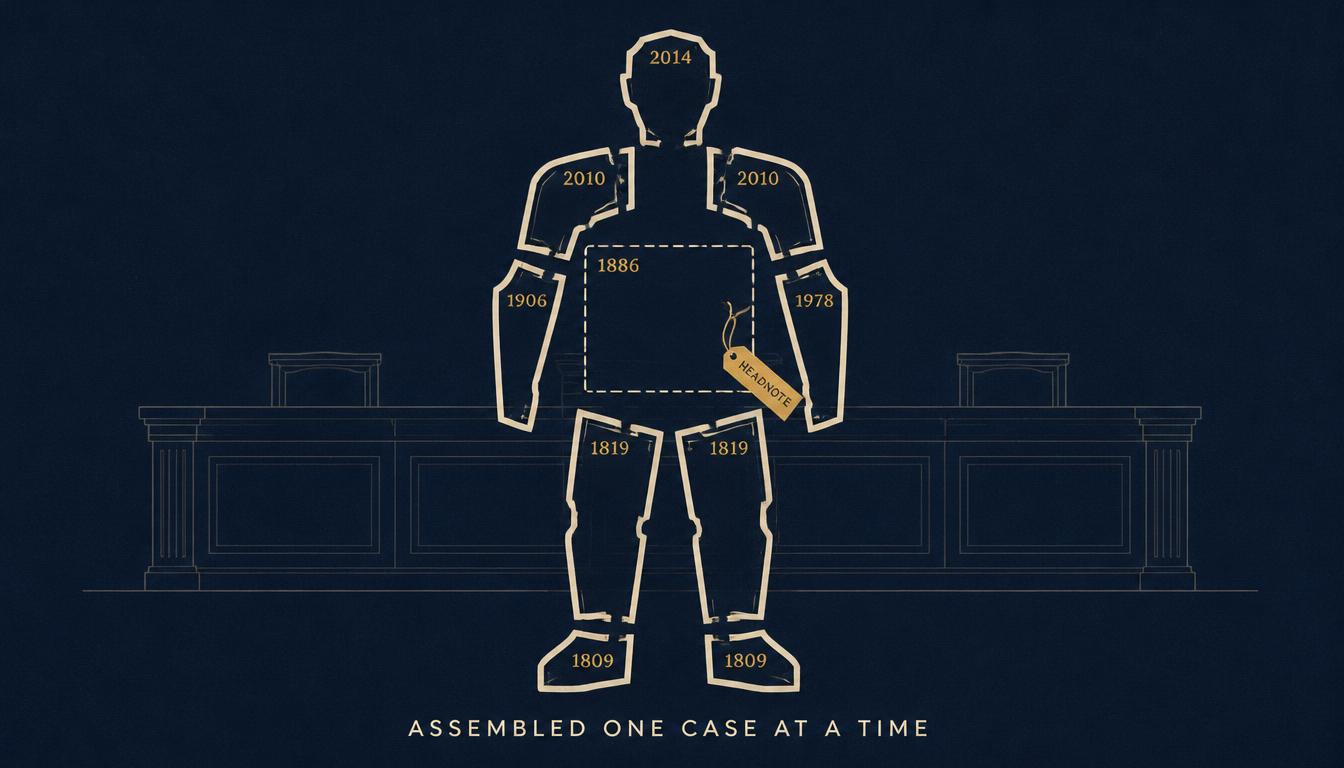
What exists instead is a sequence of cases spanning two centuries, each presenting a narrow question, each answered on grounds that seemed modest at the time, and each becoming a foundation for the next. The previous essay in this series examined how the limits on corporate charters were competed away by states seeking revenue. This one examines how, over the same period and by an entirely different mechanism, the entity inside those charters acquired constitutional standing.
The sequence has a feature worth stating at the outset, because it is not generally noticed. The first corporate rights case ever decided by the Supreme Court was brought by a bank. The case that established corporate political speech under the First Amendment was brought by a bank. The institution at the center of this catalog's work has been the vehicle for corporate constitutional expansion at both ends of the two-hundred-year arc.
1809: a bank asks whether it can sue
The Bank of the United States brought suit against a Georgia tax collector named Deveaux. The question was procedural and narrow: could a corporation sue in federal court in its own name, given that federal diversity jurisdiction extends to controversies between "Citizens of different States," and a corporation is not a citizen of anywhere?
Georgia's lawyers found the Bank's position absurd. Chief Justice Marshall nonetheless found for the Bank, reasoning that for the general purposes of a law, "this invisible, incorporeal creature of the law may be considered as having corporeal qualities." 1
Bank of the United States v. Deveaux is the first corporate rights case to reach the Supreme Court. 2 What it held is modest — the Court looked through the corporation to the citizenship of its members, rather than treating the corporation itself as a citizen. But it established something that everything afterward depends on: that a corporation can appear before a federal court as a litigant in its own name, rather than as a list of every shareholder, director and employee. 3
1819: the charter becomes a contract
Ten years later came the decision that did the most conceptual work.
New Hampshire's legislature attempted to convert Dartmouth College — chartered by George III in 1769 — into a public university by rewriting its charter. The state's argument was that a college established for education is a public corporation and therefore subject to legislative control. 4
Marshall rejected it, holding that the charter was a contract between the state and the institution, and that the Contract Clause of Article I, Section 10 barred the state from impairing it. 5 His characterization of the entity is the most quoted sentence in American corporate law:
"A corporation is an artificial being, invisible, intangible, and existing only in contemplation of law." 6
The sentence is usually quoted as though it diminishes the corporation. Read in context it does the opposite. Marshall is explaining that precisely because the corporation exists only in contemplation of law, it possesses exactly the properties the law gives it — including immortality and the capacity to hold property across generations — and that those properties are not subject to legislative revision once granted.
The states understood immediately what had happened. As the previous essay noted, most responded by writing a reserved power to amend or repeal charters into their general incorporation statutes — the principal mechanism by which they hedged the commitment Dartmouth had imposed. 7 That reservation remains on the books. It has simply gone unused.
1886: the headnote
The episode most often cited as the origin of corporate personhood is also the one where the least actually happened.
Santa Clara County v. Southern Pacific Railroad was a tax case. The county had assessed taxes on the railroad; the railroad disputed the assessment. The Court decided for the railroad on grounds having nothing to do with constitutional personhood — the state had improperly assessed the taxes. 8
The constitutional proposition entered through the headnote. The reporter of decisions, J.C. Bancroft Davis, prefaced the opinion with a summary recording a remark Chief Justice Morrison Waite made before oral argument:
"The Court does not wish to hear argument on the question whether the provision in the Fourteenth Amendment to the Constitution which forbids a state to deny to any person within its jurisdiction the equal protection of the laws applies to these corporations. We are all of opinion that it does." 9
A headnote is an unofficial summary prepared by the reporter. It is not part of the Court's opinion and carries no precedential weight. Corporate personhood was not at issue in the case and the opinion does not address it. 10
Later courts cited the headnote. By 1897 the Court was describing it as "well settled" law that corporations are persons within the provisions of the Fourteenth Amendment, and striking down state regulations on equal protection grounds. 11 The 1880s and 1890s produced a line of railroad cases building on it, and the doctrine was treated thereafter as established. 8
The framework states the obvious caution: the fact that a doctrine entered through an irregular route does not establish that it is wrong. Many sound legal rules have untidy origins. What the episode does establish is that the proposition was never argued and decided on its merits before a court — which means it was never tested by the adversarial process that is supposed to produce reliable constitutional conclusions.
1906 through 1978: the accumulation
The pattern after Santa Clara is accumulation by increment, with each case addressing one right.
Hale v. Henkel (1906) extended Fourth Amendment protection against unreasonable searches to corporations, while simultaneously holding that corporations have no Fifth Amendment privilege against self-incrimination. 12 The asymmetry is instructive: the Court was not granting personhood wholesale. It was deciding, right by right, which constitutional protections an artificial entity could invoke.
First National Bank of Boston v. Bellotti (1978) is the case that matters most for what followed, and it brings the sequence back to a bank. Massachusetts had prohibited corporate expenditures to influence ballot questions not materially affecting the corporation's business. The Court struck the prohibition down, holding that corporate political speech is protected by the First Amendment through the Due Process Clause. 13
Bellotti is the direct precursor to Citizens United v. Federal Election Commission (2010), which extended the principle to independent expenditures in candidate elections and overruled Austin v. Michigan Chamber of Commerce, a case that had held political speech could be restricted based on the speaker's corporate identity. 14
Burwell v. Hobby Lobby (2014) extended religious exercise rights under the Religious Freedom Restoration Act to closely held for-profit corporations — the furthest extension to date, and notably one resting on a statute rather than directly on the Constitution. 14
What the sequence has in common
Four features recur across two centuries, and together they explain how the result was reached without anyone choosing it.
Each case asked a narrow question. Can this entity sue in federal court? Is this charter a contract? Was this tax assessment proper? May this expenditure be prohibited? None asked what a corporation fundamentally is, and a court answering a narrow question does not reach the broad one.
Rights were granted individually and asymmetrically. Hale v. Henkel granted Fourth Amendment protection and withheld the Fifth Amendment privilege in the same opinion. This is not a doctrine of personhood. It is a list, assembled over time, and the list grew.
The holdings were frequently narrower than the citations. Santa Clara decided a tax question and was cited for a constitutional proposition. Deveaux looked through the corporation to its members and is remembered as the first corporate rights case.
No proceeding ever asked whether the accumulated result was intended. This is the structural point. An entity that acquires capacities one at a time, each justified on narrow grounds, never faces a tribunal asking what it has become — because no case presents that question. There is no procedural vehicle for it.
The framework has made this observation in other contexts and makes it again here, because the pattern is the same one Article 53 identified in market structure and Article 54 identified in resolution authority: the consequential outcome is produced by an accumulation of individually defensible steps, none of which was the decision.
What the corporation is, in the framework's terms
The previous essay established Menger's account of capital as a structure of higher-order goods arranged in time, and identified the corporation as the legal technology for assembling it. That function is real and valuable.
The question this essay raises is what happens when the technology acquires standing against the authority that created it.
A corporation is a creature of state law. It exists, as Marshall said, only in contemplation of law — which is to say it exists because a legislature wrote it into existence, under terms the legislature set. The constitutional rights accumulated across the sequence above are rights against the government, which is the authority whose act constitutes the entity in the first place.
That is a genuinely unusual arrangement, and the framework does not claim it is incoherent. Property rights held against the state by state-created entities are defensible in principle, and the alternative — entities entirely at the disposal of whatever legislature is sitting — has obvious problems of its own, which is precisely what Dartmouth was decided to prevent.
What the framework observes is narrower. Combine the two essays:
An entity with no expiration date, no limit of purpose, no cap on size, the capacity to own other such entities, and constitutional standing against the government that creates it, is not the institution the charter system contemplated. Every one of those properties was acquired separately, most without argument, and several without a decision.
The complaint commonly directed at "capitalism" is, in the main, a description of this entity. Menger's apparatus describes something else: the formation of higher-order goods through saving and voluntary exchange. The two are routinely treated as the same subject, which has served the actual institution well.
What comes next
The two essays so far have traced what corporations gained. The third traces what individuals lost over the same period — and it turns, once again, on a banking case.
In 1976 the Supreme Court held that a depositor has no Fourth Amendment interest in his own bank records, because he conveyed them voluntarily to a third party. That holding is the constitutional foundation of modern financial surveillance, and it bears directly on everything this catalog has documented about programmable money.
Sources
Framework cross-references. Article 31 (the Mengerian ordering of goods and the classical definition of capital); Article 53 (consequential outcomes produced by accumulations of individually defensible steps rather than by decisions); Article 57 (the charter limits and their removal through state competition).
Footnotes
-
Bank of the United States v. Deveaux, 9 U.S. (5 Cranch) 61 (1809). Marshall, C.J.: for "the general purposes and objects of a law, this invisible, incorporeal creature of the law may be considered as having corporeal qualities." Full text: https://supreme.justia.com/cases/federal/us/9/61/ ↩
-
"How the 14th Amendment Made Corporations Into 'People.'" History.com. https://www.history.com/articles/14th-amendment-corporate-personhood-made-corporations-into-people — "going back to the earliest years of the republic, when the Bank of the United States brought the first corporate rights case before the Supreme Court." ↩
-
"Corporate Personhood v. Corporate Statehood." Harvard Law Review, Vol. 132. https://harvardlawreview.org/print/vol-132/corporate-personhood-v-corporate-statehood/ — On the common law doctrine of corporate personhood as "what gave the corporation the power to sue Deveaux in its own name, and… the reason the case was called Bank of the United States v. Deveaux as opposed to Every Single Shareholder, Director, and/or Employee of the Bank of the United States, Collectively v. Deveaux." ↩
-
Woodward's argument that a corporation established for education was a public corporation "liable to the control of the legislature," and the Court's rejection of it by reference to Article I, Section 10. See the case summary at Boston University's Guided History project, https://blogs.bu.edu/guidedhistory/law-and-religion/corporate-religion/corporate-personhood/ ↩
-
Trustees of Dartmouth College v. Woodward, 17 U.S. (4 Wheat.) 518 (1819). The holding that the charter granted by the British crown in 1769 was a contract within the meaning of the Contract Clause and was not dissolved by the Revolutionary War. Full text: https://supreme.justia.com/cases/federal/us/17/518/ ↩
-
Dartmouth College, 17 U.S. at 636. Marshall, C.J.: "A corporation is an artificial being, invisible, intangible, and existing only in contemplation of law." Verified against the opinion text at https://www.law.cornell.edu/supremecourt/text/17/518 ↩
-
Pollman, Elizabeth. "Corporate Personhood and Limited Sovereignty." Vanderbilt Law Review, Vol. 74 (2021). https://cdn.vanderbilt.edu/vu-wordpress-0/wp-content/uploads/sites/278/2021/11/19121712/Corporate-Personhood-and-Limited-Sovereignty.pdf — On states' reservation of the power to amend or repeal charters in general incorporation statutes following Dartmouth, described as the principal hedging mechanism. ↩
-
Santa Clara County v. Southern Pacific Railroad Co., 118 U.S. 394 (1886). The case was decided on the ground that the state had improperly assessed taxes to the railroad. Full text: https://supreme.justia.com/cases/federal/us/118/394/ — On the subsequent line of 1880s railroad cases building on it, see Pollman (as 7) and Pembina Consolidated Silver Mining Co. v. Pennsylvania, 125 U.S. 181 (1888). ↩ ↩2
-
The headnote to Santa Clara, prepared by Reporter of Decisions J.C. Bancroft Davis, recording Chief Justice Morrison Waite's statement before oral argument. Reproduced at 118 U.S. 394, 396. ↩
-
"The Evolution of Corporate Personhood." Cornell Undergraduate Law and Society Review. https://www.culsr.org/articles/the-evolution-of-corporate-personhood — "Although corporate personhood itself was not at issue in Santa Clara County v. Southern Pacific Railroad (1886), the case was fundamental in establishing a legal precedent for corporate identity under the Constitution… its legacy as pivotal in the early legal development of corporate personhood is not derived from the Court's opinion at all, but rather from the inclusion of a comment made by Chief Justice Morrison Waite in a headnote, an unofficial summary of the case written by a Reporter of Decisions." ↩
-
Gulf, Colorado & Santa Fe Railway Co. v. Ellis, 165 U.S. 150 (1897). Citing Santa Clara, the Court recognized that "corporations are persons within the provisions of the fourteenth amendment," describing the proposition as well settled. See the timeline compiled by Public Citizen, https://www.citizen.org/wp-content/uploads/students-citizens-united-guide-corporate-personhood.pdf ↩
-
Hale v. Henkel, 201 U.S. 43 (1906). Extension of Fourth Amendment protection against unreasonable searches to corporations while denying the Fifth Amendment privilege against self-incrimination. Full text: https://supreme.justia.com/cases/federal/us/201/43/ ↩
-
First National Bank of Boston v. Bellotti, 435 U.S. 765 (1978). Application of the First Amendment to corporations through the Due Process Clause, striking down a Massachusetts prohibition on corporate expenditures to influence ballot questions. Full text: https://supreme.justia.com/cases/federal/us/435/765/ ↩
-
Citizens United v. Federal Election Commission, 558 U.S. 310 (2010), overruling Austin v. Michigan Chamber of Commerce, 494 U.S. 652 (1990), which had held "that political speech may be banned based on the speaker's corporate identity." Full text: https://supreme.justia.com/cases/federal/us/558/310/ — On Burwell v. Hobby Lobby Stores, Inc., 573 U.S. 682 (2014), see https://supreme.justia.com/cases/federal/us/573/682/ ↩ ↩2
Related essays