Researched and drafted with AI assistance · reviewed and edited by Jason D. Keys
Listen
The Protection That Dissolved: United States v. Miller and the Constitutional Precondition for Programmable Money
Read in Jason D. Keys' synthesized voice
Narrated in the author’s synthesized voice, generated with AI from a recording of his own. The words are his; the delivery is machine-rendered.
Download (5.9 MB)The holding
On April 21, 1976, the Supreme Court decided United States v. Miller by a vote of seven to two, Justice Lewis Powell writing. The holding, stated in the opinion's own terms, is that bank records are not subject to protection under the Fourth Amendment. 1
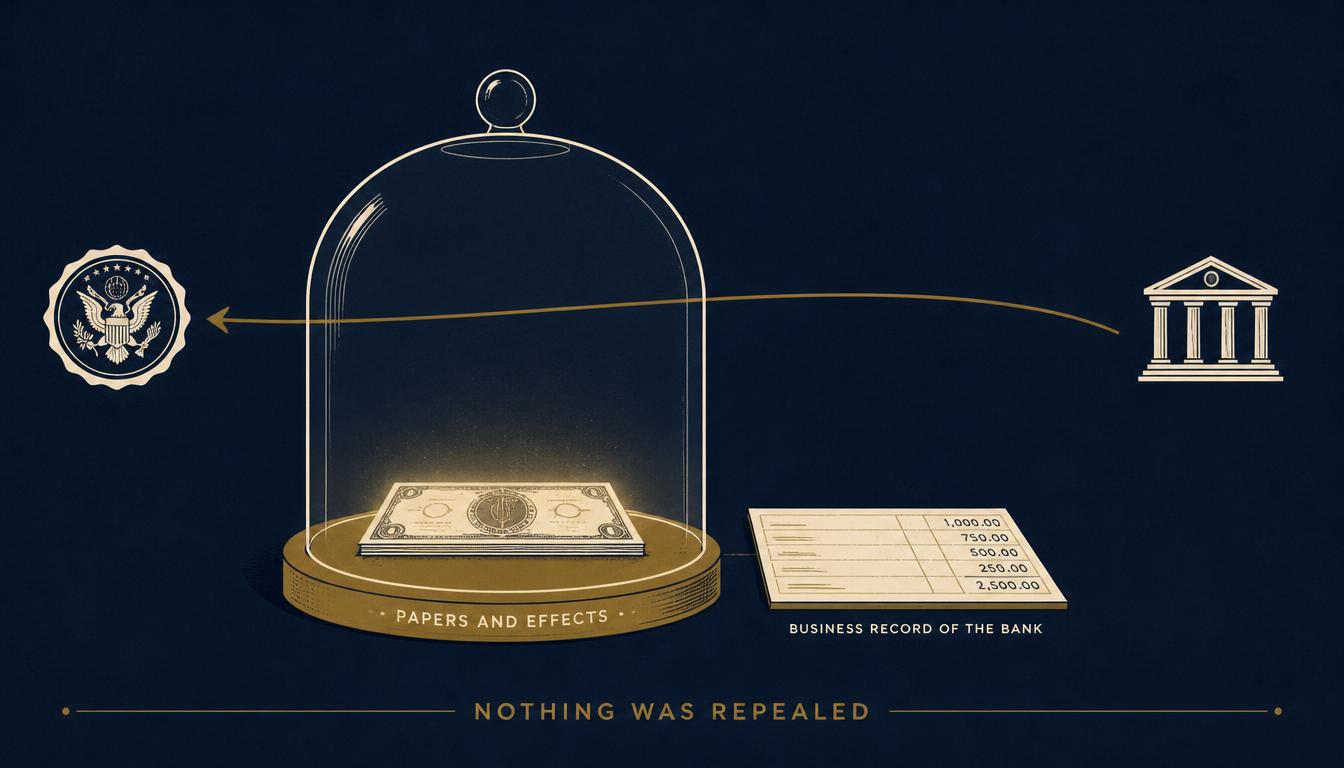
The reasoning rests on two propositions. First, that the documents in question — microfilms of checks, deposit slips, and account records — are "the business records of the banks" rather than the depositor's private papers, and the depositor has no possession or control over them. 2 Second, and more consequentially:
"The Fourth Amendment does not prohibit the obtaining of information revealed to a third party and conveyed by him to Government authorities, even if the information is revealed on the assumption that it will be used only for a limited purpose and the confidence placed in the third party will not be betrayed." 3
The clause after the comma is the one that matters, and it is worth reading twice. The protection is lost not merely when a person shares information indifferently, but when he shares it on the express understanding that it will go no further.
The two preceding essays in this series traced what corporations gained across two centuries of case law — standing to sue, constitutional protection for their charters, Fourteenth Amendment personhood by way of a reporter's headnote, and eventually political speech. This essay traces what individuals lost over the same period, and the loss arrives through the same institutional door. Deveaux in 1809 was a bank. Bellotti in 1978 was a bank. Miller in 1976 was a bank.
How the records came to exist
The records at issue existed because federal law required banks to keep them.
The Bank Secrecy Act of 1970 imposed recordkeeping and reporting obligations on financial institutions, requiring them to retain copies of customer transactions and report certain categories to the government. 4 The statute was challenged and upheld in California Bankers Association v. Shultz (1974), over dissents from Justices Douglas, Brennan, and Marshall. 5
The sequence therefore runs: the government requires banks to create records of customer transactions, and then holds that customers have no constitutional interest in the records the government required to be created.
Miller's attorney made exactly this argument. The Fifth Circuit had accepted it, reversing his conviction on the ground that a depositor's Fourth Amendment rights are violated when bank records maintained pursuant to the Bank Secrecy Act are obtained by means of a defective subpoena. 6 The lower court characterized the mechanism as the government "first requiring a third party bank to copy all of its depositors' personal checks and then, with an improper invocation of legal process," obtaining them. 2
The Supreme Court reversed. The Act's recordkeeping requirements, it held, do not alter or create a Fourth Amendment interest of a bank depositor in the bank's records of his account, and the Act "is not a novel means designed to circumvent established Fourth Amendment rights" because it was already settled before the statute that an IRS summons to a third-party bank does not violate a depositor's rights. 2
Brennan's dissent
Justice Brennan dissented, joined in substance by Justice Marshall, and his argument is the one worth preserving because it anticipates the present moment with unusual precision.
Brennan's position was that a depositor does retain a reasonable expectation of privacy in bank records, and his ground was the character of the conveyance:
"For all practical purposes, the disclosure by individuals or business firms of their financial affairs to a bank is not entirely volitional, since it is impossible to participate in the economic life of contemporary society without maintaining a bank account." 7
A person who must use a bank in order to participate in economic life has not chosen to share his financial history. He has been required to.
Marshall dissented separately, reiterating his position from California Bankers that the Bank Secrecy Act was itself unconstitutional and would lead to violations of Fourth Amendment rights. 5
The framework regards Brennan's objection as the hinge of this entire essay, and will return to it, because the condition he described as making the conveyance involuntary in 1976 has since become considerably stronger.
What the doctrine became
Miller did not remain a case about bank records.
Three years later, Smith v. Maryland (1979) applied the same reasoning to telephone records, holding that a person has no legitimate expectation of privacy in the numbers he dials because he conveys them to the phone company. 8 Together the two cases established what is now called the third-party doctrine: information a person voluntarily provides to a third party is no longer covered by a reasonable expectation of privacy, and the government may obtain it without a warrant. 9
The doctrine's reach expanded with the economy's intermediation. It is the constitutional basis on which the government obtains, without a warrant, transactional records held by banks, telephone carriers, internet service providers, and the long list of intermediaries through which modern life is conducted.
Carpenter v. United States (2018) qualified it, narrowly. The Court held five to four that the Fourth Amendment requires a warrant for extended cell-site location data, notwithstanding that the data is held by a third-party carrier. 10 Carpenter is a genuine limit and the framework notes it as such. But it is explicitly a narrow one, resting on the specific character of comprehensive location tracking, and it did not overrule Miller. Bank records remain where Miller put them.
Why this is the precondition
This catalog has documented, across several essays, an architecture under construction: the programmability of central bank digital currency, including geographic restrictions, merchant category limits, and expiration; a resolution regime under which deposits above a guarantee threshold are convertible by administrative determination; and an identity layer with published deadlines converging on the same window.
What those essays did not identify is the constitutional question underneath all of it, and Miller is the answer.
Consider the structure of the claim. Fourth Amendment protection attaches to a person's papers and effects. A physical banknote in a pocket is an effect — its existence, its denomination, and its use are not recorded anywhere, and obtaining information about them requires a search. A digital balance held at an intermediary is a record about a person, held by someone else, and under Miller it is the intermediary's business record in which the person has no protectable interest.
The implication is direct and the framework states it plainly:
In a financial system where every transaction is intermediated, no financial act is constitutionally private — and no one had to repeal anything to reach that result.
The protection does not have to be removed. It simply never attaches, because the condition that triggers it — the person's own possession of his own papers — has been designed out of the system.
This is the same structural pattern the two preceding essays identified. The charter limits were not abolished by argument; they were competed away. Corporate constitutional rights were not granted; they accumulated through narrow holdings. And financial privacy is not being repealed; it is being rendered inapplicable by a change in how money is held.
Each is a case of a consequential outcome arriving without a decision that produced it.
Brennan's objection, strengthened
The sharpest point available to this essay is that Brennan's dissent did not merely anticipate the present. It understated it.
Brennan argued in 1976 that conveyance to a bank is not voluntary because banking services are a necessity of modern commerce. That was a strong claim at the time and the majority rejected it. A person in 1976 could, with difficulty and inconvenience, conduct a substantial portion of economic life in cash.
In a system where physical currency has been retired and the unit of account exists only as a ledger entry at a supervised intermediary, the conveyance is not merely practically unavoidable. It is definitionally unavoidable, because there is no form in which the asset can be held that does not involve an intermediary record.
Brennan's argument was that a forced conveyance should not forfeit constitutional protection. The majority held that the voluntariness question did not control. A reader may reasonably conclude that the majority's reasoning, whatever its merits in 1976, was never tested against a system in which the alternative does not exist.
What the framework does not claim
Three limits on the argument, stated because the argument is strong enough not to need overstatement.
This is not a claim about intent. Nobody decided Miller in 1976 in order to enable a cashless architecture in the 2020s. The decision concerned a whiskey tax prosecution. The connection drawn here is structural, not conspiratorial, and this catalog has repeatedly found that structural connections of this kind require no coordination to produce their effects.
Statutory protection exists and is not nothing. Congress responded to Miller with the Right to Financial Privacy Act of 1978, which imposes procedural requirements on federal agencies seeking customer records. That is a real protection. It is also a statute rather than a constitutional rule, which means it can be amended by ordinary legislation and contains exceptions — a materially weaker position than the one Miller's lawyers were arguing for.
Carpenter shows the doctrine is not frozen. The Court has demonstrated willingness to limit the third-party doctrine where the information is comprehensive enough. An argument that digital financial records in a cashless system present the same character as the location data in Carpenter is available, and the framework regards it as the most plausible route to a different outcome.
The three essays together
This series began with a question about why the institution commonly called capitalism attracts a moral complaint that its defenders find unrecognizable.
The answer developed across three essays is that the complaint is aimed at something else — an institution assembled over two centuries by mechanisms that nobody controlled and no one voted on.
The charter expired, and then it stopped expiring. Purpose limits, duration limits, capitalization caps, and the prohibition on owning other corporations were competed away by states seeking revenue, with New Jersey leading and Delaware copying. Brandeis documented it from the bench in 1933 and observed that under the earlier rules "the holding company was impossible."
The entity acquired standing. Through narrow holdings beginning with a bank in 1809 and running through a reporter's headnote in 1886 to a bank's political speech in 1978, the corporation accumulated constitutional rights against the government that creates it — never by a decision addressing what it had become, because no case presents that question.
And the individual lost his own. In 1976, again through a bank, the Court held that a person has no constitutional interest in the records of his own financial life, because he gave them to someone else.
Menger's account of capital describes the formation of higher-order goods through saving and voluntary exchange. That process is not what any of the three essays describe. What they describe is a legal technology for assembling capital, which outlived its limits, acquired rights against its creator, and now operates in a system where the individual's financial existence is a business record belonging to somebody else.
Those are different subjects. Treating them as one has served the second well for a hundred years.
Sources
A note on the Right to Financial Privacy Act. Congress responded to Miller with the Right to Financial Privacy Act of 1978, 12 U.S.C. §§ 3401–3422, which imposes notice and procedural requirements on federal agencies seeking customer financial records. The framework notes this in the text as a real but statutory protection, subject to amendment by ordinary legislation and containing enumerated exceptions, and therefore materially weaker than the constitutional rule Miller's counsel sought.
Framework cross-references. Article 40 (central bank digital currency programmability — geographic restrictions, merchant category limits, expiration — and the digital yuan as operational prototype); Article 43 (threat models and the protective properties of bearer instruments); Article 53 (consequential outcomes produced by open, uncoordinated mechanisms); Article 54 (resolution authority operating on claims, and the latency argument regarding unified ledgers); Article 55 (the identity, payment and resolution layers and their published timelines); Articles 57 and 58 (the first two essays of this series).
Footnotes
-
United States v. Miller, 425 U.S. 435 (1976). Argued January 12, 1976; decided April 21, 1976. Seven to two, Powell, J. The holding that bank records are not subject to protection under the Fourth Amendment. Official report: https://www.govinfo.gov/content/pkg/USREPORTS-425/pdf/USREPORTS-425-435.pdf — Full text also at https://supreme.justia.com/cases/federal/us/425/435/ ↩
-
Miller, 425 U.S. 435. Source for the characterization of the documents as "the business records of the banks"; for the holding that "the Act's recordkeeping requirements do not alter" the Fourth Amendment interest of a depositor; for the statement that "the Bank Secrecy Act is not a novel means designed to circumvent established Fourth Amendment rights"; and for the quoted Fifth Circuit characterization of the government "first requiring a third party bank to copy all of its depositors' personal checks and then, with an improper invocation of legal process," obtaining them. See the case report at https://openjurist.org/425/us/435 ↩ ↩2 ↩3
-
Miller, 425 U.S. at 443. Verified against the official report: "This Court has held repeatedly that the Fourth Amendment does not prohibit the obtaining of information revealed to a third party and conveyed by him to Government authorities, even if the information is revealed on the assumption that it will be used only for a limited purpose and the confidence placed in the third party will not be betrayed." The passage is quoted here from "The Fourth Amendment" onward. ↩
-
Bank Secrecy Act of 1970, 84 Stat. 1114. The recordkeeping and reporting requirements imposed on financial institutions, pursuant to which the records at issue in Miller were maintained. ↩
-
California Bankers Association v. Shultz, 416 U.S. 21 (1974), upholding the Bank Secrecy Act's recordkeeping requirements. Justice Marshall's dissent in Miller reiterated his dissent in California Bankers, maintaining that the Act was unconstitutional and would lead to violations of Fourth Amendment rights. https://supreme.justia.com/cases/federal/us/416/21/ ↩ ↩2
-
United States v. Miller, 500 F.2d 751 (5th Cir. 1974), reversed. The Court of Appeals had held "that a depositor's Fourth Amendment rights are violated when bank records maintained pursuant to the Bank Secrecy Act are obtained by means of a defective subpoena." ↩
-
Miller, 425 U.S. 435, Brennan, J., dissenting. Verified against the official report: "For all practical purposes, the disclosure by individuals or business firms of their financial affairs to a bank is not entirely volitional, since it is impossible to participate in the economic life of contemporary society without maintaining a bank account." Brennan reaches the point by adopting the reasoning of the California Supreme Court in Burrows v. Superior Court under the practically identical phrasing of the state constitutional provision, and the sentence quoted is from the passage he sets out. ↩
-
Smith v. Maryland, 442 U.S. 735 (1979). Application of the third-party reasoning to telephone calling records. https://supreme.justia.com/cases/federal/us/442/735/ ↩
-
Congressional Research Service, "The Fourth Amendment Third-Party Doctrine," Report R43586. https://www.everycrsreport.com/reports/R43586.html — "In two of the most prominent third-party cases, Smith v. Maryland and United States v. Miller, the Court held that government access to telephone calling records and bank records, respectively, were not Fourth Amendment searches for which warrants were required." The doctrine "generally finds that information that a person provides voluntarily to a third-party no longer is covered by expectation of privacy, and the government can obtain such information without a warrant." ↩
-
Carpenter v. United States, 585 U.S. 296 (2018). Five to four; the Fourth Amendment requires a warrant for extended cell-site location records notwithstanding that the data is held by a third-party carrier. https://supreme.justia.com/cases/federal/us/585/16-402/ — The decision partially qualified the third-party doctrine without overruling Miller. ↩
Related essays
Contingent Actions: What a Unified Ledger Changes About a Power That Already Exists
A recurring claim in hard-money commentary holds that the next liquidity event will be used to impose central bank digital currency and to seize bank deposits through bail-in. This essay examines the documentary record and finds the claim mistaken in its structure while resting on facts that are almost entirely accurate. Bail-in is not a proposal. It has been European Union law since the Bank Recovery and Resolution Directive, under which bail-in of at least eight percent of total liabilities and own funds is a precondition for accessing the Single Resolution Fund, and under which the Single Resolution Board defines bail-inable deposits as all deposits other than covered deposits below one hundred thousand euros. The Board's own working paper concluded that under the existing creditor hierarchy, deposit guarantee schemes would rarely be able to support resolution without bailing in depositors. Nothing needs to be imposed, because the authority has existed for a decade. What the European Union did in 2026 runs contrary to the fear rather than confirming it: the Crisis Management and Deposit Insurance package, in force since May 10, 2026 and applying from May 2028, is designed specifically to let deposit guarantee funds bridge the gap so that banks can be resolved without bailing in their depositors — while simultaneously lowering the public interest assessment threshold, which expands the population of institutions routed into resolution at all. Two variables moved in opposite directions and almost no commentary has noted both. The essay then turns to the Bank for International Settlements proposal for a unified ledger, published in its 2023 Annual Economic Report and extended in 2025, which would place central bank digital currency, tokenized deposits, and tokenized assets on a single programmable platform. The framework's contribution is to identify what such an architecture would and would not change. It would not create the authority to convert a depositor's claim, because that authority exists. It would change the latency — the interval between a resolution decision and its execution, and the operational friction that currently bounds it. That friction was designed by no one and protects no one deliberately, but it functions as a constraint, and a programmable settlement layer removes it.
The Delivery Mechanism and What Comes Instead: UBI, CBDC, and the Framework's Positive Alternative
This essay is the concluding installment of *The Distribution Question* series. Article 38 established the descriptive terrain of the 2026 distribution debate — the seven variants (UBI, UHI, UBC, UBW, UBO, UBCapital, tokenized UBI), their proponents, and the substantial gap between the mass-unemployment rhetoric that justifies them and the empirical labor market data. Article 39 developed the framework's theoretical apparatus — Fekete's Janus-Face of marketability, the demonstration that universal distribution schemes fail on both faces of marketability (large and small), and the critique of the standard gold-bug argument that mechanically applies the Quantity Theory of Money. This installment engages the institutional analysis and offers the framework's constructive alternative. The essay develops four analytical lines. First, the delivery mechanism analysis: the specific institutional infrastructure through which universal distribution would actually flow, focusing on central bank digital currency (CBDC) as the emerging delivery rail and China's digital yuan as the operational prototype for conditioned money — balances that can be made to expire, restricted by merchant category, and bounded geographically. Second, the historical parallel to 20th-century monetary reform rhetoric: the framework observes that the current abundance-is-scarcity-solved arguments follow the same structural pattern as the 20th-century arguments that gold was a barbarous relic, and that both trajectories end at replacing monetary discipline with political discipline. Third, the third-order beneficiary framework scaled from personal (Article 37) to universal-citizen level: who occupies the first-order, second-order, and third-order beneficiary positions in the various proposal architectures, and why the individual recipient ends up in the third-order position in every current variant. Fourth, the framework's positive alternative: not opposition to helping displaced workers but a substrate-level restoration grounded in the Golden Triangle architecture of Article 33 and the personal-savings principles of Article 37, extended to the institutional scale that the distribution question requires. The framework's overall position across the series: the distribution debate as currently constructed engages the wrong question. The question is not 'how should we distribute the wealth AI generates' but 'what monetary and institutional substrate would enable individuals to own productive capacity broadly enough that the distribution question does not require centralized administration in the first place.' That is the question this essay engages.
Stablecoins, CBDCs, and the Privatization of the Digital Dollar
The most important monetary fact of 2026 is not Bitcoin's quantum challenge or the on-chain housing finance buildout. It is that dollar-pegged stablecoins have become the dominant crypto-monetary instrument globally — Tether holds $141 billion in U.S. Treasuries, USDT and USDC together exceed $265 billion in circulation inside a $320 billion stablecoin market, and 43% of Sub-Saharan African crypto volume runs through stablecoins. Meanwhile, retail CBDCs have failed almost everywhere they have been deployed. The U.S. has explicitly chosen stablecoin regulation (the GENIUS Act) over a digital dollar. The framework's reading: the digital dollar layer has been privatized to Tether and Circle, and almost no one is calling this what it is.