Part Four: Catallactics
Chapter XXII — The Nonhuman Original Factors of Production
Ludwig von Mises · Human Action (1949) · A New Austrian Reading
"Land is, in the praxeological sense, a factor of production." — Ludwig von Mises, Human Action, Ch. XXII (paraphrased for length)
Chapter XXII — The Nonhuman Original Factors of Production
What Mises argues
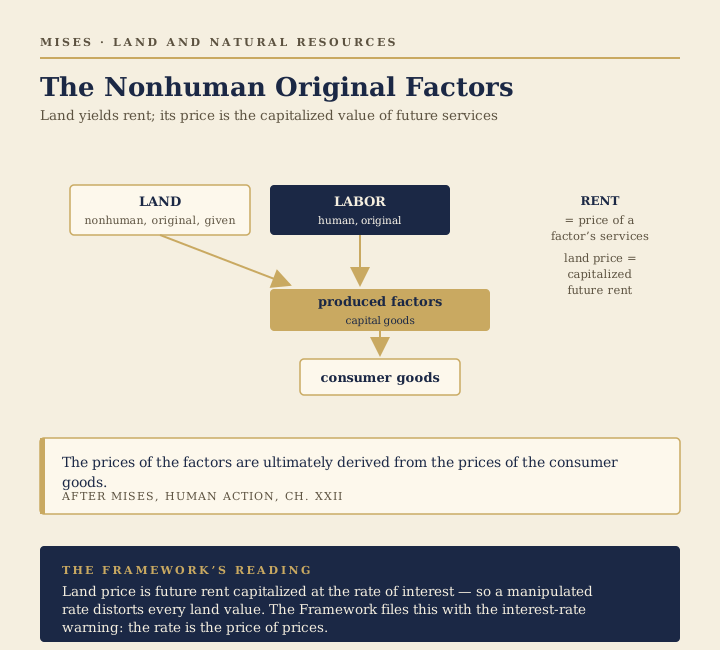
Alongside labor, the other original (non-produced) factor is land — standing for all the nonhuman conditions and natural resources given prior to any human production. Everything else, the capital goods, is produced by combining land and labor over time. The service of a factor commands a price; the price of the durable factor's services is rent, and the price of the factor itself is the capitalized value of its expected future services, discounted to the present.
Mises treats resource use, conservation, and the time-structure of land services as ordinary economic problems: an owner weighs present against future yields exactly as time preference dictates, so private property in land tends to steward it toward its most valued uses across time. There is nothing economically peculiar about land that exempts it from the general theory of pricing and imputation.
The lineage
Böhm-Bawerkian capitalization and Mengerian imputation, applied to the original factors.
The Framework's Reading
The Framework affirms the chapter and underlines one line in it: the price of any durable factor is its future services capitalized at the rate of interest. That makes the interest rate the price of prices — the denominator under every land value, every capital asset, every long-dated claim. A manipulated rate therefore does not distort one market; it distorts the valuation of the entire durable-asset structure at once. This is the quiet reason the interest-rate divergence (Ch. XIX) matters so much: get the rate wrong, whether by central decree or by conflating it with the discount, and every capitalized value in the economy inherits the error.
Cross-references
- Atlas: Theory of Interest
- Back to: Chapter XIX