Part Four: Catallactics
Chapter XXIII — The Data of the Market
Ludwig von Mises · Human Action (1949) · A New Austrian Reading
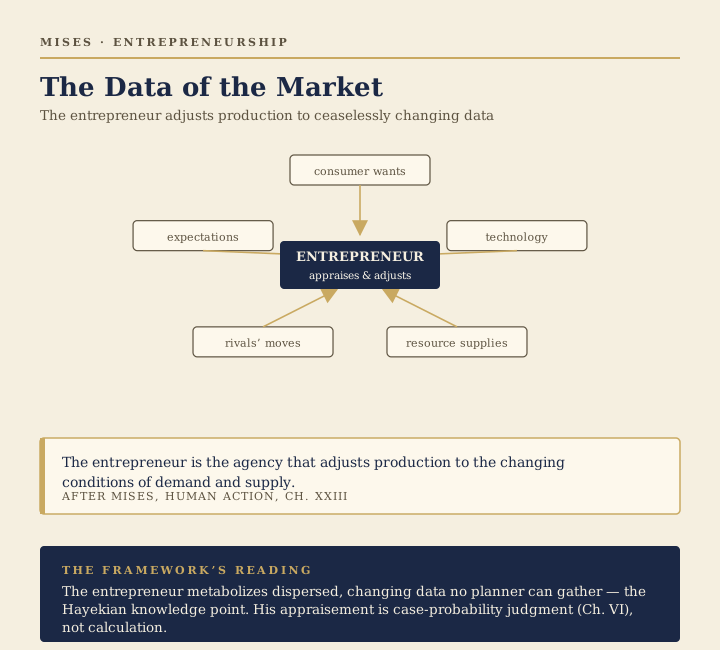
"The driving force of the market is the promoting and speculating entrepreneur." — Ludwig von Mises, Human Action, Ch. XXIII (paraphrased for length)
Chapter XXIII — The Data of the Market
What Mises argues
The market is never at rest because its data — consumer wants, technology, resource availabilities, the actions of rivals, expectations about the future — change ceaselessly. The entrepreneur is the agency that responds: alert to discrepancies between present prices and anticipated future prices, he redirects factors toward what consumers will value, profiting when he judges rightly and losing when he does not. Mises stresses the promoter function — the restless, driving entrepreneurship that initiates change rather than merely adapting to it. Entrepreneurship is not a distinct class of persons but a function present in all action under uncertainty; in the market it is concentrated where appraisement of the future is decisive.
The lineage
Mises' entrepreneurship joins Hayek's emphasis on dispersed knowledge: the data are scattered across millions of minds and can be integrated only through the price system, never assembled by a planner.
The Framework's Reading
The Framework affirms this chapter and ties two earlier threads to it. The entrepreneur's work is appraisement under case probability (Ch. VI) — judgment of unique situations, not computation from a frequency table — which is why it cannot be automated away or centrally replicated. And it is the living mechanism of the Price Signal: the entrepreneur is how dispersed data becomes a price and how a price becomes an adjustment. Any regime that dulls the signal (a manipulated rate, a controlled price) does not just distort a number — it blinds the one agency capable of metabolizing the economy's changing data.
Cross-references
- Atlas: The Price Signal
- Back to: Chapter VI — Uncertainty