Part Four: Catallactics
Chapter XXIV — Harmony and Conflict of Interests
Ludwig von Mises · Human Action (1949) · A New Austrian Reading
"What produces a man's profit in the market is the eradication of another's uneasiness." — Ludwig von Mises, Human Action, Ch. XXIV (paraphrased for length)
Chapter XXIV — Harmony and Conflict of Interests
What Mises argues
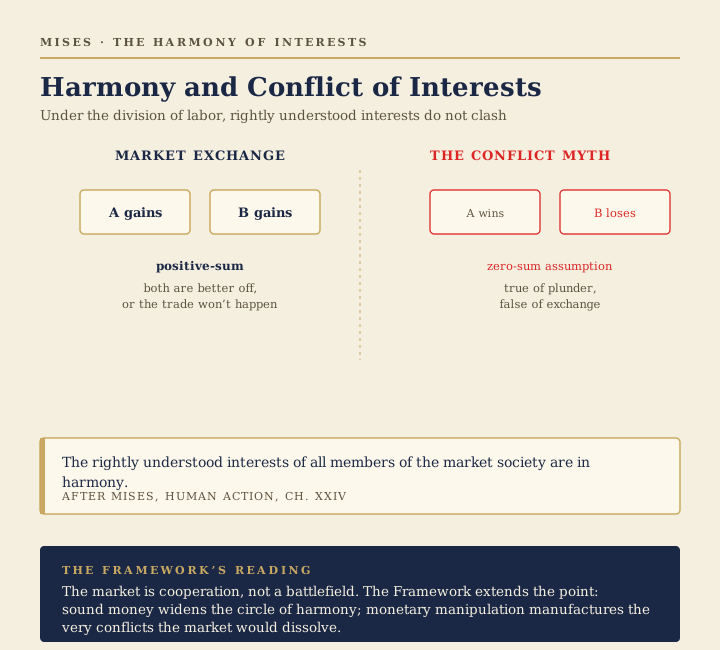
Mises confronts the deep assumption behind most social conflict theory: that one person's gain is another's loss. Under the division of labor, he argues, this is simply false. Voluntary exchange is positive-sum — each party trades only because he values what he receives more than what he gives, so both are better off or the trade does not occur. The rightly understood long-run interests of all participants in the market society are therefore in harmony: everyone benefits from the greater productivity of cooperation, from capital accumulation, from the peaceful division of labor extended across the globe.
The zero-sum picture, Mises says, is true of plunder — of the raider, the conqueror, the monopolist privileged by force — but these are violations of the market, not features of it. Class-conflict and nation-conflict doctrines mistake the logic of predation for the logic of exchange. Genuine conflicts of interest arise from interference and privilege, not from free cooperation.
The lineage
The classical-liberal harmony-of-interests doctrine, given rigorous praxeological grounding.
The Framework's Reading
The Framework affirms this chapter and draws it toward money. Exchange harmonizes interests; the medium of exchange, when sound, extends that harmony across time and distance by letting strangers cooperate through prices they can all trust. Monetary manipulation does the opposite: the Cantillon effect (Ch. XVII) makes new money a genuine transfer from late receivers to early ones — manufacturing a real, zero-sum conflict inside a system that would otherwise be positive-sum. Sound money widens the circle of harmony; debased money forges the very class antagonisms the conflict theorists then point to as proof of the market's injustice.
Cross-references
- Back to: Chapter XVII — Indirect Exchange (the Cantillon effect)
- Forward to: Chapter XXXII — Confiscation and Redistribution