Part Five: Social Cooperation Without a Market
Chapter XXV — The Imaginary Construction of a Socialist Society
Ludwig von Mises · Human Action (1949) · A New Austrian Reading
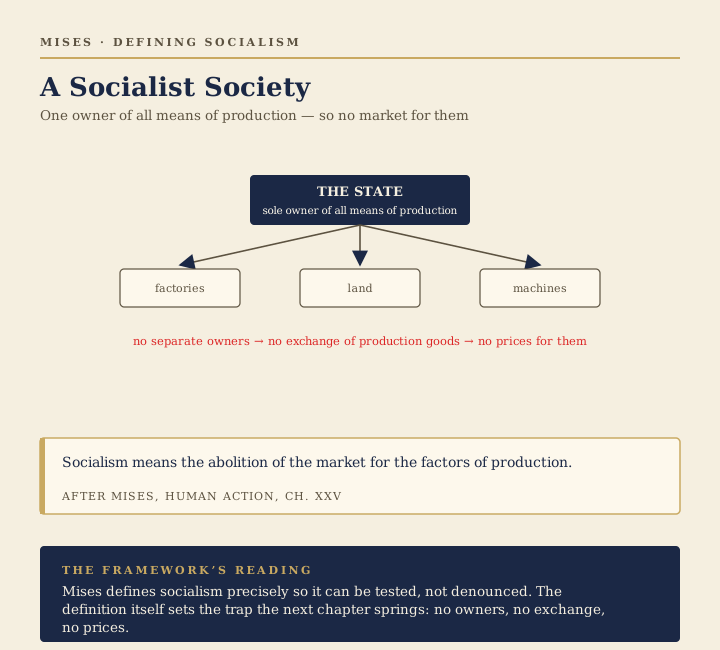
"The socialist system abolishes the market and market prices altogether." — Ludwig von Mises, Human Action, Ch. XXV (paraphrased for length)
Chapter XXV — The Imaginary Construction of a Socialist Society
What Mises argues
Before he can evaluate socialism, Mises defines it with care. Socialism is the system in which the means of production are owned and directed by a single agency — the state, the community, the central board. It is not defined by its motives (equality, justice) but by its structure: the abolition of private ownership of the factors of production and therefore of any market in them. Whatever the variety — the Marxian, the German-war-economy pattern (Zwangswirtschaft), the syndicalist — the defining feature is that production goods no longer change hands between competing owners.
Mises treats socialism as an imaginary construction to be analyzed on its own terms, granting its planners the best of intentions and full technical knowledge. The question is not whether planners are wicked or ignorant, but whether the system as defined can perform the essential task of any economy: allocating scarce means among competing ends rationally.
The lineage
Mises' own framing, sharpened in his 1920 calculation essay and here embedded in the full praxeological system.
The Framework's Reading
The Framework affirms this chapter and admires its method: define the opponent's position at full strength, then test it. The definition is the whole game. By locating socialism's essence in the abolition of the market for production goods, Mises has already identified where the failure must occur — not in effort or morality, but in the missing prices. The next chapter simply follows the logic to its conclusion, and it is the same logic the Framework applies to any partial abolition of a market, including the administrative setting of the one price that is the price of all prices: interest.