Part Five: Social Cooperation Without a Market
Chapter XXVI — The Impossibility of Economic Calculation Under Socialism
Ludwig von Mises · Human Action (1949) · A New Austrian Reading
"Without economic calculation there can be no economy." — Ludwig von Mises, Human Action, Ch. XXVI (paraphrased for length)
Chapter XXVI — The Impossibility of Economic Calculation Under Socialism
What Mises argues
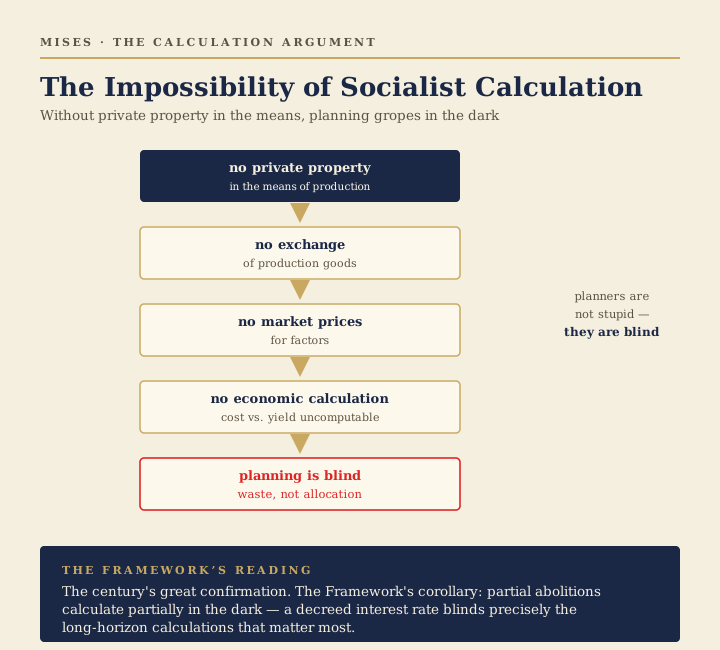
This is Mises' most famous single argument — the socialist calculation problem. The chain is short and, he holds, unbreakable. Rational allocation requires economic calculation in money prices (Ch. XII–XIII). Money prices for the factors of production can arise only from their exchange between competing owners on a market. Such exchange requires private ownership of the means of production. But socialism, by definition (Ch. XXV), abolishes private ownership of the means of production. Therefore socialism abolishes the very prices that calculation depends on — and with them, the possibility of calculation itself.
The planners are not stupid or lazy; they are blind. They may know engineering and inventory, but they cannot know whether a given use of steel and labor is more or less wasteful than the alternatives, because there is no common denominator in which to compare. Central planning therefore cannot allocate rationally; it can only grope, substituting arbitrary directives or shadowing world-market prices it has not itself generated. The problem is not incentives (that is a separate objection); it is the sheer absence of the information that prices carry.
The lineage
Mises' 1920 breakthrough, which launched the socialist-calculation debate and which Hayek later deepened into the knowledge problem. It is arguably the twentieth century's most important theorem in economics, vindicated by the collapse of the planned economies.
The Framework's Reading
The Framework affirms this as decisively as anything in the book — and extends it. Mises analyzed total abolition of the market for production goods. But the logic scales down: any partial abolition calculates partially in the dark. When the state fixes one crucial price, it blinds calculation to the extent that price matters. The most consequential case is the interest rate, which discounts every long-horizon plan: a decreed rate is a small, permanent socialist calculation problem installed at the center of a market economy, blinding exactly the intertemporal calculations — capital, roundabout production, the structure of stages — on which prosperity most depends. Chapter XXVI condemns full socialism; the Framework reads it as also condemning the administered rate.
Cross-references
- Atlas: The Price Signal
- Back to: Chapter XIII — Monetary Calculation as a Tool of Action
- Forward to: Chapter XXXI — Currency and Credit Manipulation