Part Six: The Hampered Market Economy
Chapter XXVII — The Government and the Market
Ludwig von Mises · Human Action (1949) · A New Austrian Reading
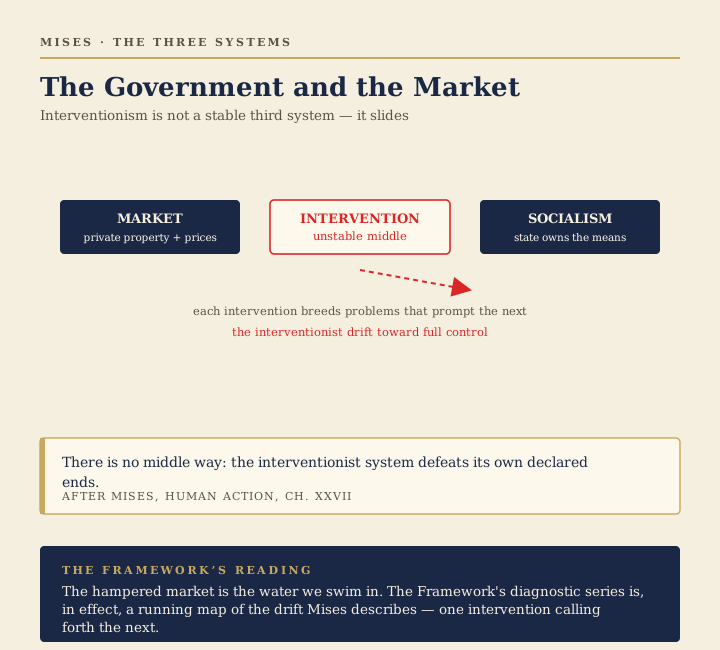
"The interventionist policies bring about conditions which their authors did not intend." — Ludwig von Mises, Human Action, Ch. XXVII (paraphrased for length)
Chapter XXVII — The Government and the Market
What Mises argues
Mises opens the analysis of the hampered market economy — the real-world system that is neither pure capitalism nor full socialism but capitalism obstructed by government intervention. His central thesis is that interventionism is not a coherent third system. Each isolated intervention (a price control, a subsidy, a restriction) produces consequences that, by the interveners' own standards, are worse than the situation it aimed to fix. Confronted with these new problems, the government faces a choice: repeal the intervention, or add another to patch it. The logic of patching leads, step by step, toward ever more comprehensive control — the interventionist drift toward de facto socialism.
Government as such is not the target; Mises grants the state its protective functions. The target is the specific project of directing the market's outcomes while leaving its forms in place — the attempt to have the productivity of the market and the results of the plan at once.
The lineage
Mises' own theory of interventionism, developed across his work of the 1920s and 1930s and systematized here.
The Framework's Reading
The Framework affirms this chapter and treats it as the master template for its own applied work. The Watching the Cracks diagnostic series is, essentially, a real-time chronicle of Chapter XXVII: a specific intervention, its unintended consequence, and the next intervention called forth to conceal the last. Monetary interventionism is the purest case, because its consequences (mispriced time, malinvestment, capital erosion) are the slowest to surface and the most tempting to patch with more of the same.
Cross-references
- Forward to: Chapter XXXVI — The Crisis of Interventionism