Part Six: The Hampered Market Economy
Chapter XXVIII — Interference by Taxation
Ludwig von Mises · Human Action (1949) · A New Austrian Reading
"There is no such thing as a neutral tax." — Ludwig von Mises, Human Action, Ch. XXVIII (paraphrased for length)
Chapter XXVIII — Interference by Taxation
What Mises argues
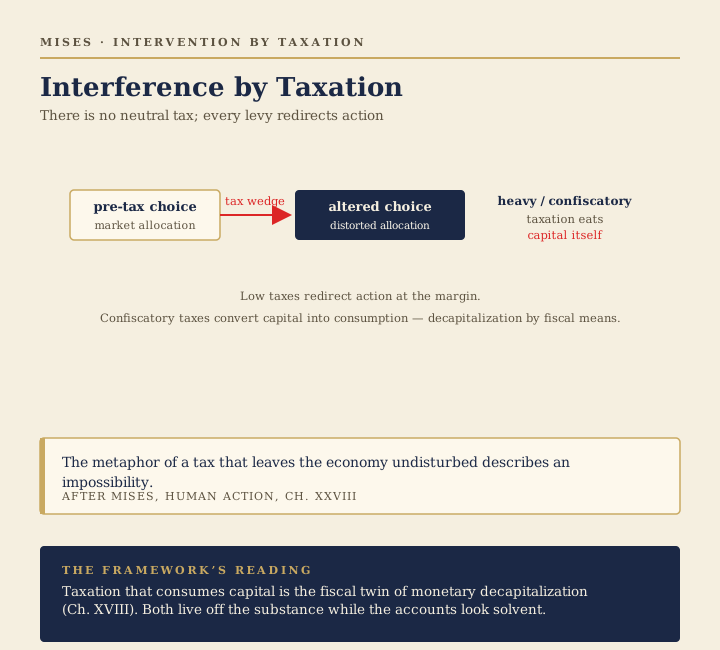
Every tax alters the market. Taxation transfers command over resources from private actors to the government and, in doing so, changes relative prices, incentives, and the direction of production. The ideal of a neutral tax — one that funds the state without disturbing the market's allocation — is, Mises argues, a chimera; the closest approximations still redirect action at the margin.
The graver case is heavy or confiscatory taxation, especially of profits, capital, and inheritance. Because such taxes fall on the sources of capital accumulation, they tend to convert capital into consumption: the community lives off its accumulated substance rather than maintaining and growing it. Taxation aimed at redistribution, pursued far enough, undermines the very capital stock whose yield it means to redistribute.
The lineage
Mises' fiscal application of the general theory of intervention.
The Framework's Reading
The Framework affirms this and pairs it with a theme from Chapter XVIII: decapitalization has two doors, fiscal and monetary. Confiscatory taxation consumes capital openly; monetary manipulation consumes it silently, by letting profits be reckoned in a depreciating unit. Both let a society live off its substance while its books report health. The Framework's interest is chiefly the monetary door, but Chapter XXVIII is the reminder that the fiscal one opens onto the same room.