Part Six: The Hampered Market Economy
Chapter XXXI — Currency and Credit Manipulation
Ludwig von Mises · Human Action (1949) · A New Austrian Reading
"The gold standard removes the determination of the purchasing power of money from politics." — Ludwig von Mises, Human Action, Ch. XXXI (paraphrased for length)
Chapter XXXI — Currency and Credit Manipulation
What Mises argues
This chapter is Mises' frontal assault on monetary intervention. He analyzes inflation (increasing the quantity of money and fiduciary media) and deflation, and the government's perennial temptation toward the former: inflation lets the state spend without visible taxation, favors debtors and early receivers of new money, and manufactures the illusion of prosperity — for a while. The costs come later and fall on the whole society through the destruction of the monetary unit and the boom-bust cycle (Ch. XX).
Against this stands the gold standard. Its virtue, for Mises, is precisely that it takes the quantity of money out of the hands of government. Under a genuine gold standard the purchasing power of money is determined by the market and by the physical facts of gold mining, not by the discretion of officials. Mises is unsentimental: gold is not perfect, but it is the only money yet found that politics cannot manufacture at will. Sound money is a bulwark of freedom because it denies the state the printing press. His prescription is the restoration of a hard, redeemable, government-proof gold standard.
The lineage
Mises' lifelong monetary program, from The Theory of Money and Credit (1912) onward.
The Framework's Reading
On the essentials, Mises and the Framework stand together: stop the manipulation, deny the state the printing press, restore gold. But this is the third and final full Fekete divergence, and it completes the pattern of Chapters XIX and XX.
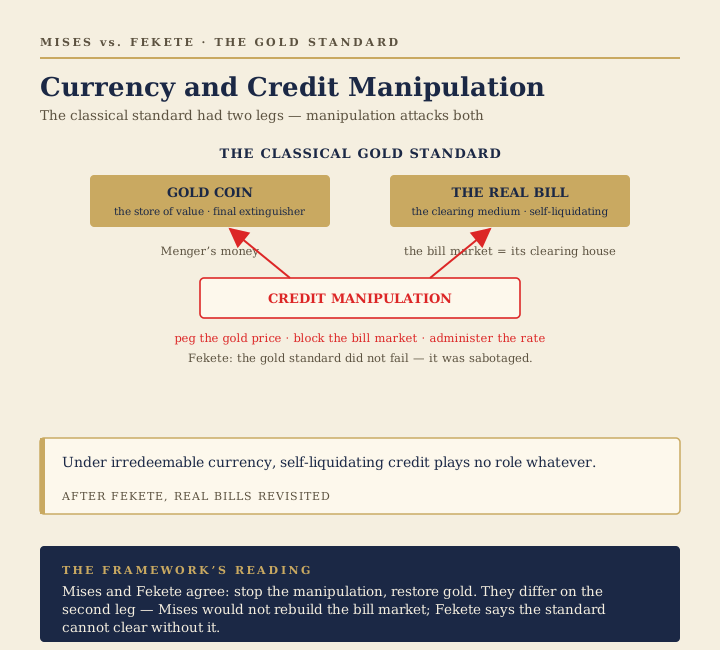
Fekete's claim is that the classical gold standard had two legs, not one. The first was the gold coin — Menger's most-saleable good, the store of value and the final extinguisher of debt. The second was the real bill — the self-liquidating clearing instrument that moved consumer goods to market and whose discount market was, in effect, the gold standard's clearing house. A gold coin alone cannot clear the enormous seasonal flow of consumer goods; there is never enough saved capital to finance it all. The bill market did that work, without inflation, because the bills self-extinguished into consumer gold within the season.
On Fekete's reading, the gold standard did not fail of its own contradictions — it was sabotaged, in stages, by blocking the international bill market and then severing gold entirely. And here is the sharp point for this chapter: Mises, having no discount rate and classing the real bill with inflationary fiduciary media (Ch. XIX–XX), would restore only the first leg. Fekete argues a one-legged gold standard cannot stand — that without a rehabilitated bill market the restored standard would seize up for want of a clearing mechanism, and be abandoned again. The Framework's monetary program is therefore two-legged: gold coin and real bill, store of value and clearing medium.
The traditional Austrian reply
The Rothbardian mainstream endorses Mises' gold program and rejects Fekete's second leg outright. On its view the real bill is fiduciary media with a short fuse; a 100 percent gold standard needs no bill market, and any monetized bill is inflationary. The mainstream would say the classical standard's clearing was done well enough by gold and fully-backed substitutes, and that Fekete's "clearing house" is a back door for the very credit expansion the gold standard exists to prevent. This is the same fault line as Chapters XIX and XX, now drawn through the reform program itself: one-legged or two-legged gold standard is the open question, and it is the practical stake of the whole New Austrian project.
Cross-references
- Atlas: Money vs. Currency · Real Bills Doctrine · Gold Basis and Co-Basis
- Back to: Chapter XIX · Chapter XX · Chapter XXX
- Fekete: Real Bills Revisited, The Gold Problem Revisited, and "Waggon-Way in the Air" (professorfekete.com)