Part Six: The Hampered Market Economy
Chapter XXXII — Confiscation and Redistribution
Ludwig von Mises · Human Action (1949) · A New Austrian Reading
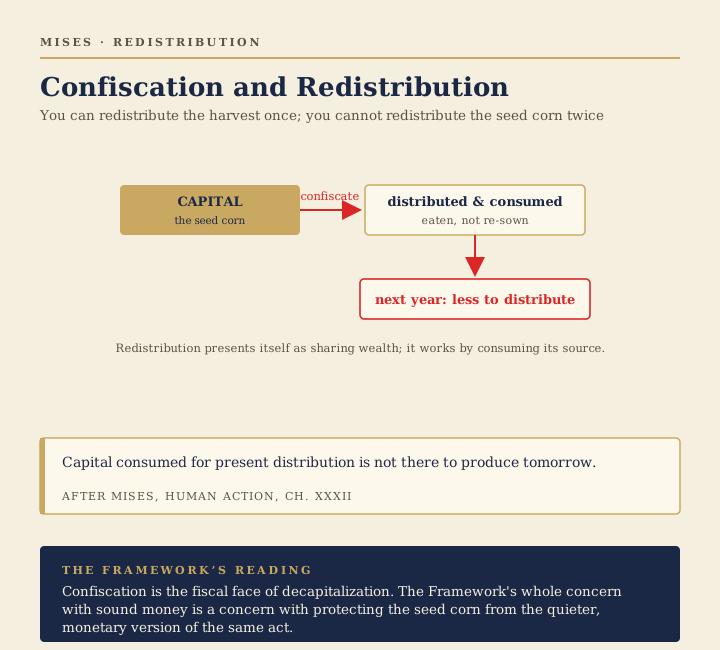
"The long-run effect of confiscatory measures is capital consumption." — Ludwig von Mises, Human Action, Ch. XXXII (paraphrased for length)
Chapter XXXII — Confiscation and Redistribution
What Mises argues
Mises examines the interventions that seize and redistribute wealth — confiscatory taxation of capital and inheritance, and the broader program of leveling. His economic point is not a moral objection but a structural one: wealth that is confiscated for present distribution is, in large part, capital, and capital consumed is capital that no longer produces. You can redistribute an existing stock once; but doing so eats the source of future income, so the pool available to redistribute shrinks year over year. The apparent egalitarian gain today is purchased by a poorer, less-capitalized society tomorrow — and it is the wage-earner, whose real wages depend on capital per head, who is hurt most in the end.
The lineage
Mises' application of capital theory to the politics of redistribution.
The Framework's Reading
The Framework affirms this and reads it alongside Chapters XVIII and XXVIII: confiscation is the fiscal face of decapitalization, monetary manipulation the silent one. Both consume the seed corn; one does it with a visible levy, the other by letting the unit of account rot so that capital is eaten under cover of nominal profit. The Framework's insistence on sound money is, at bottom, insistence that the seed corn be protected from the quieter of the two thefts.