Part Six: The Hampered Market Economy
Chapter XXXIII — Syndicalism and Corporativism
Ludwig von Mises · Human Action (1949) · A New Austrian Reading
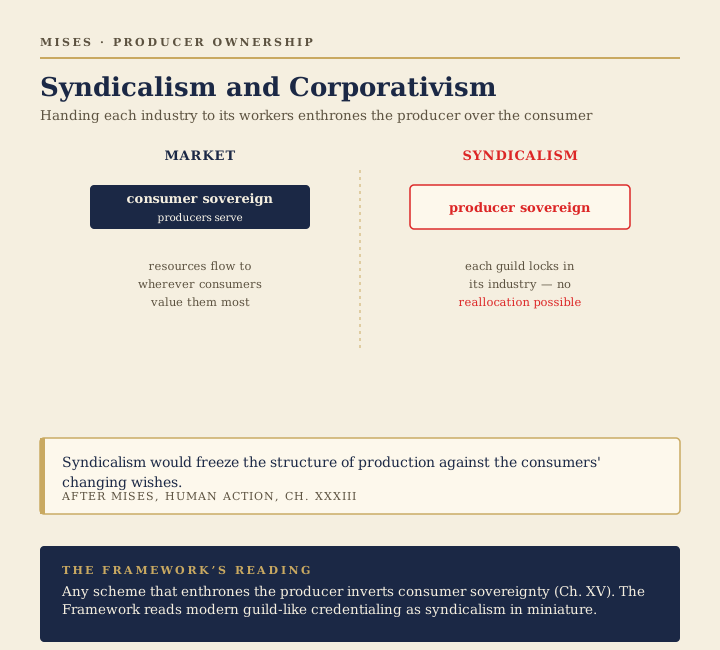
"Syndicalism makes the producers of a branch the owners of its plants." — Ludwig von Mises, Human Action, Ch. XXXIII (paraphrased for length)
Chapter XXXIII — Syndicalism and Corporativism
What Mises argues
Syndicalism proposes that each industry be owned and run by the workers employed in it. Mises shows the idea is economically incoherent. It enthrones the producer over the consumer: once the workers of a branch own its plants and capture its returns, they have every interest in restricting entry, resisting labor-saving innovation, and freezing the industry against the consumers' changing wishes. Reallocation of capital and labor across industries — the very thing a productive economy requires — becomes impossible, because no group will vote to shrink its own domain. Corporativism (the organization of the economy into state-sanctioned producer bodies) shares the defect: it substitutes the interests of organized producers for the sovereignty of consumers, and in practice becomes a mask for state direction.
The lineage
Mises' critique of the producer-cooperative and corporative-state ideologies prominent in his era.
The Framework's Reading
The Framework affirms this and finds its shadow in the present. Wherever an occupation is handed effective control over its own entry — licensing boards, guild-like credentialing cartels, professional bodies that set who may practice — you have syndicalism in miniature: producer sovereignty smuggled in under the language of standards. This is the institutional engine of the labor-saleability inversion the diagnostic series tracks. Chapter XXXIII named the principle; the credentialing economy is its diffuse, modern form.