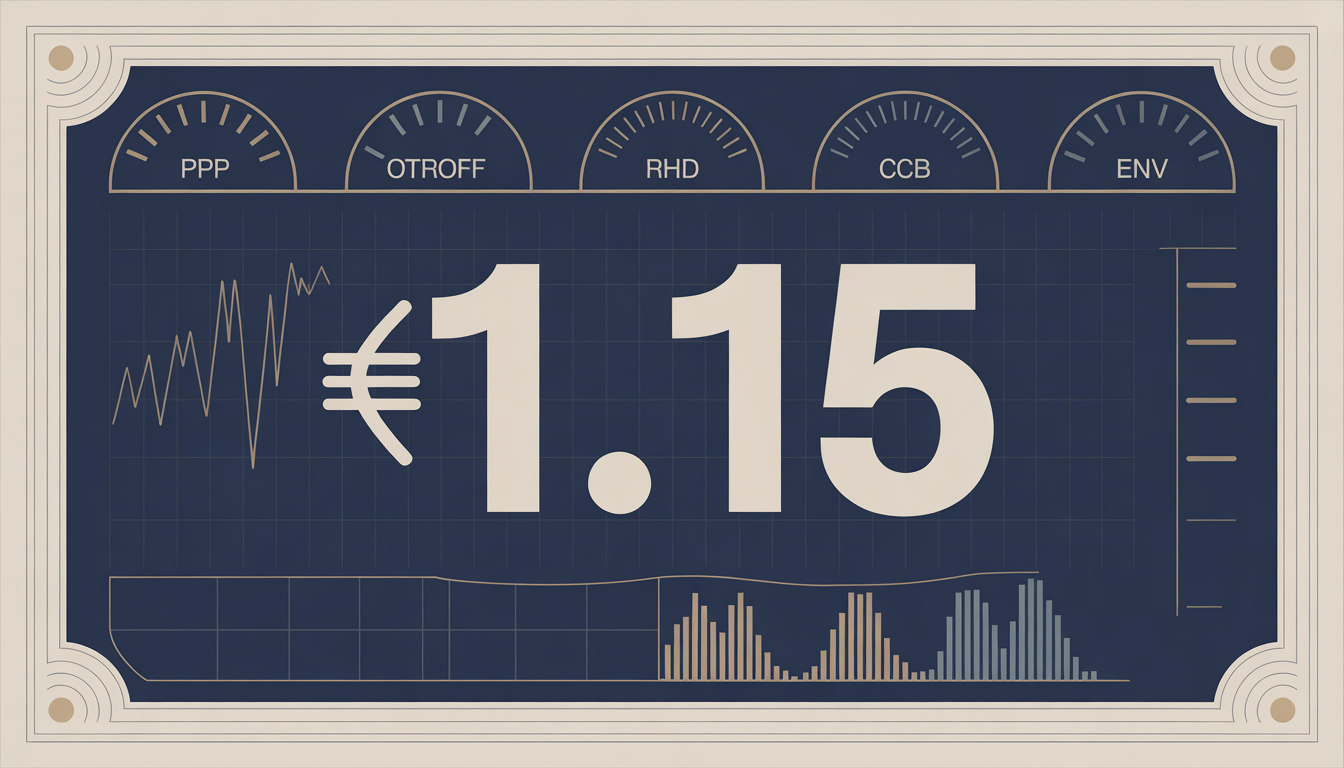
The U.S. Treasury market is the deepest financial market on earth. Two nearly-identical 10-Year Treasury notes — one auctioned this quarter, one auctioned last quarter — trade at persistently different yields. That gap prices saleability. Nothing else. Same credit. Same duration. Same tax treatment. Same clearing infrastructure. Only the newer issue is the on-the-run benchmark; the older is off-the-run. This week the framework's diagnostic apparatus made that reading operational as OTROFF — the sovereign-substrate saleability premium, live at /toolkit/otroff-spread. And the ledger is dense: the ICBC retail paper-gold deadline passed Friday; a fourth 2026 bank failure landed July 17; Hormuz is at near-standstill; and Warsh's second FOMC arrives Wednesday.
Featured essay: read the full analysis →
Researched and drafted with AI assistance · reviewed and edited by Jason D. Keys
Listen
Issue #014 — The Saleability Premium
Read in Jason Keys' synthesized voice
Narrated in the author’s synthesized voice, generated with AI from a recording of his own. The words are his; the delivery is machine-rendered.
Download (6.7 MB)Welcome to Issue #014 of The Dispatch. Each Monday, this letter takes one situation from the week's news and reads it through the lens of Carl Menger and Antal Fekete — paired with a foundational concept, the dashboard, the framework's prediction record, and a piece from the archive. If someone forwarded this to you, subscribe here.
The Lens
The U.S. Treasury market is the deepest financial market on earth. More than $28 trillion outstanding and average daily trading volume above $900 billion on SIFMA's 2024 figures, both higher since. Every serious institutional portfolio holds it. Every serious central bank holds it. It clears through the largest, best-instrumented dealer network any market has ever produced.
Inside that market, two nearly-identical 10-Year Treasury notes trade at persistently different yields. One was auctioned on May 12, 2026 (the on-the-run). One was auctioned on February 11, 2026 (the off-the-run). Both mature in 2036. Both carry the full faith and credit of the U.S. government. Both settle through the same clearing infrastructure. Both receive the same tax treatment. Same credit. Same duration. Same everything — except that the newer issue is the benchmark, and the older one is not. When the market pays a premium for one over the other, that premium is dominated by the market's pricing of saleability — though the literature also attributes part of the spread to repo specialness and financing advantage rather than to liquidity preference alone.
This week the framework's diagnostic apparatus made that reading operational. OTROFF — the maturity-adjusted 10-Year on/off-the-run Treasury spread — is now live at /toolkit/otroff-spread. It is the fifth component the Mengerian Stress Index originally specified but had not yet had operational. It is, in framework terms, the most direct diagnostic of saleability within the U.S. Treasury market itself.
The ledger this week is also dense. The ICBC retail paper-gold deadline passed Friday July 24 — Forum #34's recorded prediction operationally confirmed. Farmers State Bank of Oakley, Kansas failed July 17 — the fourth U.S. bank failure of 2026, twice the 2024–2025 baseline of two per year with more than five months left in the year. Hormuz shipping is at near-standstill — traffic down to ~10 vessels/day (from 108 pre-crisis normal), 70% of tanker transits running "dark," eight of the world's largest container carriers rerouting via Cape of Good Hope. Warsh's second FOMC is Tuesday–Wednesday (July 28–29) — the first substantive durability test of the Issue #009 institutional pivot.
The new instrument arrives at a moment when the framework's cumulative prediction record is stacking up.
Lead Essay: What OTROFF Measures, and Why It Matters
The Treasury market's on-the-run / off-the-run distinction is one of the most reliable saleability signals available in any financial market. Every quarter, the Treasury auctions a new 10-Year note. That new note becomes the benchmark issue — the on-the-run — and inherits the deepest secondary-market liquidity in the world's largest sovereign-debt market. The immediately preceding note becomes off-the-run: seasoned, still trading, still perfectly good collateral for repo, but no longer the market's benchmark.
The two notes differ in age by about ninety days. They typically differ in coupon by 12.5 to 25 basis points (whatever the Treasury set at auction). Once you adjust for the coupon difference and the small maturity gap using the Treasury's published Daily Par Yield Curve, any residual yield difference is the market pricing the newer note's benchmark saleability against the older note's seasoned saleability.
During ordinary times, OTROFF sits in the 1–5 basis point range — small enough that it is invisible to most participants and barely discussed even in specialist Treasury commentary. During flight-to-liquidity events, it widens dramatically: it spiked above 15 bps during the August 2007 quant crisis and the September–October 2008 acute phase of the Great Financial Crisis; above 10 bps during the summer 2011 European debt crisis; above 30 bps during the September 2019 repo dislocation that the Federal Reserve managed through hundreds of billions of dollars of emergency intervention; and above 25 bps during the March 2020 COVID Treasury-market seizure that produced the Federal Reserve's largest single emergency response since 2008.
In each of those episodes, the OTROFF spike led the visible signs of Treasury-market stress by days to weeks. The framework treats OTROFF as one of the cleanest early-warning indicators available for sovereign-substrate strain because it isolates the specific variable that mainstream commentary systematically underweights: the market's ongoing pricing of saleability, held constant against credit and duration.
Where is OTROFF now? As of July 27, 2026, the reading is 0.67 basis points maturity-adjusted. Extremely tight. Well below the 1–5 bp ordinary range. The Treasury-market saleability substrate is not stressed. The current on-the-run 10-Year note (CUSIP 91282CQQ7, auctioned May 12, yielding 4.6421%) trades at essentially the same yield as the immediately preceding off-the-run note (CUSIP 91282CPZ8, auctioned February 11, yielding 4.6381%) once the small maturity gap is adjusted for.
This is the framework's most important initial finding: the substrate stress the catalog has been documenting across the last thirty-seven Forum essays is not currently showing up at the Treasury market. The stress is elsewhere — in gold and silver basis (which oscillated wildly through late 2025 and early 2026, now moderating); in the FX cross-currency basis (which remains at the framework's Z-score cap despite easing modestly from spring peaks); in the repo haircut dispersion (which has been persistently elevated for months); in the housing and commercial-real-estate markets (documented across the catalog's housing essays); in the airline sector (Forum #35); in the DFC's zero-policies facility (Forum #36).
But not, currently, in the on/off-the-run Treasury spread. The world's largest and most institutionally-supported market for U.S. sovereign debt is functioning smoothly at the specific granularity where saleability isolation is possible.
The framework's analytical posture on this: the Treasury market's saleability is the anchor that all the other substrate diagnostics depend on. Federal Reserve balance-sheet operations, primary dealer inventory management, repo funding, secondary-market clearing, foreign central bank reserve management, corporate treasury cash management — all of it depends on the on-the-run Treasury being the world's benchmark saleable sovereign asset. When OTROFF widens, that anchor is showing strain. When it doesn't, the substrate condition — whatever else is happening — is not yet reaching the anchor.
The new instrument is worth watching for specific reasons. OTROFF has been the framework's "missing" fifth MSI component since Forum #12 spec'd the dashboard. Its absence meant the MSI was structurally undersampling sovereign-substrate stress. Now that OTROFF is live and included in the composite, the MSI reading of 1.69 / "moderate elevation" — a new regime label distinct from "elevated" and "acute stress" — reflects a fuller diagnostic than any prior reading. The Treasury market's structural calm is now visible in the composite alongside the persistent stress in the FX and repo components.
Alongside OTROFF, the toolkit also gained decontaminated basis and live-spot cobasis for precious metals — refined calculations that remove specific measurement contaminations (LBMA fix timing, spot-price staleness) from the gold basis reading. The dashboard's basis metric is now more accurate to what Fekete's original framework was measuring in his 2000s work.
→ See the new instrument: OTROFF — On/Off-the-Run 10-Year Treasury Spread · Mengerian Stress Index
Concept in Focus: The Saleability Premium
Carl Menger's 1892 essay On the Origin of Money established the analytical apparatus underneath every reading in this dispatch. Menger observed that goods differ in Absatzfähigkeit — the ease with which they can be exchanged for other goods at prices approximating their actual value, across varying quantities and conditions. The most saleable good in a market becomes money through unplanned social evolution; lower-saleability goods circulate at increasing discounts as conditions deteriorate.
Saleability is not credit risk. It is not duration risk. It is a distinct third dimension — the market's ongoing pricing of how easy it is to sell or buy the asset without moving the price against yourself. In the pre-1971 monetary architecture, this dimension was mostly obscured because gold coin was the benchmark saleable asset and its saleability was structural. In the post-1971 substitute-layer environment, saleability has become a variable — priced continuously by markets, differently across instruments, and observably in specific spreads.
OTROFF is Menger's saleability concept applied to the Treasury market at the specific granularity where credit and duration are held constant. The on-the-run and off-the-run 10-Year notes have essentially identical credit risk (both direct U.S. Treasury obligations) and essentially identical duration (differing by about ninety days on a ten-year instrument). Any yield gap after the small maturity adjustment is the market pricing saleability. This is the cleanest sovereign-substrate saleability signal any market makes available.
The framework's cumulative saleability-diagnostic apparatus, with OTROFF now included, reads across five distinct market segments:
- Gold basis (Fekete's classical framework signal) — saleability of physical monetary metal against futures paper
- Silver basis + silver-gold ratio — the second face of the historical bimetallic monetary substrate
- FX cross-currency basis — saleability across sovereign currency zones
- Repo haircut dispersion — saleability across collateral quality tiers in short-term funding markets
- OTROFF — saleability within the sovereign-debt benchmark itself, with credit and duration held constant
Each metric isolates a different piece of the saleability spectrum Menger identified. Together they constitute the framework's most complete diagnostic of substrate condition — and the addition of OTROFF closes the specific gap the catalog has been operating with since Forum #12 was published in May 2026.
The Atlas page on the Origin of Money covers Menger's saleability spectrum in full.
The Scorecard
Four framework predictions have entered resolution windows this week.
Forum #34 China physical clearing architecture — CONFIRMED. The ICBC retail paper-gold deadline passed Friday July 24. Postal Savings Bank, Ping An Bank, and other major state banks have also wound down individual precious metals trading services linked to the Shanghai Gold Exchange. The framework's May 2026 prediction that "the retail paper-gold layer is being pulled out by design" is operationally confirmed. The parallel physical-clearing infrastructure — Hong Kong Precious Metals Central Clearing, Singapore Loco Gold, SGE International Board expansion, PBOC accumulation — continues operating.
Forum #16 banking diagnostics — baseline exceeded. Farmers State Bank of Oakley, Kansas failed on July 17, becoming the fourth 2026 U.S. bank failure. The framework's 2024–2025 baseline was two failures per year; 2026 has now exceeded that baseline at 4 with more than five months of the year remaining. Not a systemic threshold — Farmers State is small — but the trend the framework was watching has begun to move.
Forum #26 / Forum #36 Hormuz trajectory — worsening. Trump declared the ceasefire over on July 8. Traffic down to ~10 vessels/day. Non-Iranian-linked ship transits fell from 108 to 25 week-on-week. 70% of tanker transits running dark (transponders off) — up from 55% the prior week and 42% two weeks earlier. Eight of the world's largest container carriers have suspended Hormuz transits or rerouted via Cape of Good Hope. The DFC $40B facility remains at zero policies. The framework's "normalization not before 2028" recorded prediction is tracking on schedule; the July CPI print (mid-August) is the next resolution test for the energy-channel propagation.
Forum #32 Warsh institutional pivot — Wednesday's meeting is the durability test. The framework's recorded prediction was that the 130-word statement discipline and the Chair's dot-plot abstention would hold through at least September and October. Warsh's second FOMC concludes Wednesday July 29 with statement at 2:00 p.m. ET. Watch: (1) statement length (≤~150 words = substantive; >200 words = re-expansion begins); (2) whether Warsh submits a personal dot to the SEP; (3) whether early task force findings are referenced. Fortune's July 25 preview frames the meeting as another "family feud" — consistent with the pivot's durability.
New predictions from Forum #12 / OTROFF launch: the framework will now track OTROFF as a leading indicator of Treasury-market stress. Specific testable prediction: if the substrate condition the catalog has been documenting reaches the Treasury-market anchor, OTROFF will spike above 5 basis points before the mainstream commentary widely acknowledges Treasury-market stress. If OTROFF remains below 5 bps through year-end 2026, the substrate condition remains localized to the FX / repo / precious-metals / housing / airline segments the catalog has documented — not yet at the anchor.
The Actionable
The framework's operational observations calibrated to this week's OTROFF launch and the resolving predictions:
- Bookmark OTROFF as a standing personal-finance diagnostic. The reading is public, updates daily after the U.S. Treasury FedInvest end-of-day file posts, and requires no financial-market expertise to interpret. Below 5 basis points: Treasury market functioning normally. 5–10 basis points: elevated flight-to-liquidity, comparable to acute non-crisis periods. Above 10–15 basis points: substrate strain has reached the sovereign-debt anchor. The metric leads visible Treasury-market crisis signals by days to weeks.
- The MSI composite is now more informative. With OTROFF included, the composite reading integrates sovereign-substrate condition alongside FX, repo, and precious-metals substrates. A moderate-elevation reading with a benign OTROFF indicates the substrate stress is real but not yet at the anchor. A moderate-elevation reading with a spiking OTROFF would indicate the opposite — and would be the framework's clearest single warning signal.
- Watch Warsh Wednesday. Statement length, dot-plot participation, and task-force references are the three signals the framework is tracking. The /scorecard will update with the resolution the day after the meeting.
- The framework's substrate-fragility thesis is receiving continued empirical support at multiple layers this week (ICBC confirmed, banking baseline exceeded, Hormuz worsening) — but not at the Treasury market itself. The saleability anchor is holding. This is the specific empirical piece that a coherent framework reading needs to acknowledge honestly.
Educational content only — not investment advice.
From the Archive
"The Fed is helpless: it must buy at the higher price... The fact goes virtually unrecognized that open market operations render bond speculation risk free. All the speculators have to do is to second-guess the Fed. They know that the Fed must be a net buyer. They know the identity of the agents the Fed is using to execute its purchase orders, and stalk them."
— Antal Fekete, Front-Running the Fed in the Treasury Market (February 2010)
Fekete's 2010 essay examines the practice of front-running the Federal Reserve's bond purchases — buying Treasuries ahead of known Fed buying programs to profit from the artificially elevated prices that the Fed's subsequent buying will produce. Fekete's structural argument: the practice is individually rational and collectively destructive. Individual bond speculators front-run the Fed because doing so is the highest-probability trade available in a market where the largest buyer's identity and approximate timing are publicly known. Collectively, the practice destroys the allocative function of the interest-rate structure, subordinates the productive economy to the demands of speculators positioned inside the Fed's information advantage, and accelerates the capital destruction the framework has traced across the post-1971 substitute-layer environment.
OTROFF is not a direct measurement of front-running dynamics, but it operates in the same market Fekete was analyzing — the Treasury market where the Fed's operations shape the pricing infrastructure that all other financial markets depend on. When the Treasury market's saleability anchor holds despite the Fed's continued operations and despite the substrate stress the catalog has documented elsewhere, that is a specific empirical fact worth noticing. When the anchor begins to move, that is a different specific empirical fact. OTROFF tells us which is which.
→ Read the full essay in the Fekete Archive
Also This Week
- New toolkit instrument: OTROFF — On/Off-the-Run 10-Year Treasury Spread is now live, sourced from Treasury FedInvest end-of-day per-CUSIP prices with maturity adjustment via the Daily Treasury Par Yield Curve. One of the five components of the Mengerian Stress Index that had been spec'd but not previously operational.
- Decontaminated basis + live-spot cobasis — refined precious-metals substrate calculations using continuous live spot rather than the once-daily LBMA fix, plus Weiner-style cobasis that Fekete's original framework distinguished from the futures-fix basis. The gold-basis reading is now more precisely measuring what the Fekete framework was measuring in the 2000s.
- ICBC deadline confirmation — the July 24 clearing session ended retail paper-gold trading via the Shanghai Gold Exchange at China's major state banks. Forum #34's recorded prediction operationally confirmed.
- Fourth 2026 bank failure — Farmers State Bank of Oakley, Kansas, closed July 17. Kansas Farmers acquired the deposits. The 2024–2025 baseline of two failures per year is now exceeded with more than five months remaining in 2026.
- Warsh FOMC Wednesday July 29 — statement 2:00 p.m. ET, press conference 2:30 p.m. ET. The framework's scorecard will update with the resolution the day after.
- Atlas: The Origin of Money — Menger's saleability spectrum, the foundation underneath OTROFF, the gold basis, the silver-gold ratio, the FX cross-currency basis, the repo haircut dispersion, and every other saleability-diagnostic reading in the framework's dashboard.
The Dispatch — New Austrian Economics
Get this in your inbox every Monday
Free weekly analysis through the Menger–Fekete framework. No jargon without definition.
Educational content only. Nothing in The Dispatch constitutes investment advice, financial advice, or a recommendation to buy or sell any security or asset. All analysis is provided for educational and informational purposes within the New Austrian Economics framework. Consult a qualified financial adviser before making any investment decisions.