
Researched and drafted with AI assistance · reviewed and edited by Jason D. Keys
On the evening of June 25, 2026, the Industrial and Commercial Bank of China — the world's largest bank by assets, with approximately $6.5 trillion in total holdings — issued an administrative notice that received modest coverage in Western financial press and substantial attention in Asian markets. 1 The notice stated that ICBC would fully cease all individual precious metals trading services linked to the Shanghai Gold Exchange effective July 24, 2026. 2 Customers holding open positions in gold or silver agency contracts were given thirty days to close or transfer them; those who failed to act would face administrative closure of their accounts at month-end. The bank cited precious metals risk management and business requirements as the operational reason and provided no broader strategic explanation. The Western press coverage that did appear treated the announcement as a regulatory tightening — a major Chinese bank protecting its retail customers from elevated volatility following gold's retreat from the $5,626.80 record set on January 29, 2026 to roughly $3,986 at the end of June — a seven-month low, reached after a 12.1 percent June decline that was gold's worst month since October 2008 and its worst quarter in thirteen years. 3
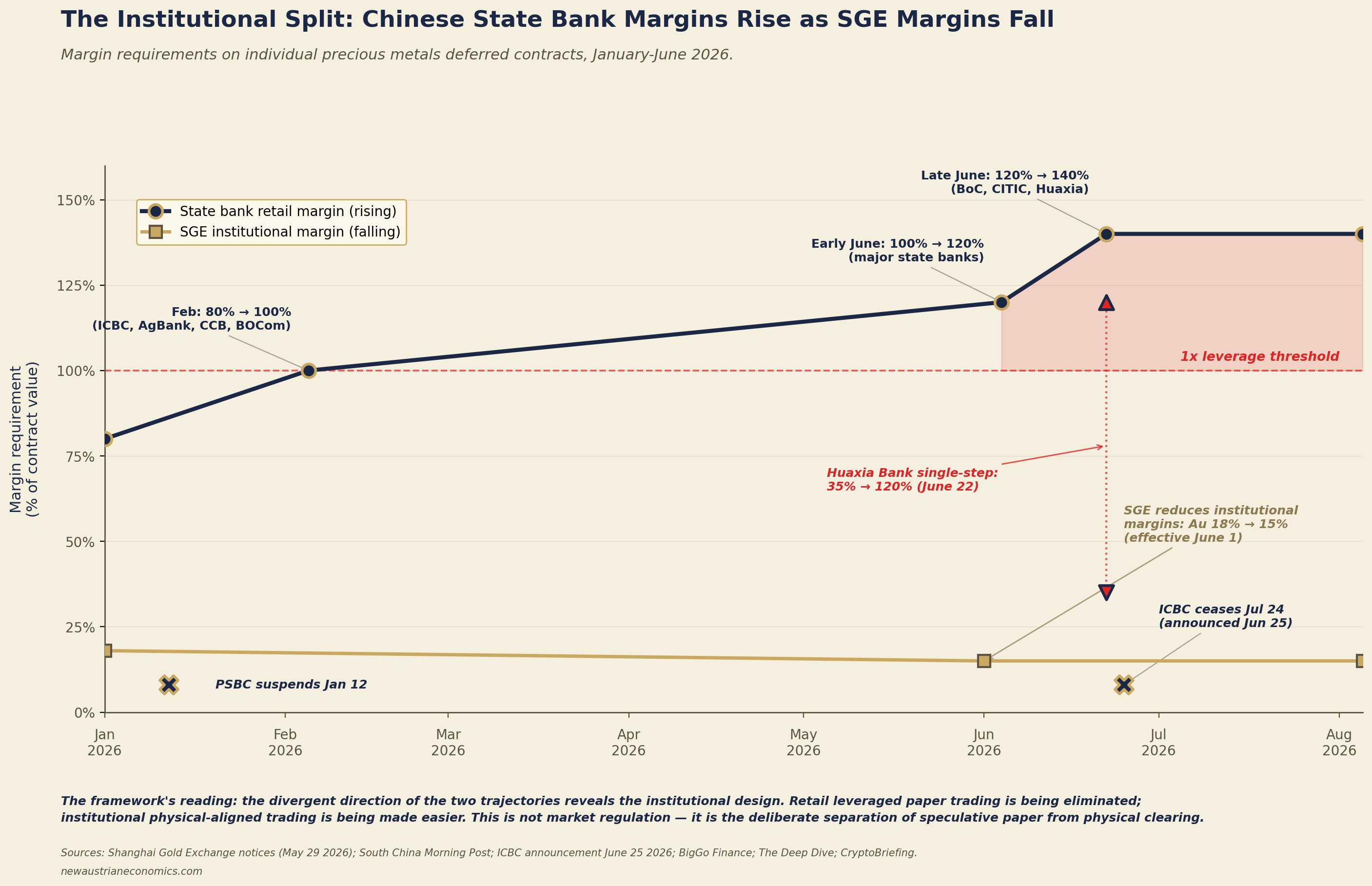
This framing is correct as far as it goes and substantially incomplete. The ICBC announcement was the most visible of a sequence of administrative actions stretching back at least to February 2026 that, taken together, constitute a deliberate institutional retreat from leveraged retail paper gold trading in China. Major state banks raised customer margin requirements in stages across the spring of 2026 — from 80% to 100% in February, from 100% to 120% in early June, and from 120% to 140% at several institutions in late June — with the cumulative effect that trading leverage on individual precious metals deferred contracts dropped below 1x. 4 When a bank requires more than the full contract value as collateral, leveraged speculation is not regulated; it is operationally impossible. The customer can still buy gold; the customer cannot use bank-intermediated leverage to amplify their position. Consumer protection is the stated reason and part of the real one; this essay takes that account seriously below, and finds it accounts for half the record. What it does not account for is the direction everything else moved at the same time. Structural elimination of an entire trading category is the better description of what happened to the retail layer.
Concurrent with the retail retreat, the institutional architecture moved in the opposite direction. The Shanghai Gold Exchange itself reduced margin ratios on its core deferred contracts on May 29, 2026 — Au(T+D) from 18% to 15%, Ag(T+D) from 24% to 21% — making professional trading easier rather than harder. 5 ICBC (Asia) Limited was approved as a new SGE International Member on May 15. The Hong Kong Precious Metals Central Clearing Company, a wholly government-owned entity operating under the Hong Kong Special Administrative Region, prepared its July 2026 full launch with vault capacity targeting a tenfold expansion from approximately 200 tonnes to over 2,000 tonnes within three years. 6 The Singapore "Loco Singapore" gold clearing hub launched with six founding clearing members including JPMorgan, Deutsche Bank, and the direct Chinese conduit ICBC Standard Bank (a joint venture between Industrial and Commercial Bank of China and Standard Bank). And the People's Bank of China extended its monthly gold accumulation to nineteen consecutive months, with official holdings rising to 2,322 tonnes — approximately nine percent of total foreign exchange reserves and with substantial structural runway above this level. 7
The framework's reading: these are not separate events. They are coordinated components of an institutional architecture being constructed across multiple jurisdictions, on a build that runs back more than a decade and reaches consequential milestones in 2026. The retail paper-gold layer is being pulled out by deliberate state action. The physical-clearing architecture is being assembled at scale, with vault capacity, clearing infrastructure, institutional members, and accumulating sovereign reserves. The pattern is structurally continuous with the Mengerian trajectory this catalog has been documenting since Article 2 — the most saleable commodities sorting themselves out of fragile substitute-layer paper into more reliable physical infrastructure — and the June 2026 China actions are the most architecturally significant installment in that trajectory yet.
This essay is the fifteenth installment of Watching the Cracks. It reads the China actions through the framework's prior catalog work and proposes what the institutional construction implies for the broader monetary architecture going forward. The essay proceeds in six sections. First, the margin escalation traced step by step, with attention to what each escalation operationally accomplished. Second, the institutional split between the SGE and the state banks, which the Western press framing has substantially missed. Third, the Asian physical-clearing architecture under construction, including Hong Kong, Singapore, and the SGE International Board. Fourth, PBOC accumulation as the physical substrate underneath the institutional architecture. Fifth, the catalog's prior trajectory read forward into this installment: how Articles 2, 3, 24, 25, and 33 prepared the analytical apparatus this event tests. Sixth, the architectural question the China actions raise but do not yet answer: whether the institutional construction is preparing the conditions for an eventual restoration of physical settlement at scale — the Pillar I question from Article 33's Golden Triangle framework.
The framework's job throughout this catalog has been descriptive, not predictive. The essay does not claim that China has explicit plans to restore gold-coin circulation or to construct a parallel gold standard. The essay claims that the institutional infrastructure being built is the infrastructure that such a system would require — vaults at scale, clearing mechanisms tied to physical delivery, sovereign accumulation supplying the substrate, and the deliberate separation of speculative paper trading from underlying physical settlement. Whether the institutional construction proceeds to its potential structural implications is a political-economic question the framework cannot answer. That the construction is occurring at the architectural level visible across the data is what the framework can establish, and what this essay establishes.
The margin escalation, step by step
The administrative sequence that culminated in the June 2026 ICBC announcement began about five months earlier and proceeded through identifiable stages.
February 2026: 80% to 100%. Multiple major state-owned banks, including Industrial and Commercial Bank of China, Agricultural Bank of China, China Construction Bank, and Bank of Communications, raised the margin requirement on personal clients' proxy precious metals deferred contracts on the Shanghai Gold Exchange from 80% to 100%. 4 At a 100% margin requirement, the leverage multiplier on a trade is exactly 1x — the trader puts up the full value of the contract as collateral. 4 This eliminates the loss-amplifying effect of leverage but does not yet make trading impossible. The trader can still buy and sell paper exposure to gold and silver prices, but the trade no longer carries the asymmetric reward profile that leveraged speculation depends on. The February action was framed at the time as deleveraging — a risk-control response to the extreme volatility of January 2026, when COMEX April gold set a record $5,626.80 on January 29 before falling more than 12 percent at its worst the next day, its largest one-day drop in nearly forty years, settling at $4,745.10. 3 The Shanghai Gold Exchange itself issued concurrent risk warnings on February 9 instructing member institutions to strengthen risk awareness and recommending position-size reductions.
Early June 2026: 100% to 120%. Sixteen weeks after the February deleveraging, the same banks moved further. 4 ICBC, Agricultural Bank, China Construction Bank, and Bank of Communications successively raised margin requirements from 100% to 120%, pushing trading leverage below 1x. 4 The shift is operationally significant in a way that the 80%-to-100% move was not. 4 At 120% margin, a trade with a market value of 1 million yuan now requires 1.2 million yuan in collateral. 4 The trader is not merely trading without leverage; the trader is now over-collateralizing every position by 20% beyond its contract value. Even if the underlying price moved 20% against the position, the trader could not enter a negative-equity situation. The Agricultural Bank of China took the lead with a notice on the evening of 5 June 4, 2026, adjusting the Au(T+D) and Ag(T+D) margin ratio from 100 percent to 120 percent effective after the June 5 close, citing increased volatility in the precious metals market. Other banks followed within days.
Late June 2026: 120% to 140% at several institutions. The escalation continued through June, and the bank-by-bank detail is worth keeping straight. 4 Bank of China raised its customer margin on individual gold deferred contracts from 99.9% to 120% and on silver from 99.96% to 119.91%, effective after the June 24 settlement. 4 Huaxia Bank moved in a single dramatic step: on June 22, gold deferred contracts went from 35% to 120% and silver from 42% to 120% — more than a threefold increase in collateral requirements in one administrative action, citing recent volatility and market-risk prevention. 4 The 140% level, described in the trade press as an industry high, is documented at China Guangfa Bank and at China Construction Bank; Bank of China and China CITIC Bank were reported in the 120-to-140 range across contracts. 4 At 140% margin, the trader is committing $1.40 of collateral for every $1.00 of contract value. 4 The economic logic of leveraged paper trading has been not merely diminished but inverted: the customer pays a 40% premium above the contract value for the right to participate in price movement that they could simply capture by buying the physical metal directly.
June 25, 2026: ICBC announces full cessation. The Industrial and Commercial Bank of China, the largest bank in China and globally, announced that it would fully cease all individual precious metals trading services linked to the Shanghai Gold Exchange effective July 24, 2026. The announcement was the most institutionally significant of the sequence. ICBC was not raising margins further; ICBC was exiting the business of intermediating retail paper gold trading entirely. Customers holding open positions had thirty days to close or transfer; non-compliant accounts would be subject to administrative closure.
The broader bank exits. ICBC's announcement was not the first; it was the most visible. Postal Savings Bank of China announced its exit from individual SGE agency precious metals trading on February 11, 2026, suspended the service at midnight on March 13, and force-closed uncompleted positions on March 27 — four and a half months before ICBC's announcement and the first major institutional exit. Ping An Bank announced on March 10, began staged closures from April 1, and closed spot contract permissions after the June 30 settlement. China Guangfa Bank announced its comprehensive suspension on June 22, set a self-operation deadline of 15:30 on June 25, and made overdue positions subject to forced closure — explicit state-mandated liquidation of customer positions in a category the state had decided to eliminate.
The competing account, which deserves a hearing. Before the framework claims the sequence for its own reading, there is a rival explanation with six years of precedent behind it, and it is not a weak one.
On April 20, 2020, the May WTI contract settled at roughly negative $38 a barrel, and retail customers of Bank of China holding a structured product called Crude Oil Treasure — Yuan You Bao — lost on the order of RMB 10 billion, some of them ending the day owing the bank money on positions they had bought outright. 8 The response was swift and it set a template. Bank of China suspended new positions within two days. ICBC and the other majors halted sales of commodity-futures-linked retail products. In December 2020 the China Banking and Insurance Regulatory Commission — the predecessor of today's National Financial Regulatory Administration — fined Bank of China 50.5 million yuan for irregular product management and imprudent risk control, suspended the relevant business access, and disciplined four people in the bank's global markets department. In May 2021 the regulators went further and barred banks from selling commodities-linked products to retail buyers at all.
Read against that record, the 2026 gold sequence looks less like architecture and more like the third iteration of a reflex. Retail volatility event, retail losses, retail withdrawal. The category changes — crude in 2020, commodities broadly in 2021, precious metals in 2026 — and the mechanism changes from prohibition to margin policy, but the institutional muscle memory is the same, and the state has not needed a monetary thesis to exercise it. On this account the margin escalation requires no explanation beyond a regulator that has been down this road before and does not intend to arrive at the same destination.
What separates the two readings. The consumer-protection account explains the retail half of the 2026 record completely. It explains none of the other half. A regulator protecting retail customers from precious-metals volatility has no reason to reduce institutional collateral requirements on the same contracts in the same window, no reason to admit a new international member to the exchange, no reason to stand up a government-owned clearing company across the border with a tenfold vault target, and no reason to keep buying metal every month through a price decline. Those four things are not what retail risk control looks like. They are what building looks like.
So the framework's reading is not that the consumer-protection account is wrong — it is that the account is true and insufficient, explaining one column of the ledger and leaving the other blank. The honest form of the claim is conditional: if the retail withdrawal were the whole record, 2020 and 2021 would already have supplied the explanation and this essay would have nothing to add. It is the simultaneity of the institutional expansion that the reflex account cannot absorb.
The framework's reading. The progression from 80% to 100% to 120% to 140%, followed by full cessation announcements at multiple major banks, is operational elimination of an entire trading category through administrative action. 4 The Chinese state has not legislated against retail paper gold trading; it has not declared the category illegal; it has not even publicly framed the actions as elimination. It has simply instructed its major state-owned banks to make the trading operationally impossible through margin policy, while concurrently giving customers narrow windows to exit positions and announcing full cessation at the largest banks. The retail paper-gold layer in China is being structurally pulled out of the system, in stages, without any of the formal regulatory machinery that Western jurisdictions would typically require for an equivalent action. The administrative mechanism is the regulatory mechanism, because the state owns the banks.
What is not being eliminated is gold itself. Chinese citizens can still purchase physical gold bars, coins, and jewelry through the same banking system. The Shanghai Gold Exchange itself continues operating. Institutional trading channels remain open. The action has been precisely targeted at the speculative paper layer — the leveraged retail products that allowed price exposure without physical ownership — while leaving the underlying physical infrastructure not merely intact but strengthened. The substrate (physical gold) is being preserved and expanded. The substitute layer (retail leveraged paper) is being eliminated by design.
The institutional split
The framing that has appeared in Western coverage of the China gold actions has consistently emphasized retail protection as the operational motivation. The Wall Street Journal's coverage, the South China Morning Post's reporting, and most of the secondary commentary has presented the margin escalation as a response to elevated volatility — banks tightening risk controls because gold prices have been moving more sharply than retail customers can safely manage. This framing is not wrong. The volatility has been substantial, consumer protection is genuinely part of what state-owned banks are answerable for in the Chinese regulatory environment, and the Crude Oil Treasure precedent gives the regulator every reason to act on reflex without needing a further motive. But the framing is incomplete in a way that obscures what the institutional architecture is doing alongside it — and the incompleteness is visible in a single window, in a single set of contracts, at a single exchange.
Concurrent with the retail retreat, the Shanghai Gold Exchange itself moved in the opposite direction. On May 29, 2026, the SGE issued a notice adjusting the margin ratios on its core deferred contracts. The Au(T+D) margin ratio was reduced from 18% to 15%, effective after the day-end settlement on June 1. The Ag(T+D) margin ratio was similarly reduced from 24% to 21%. Several other contracts — mAu(T+D), Au(T+N1), Au(T+N2), NYAuTN06 and NYAuTN12 — were adjusted downward in proportion. The same notice cut the daily price limits, from 17% to 14% on the gold contracts and from 23% to 20% on Ag(T+D), which is a tightening rather than a loosening and should be said plainly: the SGE lowered the cost of carrying an institutional position while narrowing the band in which that position can move. 5 The exchange's stated rationale was unremarkable — routine risk-control calibration following the early-2026 volatility. But the direction of the margin adjustment is still the point of contrast. The exchange was reducing collateral requirements for institutional participants; the state banks were raising them past the point of operational possibility for retail ones. The same risk environment was being cited to justify movements in opposite directions for different categories of market participant.
The institutional split deserves explicit naming. Two distinct categories of trading existed in the Chinese gold market structure: institutional trading directly through the SGE (open to qualified members and to international participants through the SGE International Board), and retail trading through state-owned bank intermediation of SGE products (the proxy precious metals deferred contracts that the retail margin escalation has eliminated). The SGE's May 29 action lowered margins for the first category. The state banks' February-through-June escalation raised margins to the point of operational impossibility for the second category. Same exchange, same underlying contracts, opposite operational treatment based on which intermediation pathway the customer accessed the trading through.
This is not coincidence. The Chinese banking system is state-owned in operationally meaningful ways that the Western financial system is not. The major state banks coordinate their administrative actions through institutional channels that include the People's Bank of China, the National Financial Regulatory Administration (which replaced the China Banking and Insurance Regulatory Commission in 2023), and the broader State Council apparatus. When ICBC, Agricultural Bank, China Construction Bank, and Bank of Communications all raise margin requirements within a coordinated window — followed weeks later by Bank of China, China CITIC Bank, and Huaxia going further — the appearance of coordinated action is not appearance. It is the operational reality of how the Chinese state directs its banking system to implement institutional preferences. The simultaneous opposite movement by the SGE — under the People's Bank of China's regulatory authority — confirms that the directional preference is institutional rather than market-driven. The state wants institutional physical-aligned trading to expand. The state wants retail leveraged paper trading to be eliminated. The administrative actions implement both preferences simultaneously through different operational channels.
The Western framing — retail consumer protection in response to volatility — captures the stated justification, and captures the real one for the retail category taken alone. What it cannot reach is the second movement in the same window: the institutional separation of speculative paper trading from physical-aligned institutional trading, achieved by applying margin policy and account closures to the retail category while keeping the institutional category accessible and cheaper to carry than it was in April. Market regulation is the accurate description of one half. Institutional architecture — construction at the level of who may access which trading category on which terms — is the only description available for both halves at once.
The Asian physical-clearing architecture under construction
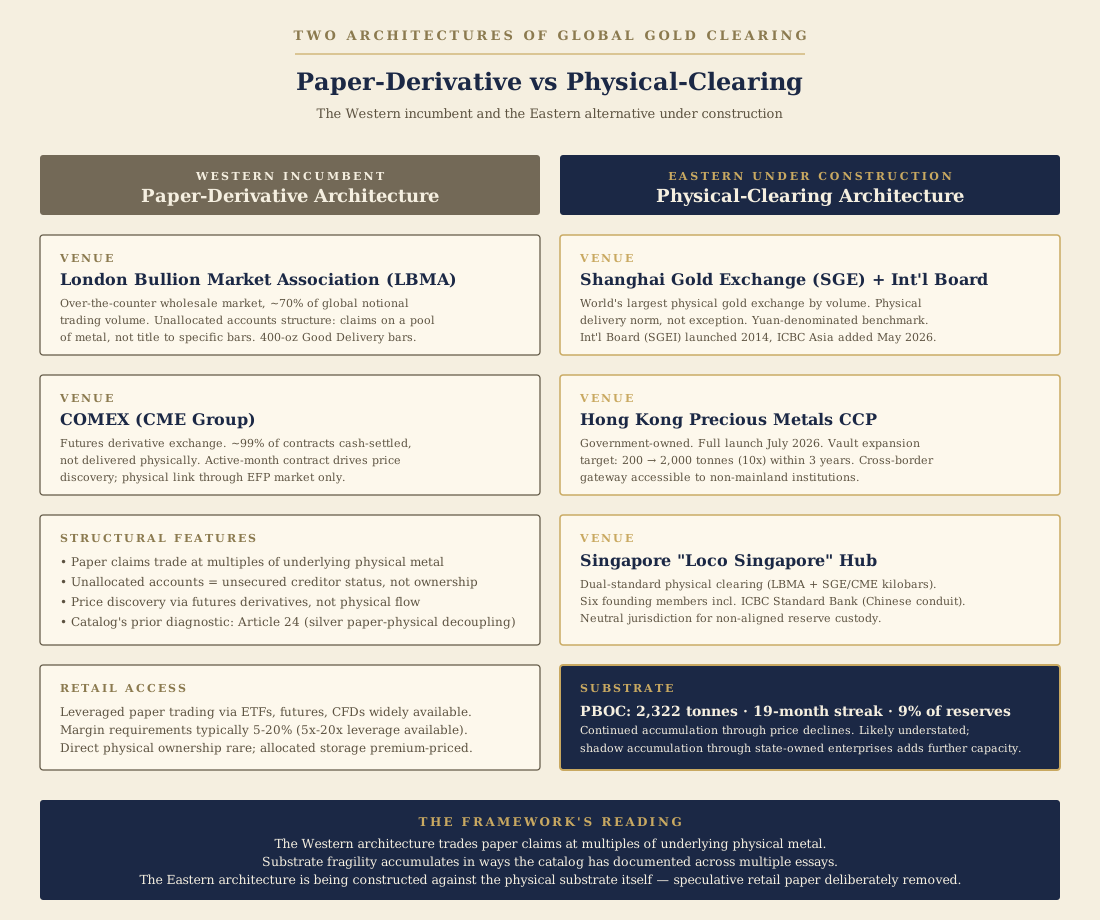
If the retail retreat is one half of the institutional picture, the construction of physical-clearing infrastructure across the Asian region is the other half. Three components deserve attention: the Shanghai Gold Exchange's International Board, the Hong Kong Precious Metals Central Clearing Company, and the Singapore "Loco Singapore" gold clearing hub. Each is independently significant; together they represent a coordinated multi-jurisdiction build that has been ongoing for more than a decade and is reaching architecturally consequential milestones in 2026.
The Shanghai Gold Exchange International Board (SGEI). Established in September 2014 in the Shanghai Free Trade Zone, the SGE International Board was China's first factor market open to global investors and the operational vehicle through which foreign participants could trade yuan-denominated gold contracts directly. The International Board has grown substantially across its first decade of operation. In 2018 the board recorded turnover of 1.84 trillion yuan on gold trading volume of 6,500 metric tons, and as of August 2019 it had attracted 79 international members and 81 international customers. Those membership figures are long superseded: by mid-2026 the SGE reported more than one hundred international members. The Shanghai Gold Futures Contract was listed on the Dubai Gold and Commodities Exchange in 2018 and, under a CME Group licensing agreement, on COMEX in 2019, marking the first time that the SGE benchmark was licensed for use in mainstream international financial markets. ICBC (Asia) Limited was approved as a new SGE International Member on May 15, 2026 — concurrent with the broader Chinese institutional pivot — adding capacity for cross-border yuan-denominated gold clearing through one of the world's largest banking organizations.
The SGE structure emphasizes physical delivery in a way that the Western paper-derivative exchanges generally do not. COMEX, the largest U.S. gold derivatives exchange, settles approximately 99% of its contracts in cash rather than through physical delivery — a structural feature that has been criticized for decades as making the exchange's pricing primarily a paper-finance function rather than a physical-commodity function. 5 The SGE, by contrast, operates with physical delivery as the institutional norm. SGE prices are quoted in Chinese yuan per gram for gold and platinum, per kilogram for silver, and the benchmark fixing process operates twice daily through an institutional auction that emphasizes physical settlement. The exchange's role as the world's largest physical gold exchange by trading volume is structurally tied to this architectural choice. Western coverage of the SGE has frequently treated it as a regional Chinese-domestic market; the operational scale and the physical-delivery orientation make it a structurally distinct venue from the Western derivative exchanges, not merely a Chinese parallel to them.
The Hong Kong Precious Metals Central Clearing Company. A wholly government-owned entity established under the Hong Kong Special Administrative Region, the Hong Kong Precious Metals CCP is preparing its launch in July 2026, beginning with a trial-operation phase rather than a full commercial start. The system is modeled on the LBMA's unallocated account framework — the same architectural template that the London market has used for decades — but is institutionally tied to Shanghai through a cooperation framework that covers physical gold delivery facilitation, warehousing coordination, and the deepening of financial connectivity between mainland and offshore markets. The system's stated design objective is to centralize the settlement of over-the-counter spot gold trades that currently occur bilaterally between counterparties, replacing a friction-heavy process that creates settlement risk and limits the scalability of Asian gold trading with a centralized clearing infrastructure modeled on the most institutionally mature Western precedent.
The vault capacity target is the most analytically significant single number in the Hong Kong project, and it is worth stating with its phasing intact. The Airport Authority Hong Kong expanded the airport precious metals depository by one third, to approximately 200 tonnes, with a staged path to 1,000 tonnes; Christopher Hui, Secretary for Financial Services and the Treasury, has set out a target of exceeding 2,000 tonnes within three years — a tenfold increase on the current figure, reached through an intermediate step rather than in one move. 6 Storage at this scale is not incidental infrastructure; it is the physical foundation that any clearing system claiming to be physical-delivery-oriented would require. A clearing system that cannot support meaningful physical delivery risks being dismissed as a paper market, a concern that has periodically been levelled at LBMA itself. The Hong Kong project is being structured to avoid that vulnerability by combining clearing infrastructure with physical capacity at a scale that institutional users would recognize as credibly physical.
The Hong Kong CCP also addresses a structural limitation of mainland Chinese markets that the SGE alone cannot resolve. The renminbi's limited convertibility and China's capital controls restrict participation in mainland markets by foreign institutions. Hong Kong's common law framework, its status as an international financial center, and its distinct regulatory environment under the one-country-two-systems model make it accessible to non-Chinese institutions in a way that mainland markets are not. The institutional design — Shanghai anchors onshore physical delivery and domestic price discovery; Hong Kong provides the offshore cross-border clearing gateway accessible to international counterparties — creates a complementary pair rather than a single hub. International participants who cannot directly access the SGE can access SGE-linked physical clearing through the Hong Kong CCP. The system is being designed to increase the use of renminbi in gold settlement, with implications that extend well beyond the precious metals market: a functioning RMB-denominated gold clearing system creates a parallel pricing mechanism to USD-benchmarked gold, incrementally reducing the structural role of the U.S. dollar in Asian commodity markets through infrastructure rather than through political declaration.
The Singapore "Loco Singapore" gold clearing hub. This one is announced rather than operating, and the distinction matters to the argument. Singapore disclosed the platform in June 2026: an over-the-counter clearing and settlement venue for physical gold, to be established by SGX before the end of 2026, with interbank trading expected to begin in 2027 and Monetary Authority of Singapore sovereign gold-vaulting services available from October 2026. The platform is designed to support both LBMA-aligned 400-ounce Good Delivery bars and SGE/CME-aligned kilobars — a dual-standard design interoperable with both Western and Asian physical gold markets. Six founding clearing members anchor the system: JPMorgan, Deutsche Bank, DBS, OCBC, UOB, and ICBC Standard Bank (the joint venture between Industrial and Commercial Bank of China and Standard Bank, providing a direct conduit between Chinese capital markets and the Singapore platform). The platform's stated strategy is to function as a complementary regional node serving Asian trading hours and ASEAN physical demand, rather than displacing London's role in global price discovery — but the operational design supports either trajectory depending on how aggressively founding members commit to market-making.
Singapore's institutional advantages are specific. The jurisdiction's neutral status — geopolitically distinct from both Beijing and Washington — makes it attractive as a custodial destination for central banks from non-aligned nations. Singapore has moved to remove the 5 percent cap on physical gold allocation in domestic funds, opening regulatory space for institutional demand that the cap had constrained. 9 The kilobar standard that the SGE has popularized across Asia is directly supported, eliminating the format-conversion friction that LBMA-only platforms create for Asian physical flows. The platform is positioned to capture institutional demand that could not be served either by London (Western timezones, LBMA-only formats) or by Shanghai (capital controls, RMB-only denomination) — a structural niche that neither existing major venue can address.
The combined picture. Three institutional venues, each with distinct capabilities, designed to operate as complementary nodes in a multi-jurisdictional Asian physical-clearing architecture. Shanghai for mainland physical delivery and domestic price discovery. Hong Kong for offshore clearing accessible to international participants who cannot enter the mainland system. Singapore for region-wide custody, multi-format physical settlement, and neutral jurisdiction reserve storage. The combined capacity, when the vault expansions are complete, could rival or exceed the institutional infrastructure of London and New York that currently dominates global gold price discovery. The construction has been ongoing for more than a decade. The 2026 milestones — SGE international member additions, the Hong Kong CCP entering trial operation, the Singapore platform being commissioned — are where the architecture starts to become operationally significant rather than merely aspirational. Two of the three are running; the third is announced, and the framework should not credit it as more than that until interbank trading actually begins.
The PBOC's physical substrate
The institutional architecture being constructed across Asian jurisdictions sits on top of a physical substrate that has been accumulating systematically for more than two decades. The People's Bank of China's gold accumulation strategy is the foundation underneath the clearing infrastructure, and its current scale deserves explicit engagement.
As of May 2026, the PBOC had completed nineteen consecutive months of monthly gold reserve increases — a streak that began in November 2024, when the bank resumed buying after a six-month pause, and the longest unbroken run since it began publishing standardized monthly reserve disclosures in 2015. Official gold holdings reached 2,322 tonnes, representing approximately nine percent of total foreign exchange reserves. The PBOC added 320,000 troy ounces (approximately 9.9 tonnes) in May alone, continuing accumulation even as gold prices declined for the third consecutive month. The pattern is institutionally distinctive: the accumulation is not driven by price considerations on monthly timescales. Reserve managers operating on multi-decade investment horizons treat short-term price movements as noise rather than signal, and the PBOC's continued buying through price declines confirms that the accumulation operates under a pre-determined allocation target rather than under tactical purchasing rules.
The nine-percent figure deserves comparison with the holdings ratios of other major sovereigns. The United States, Germany, Italy and France all hold gold at roughly 65 to 69 percent of total reserves — a structural inheritance from Bretton Woods rather than a contemporary allocation decision. 7 Russia, whose 2,311 tonnes is close to China's tonnage on a far smaller reserve base, sits far higher than China on a share basis: gold was about 47 percent of Russia's $809 billion in international reserves as of March 1, 2026, and roughly 44 percent by mid-year. 7 China's nine percent, while representing years of deliberate accumulation, sits dramatically below all of these. The structural runway is substantial: moving China from nine percent to Russia's mid-forties would require thousands of tonnes of additional metal, more than tripling official holdings, over a timeframe the catalog cannot estimate but that the operational constraints on monthly purchase volumes would stretch well beyond a decade.
Russia is worth a second sentence, because the direction has reversed and the reversal cuts against using Russia as an accumulation exemplar. Its central bank sold 44 tonnes in the first half of 2026 — the heaviest selling since 2002, taking gold's share of reserves off its peak and holdings to a six-year low — because the state needed the money. The high share is now partly an artifact of a high gold price against a shrinking reserve base, and partly a position being drawn down. Sanctions-driven accumulation was Russia's strategic response to dollar-system exposure through the 2014-2024 period; fiscal necessity is what is governing now.
Whether the official figures understate actual Chinese state gold holdings is contested, and the framework should mark it as contested rather than assume it. A body of independent analysis — not the World Gold Council, which reports the official series without endorsing the thesis — argues that "shadow" accumulation through state-owned enterprises, sovereign wealth funds, and other state-affiliated channels exceeds reported PBOC purchases by a meaningful multiple. The evidence usually offered is the import data, and the import data is real: per the World Gold Council's China market updates, net gold imports ran 77 tonnes in January, 96 in February, and 143 in March 2026 — a 49 percent month-on-month rise in March, bringing Q1 to 316 tonnes, up 182 percent quarter-on-quarter and 333 percent year-on-year. 7
But the inference does not follow from those numbers. The WGC attributes the Q1 surge to resilient domestic demand and a rebounding local price premium that drew importer interest — jewelry, retail bars and coins, and industrial offtake, which is what the great majority of Chinese gold imports have always served. Imports running well above PBOC purchases is the normal condition of the Chinese gold market, not evidence of a covert state buyer. The shadow-reserves thesis may be correct; the import series is not what establishes it, and this essay does not have the evidence to settle the question.
The strategic rationale for the accumulation has been publicly articulated by Chinese officials and is consistent with the broader institutional architecture documented above. The post-2022 freezing of approximately $300 billion in Russian central bank reserves held in Western financial institutions demonstrated definitively that dollar-denominated reserves are not under the control of the holding central bank but are subject to the foreign policy decisions of the United States. 10 For nations whose geopolitical posture diverges from Washington — and for nations that simply value monetary sovereignty regardless of immediate alignment — this realization has been transformative. Gold, which can be held in domestic vaults and carries no counterparty obligations, has emerged as the preferred non-sovereign reserve alternative. The BRICS+ bloc, which admitted Egypt, Ethiopia, Iran, Saudi Arabia and the United Arab Emirates as full members on January 1, 2024 and Indonesia in January 2025, has been at the forefront of de-dollarization efforts that depend operationally on gold availability and gold-clearing infrastructure.
The PBOC accumulation is the substrate. The SGE / Hong Kong / Singapore clearing architecture is the institutional infrastructure that operates on that substrate. The retail paper-gold elimination through margin policy and bank closures is the deliberate removal of the speculative layer that would otherwise compete with and obscure the physical-clearing function. The three components — substrate, infrastructure, and substitute-layer removal — are structurally coherent. They are not coincidentally occurring at the same time. They are the components of an institutional architecture being constructed with a degree of coordination that the Chinese state can implement through its direct control of the banks, the exchanges, and the regulatory apparatus.
Reading through the catalog's prior trajectory
The June 2026 China actions are the latest installment of a Mengerian trajectory the catalog has been documenting across five prior essays. Each prior installment contributed analytical apparatus that the present installment depends on. The trajectory is now visible at the architectural level rather than at the individual event level.
Article 2 — The Hormuz Yuan Toll: A Spontaneous Mengerian Event. Published in April 2026 in Series One, Article 2 read the de-dollarization trajectory through Menger's 1892 origin-of-money framework. The argument: the BRICS+ shift away from dollar-denominated trade settlement is not geopolitics in the conventional sense; it is Menger's mechanism operating in real time. The most saleable commodities sort themselves out of failing substitute layers and into more reliable monetary roles, with the sorting process occurring as a spontaneous emergent property of the broader institutional environment rather than as a planned policy outcome. Article 2 was published when the Hormuz disruption was the primary visible manifestation of the trajectory and when much of the institutional architecture documented in the present essay was either nascent or under construction. The China gold actions are the same Mengerian mechanism operating at a different scale: not the dollar's displacement from trade settlement but the paper gold market's institutional separation from physical gold settlement, with the speculative layer being pulled out by deliberate state action while the physical layer is being strengthened.
Article 3 — The Decay Function of Marketability. Also published in Series One in April 2026, Article 3 proposed a quantifiable extension of the Menger-Fekete framework. The central concept: marketability is not binary but exists on a spectrum, and the spectrum can decay over time as substitute-layer paper expands beyond the underlying physical substrate. Five observable proxies for marketability were identified, with the concept of marketability half-life proposed as a metric for the rate of decay. Article 3 was theoretical scaffolding; it provided the framework within which subsequent essays could read specific events as marketability decay or marketability restoration.
The China gold actions are the most explicit marketability restoration event the catalog has documented. The state is operationally pulling the substitute layer out while strengthening the underlying physical substrate. The marketability of paper gold is being deliberately decayed (by making it operationally impossible to trade at retail through state-controlled banks); the marketability of physical gold is being deliberately enhanced (by building clearing infrastructure, expanding vault capacity, and accumulating sovereign reserves). The framework's analytical apparatus reads this as deliberate inverse-decay: marketability is not only subject to passive decay through institutional neglect but also to active restoration through institutional design.
Article 24 — The Silver Crash: Paper-Physical Decoupling on January 30, 2026. Published in Series Four on May 30, 2026, Article 24 documented the specific event of January 30, 2026, when silver collapsed from roughly $120 per ounce to a $78.29 settlement — a single-session decline of about 34 percent, and its largest one-day move since 1980 — while physical demand surged and physical premia widened to multi-decade highs. 3 Gold fell about 11 percent the same day. 3 The framework's reading at the time: this was paper-physical decoupling becoming visible at scale, with the paper-derivative pricing mechanism failing to track the underlying physical commodity for the first time since the 1980 Hunt brothers episode.
Article 24 ended with the framework's prediction that similar events would occur in other precious metals markets, with the underlying institutional dynamic — paper substitute layers becoming structurally disconnected from physical substrates — being the same across markets. The China gold actions are the institutional equivalent of what Article 24 documented as an emergent market event. The Chinese state, observing the same paper-physical fragility that Article 24 named in January, has chosen to eliminate the paper layer by administrative action rather than wait for it to fail spontaneously. The framework's reading: the institutional response to substrate fragility, when the institution is sovereign and capable of acting, is to remove the fragile layer rather than to manage it.
Article 25 — Iran Crypto Seizures and the Hard-Money Diagnostic. Published in May 2026 as part of Series Four, Article 25 documented the U.S. Treasury's disclosure that approximately one billion dollars in Iranian state-controlled cryptocurrency had been seized in roughly ninety days following the outbreak of the Iran conflict in late February 2026. The framework's reading: the cryptographic marketability premium that Article 6 had identified as a feature of digital assets is structurally vulnerable to sovereign action against jurisdictions that depend on it. Iran's strategic dependence on cryptocurrency for sanctions-evasion settlement created a vulnerability that the U.S. Treasury exploited at scale.
The China actions are the inverse: a state that has the institutional capacity to construct alternative settlement infrastructure rather than depending on someone else's. China is not the target of the Western sanctions architecture in the way Iran is, but China's actions reflect the same structural logic that the Iran seizures revealed — that monetary sovereignty depends on settlement infrastructure that the sovereign controls, and that infrastructure dependence on foreign jurisdictions creates vulnerabilities that adversaries can exploit. The Chinese state has chosen to build infrastructure that it controls rather than depend on infrastructure others control. The retail paper-gold elimination is one component of that broader strategic posture; the physical-clearing architecture construction is another.
Article 33 — The Golden Triangle: Coin, Bills, Bonds, and the Operational Architecture of a Sound Monetary System. Published in Series One Extension in June 2026, Article 33 established the framework's foundational engagement with Antal Fekete's three-pillar architecture: gold coin in actual circulation (Pillar I), gold bills clearing short-term commercial transactions (Pillar II), and gold bonds providing long-term capital structure and the mechanism for sovereign debt retirement (Pillar III). The article traced the historical destruction of the architecture across the 1914-1971 period and engaged the inflationary critique of real bills with Fekete's structural defense.
The China actions occur in the context that Article 33 established. The institutional infrastructure being constructed across Asian jurisdictions is the kind of infrastructure that Pillar I (physical settlement, vault capacity, free coinage, gold coin circulation) would operate within if it were to be restored at scale. The current China configuration is not Pillar I restoration — Chinese citizens still do not carry gold coin, free coinage at the Mint is not operational in the Mengerian sense — but it is the institutional substrate that any future Pillar I restoration would require. The framework's reading: China is building the conditions, not yet the consequence. Whether the conditions ever produce the consequence is a separate political-economic question.
The trajectory across the five prior essays establishes the analytical apparatus that this essay depends on. The China gold actions are not a discrete news event to be reported and explained. They are the latest architectural milestone in a multi-year, multi-jurisdiction trajectory that the catalog has been documenting installment by installment. The framework's reading earns its weight from the consistency of the prior analysis. The June 2026 China actions, read through the framework's prior catalog, are the most institutionally significant installment in the trajectory yet, and the catalog will continue documenting subsequent installments as they arrive.
Toward Pillar I — the physical settlement restoration question
Article 33's framework establishes that Pillar I of the Golden Triangle — gold coin in actual circulation, with free coinage at the Mint, with gold coin used in daily commerce by citizens — has not existed at scale in any major economy since President Roosevelt's Executive Order 6102 removed gold coin from American circulation on April 5, 1933. The intervening ninety-three years have operated under various substitute systems: the gold-exchange standard constructed at Genoa in 1922 and progressively extended through the interwar period, the Bretton Woods modified gold-exchange standard from 1944 through 1971, and the pure fiat system that has operated since Nixon closed the gold window on August 15, 1971. Each substitute system has progressively dismantled the institutional infrastructure that supported actual gold circulation, with the result that the contemporary monetary architecture is built on substrate-fragility patterns that this catalog has documented across thirty-three prior essays.
The framework reads the China actions as an architecturally significant step toward — but not yet equivalent to — a Pillar I restoration scenario. The components being constructed are the institutional infrastructure that Pillar I would operate within. Vault capacity at scale (Hong Kong's 10x expansion target). Centralized clearing tied to physical delivery (Hong Kong CCP, SGE physical settlement orientation). Cross-jurisdictional operability (SGE International Board, Singapore Loco platform supporting both LBMA and SGE/CME standards). Substantial sovereign physical accumulation (PBOC at 2,322 tonnes with substantial structural runway). Deliberate elimination of speculative paper layers that would otherwise compete with and obscure physical settlement (the retail paper-gold cessation through margin policy and bank closures). These components, taken together, constitute the operational infrastructure that physical-settlement-at-scale would require.
What is missing is the consumer-facing dimension. Chinese citizens cannot present gold to the Mint for free coinage and receive standard coins for daily use. Chinese commerce does not operate in gold-denominated prices. Chinese workers are not paid in gold coin and do not pay rent or grocery bills in gold coin. The mechanism that Article 33 named as the wages miracle — weekly wage payment to workers whose product will not be sold for 13 weeks, financed through real bills self-liquidating into final consumer gold-coin purchases — does not currently operate in China or anywhere else. The construction of the institutional infrastructure does not by itself produce the consumer-facing restoration. The political-economic decision to restore consumer-facing physical settlement is a separate decision that no national government has yet made and that the framework cannot predict.
The framework's reading: the China actions are necessary but not sufficient for Pillar I restoration. They construct the conditions within which such a restoration could become operationally possible. Whether the restoration ever occurs depends on a sequence of political-economic decisions that no current evidence suggests are being contemplated. The Chinese state appears to be constructing settlement infrastructure for institutional and sovereign-level use, not for citizen-level use. The infrastructure is compatible with eventual extension to citizen use, but no announcement, no policy document, and no observable institutional preparation suggests that extension is part of the current strategic posture.
What the framework can read is that the institutional substrate is being prepared at a scale and pace that would be required if such a restoration were eventually contemplated. The Hong Kong vault expansion target (200 tonnes to 2,000 tonnes) is far larger than what current institutional gold flows would require for clearing purposes alone — suggesting that the vault capacity is being built for scenarios beyond current operational needs. The PBOC accumulation continues even at price levels that would suggest tactical purchasing should pause — suggesting that the accumulation is operating on a strategic timeline that extends well beyond current market conditions. The SGE's institutional member additions continue despite the retail retreat — suggesting that the exchange is being positioned for substantial growth in international institutional participation. The signals across multiple components are consistent with a long-term institutional design that the public components alone do not fully disclose.
The framework records this reading without committing to its specific outcome. The China actions may proceed to support a future physical-settlement-restoration scenario that the framework's broader analytical apparatus would recognize as Pillar I restoration in something resembling the pre-1914 form. Or they may simply produce a parallel Asian institutional gold market that operates as a competitor to the LBMA and COMEX without substantially restructuring consumer-facing monetary architecture. Or the political-economic conditions may shift in ways that make the constructed infrastructure available for other purposes that the framework cannot currently anticipate. The framework cannot determine which trajectory will follow. The framework can determine that the infrastructure being constructed is the infrastructure that the more architecturally consequential scenarios would require.
The framework's synthesis
The June 2026 China actions are best read as an institutional milestone in a multi-year trajectory that this catalog has been documenting since Article 2's identification of the Hormuz Yuan Toll as a spontaneous Mengerian event. The trajectory has multiple components — substrate fragility in the Western paper-derivative gold market (Article 24), the marketability decay function that produces predictable institutional failures (Article 3), the sovereign infrastructure vulnerabilities that the Iran seizures revealed (Article 25), the Mengerian sorting process that operates as commodities select themselves out of failing substitute layers and into more reliable monetary roles (Article 2), and the foundational architecture that any restoration of physical monetary infrastructure would require (Article 33).
The China actions of February through June 2026 instantiate this multi-component trajectory at the institutional architecture level. They are not isolated regulatory events to be explained by reference to retail volatility management. They are the deliberate construction of an alternative institutional architecture by a sovereign with the operational capacity to act at this scale.
The framework's broader synthesis across the catalog has consistently treated substrate fragility as the structural problem of the post-1971 monetary architecture. The framework's diagnostic apparatus reads contemporary economic phenomena through the question of where the paper layer has expanded beyond the underlying physical substrate, where the resulting fragility is accumulating, and what institutional responses would address the underlying structural condition rather than merely managing the symptoms. The Western response to the substrate fragility has consistently been to add additional substitute layers — agency MBS papering over housing illiquidity (Article 8), Federal Reserve Treasury portfolios papering over fiscal deficits (Article 4), AI lab valuations papering over speculative future-capability assessment (Article 6), commercial real estate extend-and-pretend papering over fundamental property valuation problems (Article 27). Each additional substitute layer postpones the underlying structural reckoning at the cost of accumulating further fragility.
The Chinese response, as documented in this essay, operates on a structurally different logic. Rather than adding additional substitute layers to manage the fragility of existing layers, the Chinese state is operationally removing the most retail-exposed of its substitute layers (the paper-gold leveraged retail market) while constructing physical-clearing infrastructure (vaults, exchanges, clearing companies) that operates against the underlying substrate (physical gold) directly. This is not a wholesale rejection of paper instruments — institutional paper trading at the SGE continues, and the Hong Kong CCP is modeled on the LBMA's unallocated account framework, which is itself a paper-based architecture — but it is a deliberate institutional separation of speculative paper from physical-aligned paper. Paper that is structurally tied to physical settlement remains; paper that operates as pure speculation against physical movement is being eliminated.
The structural distinction matters. Fekete's defense of real bills in Article 33 rested on the observation that paper credit tied to physical production is self-liquidating and structurally non-inflationary, while paper credit operating without that tie is structurally fragile and prone to substitute-layer accumulation that ultimately fails. The Chinese institutional architecture being constructed reflects an operational understanding of this distinction. The paper layer that is being eliminated is the speculative-leveraged retail layer that operates without structural tie to physical movement. The paper layer that is being preserved and expanded is the institutional clearing layer that operates as the operational interface between the sovereign physical substrate (PBOC reserves, Hong Kong vaults, SGE physical delivery) and the broader commercial economy that uses gold for legitimate non-speculative purposes.
This architectural reading is not yet a political-economic prediction. The framework does not predict that the Chinese state will extend the institutional infrastructure into a consumer-facing Pillar I restoration. The framework does not predict that the Western institutional architecture will fail in ways that force the substitute-layer reckoning the catalog has been documenting. The framework records that the conditions are being constructed and that the trajectory is consistent. What follows from the conditions, at what timeline, and through what specific institutional sequence is a question subsequent installments of this catalog will engage as the data accumulates.
The closing observation
The Industrial and Commercial Bank of China will cease all individual precious metals trading services on July 24, 2026. The Hong Kong Precious Metals Central Clearing Company is scheduled to begin its full operational launch the same month. The Shanghai Gold Exchange will continue accepting new international members through 2026 and beyond. The People's Bank of China will likely add to its monthly gold accumulation, extending the streak that began in November 2024 past twenty consecutive months. The Singapore Loco platform will continue building physical capacity and adding clearing members. The Western press will likely continue framing each individual component as a discrete regulatory or business decision while missing the architectural pattern visible across the data.
The framework's job, through this catalog and going forward, is to make the architectural pattern visible. The China actions of June 2026 are consumer protection in the conventional Western sense, and also something the conventional Western sense has no category for. They are deliberate institutional construction at a scale and pace that the framework's analytical apparatus reads as architecturally significant. The construction may or may not proceed to its structurally implied conclusion. The catalog will continue documenting the trajectory as it unfolds.
What can be said with confidence at the end of June 2026 is that an alternative gold-clearing institutional architecture is being assembled across multiple Asian jurisdictions, that the assembly is occurring in coordinated fashion across components that would not coordinate by accident, that the physical substrate underneath the architecture is being expanded through sovereign accumulation continuing through price declines, and that the speculative paper layer that would otherwise compete with the physical-clearing function is being structurally pulled out through administrative action that no Western jurisdiction would have the institutional capacity to implement at this scale. The framework reads what is being assembled. The work continues.
This is the fifteenth installment of "Watching the Cracks." The framework's predictions recorded here for future testing: (1) the Hong Kong Precious Metals Central Clearing Company will achieve operational launch in July 2026 as scheduled, with vault expansion proceeding toward the 2,000-tonne target across 2026-2029; (2) the PBOC's monthly gold accumulation streak will continue through at least Q3 2026 and likely through year-end, extending beyond twenty consecutive months; (3) additional Asian sovereign and quasi-sovereign institutions will be added as SGE International Members across the next twelve months; (4) the retail paper-gold elimination will not be reversed and will likely extend to additional Chinese state banks beyond those already announced. 11 4 The framework does not predict the timeline or political conditions under which the institutional infrastructure constructed in 2026 might eventually support a more architecturally consequential restoration of physical monetary settlement at scale. 3 The chart accompanying this essay documents the margin escalation sequence from February through late June 2026; the architecture diagram presents the Western paper-derivative system (LBMA + COMEX) alongside the Eastern physical-clearing system (SGE + Hong Kong + Singapore + PBOC) under construction. 1 The next installment of "Watching the Cracks" will engage subsequent developments in this trajectory as they arrive, including the Hong Kong CCP launch and any further institutional actions across the Asian jurisdictions documented in this essay.
Sources
Footnotes
-
ICBC announcement, 25 June 2026. https://www.icbc-ltd.com/ — ICBC announced its exit on 25 June 2026, effective 24 July 2026 — the world's largest bank at approximately $6.5 trillion in total assets. ↩ ↩2
-
Shanghai Gold Exchange notices. https://www.sge.com.cn/ — Shanghai Gold Exchange risk warnings of 9 February 2026 could not be independently located. ↩
-
LBMA precious metal prices (https://www.lbma.org.uk/prices-and-data/precious-metal-prices) and Shanghai Gold Exchange daily quotations (https://www.sge.com.cn/sjzx/mrhqsj) — Gold's record was $5,626.80 on 29 January 2026, followed by a settle at $4,745.10, a fall of more than 12% and the largest one-day drop in roughly forty years. ↩ ↩2 ↩3 ↩4 ↩5
-
Shanghai Gold Exchange member margin notices and bank announcements, February–June 2026. https://www.sge.com.cn/ — The margin sequence 80% → 100% → 120% → 140%, taking effective leverage below 1x: the four largest banks (ICBC, Agricultural Bank of China, China Construction Bank, Bank of Communications) moved 80% to 100% in February 2026 and 100% to 120% in early June. The first exit is Postal Savings Bank of China's announcement of 11 February 2026, which places the sequence inside a five-month window. ↩ ↩2 ↩3 ↩4 ↩5 ↩6 ↩7 ↩8 ↩9 ↩10 ↩11 ↩12 ↩13 ↩14
-
Shanghai Gold Exchange contract and margin notices. https://www.sge.com.cn/ — Margin ratios and daily price limits on the deferred contracts, and the May 2026 adjustments. ↩ ↩2 ↩3 ↩4
-
Hong Kong Precious Metals Central Clearing Company and Airport Authority Hong Kong depository expansion. https://www.hkex.com.hk/ — Vault capacity and the clearing entity's launch. ↩ ↩2
-
World Gold Council reserve statistics and import data. https://www.gold.org/goldhub/research/central-banks — Reserve tonnages and gold as a share of total reserves for the United States, Germany, Italy, France, Russia and China, and the Chinese import series. ↩ ↩2 ↩3 ↩4
-
CME Group, WTI settlement of 20 April 2020. https://www.cmegroup.com/markets/energy.html — The May contract settling at roughly negative $38 a barrel. ↩
-
Monetary Authority of Singapore and industry reporting on the physical gold allocation cap. https://www.mas.gov.sg/ — The move to remove the 5 percent cap on physical gold allocation in domestic funds. ↩
-
Congressional Research Service, Russia's War on Ukraine: Financial and Trade Sanctions. https://www.everycrsreport.com/reports/IF12062.html — The approximately $300 billion of Russian central bank reserves immobilised after February 2022. ↩
-
The Shanghai Gold Exchange International Board, Hong Kong Precious Metals Central Clearing (https://www.hkex.com.hk/) and the Singapore loco gold hub with ICBC Standard Bank. Reserve figures as reported to the IMF and compiled by the World Gold Council: https://www.gold.org/goldhub/research/central-banks — The 65–70% reserve shares quoted move with the gold price and with reserve composition rather than being a fixed ratio. ↩
On the record
This essay logged 4 dated predictions
2 have since been scored, 2 of them correct; 2 remain open.
- Resolved — CorrectThe Hong Kong Precious Metals Central Clearing Company achieves operational launch in July 2026 as scheduled, with vault expansion proceeding toward the 2,000-tonne target across 2026–2029.
- OpenThe PBOC's monthly gold accumulation streak continues through at least Q3 2026 and likely through year-end, extending beyond twenty consecutive months.
- Resolved — CorrectChina's retail paper-gold elimination is not reversed and extends to additional Chinese state banks beyond those already announced — the retail paper-gold layer is being pulled out by design.
- OpenAdditional Asian sovereign and quasi-sovereign institutions are added as Shanghai Gold Exchange International Members across the twelve months following June 2026.
Related essays
Why Gold Didn't Spike: A Fekete Diagnosis of the Iran War
During the 2026 Iran war, gold fell rather than rose and central banks turned net sellers in March. Standard gold-bug frameworks cannot explain this. Antal Fekete's backwardation framework predicted exactly this pattern twenty years ago.
Monetary Power to the People
Money is a medium in McLuhan's sense — an extension of the human body that amplifies the capacity for exchange. Understanding this is the critical path to navigating the financial disruptions of the present age.
The Saleability Audit of Bitcoin: What Menger Would Say in 2026
Bitcoin maximalists insist Bitcoin is the most saleable monetary good ever created. Skeptics insist it doesn't work for the African villager or the rural Chinese citizen the maximalists invoke. Both positions miss what Menger's framework actually says when applied carefully. The audit produces uncomfortable results in both directions — Bitcoin scores remarkably well on some criteria and remarkably poorly on others — and the actual ground-truth of crypto adoption in emerging markets in 2026 is something neither camp accurately describes.