
Researched and drafted with AI assistance · reviewed and edited by Jason D. Keys
At 2:00 p.m. Eastern Time on Wednesday, June 17, 2026, the Federal Open Market Committee released its postmeeting statement following the conclusion of Federal Reserve Chair Kevin Warsh's first scheduled meeting as the institution's seventeenth chair — confirmed by the Senate 54-45 on May 13, 2026 and sworn in on May 22. 1 The statement was 130 words. The Committee voted 12-0 to hold the federal funds rate target range at 3.50-3.75%, where it has stood since the December 2025 rate cut concluded the prior easing cycle. 2 Seventeen of eighteen participants in the Summary of Economic Projections judged the risks to their inflation forecasts to be tilted to the upside; one judged balanced risks; zero saw downside risk. 3 The median projection for the year-end 2026 federal funds rate moved from 3.4% in the March SEP to 3.8% in June — flipping the committee's implied policy path from one expected cut to one expected hike. 4 Warsh himself declined to submit a personal projection to the dot plot, an unprecedented choice for a sitting Chair.
At the press conference half an hour later, Warsh announced five task forces to review Federal Reserve operations: communications, balance sheet policy, use of existing data sources, productivity and jobs, and — most consequentially for the framework's broader analytical project — the Fed's inflation framework. Their common charge, in Warsh's words, is to "start with first principles, ask hard questions, examine current practice, consider alternatives, and ultimately propose next steps for policymaker consideration."
Each of these institutional choices deserves careful framework reading. Taken together, they constitute the most substantial single-meeting restructuring of the Federal Reserve's communication regime since the regime itself began in February 1994. 5 This essay argues that the restructuring is not merely cosmetic, not merely the new Chair establishing his preferences in public, and not merely a political-economy stress test arriving under the Warsh transition. The restructuring is two coherent structural moves operating in tandem: a deliberate retreat from the post-1994 forward-guidance regime that built the substitute-layer architecture the catalog has been documenting across nearly two years of essays, and an opening of the inflation-measurement question that this catalog's Article 20 ("Aggregates That Lie") began making in detail in May. The framework reads what the institution has now operationally adopted.
This is the fourteenth installment of Watching the Cracks. It proceeds in four sections. First, the 130-word statement read against the 32-year arc of FOMC communication evolution from Greenspan 1994 through Bernanke and Powell to Warsh. Second, the unprecedented choice by the sitting Chair to abstain from the dot plot, and what the abstention reveals about the institution's current relationship to its own forecasting apparatus. Third, the inflation-measurement task force read against the catalog's prior critique of how the Federal Reserve constructs and defends its 2% target. 3 Fourth, the framework's synthesis of what the institutional pivot reveals about the broader monetary architecture the catalog has been documenting, and what to watch for as the Warsh-era restructuring proceeds.
A note on intellectual posture before proceeding. The framework's job throughout this catalog has been to make structural conditions visible through specific empirical analysis. The catalog has documented predictions across multiple sectors; many of those predictions have been validated against subsequent data. The Warsh first meeting includes several institutional moves that are consistent with the framework's prior critique. But the framework should resist triumphalism. The institution adopting a critique is not the same as the institution being persuaded by the critique, and the institution restructuring its communication apparatus is not the same as the institution successfully managing the underlying substrate fragility the apparatus was designed to mask. The framework's reading is descriptive of what has happened operationally. The reading does not predict whether the operational changes will produce the outcomes the framework's broader thesis would consider necessary.
The 130-word retreat
The framework reads Warsh's 130-word statement against a specific historical trajectory. On February 4, 1994, Chairman Alan Greenspan issued the first postmeeting statement in Federal Reserve history. The statement was 99 words in four sentences. It announced not a numerical rate target but a decision "to increase slightly the degree of pressure on reserve positions" — the Fed did not publish a federal funds target until 1994-95 — described as "the first firming of reserve market conditions by the Committee since early 1989," and gave Greenspan's reasoning for announcing immediately: "to avoid any misunderstanding of the Committee's purposes." The 1994 statement was a discrete innovation in Fed communication, breaking with the prior regime in which monetary policy decisions were inferred by market participants from open market operations rather than announced explicitly. For the next five years, statements were issued only at meetings where the Committee changed the target rate. In May 1999, the Committee began releasing statements after every meeting. In February 2000, the statements began including an early form of forward guidance — the "balance of risks" assessment that signaled the Committee's directional bias for future policy.
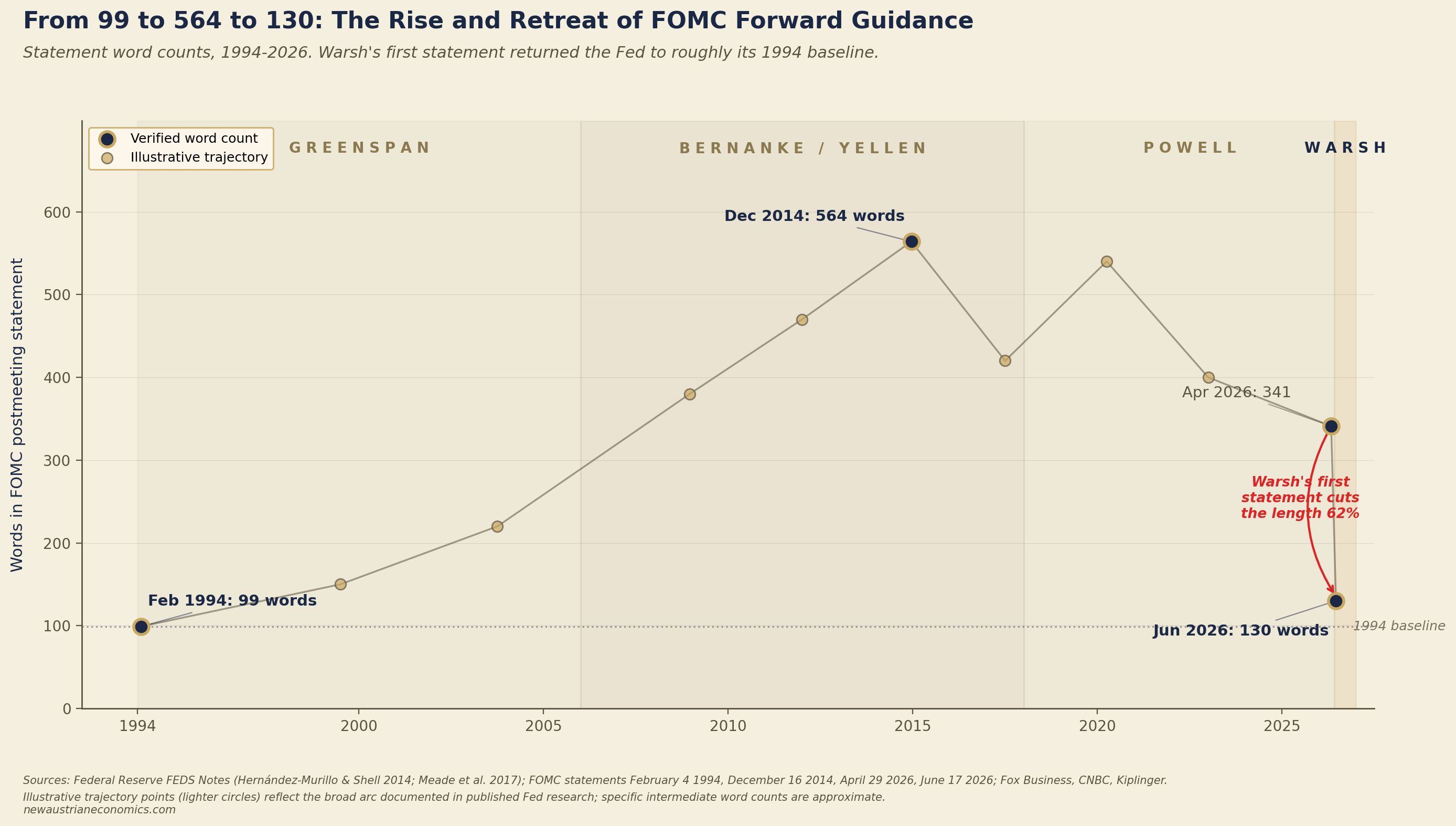
The trajectory after 2000 is the central documented arc of post-Volcker monetary policy communications. 6 Forward guidance became a regular component of the postmeeting statement throughout the 2000s, expanded substantially during the 2008-2009 financial crisis as the federal funds rate approached the zero lower bound, and was elevated by Chairman Ben Bernanke as one of the primary policy instruments available to the Federal Reserve when conventional rate cuts had reached their limit. By December 2014 the postmeeting statement had grown to roughly 562 words of policy text — more than five times the length of Greenspan's original 99 words. The apparatus was Bernanke's, but the December 2014 statement was not: Bernanke had left the Board in January 2014, and that statement went out over Janet Yellen's name. The Federal Reserve's own published research documented this trajectory in detail. Hernández-Murillo and Shell, writing in the St. Louis Fed's Economic Synopses in 2014, found that early statements read at a grade level of nine to fourteen years of schooling while recent ones read at "three years beyond a 4-year college degree"; Acosta and Meade followed with a semantic analysis in FEDS Notes in September 2015 — a measurable rise in technical specificity that Fed researchers themselves analyzed as a structural change in how the institution communicates with the public.
The intellectual case for the expansion was articulated explicitly by Bernanke himself in his January 2020 American Economic Association presidential address. Forward guidance, Bernanke argued, was a "powerful policy tool" that — combined with quantitative easing — gave the Federal Reserve significant additional space to provide monetary accommodation when standard policy rates were at the zero lower bound. The mechanism Bernanke described was straightforward: by shaping market expectations about the future path of short-term rates, the central bank could affect long-term rates that historically had been more important for private-sector borrowing decisions. Bernanke's framing was widely accepted by Fed leadership across both his and Janet Yellen's tenures, and was inherited by Jerome Powell when he assumed the chairmanship in 2018. Powell maintained the basic apparatus while adjusting the specific language across different policy phases — emphasizing patience during the late 2018 pivot, explicit calendar guidance during the early COVID response, and "data dependence" through the 2022-2024 tightening cycle.
The structural critique of forward guidance — which has existed throughout the regime but has accumulated weight in recent years — operates on three observations. First, forward guidance only works to the extent that market participants believe the central bank will follow through on its stated path, which means the tool's effectiveness depends on a credibility-trust relationship that the central bank must continuously manage. Second, the central bank's projections about future policy are themselves uncertain forecasts, and communicating those forecasts as if they were commitments creates an information asymmetry between what the central bank knows and what it tells the public. Third, the accumulated apparatus of forward guidance, dot plots, summary of economic projections, and press conference messaging tends to over-determine the policy environment, generating market dependence on central bank communication that the central bank then must continue producing to avoid disruptive shocks when expectations diverge from outcomes.
Kevin Warsh has been a public critic of all three dimensions of the forward-guidance regime for years. Warsh served on the Federal Reserve Board of Governors from 2006 to 2011, including through the most severe phase of the 2008 financial crisis, and has been associated with the institutionally hawkish faction of post-crisis Fed analysis. He has long criticized the institution for communicating too much and too precisely; he dismissed core PCE — the Fed's preferred inflation gauge — as a "rough swag," swag being short for scientific wild guess; and he told the Senate Banking Committee on April 21, 2026, during his confirmation hearing, that "inflation is a choice, and the Fed must take responsibility for it." His pre-confirmation positions made clear that he would seek to substantially restructure the communication regime. 7 The market participants who watched his confirmation expected exactly the kind of statement compression that arrived on June 17.
Warsh's first statement at 130 words is structurally comparable to Greenspan's 1994 baseline. The size of the reduction depends on what is counted. On policy text alone, the April statement ran 244 words and the June statement 114, a reduction of about 53%. 8 The 341-word figure for April includes the voting-members list, which in April was unusually long because four members dissented and each dissent was explained; the widely reported 130 words for June includes the vote line. Counted consistently, the cut is roughly half rather than nearly two-thirds — which is still the sharpest single-meeting compression in the regime's history. The eliminated content was not arbitrary; it consisted of the specific forward-guidance language that the post-2000 regime had progressively built into each statement. The April statement included language signaling an easing bias for future policy — the Committee would weigh "the extent and timing of additional adjustments to the target range," where the word additional implied that the next move, like the last ones, would be a cut. Three members had dissented in April specifically over that bias. It is gone from the June statement. The April statement also carried two paragraphs of calibration about how the Committee would assess incoming information and what it would take into account; both are gone. What remained in the 130 words was a brief description of current economic conditions and a vow to control inflation. As Warsh said at the press conference: "It's a bit shorter, a bit simpler and it dispenses with some older language. That statement just gives you the facts, as best we can judge it."
The framework's reading: forward guidance was always partially a manipulation mechanism dressed as transparency. Its effectiveness in shaping market expectations depended on the central bank presenting its own uncertain forecasts as if they were policy commitments, and on market participants accepting that presentation as informationally meaningful even when the underlying economic conditions did not warrant the implied confidence.
The post-2008 expansion of forward guidance occurred precisely during the period when the Federal Reserve's balance sheet operations were producing the substitute-layer architecture the catalog has been documenting — agency MBS holdings, expanded Treasury portfolios, the operational scaffolding of substitute claims on substitute claims that the framework's Article 8 on agency MBS, Article 27 on commercial real estate's extend-and-pretend cycle, and other catalog installments have engaged at the structural level. The communication regime grew in lockstep with the substrate-fragility accumulation. The communication regime functioned, throughout this period, to maintain market confidence in the institutional management of conditions that the institution could not actually fully control.
Warsh's deliberate dismantling of the communication regime is the institution's own acknowledgment that the prior arrangement was not working as advertised. The framework does not claim that Warsh has consciously adopted the catalog's specific critique; the framework does claim that the institutional choice Warsh has made is operationally consistent with what the catalog has been arguing for. The Greenspan 1994 baseline was a discrete announcement of rate decisions with brief reasoning. The Warsh 2026 baseline returns substantially to that posture. The 32-year experiment with progressively elaborate forward guidance has been substantially walked back by the institution itself.
The Chair without a dot
The second institutional choice that warrants careful reading is Warsh's decision not to submit his own projection to the Summary of Economic Projections — the so-called "dot plot" that maps the year-end interest rate forecasts of FOMC participants. The June 17 dot plot contained 18 dots for 2026, 2027, and the longer run, and 17 dots for 2028. Under standard practice, with 19 participants (7 Board governors plus 12 Federal Reserve Bank presidents), the chart would contain 19 dots. The missing dot, Warsh confirmed at the press conference, was his own. He had encouraged his colleagues to submit their projections but had declined to submit his.
The choice is unprecedented for a sitting Chair. No Chair has previously abstained. The SEP itself dates to November 2007, but the interest-rate projections that became the dot plot were added in January 2012, so the relevant record is fourteen years rather than nineteen: Bernanke, Yellen and Powell each submitted a rate projection in every quarterly cycle from 2012 onward. The Chair's dot has historically been treated as a meaningful signal even though its specific identification has never been published; sophisticated Fed watchers have inferred which dot belonged to the Chair through comparison with the Chair's prior projections and through analysis of dispersion patterns across meetings.
Warsh's stated reasoning for abstaining was that he is reconsidering the value of the forecasting tool itself and did not want to commit to a projection in a regime he was actively reviewing. The five task forces include one specifically reviewing "the Fed's monetary policy operations" and another reviewing communications — both of which would naturally engage the question of whether the SEP and dot plot should continue in their current form. Warsh has said in prior public statements that the dot plot creates an "anchoring" problem in which market participants treat the projections as commitments rather than as conditional forecasts, with the same credibility-mechanism problems that apply to the broader forward-guidance apparatus.
The framework reads the Chair's abstention as a deeper version of the 130-word statement's message. The 130-word statement removes the content of forward guidance from the communication regime. The Chair's abstention from the dot plot removes the signal of the Chair's own projections — which has been one of the most closely watched single pieces of information in monetary policy communications for the past two decades. The combined message: the Chair believes that the current apparatus for communicating policy expectations is structurally flawed, and he is operationally exiting his own participation in it while leaving the rest of the apparatus running for the time being.
This is consistent with the catalog's prior analysis of how central bank communication regimes generate the substitute-layer dynamics the framework has documented. Article 20 made the case that the 2% target itself is a monetarist artifact whose communication function exceeds its analytical justification. 3 The Chair declining to participate in the dot plot is an institutional acknowledgment that some communication tools may be more performative than informational. A Chair who continues to believe in the analytical content of his own forecast would submit it; a Chair who believes the forecast format itself misrepresents what monetary policy can know would not. Warsh's choice is the second posture made operationally explicit.
The institutional implication is structurally consequential. The dot plot has been one of the primary information transmission mechanisms by which market participants formed expectations about future Fed policy. Removing the Chair's input from this mechanism, while preserving the rest, creates an asymmetry that market participants will need to interpret as the new regime stabilizes. The September 16, 2026 SEP — the next quarterly release — will be the first complete cycle in which the Warsh-era practice operates. If Warsh continues to abstain, the dot plot will progressively become an institution-without-the-Chair forecast. If Warsh announces a broader reform — possibly discontinuing the SEP in its current form — the September meeting could include that announcement.
The task force that adopts the framework's argument
The most analytically consequential single announcement from Warsh's June 17 press conference was the formation of five task forces to review Federal Reserve operations. The five task forces will review communications, balance sheet policy, the use of existing data sources, productivity and jobs, and — most consequentially for the framework's project — the Fed's inflation framework. Warsh said he expects them to begin work within a couple of weeks, to "start to provide framing in the fall," and hopefully for most if not all to conclude by year-end. He noted that the inflation task force will not consider changes to the Fed's 2% target itself at this stage. 3
A precision worth stating: the fifth task force's public remit is the Fed's inflation framework, and the press-conference coverage rendered its subject as the causes of inflation. Whether measurement falls inside that remit is an inference rather than a quotation — a well-founded one, given that the Chair who set the remit has called the Committee's preferred gauge a rough swag, but an inference. The distinction matters, because the argument that follows rests on it.
The framework reads the inflation-measurement task force as the most direct institutional adoption of the catalog's prior critique that has yet occurred. Article 20 of this catalog — published on May 22, 2026 — argued that the 2% target was a monetarist artifact whose institutional origin was the Reserve Bank of New Zealand's adoption in 1990 under Governor Don Brash, that the Boskin Commission's 1996 methodological changes to U.S. CPI calculation produced a measurement framework that systematically understates household cost-of-living changes, and that the broader apparatus of inflation measurement has accumulated structural problems that the institution has not been willing to engage publicly. 3 The article was published as the framework's most direct critique of how the Federal Reserve constructs and defends its central policy target. The Warsh task force is now operationally opening exactly this question.
The framework needs to engage what this means with care, because the catalog's intellectual posture has consistently been to make falsifiable forward predictions and engage the results honestly. The Warsh task force is not the same as the Federal Reserve formally repudiating its prior inflation-measurement methodology. The task force is exactly what its name describes: an institutional review process that will produce findings and recommendations through fall 2026 and may or may not result in operational changes to how the institution constructs its target measurement. The framework's reading is that the task force represents the institution opening the question that the prior regime treated as closed, with the institutional intent to address what Warsh and his colleagues believe to be real measurement problems.
The specific institutional questions the task force will engage are not yet public, but several can be inferred from Warsh's prior public statements and from the broader trajectory of his analytical positions. Warsh has been a long-standing critic of core PCE as the Fed's preferred inflation measure, calling it a "rough swag" and favoring trimmed measures — specifically the Dallas Fed's trimmed mean PCE and the Cleveland Fed's median PCE — which strip the most extreme price movements at both ends of the basket before taking a weighted average. The task force may produce recommendations to shift the Fed's preferred measure or to expand the set of measures the Committee considers. Warsh has also suggested that the Fed's inflation measurement does not adequately capture the price changes households actually experience, a critique that aligns with the broader catalog of work — including this catalog's Article 23 on college tuition versus CPI and wages — documenting the gap between official measurement and household reality.
The 2% target itself, Warsh said, will not be revisited at this stage. 3 His framing was distinctive: he said he focuses on the left of the decimal point — "the '2' is the left, the '0' is the right." Asked whether he was considering raising or lowering the target, Warsh said he saw "no reason — until we've reestablished our commitment and ability to deliver on the 2% objective — to revisit it." The framework's reading: the Chair has chosen to defend the 2% target verbally while operationally opening the question of how 2% is measured. 3 Without changing the headline number, the institution can change what the number means — through methodological adjustments, through shifts in preferred indices, through reweighting of components, through any of the specific technical changes the task force may recommend. The number stays the same. What the number describes is what is being put on the table.
This is precisely the analytical move the framework has been making since Article 20. The argument was not that 2% is the wrong number; the argument was that 2% as constructed by the current measurement apparatus is a structurally flawed target whose underlying mechanics deserve scrutiny. 3 The Warsh task force is operationally opening the scrutiny. The framework does not predict what the task force will conclude or what operational changes will follow from its work. The framework does observe that the institution has, through the task force's formation, conceded that the prior measurement regime is not analytically settled in the way the prior communication regime presented it as being.
The other four task forces deserve briefer notice because they each touch the catalog's prior analysis at specific points. The balance sheet policy task force engages the framework's prior work on open market operations (Article 4) and the substitute-layer architecture of central bank balance sheet operations more directly than a review of policy implementation in the abstract would. The communications task force will engage the questions discussed above about forward guidance, the dot plot, and the broader transparency regime. The data sources task force will examine what the institution measures, which connects to the catalog's prior critique of how aggregates obscure structural conditions (Articles 17, 20, 26, 28, 29). The productivity and jobs task force will engage the dynamics the catalog's Article 28 documented in detail — the AI labor substitution effects, the saleability inversion across occupation categories, and the broader question of what labor market metrics actually measure in 2026 conditions.
The framework's broader observation: Warsh has, through these five task forces, opened every substantive institutional question that the catalog has been engaging across the past two years of essays. The task forces are not exhaustive — they do not engage the housing dynamics, the cryptocurrency dynamics, the supply chain propagation dynamics, or the commercial real estate dynamics that the catalog has documented separately. But the four central institutional questions of Federal Reserve operations — policy implementation, communications, data measurement, and labor market analysis — are now all being institutionally reviewed by the new Chair within his first month in office. The reviews may produce substantive reform; they may produce cosmetic adjustments; they may produce reports that disappear into institutional files. The framework's reading is that the opening of the reviews is itself the analytically consequential event, regardless of what the reviews ultimately produce.
The framework's synthesis
The institutional pivot Warsh executed on June 17 should be read as structurally coherent rather than as a collection of separate institutional choices. The 130-word statement, the Chair's abstention from the dot plot, the five task forces, and the 17-of-18 hawkish risk assessment all operate together as the new Chair establishing a different relationship between the Federal Reserve and the broader monetary architecture the catalog has been documenting.
The prior regime, from approximately 1994 through 2026, accumulated a communication apparatus designed to project institutional confidence about the management of substrate conditions whose actual operation the institution could not fully control. The post-2008 expansion of the apparatus occurred during the period when the substitute-layer architecture of agency MBS, expanded Treasury holdings, central bank balance sheet operations, and the broader scaffolding of substitute claims on substitute claims grew to its current configuration. The communication regime functioned, throughout this period, to maintain market confidence in conditions that the institution managed through increasingly elaborate substitute-layer mechanisms.
The framework's broader argument across the catalog has been that this configuration produced accumulated substrate fragility — visible across banking (Article 16, Article 27), housing (Articles 17-19), supply chains (Articles 26, 29), precious metals (Article 24), cryptocurrency (Articles 13-15, 25), commercial real estate (Article 27), and labor markets (Article 28) — that the institution cannot resolve through conventional monetary policy because the conventional toolkit produced the substrate fragility in the first place.
Warsh's institutional pivot can be read in two distinct ways, and the framework should be honest about which it does and does not commit to.
One reading: the pivot is a substantive recognition that the prior regime did not work, and the new Chair intends to restructure the institution in ways that will reduce its dependence on substitute-layer architecture and refocus monetary policy on the more limited objectives a central bank can credibly pursue. Under this reading, the task forces will produce meaningful reforms, the communication regime will continue to compress toward something closer to the 1994 baseline, and the institution will operationally pull back from the post-2008 expansion of its responsibilities. This reading is consistent with Warsh's pre-confirmation positions and with the structural logic of the moves he made on June 17.
A different reading: the pivot is primarily a political-economy response to the specific 2026 conditions Warsh inherited — high inflation, political pressure from the Trump administration that nominated him to deliver rate cuts, market expectations that were misaligned with the institutional credibility-establishment task he needed to execute — and the structural changes are temporary credibility moves rather than durable institutional reforms. Under this reading, the task forces will produce reports that are quietly incorporated without substantive operational changes, the communication regime will gradually re-expand as Warsh consolidates his institutional position, and the institution will return to something resembling the pre-2026 configuration once the immediate inflation pressure subsides.
The framework cannot determine which reading is correct from the available evidence on June 17 alone. The signal from Warsh's specific institutional choices is consistent with both readings, and both readings are consistent with his prior public statements. What the framework can observe is that the direction of the institutional choices is consistent with the catalog's prior critique, that the task force on inflation measurement is operationally opening the specific question the framework's Article 20 began making in May, and that the broader pattern of substitute-layer fragility the catalog has been documenting is now being acknowledged at the institutional level in ways that the prior regime would not have allowed.
The September 15-16, 2026 FOMC meeting will be the first complete test of which reading is correct. By that meeting, the May and June PCE prints will have arrived, the early Q3 2026 economic data will be visible, the initial work of the five task forces will be underway, and the markets will have had three months to adjust to the new communication regime. If the September statement returns to the prior length and complexity, the framework will conclude that the political-economy reading was correct. 8 If the September statement maintains the 130-word baseline and incorporates the early task force findings into the new regime, the framework will conclude that the substantive reading is correct. The 17 of 18 hawkish dot plot positions suggest the committee is operating in a posture consistent with the substantive reading, but the framework should resist drawing conclusions from a single meeting.
The closing observation
The Federal Reserve's communication regime has been the institutional infrastructure for one of the most consequential monetary architecture transformations in U.S. economic history — the post-2008 substitute-layer expansion that the framework's catalog has been documenting across two years of specific applied analysis. The regime was built progressively from Greenspan's 1994 first statement through Bernanke's 2008-2014 forward-guidance expansion, maintained through Yellen and Powell with adjustments to specific language, and used by all three of those chairs to project institutional confidence about conditions whose operational reality the regime existed in part to obscure.
Warsh's June 17 statement is roughly the length of the regime's original 99-word baseline before forward guidance was introduced — 114 words of policy text, 130 as reported. The arc from 99 to 562 and back to 114 is the regime's complete rise-and-retreat in three data points. The Chair himself declined to submit his projection to the forecast apparatus that has been one of the regime's central tools. Five task forces have been formed to review the institutional infrastructure across the dimensions that align most directly with the framework's prior critique. The institution has not announced that it is repudiating the prior regime. The institution has operationally begun walking the regime back.
The framework's prior catalog made specific predictions across multiple sectors that subsequent data has substantially validated. The May 2026 CPI release validated the Hormuz lag predictions in Article 26. The FDIC Q1 2026 Quarterly Banking Profile validated the banking diagnostics in Article 16. The CRE fire-sale transactions documented in Article 27 are continuing through 2026 with the trajectories the article forecast. The Iran wallet seizures Article 25 documented continued through Bessent's Reagan Forum disclosures. The Warsh first meeting is the latest validation event — not of a specific predicted data point, but of the broader structural reading the catalog has been arguing for: that the post-2008 monetary architecture has accumulated substrate fragility beyond what the institution can manage through the prior toolkit, and that the institutional acknowledgment of this fact, when it arrives, will arrive through institutional restructuring rather than through public retraction.
The institutional restructuring has now begun. The framework's next several installments will engage what the September FOMC meeting reveals about whether the restructuring is durable, what the May and June PCE prints test from Article 26's predictions, and what the task force reports begin producing as fall 2026 arrives. The pattern of catalog work continues as it has throughout the past two years: applied analysis grounded in specific empirical events, framework-derived reading of what the events reveal about broader structural conditions, falsifiable predictions made in print and engaged honestly when subsequent data tests them, and intellectual honesty about what the framework can and cannot determine from the evidence available at any specific moment.
Warsh's first meeting is one such moment. The institution has executed a substantial communication regime restructuring and opened a task force review of the specific question the catalog has been pushing on. The framework reads what has happened. The framework records its reading for future testing. The work continues.
This is the fourteenth installment of "Watching the Cracks." The framework's predictions recorded here for future testing: the September 15-16, 2026 FOMC meeting will be the primary test of whether Warsh's communication regime restructuring is durable (statement length holds at or below ~150 words; Chair continues abstaining from dot plot; early task force findings incorporated) versus political-economy temporary (statement length re-expands; institutional posture re-stabilizes to pre-Warsh configuration). The framework's prediction is that the restructuring will hold through at least the September and October meetings, with possible re-expansion in 2027 as immediate inflation pressures moderate. The inflation-measurement task force is expected to produce findings in fall 2026 that will include recommendations to expand the Fed's preferred inflation measure set (trimmed-mean PCE, possibly additional alternative measures), but will not include recommendations to formally change the 2% target. 3 The chart accompanying this essay shows the 99-word, 562-word, 244-word and 114-word data points anchoring the 1994-2026 arc, all counted on policy text alone; intermediate trajectory points are illustrative. The PCE release scheduled for Thursday June 25 will provide the next major data point for testing Article 26's broader Hormuz lag prediction trajectory.
Sources
Footnotes
-
U.S. Senate roll call vote and Federal Reserve Board membership record. https://www.federalreserve.gov/aboutthefed/bios/board/ — Warsh is the Fed's seventeenth Chair, confirmed 54–45 on 13 May and sworn in 22 May 2026. ↩
-
Federal Reserve. FOMC statement of 17 June 2026, released 2:00 p.m. ET. https://www.federalreserve.gov/newsevents/pressreleases/monetary20260617a.htm — 130 words as reported (114 words of policy text on a like-for-like basis); a 12–0 vote to hold at 3.50–3.75%. ↩
-
Federal Reserve press conference, 17 June 2026. https://www.federalreserve.gov/monetarypolicy/fomccalendars.htm — The five task forces cover balance sheet policy, communications, data sources, productivity and the labor market, and the Fed's inflation framework. The fifth body's remit is the inflation framework; press-conference coverage rendered its subject as the causes of inflation. The bodies were to begin within weeks, frame in the fall and mostly conclude by year-end, and the inflation task force was not to consider changing the 2% target at this stage. ↩ ↩2 ↩3 ↩4 ↩5 ↩6 ↩7 ↩8 ↩9
-
Federal Reserve, FOMC statement and Summary of Economic Projections, 17 June 2026. https://www.federalreserve.gov/newsevents/pressreleases/monetary20260617a.htm — Federal Reserve and the accompanying Summary of Economic Projections — 17 of 18 participants weighted inflation risks to the upside with one balanced and none to the downside, for both PCE and core PCE; the median year-end 2026 dot moved from 3.4% in March to 3.8% in June; 18 dots for 2026, 2027 and the longer run against 17 for 2028. Warsh's abstention is confirmed by the submitter count falling from nineteen to eighteen. ↩
-
The first postmeeting statement, 4 February 1994, is 99 words in four sentences by direct tokenization. It announced a change in "pressure on reserve positions"; no numerical funds-rate target was published in 1994. Greenspan's stated reason — "to avoid any misunderstanding of the Committee's purposes" — is verbatim. Statements were issued only at rate-change meetings until May 1999, then after every meeting, with balance-of-risks language from February 2000. ↩
-
The December 2014 statement runs about 562 words of policy text and is signed "Janet L. Yellen, Chair." Bernanke left the Board in January 2014. ↩
-
Warsh served on the Board 2006–2011. He dismissed core PCE as "a rough swag" at his confirmation hearing, and told Senate Banking on 21 April 2026 that "Inflation is a choice, and the Fed must take responsibility for it." His criticism of the institution for overcommunicating is documented as a position rather than as that word. The April statement carried an easing bias since removed, over which three members dissented; the disputed language was "the extent and timing of additional adjustments." ↩
-
Hernández-Murillo, Rubén and Hannah Shell, St. Louis Fed Economic Synopses, 2014; and Acosta, Miguel and Ellen Meade, FEDS Notes, September 2015. The Flesch-Kincaid finding of a reading grade level "three years beyond a four-year college degree" verifies, against a 9-to-14-year baseline for general readership. Like for like, the June statement is a 53% reduction from April's 244 words of policy text to 114. ↩ ↩2
On the record
This essay logged 2 dated predictions
None have reached their resolution window yet. They are logged with explicit criteria, and will be scored as the evidence arrives — right or wrong.
- OpenThe Warsh communication-regime restructuring holds through at least the September and October 2026 FOMC meetings — statement length at or below ~150 words, the Chair continuing to abstain from the dot plot — with possible re-expansion in 2027 as immediate inflation pressures moderate.
- OpenThe Fed's inflation-measurement task force produces findings in fall 2026 recommending an expanded preferred-measure set (trimmed-mean PCE, possibly additional alternatives), but does not recommend a formal change to the 2% target.
Related essays
Open Market Operations at Light Speed: How AI Converted Fekete's 1922 Warning into a Closed-Loop Capital Destruction Engine
Fekete argued that the illegal introduction of open market operations in 1922 made bond speculation risk-free and destabilized the interest-rate structure. AI-driven algorithmic trading has automated this mechanism and accelerated it to the physical limits of latency. The predicted consequence — systemic capital destruction — is no longer theoretical.
The Boomer Trade: A One-Time Monetary Windfall and Why It Cannot Be Replicated
Between 1971 and 2021, the American homeowner cohort participated in a 50-year monetary regime characterized by a closed gold window, sustained inflation, and a 16-percentage-point fall in interest rates. The wealth transfer this produced — from younger workers to housing asset holders, mediated by the dollar's debasement — was the largest peacetime intergenerational redistribution in U.S. history. It cannot be repeated. The post-2021 cohort is being asked to pay out the windfall at terms the underlying economic reality cannot support.
Housing as Anti-Money: A Menger-Fekete Audit of the American Mortgage in 2026
The asset class with the worst Mengerian saleability characteristics on earth has been culturally positioned as the central wealth-building instrument of American life. Audited rigorously through the New Austrian framework, the modern American home is closer to anti-money than to money, and the mortgage that funds it is a 90-year experiment in inducing households to behave as miniature bond issuers in a perpetually inflating currency.