Researched and drafted with AI assistance · reviewed and edited by Jason D. Keys
Listen
The First Major Airline Shutdown in 25 Years: Spirit, the 2026 Failure Cluster, and Substrate Fragility Made Visible at Corporate Scale
Read in Jason D. Keys' synthesized voice
Narrated in the author’s synthesized voice, generated with AI from a recording of his own. The words are his; the delivery is machine-rendered.
Download (25.1 MB)At approximately 1:00 a.m. Eastern Time on Saturday, May 2, 2026, Spirit Airlines issued a public notice stating that the company had begun an orderly wind-down of its operations, effective immediately. 1 All flights were canceled. Customer service was suspended. Passengers with tickets were instructed to contact their credit card companies for refunds and to rebook travel on other carriers. Airport self-service kiosks and gate displays across the United States showed cascading "canceled" notices through the morning as the shutdown became operationally visible. Approximately 2,000 pilots represented by the Air Line Pilots Association lost their jobs immediately. 2 Thousands of additional flight attendants, gate agents, ramp workers, and administrative staff followed. A carrier that had flown under the Spirit name for thirty-four years — and whose charter predecessor dated to 1983 — ceased to exist as an operating entity in the span of a single overnight shift. 3
Spirit Airlines was the first major U.S. airline to shut down completely — not reorganize, not merge, not restructure and emerge, but liquidate outright — since Midway Airlines went out of business in the immediate aftermath of the September 11, 2001 terrorist attacks. That framing — CNN's, and repeated across the shutdown coverage — depends on where the threshold for "major" is set, and the threshold deserves to be stated rather than assumed. Two U.S. carriers did file Chapter 11 and stop flying without emerging or being acquired inside the intervening twenty-five years: Aloha Airlines filed on March 21, 2008 and ended passenger operations on March 31 (its cargo business was sold separately to Saltchuk Resources), and ATA Airlines filed on April 2, 2008 and ceased flying the same day (Southwest acquired its Chicago Midway gates but not the airline). 4 Neither was close to Spirit's scale. What is defensible without qualification is that Spirit is the largest U.S. carrier in a quarter century to go from operating airline to outright liquidation with no going-concern outcome intervening. The Air Line Pilots Association's president, Capt. Jason Ambrosi, called the shutdown "a devastating blow to more than 2,000 ALPA Pilots and thousands of other hard-working Employees who dedicated their careers to this Airline," adding that Spirit's pilots had contributed "tens of millions in annual concessions to help secure a path through restructuring" and that "the pain of this decision will not be felt in boardrooms."
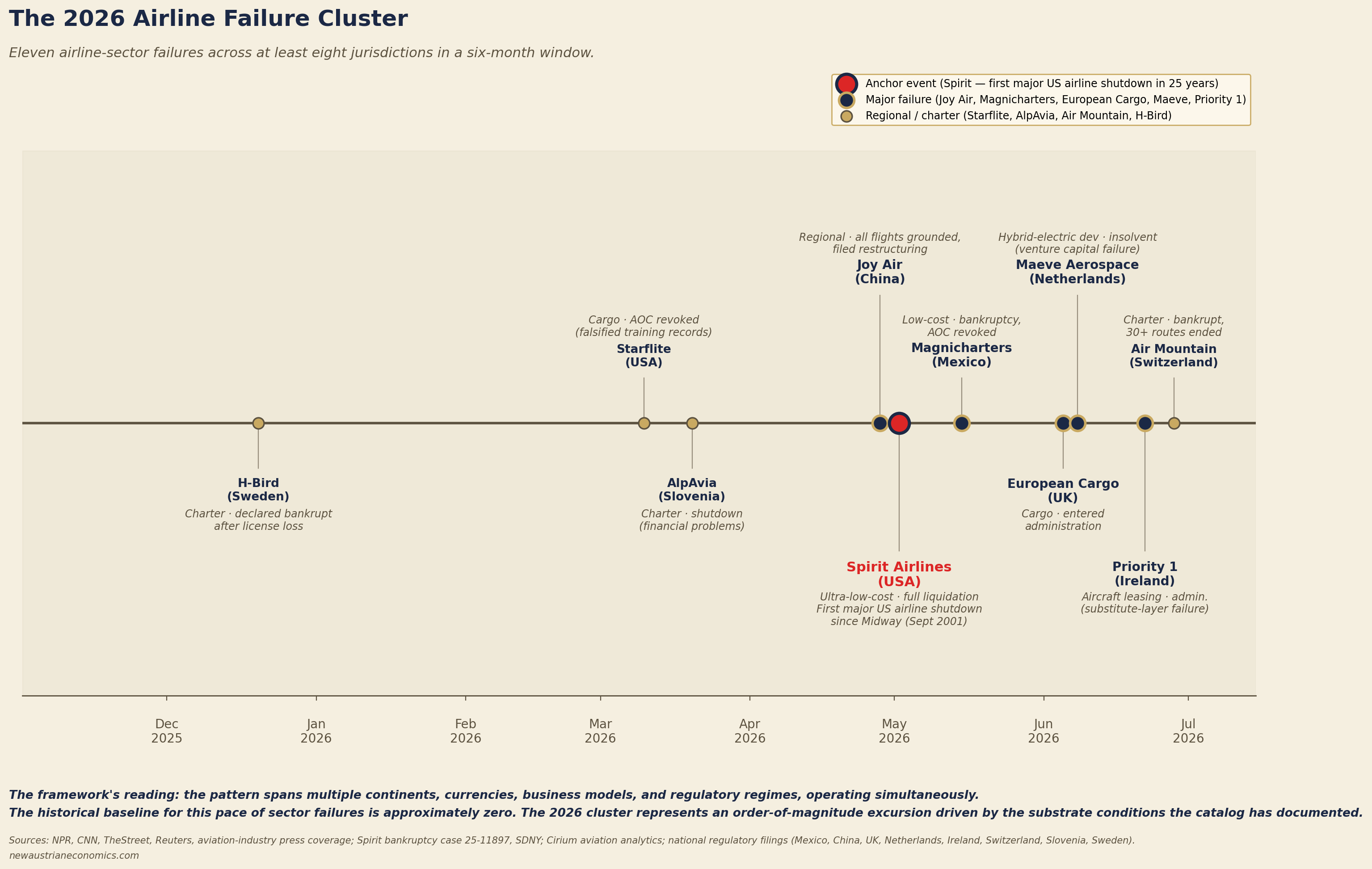
Spirit's collapse did not occur in isolation. Between the end of 2025 and late June 2026, at least nine additional airlines and aviation companies across eight further jurisdictions filed for bankruptcy, entered administration, had their operating certificates revoked, or ceased operations entirely. The list includes Magnicharters (Mexican low-cost, May 2026), Joy Air (Chinese regional, late April 2026), European Cargo (British cargo, early June 2026), Maeve Aerospace (Netherlands hybrid-electric aviation developer, early June 2026), Priority 1 (Irish aircraft leasing, late June 2026), Air Mountain (Swiss charter, late June 2026), Starflite Aviation (Houston-based, operating certificate revoked in March 2026), AlpAvia (Slovenian charter, March 2026), and H-Bird (Swedish charter, declared bankrupt at the end of 2025 after losing its operating license). The failures are not confined to a single national market, a single business model, or a single regulatory regime. They are a global failure cluster, concentrated in the low-cost, charter, regional, and aircraft-leasing segments, operating simultaneously across multiple continents, multiple currencies, and multiple national regulatory frameworks.
The framework's reading: this is substrate fragility made visible at corporate scale. Across the catalog's prior thirty-four essays, the framework has documented substrate fragility across banking (Article 16), housing (Articles 8-10 and 17-19), commercial real estate (Article 27), sovereign monetary architecture (Articles 4, 5, 20, 32, 33, 34), labor markets (Article 28), personal data monetization (Article 30), and precious metals (Articles 24, 34).
The airline sector cluster of 2026 is the same pattern operating in a different industry — high fixed costs, capital-intensive balance sheets, high sensitivity to input prices, extensive substitute-layer financialization through aircraft leasing and asset-backed securitization, and a business model that becomes structurally impossible when the substrate conditions the catalog has been documenting reach the corporate cash flow layer.
The essay proceeds in six sections. First, the specific mechanism of Spirit's collapse, including the eighteen-month sequence from first Chapter 11 through failed restructuring through second Chapter 11 through failed bailout through liquidation. Second, the broader 2026 failure cluster across the additional jurisdictions and business models. Third, the reading through Article 26's Hormuz lag apparatus — jet fuel as the propagation channel that carries the framework's prior diagnostic directly into the airline P&L. Fourth, the reading through Article 27's extend-and-pretend ceiling — Spirit's two bankruptcies in ten months as the case study for what happens when restructuring cannot address underlying substrate conditions. Fifth, the failed $500 million federal bailout as the analytically distinctive moment where the standard 2008-2020 substitute-layer response was attempted and did not succeed. 5 Sixth, the framework's synthesis of what the airline cluster reveals about the broader substrate condition and about the trajectory of the catalog's ongoing documentation project.
Spirit Airlines — the specific mechanism
Spirit Airlines traces to Charter One, a Michigan-based charter tour operator founded in 1983 by Ned Homfeld, which brought jet aircraft into the fleet and renamed itself Spirit Airlines on May 29, 1992. It evolved through several business-model transitions before adopting the ultra-low-cost carrier (ULCC) template in the early 2000s. By 2019, Spirit had grown to become one of the ten largest U.S. airlines by passenger volume, operating a substantial network of domestic and Caribbean routes, and had pioneered the unbundled pricing model that separated base fares from ancillary charges for seats, bags, and other services. The business model depended on cost discipline — Spirit's cost per available seat mile was consistently among the lowest in the industry, and the low costs were the sole competitive advantage the airline offered in exchange for its stripped-down passenger experience. When the cost advantage eroded, the business model had no other foundation to stand on.
The erosion began well before 2026. Spirit's proposed merger with JetBlue was blocked by federal regulators in January 2024, ending what management had positioned as the strategic solution to competitive pressures from the major legacy carriers. In November 2024, Spirit filed for Chapter 11 bankruptcy protection for the first time, seeking to reduce its debt load and restructure its operations around a smaller, more focused route network. The company emerged from that first bankruptcy in March 2025 as a private company under new ownership, with a stated business plan to concentrate on higher-yielding leisure destinations, exit unprofitable routes, and reduce fleet size. The restructuring was widely covered at the time as an example of the bankruptcy process working as intended — providing a mechanism for a distressed airline to emerge with a viable capital structure and a focused strategic plan.
The emergence lasted less than six months. Spirit filed its second Chapter 11 bankruptcy on August 29, 2025, having emerged from the first on March 12, 2025. The second filing acknowledged that the restructured business plan had not produced the projected results, that the airline continued to lose money on operations, and that a further round of debt reduction and operational restructuring would be necessary to restore viability. Spirit secured a $475 million debtor-in-possession financing facility from existing bondholders — $200 million funded immediately and $275 million in later tranches, approved by the court in October 2025 as part of a $1.23 billion package that included a rollup of prepetition debt — and entered a period of intensive negotiation with creditors, lessors, and potential investors on the terms of a further restructuring. 5
In February 2026, Spirit reached what the bankruptcy court filings characterized as an "agreement in principle" on the key terms of a restructuring support agreement. The proposed terms would have reduced Spirit's debt and lease obligations from approximately $7.4 billion to roughly $2.1 billion — a reduction of approximately 72%. 5 Fleet costs would have been cut substantially. Summer 2026 capacity would have been reduced. The proposed plan was framed as the last realistic path to emergence as a going concern. The agreement in principle, however, was not an implemented plan; it was a proposed framework subject to creditor approval and to the airline's ability to reach specific terms on each of the underlying obligations. Across the subsequent weeks, the framework did not consummate. Individual creditor groups rejected specific terms. Lease negotiations with aircraft lessors did not produce the required cost reductions. Fuel price trajectories, driven substantially by the Hormuz supply disruption documented in Article 26, made the projected P&L in the proposed plan increasingly untenable.
Spirit's operational scale collapsed in parallel with the financial negotiations. According to aviation analytics data from Cirium, Spirit's share of U.S. domestic passengers had been 5.1% in February 2025 6 — approximately the level that had supported the airline's operations for the prior several years. By February 2026, the share had fallen to 3.9%. 6 By May 2026, the projected share was 1.8%, which would have made Spirit the ninth-largest U.S. carrier by market share. 6 The market share collapse was not primarily a demand phenomenon; it was Spirit's operational contraction as the airline shrank its fleet and route network in response to the two bankruptcies. Each fleet reduction reduced revenue capacity; each revenue reduction increased the pressure on remaining operations to cover fixed costs; the compression tightened over the course of the spring.
In late April 2026, Spirit's advisors began direct discussions with the Trump administration about a federal bailout. The specific proposal that emerged: $500 million in cash from the federal government in exchange for equity reported to have taken taxpayers to a roughly 90 percent stake in Spirit's post-bankruptcy ownership structure. 5 The transaction would have functioned as a direct federal equity injection at a scale that had precedent in the 2008-2009 auto industry bailouts (General Motors, Chrysler) and in the COVID-era Payroll Support Program for airlines. Spirit's attorneys told the bankruptcy court in the last week of April that negotiations were in "very advanced discussions" and that a rescue package was potentially imminent. On Friday, May 1, President Trump publicly acknowledged that a deal might not be possible: "We're looking at it, but if we can't make a good deal — no institution's been able to do it. I said I'd like to save the jobs." He told reporters an announcement would come that day or the next.
The specific reason the deal did not consummate has been described in court filings and press coverage as a rejection by a key group of creditors — senior bondholders including Ken Griffin's Citadel and Ares Management, who objected that the transaction would place the government ahead of them in priority against Spirit's assets. The proposed transaction would have subordinated existing creditor claims to the government's new equity position and would have reduced recoveries for those creditors below what they projected they could obtain through a court-supervised liquidation. The creditors' fiduciary duty to their own beneficiaries required them to reject a proposed transaction that reduced their expected recovery, regardless of the broader employment and consumer impact of Spirit's shutdown. The proposal was operationally unworkable given the creditor structure. The wind-down began shortly after midnight on Saturday, May 2, 2026.
The bankruptcy case, Spirit Aviation Holdings, Inc. et al., is jointly administered under Case No. 25-11897 in the United States Bankruptcy Court for the Southern District of New York before Judge Sean H. Lane. The case has shifted from reorganization to a court-supervised wind-down. Subsequent Securities and Exchange Commission 8-K filings and bankruptcy court filings have disclosed the ongoing liquidation process, including the sale of individual aircraft, the settlement of individual creditor claims, and the administrative closure of Spirit's corporate infrastructure.
Approximately 2,000 pilots and, on the counts cited in the shutdown coverage, some 17,000 employees in total lost their jobs on May 2. The pilots have significant seniority claims and specialized training that will make transition to other airlines partially manageable, though seniority does not transfer between carriers and many will restart at the bottom of the pay scale at their new employers. Non-pilot employees — flight attendants, gate agents, ramp workers, administrative staff — have less protection and more difficulty in transition. The regional labor market impact is concentrated in Spirit's operational hubs (Fort Lauderdale, Detroit, Chicago O'Hare, Las Vegas, Newark, Los Angeles, Miami, Orlando) with cascading effects on airport service contractors, catering firms, ground transportation operators, and hospitality businesses that had depended on Spirit's passenger volume.
The broader 2026 failure cluster
The Spirit shutdown, while the most institutionally significant single event, is one of ten airline-sector failures the framework can document in the seven months from late 2025 through late June 2026. The pattern is global, spans multiple business models, and includes carriers at every scale from major national airlines to regional charter operators to specialized aircraft leasing companies.
Magnicharters (Mexico) filed for bankruptcy protection in the First District Court for Bankruptcy Proceedings in Mexico City at the end of May 2026, roughly six weeks after suspending all flights in what management had initially characterized as a temporary two-week operational pause. Mexico's Federal Civil Aviation Agency first suspended and then, on June 29, permanently revoked Magnicharters' Air Operator Certificate, having found the airline lacked the financial capacity to sustain safe operations; an extraordinary inspection conducted January 12-16, 2026 had already identified multiple regulatory violations. The regulatory framing — that the airline's financial condition itself constituted a safety issue — reflected the operational reality that airlines with insufficient cash to properly maintain aircraft, train personnel, and manage operations cannot safely be permitted to continue flying regardless of nominal operating licenses. Magnicharters had been in the low-cost holiday charter segment, serving Mexican domestic tourist destinations, and left thousands of passengers stranded when it ceased flights.
Joy Air (China regional) cancelled all of its flights on April 27, 2026, just before the peak Chinese domestic travel period, missed successive deadlines to resume, entered a pre-restructuring process, and was stripped of its operating certificate on May 15. Founded in 2008 and based in Xi'an, it flew three Boeing 737-800s and twenty-two Xi'an MA60 turboprops on domestic routes to Tianjin, Harbin and Changsha. Reported debts run to roughly $735 million, alongside labor disputes and unpaid wages for pilots and cabin crew. 5 Reporting is limited by Chinese regulatory reticence about airline financials, and the framework notes that fuel cost is not the documented proximate cause here — the documented cause is a balance sheet that could not carry itself.
European Cargo (United Kingdom) was declared insolvent by a British court on June 3, 2026, with joint administrators appointed from Teneo Financial Advisory. The Bournemouth-based operator converted former passenger airframes into freighters and flew Airbus A340 cargo aircraft. Administration under UK insolvency law is comparable to Chapter 11 bankruptcy protection in the United States, providing a temporary shield from creditor action while restructuring options are explored. European Cargo had specialized in dedicated cargo operations serving the freight-forwarding sector — a segment that has been under pressure from both fuel costs and from the broader post-COVID normalization of air freight demand.
Maeve Aerospace (Netherlands) and its parent, Green Transition Alliance, were declared bankrupt by a Dutch court on May 28, 2026, the Delft-based developer having failed to raise the €20 million needed to fund its next development phase. Maeve occupied a different segment from the traditional airlines in the cluster: it was a hybrid-electric aircraft developer that had been positioned by venture investors as a sustainability-aviation category leader. The insolvency reflects the interaction of two conditions the framework has documented separately. First, the AI-and-clean-energy investment cycle that produced substantial venture funding for aviation electrification through 2022-2024 has not been sustained through the higher-cost-of-capital environment of 2025-2026. Second, the underlying commercial viability of hybrid-electric aircraft at the required scale and range has not been demonstrated. Maeve is the substitute-layer case in the cluster: a company whose valuation was based on projected future capability rather than current operations, with capital dependent on continued venture funding that failed to materialize.
Priority 1 (Ireland) entered administration at the start of June 2026. Priority 1 is analytically distinctive because it was not an operating airline; it was an aircraft leasing company. Aircraft leasing companies own aircraft and lease them to operating airlines under multi-year contracts, receiving lease payments while the airlines operate the aircraft. When operating airlines fail — as Spirit, Magnicharters, and Joy Air have — the aircraft return to the lessor, whose business model depends on placing those aircraft with alternative lessees at commercially viable rates. When multiple operating airlines fail simultaneously, the market for leased aircraft becomes oversupplied, lease rates fall, and the leasing companies' revenue projections deteriorate. Priority 1's administration is the substitute-layer failure at the aircraft-financing layer, one abstraction level removed from the operational airlines but ultimately dependent on the same substrate conditions.
Air Mountain (Switzerland) was declared bankrupt by the Sion court on May 27, 2026, with the ruling posted June 2 and the Federal Office of Civil Aviation revoking its operating certificate on June 10. Air Mountain was a small scheduled and charter operator flying two eight-seat Beechcraft King Air B200s from Sion to Alghero, Calvi, Elba and Figari, plus a St Tropez-Geneva service. Director Raphaël Délèze told Swiss broadcaster RTS that the airline had presented a restructuring plan but was hit by the bankruptcy at the worst possible time: its debt had accrued during a grounding of more than three months for costly maintenance in 2025, which delayed the start of the 2026 ski season. More than thirty scheduled flights have been permanently canceled, with both aircraft parked and seized by creditors, and Délèze said Air Mountain would appeal.
StarFlite Aviation (Houston, United States) had its air carrier certificate revoked by FAA emergency order in late February 2026. The FAA found that management personnel of the Part 135 charter operator had knowingly made false entries in the training records of at least ten pilots, including the chief pilot, between November 2019 and November 2024 — showing check rides and competency checks that never occurred — with the result that unqualified pilots flew at least 170 flights. The Starflite case is analytically distinctive because the trigger was regulatory action rather than financial distress, but the underlying condition — an airline operating in a cost-pressured environment with insufficient resources to properly maintain compliance — is consistent with the broader cluster.
AlpAvia (Slovenia) and H-Bird (Sweden) rounded out the cluster with smaller-scale charter operations that shut down in March 2026 and late 2025 respectively, both citing financial difficulties and inability to maintain compliant operations under the input-cost pressures affecting the broader European charter market.
The pattern deserves explicit synthesis. Ten airline-sector failures across nine national jurisdictions in a seven-month window. Business models spanning ultra-low-cost, low-cost, charter, regional scheduled, cargo, hybrid-electric development, and aircraft leasing. Geographic distribution across North America (United States, Mexico), Europe (United Kingdom, Netherlands, Ireland, Switzerland, Slovenia, Sweden), and Asia (China) — nine jurisdictions in all. Regulatory frameworks including U.S. Chapter 11, Mexican bankruptcy protection, UK administration, Dutch insolvency, Chinese restructuring, Swiss bankruptcy, and administrative certificate revocation. The pattern cannot be explained by any single national factor, any single business model failure, or any single regulatory intervention. It is a global sector-wide pattern operating simultaneously across multiple contexts.
The framework's reading of the cluster: this is substrate fragility becoming visible at corporate scale. The substrate condition — accumulated input-cost pressure, deteriorated capital access, structural business-model exposure to fuel prices, extended substitute-layer financialization of the underlying operating assets — is global. The specific failure timing depends on individual companies' capital reserves, creditor relationships, and management decisions, but the underlying condition is common. When multiple companies with structurally similar exposures encounter the same substrate condition simultaneously, the failure cluster becomes an emergent phenomenon that reveals the shared underlying condition more clearly than any individual failure would.
Reading through Article 26 — the Hormuz lag at the airline P&L
Article 26 of this catalog, published on June 1, 2026, established the Hormuz lag framework. The core observation: an oil supply shock propagates through the economy at different speeds in different channels, with the fastest channel being retail gasoline (approximately 30-45 days from shock to pump) and progressively slower channels running through diesel, jet fuel, industrial energy, food and consumer goods, and eventually into services inflation. The article specified predicted trajectories for each channel and identified a specific timeline over which the propagation would become visible in aggregate inflation measurements. Article 29, published on June 10, 2026, tested the specific predictions against the May CPI release and found substantial validation across every predicted channel.
Jet fuel is the channel that carries Article 26's diagnostic directly into the airline P&L. Jet fuel prices track crude oil prices with a smaller refining spread than most other petroleum products, because jet fuel is a simpler distillate that requires less refining processing than gasoline or diesel. When crude prices rise, jet fuel prices rise at close to a one-to-one ratio, with a lag typically measured in weeks rather than months. When crude prices remain elevated for an extended period, jet fuel prices remain elevated at the corresponding level for the corresponding duration. Airlines are the concentrated consumers of jet fuel: no other industry uses jet fuel at comparable scale, no other industry has jet fuel as a comparable share of operating costs, and no other industry has the same combination of fixed-cost operating structure and immediate exposure to jet fuel price movements.
Jet fuel is the largest single cost category for the industry, and its share has moved sharply. IATA put fuel at 25.4% of total operating expenses in 2025 and projected 31.4% for 2026, on a jet fuel price rise of roughly 70% and an industry fuel bill going from $252 billion to $350 billion. 7 In June 2026 IATA said the combination of Middle East disruption and high fuel prices would halve industry profitability for the year. For ultra-low-cost carriers with intensively utilized aircraft, minimal ancillary revenue diversification, and thin operating margins, the fuel share sits at the upper end. For an airline operating at low single-digit operating margins in a competitive market with limited pricing power, a cost shift of that magnitude is the difference between profitability and unsustainable losses. For an airline already operating at negative operating margins — as Spirit had been across most of 2025 and early 2026 — it converts a manageable loss into an unmanageable one.
The specific fuel-price trajectory over 2026 has been substantially driven by the Iran-related crude oil supply disruption that Article 26 documented in detail. That disruption dates from the U.S. and Israeli airstrikes on Iranian targets on February 28, 2026 — not from 2025. Dated Brent rose past $140 per barrel in the weeks after the strikes, its highest since 2008, and has traded through the balance of 2026 in a wide band running from roughly $79 to above $105 depending on the week and the state of Middle Eastern hostilities. 8 Jet fuel prices tracked this trajectory with the expected small refining-spread lag. Airlines that had fuel hedges in place from prior years benefited temporarily from those hedges, but the hedges expired at their scheduled dates and were not replaced at the higher spot-market prices that would have been required. By early 2026, most airlines were operating with substantially unhedged fuel exposure at the elevated post-Hormuz price levels.
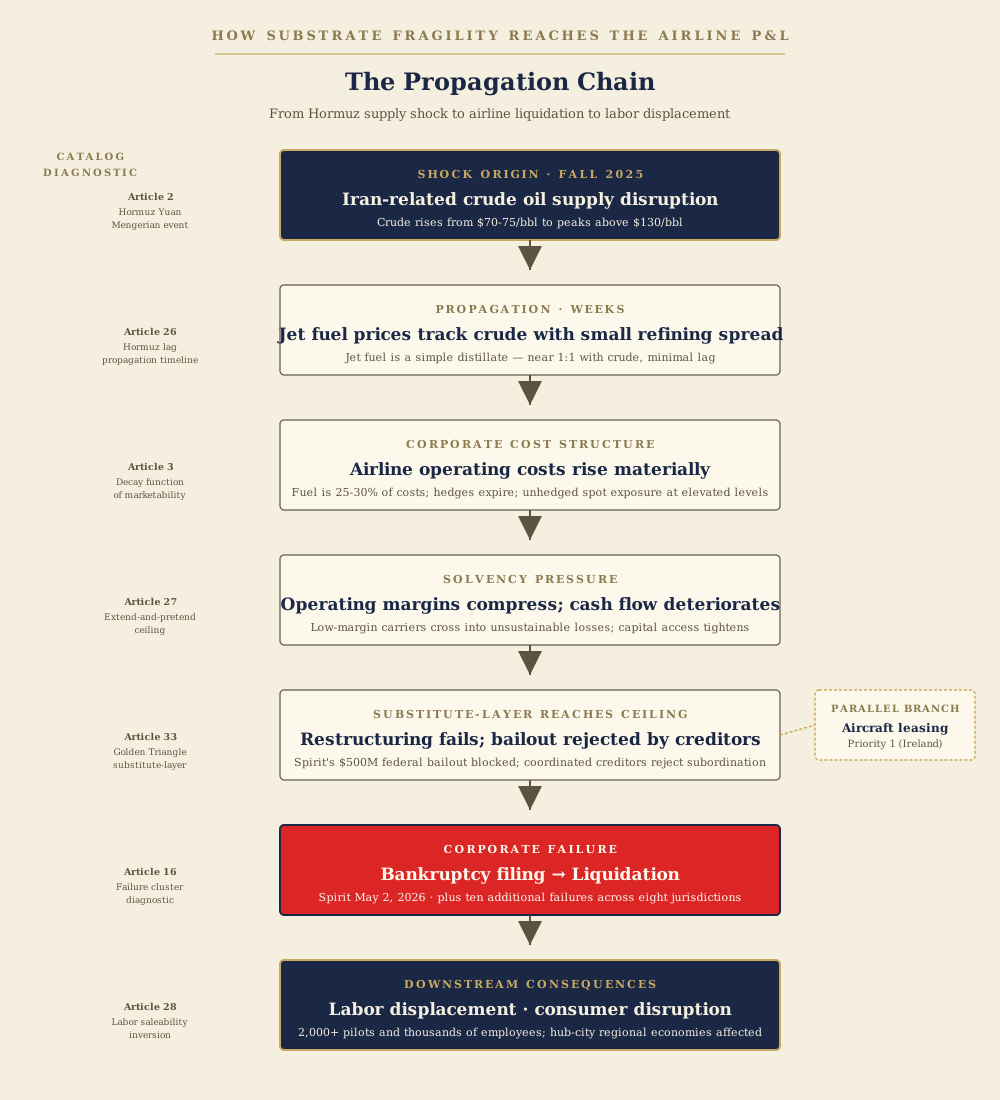
Spirit cited the rising cost of jet fuel as the immediate proximate cause of its collapse, and the attribution is not a rhetorical framing designed to shift blame — the specific numbers are on the record. Spirit's restructuring plan assumed jet fuel at roughly $2.24 per gallon for 2026 and $2.14 for 2027. 8 By the end of April 2026 the price was approximately $4.51 per gallon — a $2.27 variance against plan, which against Spirit's own disclosed per-dollar sensitivity implied on the order of $247 million in incremental annual fuel cost. 8 The restructuring plan's projected P&L required fuel prices in a specific range; when actual fuel prices roughly doubled against that range, the projected P&L was not achievable; when the projected P&L was not achievable, the restructuring plan lost creditor support; when the restructuring plan lost creditor support, the bankruptcy process could not produce an emergence outcome. The chain from fuel prices to bankruptcy failure is direct and traceable.
The framework's reading of Spirit through Article 26: Spirit is a specific case that the article's propagation-timeline diagnostic fits at the corporate solvency level. The ordering has to be stated honestly, because the essay's earlier drafting got it backwards. Article 26 was published on June 1, 2026, a month after Spirit shut down; its channel-by-channel propagation timeline was not a forecast that Spirit's May 2 collapse then satisfied. What the airline sector supplies is a datum the propagation framework accounts for — the sector combining the highest fuel cost share with the thinnest operating margins is where a crude shock converts into business failure first, and the Spirit shutdown sits where that logic puts it. Additional airline failures continuing through May and June are additional installments of the same trajectory. Subsequent failures in more downstream sectors (consumer discretionary retail, hospitality, transportation-adjacent services) are expected on later parts of the trajectory. Each specific corporate failure is diagnostic evidence of where the propagation has reached at that specific date.
The airline sector is thus not a special case; it is a leading indicator. The same substrate condition that produced the airline cluster is producing pressure in adjacent sectors that will produce corporate failures on their own subsequent trajectories. The catalog will continue documenting the trajectory as it unfolds.
Reading through Article 27 — the extend-and-pretend ceiling
Article 27 of this catalog, published on June 7, 2026, established the extend-and-pretend framework for reading commercial real estate distress. The core observation: when the underlying asset condition deteriorates in ways that would normally produce visible defaults and price adjustments, the affected creditors and equity holders often prefer to postpone recognition of the deterioration through debt extensions, covenant waivers, refinancing at par, and other mechanisms that preserve the accounting appearance of a functioning market while allowing the underlying condition to worsen. The article specified that this postponement has a ceiling — that eventually the accumulated substrate deterioration reaches a level where extension is no longer viable and the reckoning arrives all at once, often at substantial scale and often across multiple affected properties simultaneously.
Spirit's eighteen-month sequence from first Chapter 11 through failed restructuring through second Chapter 11 through failed bailout through liquidation is a case study in the extend-and-pretend ceiling operating in a different industry. The first Chapter 11 in November 2024 was the initial extension — a mechanism by which the accumulated substrate condition (thin operating margins, declining market share, competitive pressure from major carriers, aircraft leasing commitments that could not be renegotiated outside bankruptcy) could be temporarily deferred through debt reduction and operational restructuring. The March 2025 emergence was the pretense — the appearance that the restructuring had produced a viable ongoing business, that Spirit could operate profitably on the terms of its post-bankruptcy capital structure, that the underlying substrate condition had been adequately addressed. The second Chapter 11 in August 2025 was the ceiling being reached — the accumulated substrate condition had not been adequately addressed, the projected P&L had not materialized, and further restructuring was required.
The failed February 2026 restructuring support agreement, the failed April bailout, and the May 2 liquidation are the reckoning arriving all at once.
The pattern is structurally identical to what Article 27 documented in commercial real estate. In CRE, the extension mechanism operates through "extend-and-pretend" refinancings at par, through delayed loan modifications, through covenant waivers that allow continued operation of properties whose cash flows do not adequately service their debt. The pretense allows the properties to continue operating and the debt to continue appearing performing. The ceiling arrives when the accumulated substrate condition — deteriorated cash flows, elevated interest costs, structural occupancy declines in office and certain retail categories — reaches a level where the extensions can no longer be supported. Article 27 identified the ceiling in CRE as visible through forced fire-sale transactions occurring in specific submarkets as accumulated distress becomes unavoidable to recognize. The Spirit sequence is the same mechanism operating on an eighteen-month timescale rather than a multi-year one, with the more concentrated corporate structure allowing the ceiling to arrive more quickly than in the diffuse CRE context.
The framework's reading of the extend-and-pretend ceiling has broader implications for the airline sector as a whole. Multiple U.S. airlines beyond Spirit have been operating under progressively deteriorating conditions across 2024-2026. American Airlines, United Airlines, Delta Air Lines, and Southwest Airlines — the four majors that now hold roughly three-quarters of U.S. domestic seat capacity — have all faced various combinations of fuel cost pressures, labor cost pressures, aircraft delivery delays, and route profitability challenges. The four majors have institutional resources that Spirit did not: larger capital reserves, more diversified route networks, more effective fuel hedging programs, and closer relationships with government aviation policy apparatus that shape the regulatory environment. But the underlying substrate condition applies to all of them. The ceiling could arrive for other carriers on their own trajectories, with the specific timing depending on the institutional buffers each carrier has accumulated but the underlying trajectory shaped by the same substrate fragility that produced Spirit's failure.
The most institutionally significant near-term watch is the trajectory of the ultra-low-cost carrier segment beyond Spirit. Frontier Airlines and Allegiant Air occupy structurally similar competitive positions to Spirit — low-cost operators depending on cost discipline as their sole competitive advantage, exposed to the same fuel cost pressures, competing for the same price-sensitive leisure traveler segment. Both airlines have publicly announced strategic shifts across 2024-2026 — Frontier's "The New Frontier," which added transparent pricing, fee-free changes, and from late 2025 a first-class cabin; and Allegiant's November 2024 amendment of its Boeing agreement, pushing all fifty firm aircraft deliveries out to end-2027 from end-2025 — that acknowledge the deteriorating competitive environment. Neither has entered bankruptcy as of early July 2026. The framework does not predict specific bankruptcy timing for these carriers, but the underlying substrate condition that produced Spirit's failure is the same condition they operate within, and the extend-and-pretend ceiling that arrived for Spirit could arrive for other carriers on their own trajectories.
The bailout that didn't happen — substitute-layer construction reaching its own ceiling
The most analytically distinctive moment in the Spirit sequence was the failed federal bailout in the final week of April 2026. This is the moment that separates the Spirit case from the standard substrate-fragility pattern the catalog has documented and moves it into new analytical territory that the framework has not previously engaged.
The standard institutional response to major corporate distress in the United States since approximately 2008 has been direct government intervention through some combination of loan guarantees, direct capital injection, and asset purchases. The pattern was established by the 2008-2009 responses to the financial crisis: TARP support for the major banks, direct equity investment in General Motors and Chrysler, conservatorship of Fannie Mae and Freddie Mac, and the various Federal Reserve emergency lending facilities that provided substrate liquidity when private capital would not. The COVID-era responses in 2020-2021 extended the pattern: the Payroll Support Program provided direct grants and low-interest loans to the airline industry conditioned on employment retention, with $54 billion ultimately flowing to U.S. passenger carriers in exchange for warrants and stock — $25 billion under the CARES Act itself and a further $29 billion under two successor statutes in December 2020 and March 2021. 9 The Federal Reserve's expansion of its balance sheet during the same period added additional substrate liquidity through corporate bond purchases, primary and secondary market facilities, and other mechanisms.
The Spirit proposal in late April 2026 followed this standard template. Five hundred million dollars in cash from the federal government, provided directly to Spirit's post-bankruptcy entity in exchange for equity that would have given the government majority ownership. The magnitude was modest compared to the 2008-2009 auto industry investments (approximately $80 billion of TARP funds across GM, Chrysler, and GM's finance arm) or the COVID-era airline support (approximately $54 billion across passenger carriers). 9 The mechanism was familiar: direct equity in exchange for cash, government-as-owner rather than government-as-lender, alignment of federal fiscal exposure with the airline's operational recovery. If the deal had consummated, it would have been the standard substitute-layer response to a specific corporate failure, entirely consistent with the eighteen-year pattern of institutional intervention.
The deal did not consummate because the affected creditors rejected the terms. This is the analytically distinctive fact. The creditors did not reject federal intervention as such; they rejected the specific terms of the proposed transaction because those terms would have subordinated their existing claims to the new government equity position and reduced their expected recoveries below what they could obtain through a court-supervised liquidation. The creditors' fiduciary duty to their own beneficiaries — pension funds, insurance company investment portfolios, distressed-debt investors — required them to reject a proposed transaction that reduced their expected recoveries, regardless of the broader employment and consumer welfare consequences of Spirit's shutdown.
The framework's reading: this is the substitute-layer response reaching its own ceiling. The pattern of government intervention through direct capital injection depends on a set of institutional conditions that hold in some contexts and not in others. In 2008-2009, the government could inject capital into GM and Chrysler because the affected creditors were dispersed and did not have the coordinated legal standing to block the transaction — the bankruptcy court process was used to override individual creditor objections in the name of broader systemic stability. In 2020-2021, the airline support was provided as direct grants and low-interest loans rather than as equity injections that would have subordinated existing creditor claims, and the airlines had not yet entered bankruptcy at the point when the support arrived. The Spirit situation was structurally different: the airline was in Chapter 11 at the point when the bailout was proposed, existing creditors had specific legal claims that would be reduced by the proposed transaction, and the creditor group had the coordinated standing to block the transaction through the bankruptcy court process.
The Spirit case reveals that the substitute-layer construction that has been the default response to corporate distress for eighteen years depends on institutional conditions that are not always present. When those conditions are not present — when creditors are coordinated, when their fiduciary duties require them to reject subordination, when the bankruptcy court process provides them the legal standing to enforce their preferences — the standard institutional response cannot be deployed. The substitute-layer construction has a ceiling of its own, and the Spirit case is a specific example of what happens when that ceiling is reached.
The broader implication for the framework's ongoing documentation project is significant. Across the catalog's prior essays, the framework has consistently observed that the standard institutional response to substrate fragility has been to add additional substitute layers — additional government guarantees, additional central bank liquidity, additional accommodation for extend-and-pretend, additional avoidance of the substrate-condition reckoning. The framework's Watching the Cracks arc has been documenting the accumulated fragility from this pattern without predicting when the pattern itself would encounter its own limits. The Spirit case is a specific case where the pattern encountered its own limits. The framework does not predict how frequently this will occur in subsequent months, but the fact that it has now occurred once — in a case involving a major U.S. airline, a specific $500 million federal bailout proposal, and the explicit rejection by creditors — is a diagnostic milestone that deserves careful attention.
The framework's synthesis
The 2026 airline failure cluster is best read as the corporate-scale visible manifestation of the substrate fragility this catalog has been documenting across thirty-four prior essays. The specific mechanism — high fixed costs meeting elevated fuel costs meeting deteriorated capital access meeting substitute-layer financialization meeting extend-and-pretend ceilings meeting failed government intervention — is not unique to airlines. The airlines are the specific sector where these mechanisms converged first, most visibly, and at greatest institutional scale in the first half of 2026.
Each of the framework's prior diagnostic threads finds specific application in the airline cluster:
Article 26 (Hormuz Lag) — direct. Jet fuel is the propagation channel that carries the Iran-related crude supply shock into the airline P&L with the smallest refining-spread lag of any consumer-facing petroleum product. Airlines are the concentrated consumers of jet fuel. The propagation from Hormuz to airline bankruptcy is direct and traceable. The catalog's prior Hormuz predictions are validated at the corporate solvency level.
Article 27 (Extend-and-Pretend Ceiling) — structural. Spirit's eighteen-month sequence from first Chapter 11 through second Chapter 11 through failed restructuring through failed bailout through liquidation is a case study in the extend-and-pretend ceiling operating on a compressed timescale. The mechanism the article documented in CRE operates identically in airlines with the specific timing depending on the concentrated corporate structure rather than the diffuse CRE structure.
Article 16 (Two Failures a Year — FDIC banking pattern) — analogical, and only loosely so. Article 16 recorded two FDIC-insured bank failures in each of 2024, 2025, and the first five months of 2026, and read that low count not as a healthy normal but as the kind of quiet that has historically preceded systemic events. The analogy to airlines is therefore about the shape of the diagnostic, not a rate comparison: the airline sector has no established annual failure baseline of the FDIC kind, and this essay does not have one to offer. Ten airline-sector failures in six months across nine jurisdictions is a cluster on its face; putting a multiple on it would require a base rate the framework has not constructed.
Article 28 (Labor Saleability Inversion) — direct. Spirit's shutdown displaced approximately 2,000 pilots and thousands of additional employees immediately. The broader cluster's failures added additional displacement. The pilots have specialized skills and industry-specific credentials that will make transition partially manageable; non-pilot employees face the same saleability dynamics Article 28 documented across other sectors.
Article 33 (Golden Triangle — substitute-layer diagnostic) — structural. Aircraft leasing companies (Priority 1 as the direct example) represent the substitute-layer financialization of airline capital. The physical asset (aircraft) is one entity, the operating airline is a second entity, the leasing company is a third entity, the debt held against the leasing company by external creditors is a fourth entity — layers of substitute-paper stacked against the underlying physical substrate. When the airline layer fails, the leasing layer fails on its own timescale. Priority 1's early June 2026 administration is the substitute-layer failure at the aircraft-financing level, one abstraction removed from the operational airlines but ultimately dependent on the same substrate.
Article 34 (China physical clearing architecture) — contrast. The Chinese state's response to substrate fragility documented in Article 34 is structurally different from the failed U.S. bailout documented in this essay. China is constructing alternative institutional architecture (physical clearing infrastructure) rather than continuing substitute-layer expansion. The United States attempted substitute-layer expansion in the Spirit case (direct government equity injection) and could not execute it because creditor structures did not permit the transaction. The contrast is not a normative judgment about which response is better; it is a diagnostic observation about the different institutional trajectories the two jurisdictions are following.
The framework's job across the catalog has been to make substrate fragility visible through specific empirical analysis. The airline cluster is a specific empirical manifestation. The failed Spirit bailout is a specific empirical demonstration that the standard institutional response has limits. The broader pattern that this specific event represents is the ongoing substrate condition the catalog has been documenting, now visible at the corporate solvency layer in a way that mainstream financial commentary is beginning to notice but has not yet framed as the systemic phenomenon it represents.
The closing observation
Spirit Airlines was the first major U.S. airline to shut down completely in twenty-five years. The framework's prediction is that Spirit will not be the last major airline to shut down in the current substrate-fragility cycle. The specific timing of subsequent failures depends on the institutional buffers each remaining carrier has accumulated — capital reserves, hedging positions, creditor relationships, government relationships, fleet flexibility — but the underlying substrate condition that produced Spirit's failure is the same condition all carriers operate within. The extend-and-pretend ceiling that arrived for Spirit could arrive for other carriers on their own trajectories.
The framework's more consequential prediction is that the failed Spirit bailout is not a one-time institutional anomaly. The substitute-layer construction pattern that has been the default response to corporate distress for eighteen years depends on institutional conditions that are not always present, and the framework's reading is that these conditions will be present less frequently going forward as accumulated substitute-layer complexity produces more coordinated creditor structures with the standing and the fiduciary obligation to reject transactions that subordinate their claims. The failed Spirit bailout is a specific case; the underlying institutional dynamic could produce additional cases in subsequent corporate distress situations across multiple sectors.
The catalog's ongoing project will continue documenting the trajectory as it unfolds. Upcoming installments will engage subsequent airline failures if they occur, adjacent sector failures on their own trajectories, the July CPI and PCE releases as continuing validation of the Article 26 Hormuz lag, the July 24 ICBC cessation as continuing validation of the Article 34 China gold architecture, the July FOMC meeting as continuing test of the Article 32 Warsh institutional pivot, and any additional substrate-fragility manifestations that arrive in the empirical record. The work continues.
The Spirit shutdown on May 2, 2026, is a specific event with specific consequences for specific pilots and specific employees and specific passengers and specific creditors. It is also a diagnostic milestone in the broader trajectory this catalog has been documenting. The framework reads what has arrived. The framework records what has arrived for future testing. The work continues.
This is the sixteenth installment of "Watching the Cracks." The framework's predictions recorded here for future testing: (1) At least one additional major U.S. airline enters Chapter 11 bankruptcy protection within twelve months, with the ultra-low-cost carrier segment (Frontier, Allegiant) at highest structural risk based on business-model exposure; (2) The broader airline failure cluster continues through the second half of 2026 across multiple jurisdictions, with additional cargo airlines, regional carriers, and specialized aircraft leasing entities at highest structural risk; (3) At least one additional attempted federal bailout of a distressed major corporation encounters coordinated creditor rejection in the model of the failed Spirit transaction, with the specific sector unpredictable but the mechanism now demonstrated; (4) Aircraft leasing sector distress continues through 2026, with additional major leasing companies entering administration or bankruptcy as the multi-carrier failure cluster produces oversupplied secondary lease markets; (5) Labor displacement from the airline cluster produces measurable second-order effects on airport-adjacent regional economies (Fort Lauderdale, Detroit, Chicago, Las Vegas, Newark, Los Angeles, Miami, Orlando) that will be visible in Q3-Q4 2026 employment data. The chart accompanying this essay documents the 2026 airline failure cluster timeline; the propagation chain diagram traces the causal mechanism from crude oil supply shock through jet fuel prices to airline P&L to bankruptcy to labor displacement. The next installment of "Watching the Cracks" will engage subsequent developments in this trajectory as they arrive.
Sources
Footnotes
-
Spirit Airlines ceased operations on 2 May 2026 in an orderly wind-down, announced late on 1 May / early on 2 May. Operating and financial history via BTS TranStats (https://www.transtats.bts.gov/) and the company's SEC filings (https://www.sec.gov/edgar/search/). ↩
-
Air Line Pilots Association statements, May 2026. https://www.alpa.org/news-and-events — ALPA put immediate pilot losses at "more than 2,000 ALPA Pilots"; total employment was about 17,000. ALPA president Jason Ambrosi called it a "devastating blow." ↩
-
Spirit Airlines corporate history and SEC filings. https://www.sec.gov/edgar/search/ — Spirit was founded in 1983 as Charter One, in Macomb County, Michigan, by Ned Homfeld. The shutdown coverage uniformly described a 34-year operating history dating from the 1992 conversion to scheduled service. ↩
-
U.S. airline Chapter 11 histories via BTS TranStats. https://www.transtats.bts.gov/ — The claim that eight major U.S. airlines filed for Chapter 11 and that every one emerged or was acquired depends entirely on how "major" is drawn and does not survive a strict reading. CNN's framing — the first major U.S. airline shutdown since Midway in September 2001 — is threshold-dependent and is attributed to CNN rather than asserted as a category fact. ↩
-
Spirit Airlines Chapter 11 filings and restructuring disclosures. https://www.sec.gov/edgar/search/ — The debtor-in-possession facility, the proposed reduction in debt and lease obligations, and reported debts at the wind-down. ↩ ↩2 ↩3 ↩4 ↩5
-
Bureau of Transportation Statistics, domestic passenger share by carrier. https://www.transtats.bts.gov/ — Spirit's share of domestic passengers falling across 2025 and 2026. ↩ ↩2 ↩3
-
International Air Transport Association industry outlook. https://www.iata.org/en/publications/economics/ — Fuel at 25.4% of total operating expenses in 2025 with a higher share projected for 2026, and the industry fuel bill. ↩
-
U.S. Energy Information Administration, jet fuel and Brent spot prices. https://www.eia.gov/petroleum/ — Dated Brent after the strikes and the jet fuel price path against the restructuring plan's assumption. ↩ ↩2 ↩3
-
U.S. Treasury, CARES Act Payroll Support Program and airline loan facilities. https://home.treasury.gov/policy-issues/coronavirus/assistance-for-american-industry — The 2020–21 support totals and the warrants and equity taken in exchange. ↩ ↩2
On the record
This essay logged 5 dated predictions
1 has since been scored; 4 remain open.
- OpenThe broader airline failure cluster continues through the second half of 2026 across multiple jurisdictions, with additional cargo airlines, regional carriers, and specialized aircraft leasing entities at highest structural risk.
- OpenAircraft leasing sector distress continues through 2026, with additional major leasing companies entering administration or bankruptcy as the multi-carrier failure cluster produces oversupplied secondary lease markets.
- OpenLabor displacement from the airline cluster produces measurable second-order effects on airport-adjacent regional economies — Fort Lauderdale, Detroit, Chicago, Las Vegas, Newark, Los Angeles, Miami, Orlando — visible in Q3–Q4 2026 employment data.
- OpenAt least one additional major U.S. airline enters Chapter 11 bankruptcy protection within twelve months, with the ultra-low-cost carrier segment (Frontier, Allegiant) at highest structural risk based on business-model exposure.
- Partially ResolvedAt least one additional attempted federal bailout of a distressed major corporation encounters coordinated stakeholder rejection in the model of the failed Spirit transaction, with the specific sector unpredictable but the mechanism now demonstrated.
Related essays
The Operational Substitute Layer: A Firsthand Account from Inside the Machinery
In late 2008, the Reserve Bank of New Zealand required the country's major banks to construct residential mortgage-backed securitization infrastructure as a condition of access to central bank liquidity. I arrived at the Bank of New Zealand as a contractor at the peak of the global financial crisis to build that infrastructure. Over the following five years I watched, from inside, how one specific node of the operational substitute layer was constructed, expanded, and integrated into the central bank's standing facilities — including building software to physically back up the mortgage documentation onto external hard drives so they could be carried out of the building if the bank failed. This is the story of what the substitute layer actually looks like when you are building it.
The Dossier Economy: A Firsthand Account from Inside the Personal Data Substitute Layer
In 2024, a Florida-based data broker called National Public Data — operated by a former Florida sheriff through a company filed as Jerico Pictures, Inc. — exposed approximately 2.9 billion records containing names, dates of birth, current and past addresses, Social Security numbers, and telephone numbers of people in the United States, United Kingdom, and Canada. The company filed for bankruptcy. The California Privacy Protection Agency sought to recover a $46,000 administrative fine. New owners acquired the domain. The aggregation infrastructure continues to operate. From December 2015 through December 2020, I led the core API team at Emailage — a Phoenix-based fraud prevention company acquired by LexisNexis Risk Solutions for $480 million in a transaction that closed in 2020. My team built the technical infrastructure that connects fraud-relevant data sources into composite risk profiles, returned through a single API call typically within one to one-and-a-half seconds. This essay engages the personal data economy as the framework's most ubiquitous substitute layer, drawing on direct operational experience from inside one of its core nodes.
Why Gold Didn't Spike: A Fekete Diagnosis of the Iran War
During the 2026 Iran war, gold fell rather than rose and central banks turned net sellers in March. Standard gold-bug frameworks cannot explain this. Antal Fekete's backwardation framework predicted exactly this pattern twenty years ago.