
Researched and drafted with AI assistance · reviewed and edited by Jason D. Keys
On Friday, March 6, 2026, the U.S. International Development Finance Corporation issued a press release announcing what its CEO Ben Black framed as a plan to restore confidence in maritime trade and stabilize international markets, offering, in his words, "a level of security no other policy can provide." The DFC, working alongside U.S. Treasury Secretary Scott Bessent and coordinating with U.S. Central Command, would deploy up to $20 billion in maritime reinsurance capacity to restore commercial shipping through the Strait of Hormuz. 1 The facility was framed as an emergency response to what had become, by that first week of March, a near-total collapse in commercial transits through the world's most critical energy chokepoint. Roughly twenty percent of global oil supply and roughly one-quarter of global crude and petroleum maritime trade normally passed through the eighteen-nautical-mile-wide strait between Iran and Oman; estimates of the share of China's own crude imports moving through it range from under 40 percent on Chinese customs data to 45 or 50 percent in other analyses. 2 In the seven days between the February 28, 2026 U.S. and Israeli airstrikes on Iranian targets and the DFC's March 6 announcement, that passage had ceased almost entirely.
Twenty-eight days later, on April 3, 2026, the DFC and Chubb — the American property and casualty insurer that had been named lead underwriter — announced that the facility would be doubled to $40 billion with the addition of six additional U.S. insurance partners: Travelers, Liberty Mutual, Berkshire Hathaway, AIG, Starr Companies, and CNA Financial. 3 Under the expanded structure, half of the $40 billion would be assumed by the U.S. government through DFC, and half by the seven private insurers, with Chubb serving as lead underwriter with authority to set prices and terms, issue policies, assume risk, and manage claims. 4 The facility would provide War Marine Risk Insurance for Hull and Liability, War Hull Risk Insurance for War Protection and Indemnity (P&I), and War Cargo Insurance. Eligibility would be controlled through a multi-agency vetting process including sanctions screening and detailed disclosures on vessel ownership, cargo, and financing. CNA chairman and chief executive Douglas M. Worman, quoted in the DFC's announcement, described the initiative as demonstrating "how public and private partners can come together to address real-world risk." gCaptain's assessment was that the scale of the program and the speed with which major insurers joined it signaled "strong alignment between Washington and the insurance industry."
Six weeks later, in mid-May 2026, a series of industry reports from Insurance Business, Reinsurance News, and (Re)in Asia confirmed what had been widely known within specialist marine war-risk underwriting circles for approximately six weeks: the DFC facility had written zero policies. Not one dollar of coverage had been placed. Not one vessel had transited the strait under its protection. The DFC issued a statement to the Daily Caller News Foundation on May 17 confirming the situation while preserving optionality: "There are no active policies at this time. DFC is in close coordination with the White House and interagency partners. If needed, DFC's Maritime Reinsurance facility will provide $40 billion of coverage to deliver on President Trump's directive to help restore maritime trade through the Strait of Hormuz."
The market's response to the DFC facility, from the first week of its announcement through the mid-May zero-policy confirmation and continuing through the June 19 launch of a competing private-market consortium, has been consistent and unambiguous. The Lloyd's Market Association issued a public statement on March 23, 2026 — seventeen days after the initial DFC announcement — directly addressing what the LMA characterized as misinformation about the state of the insurance market: "three weeks since the start of the hostilities in the Middle East, we are still seeing reports that suggest insurance coverage is cancelled or unaffordable and that this is the reason that vessels are not transiting the Strait of Hormuz. This is not accurate." A survey of Lloyd's marine war market participants conducted in the same window found that 88% retained appetite to write hull war risks and over 90% continued to offer cargo coverage. 5 Steve Ogullukian, deputy global underwriting director and reinsurance director at the American P&I Club, was direct in his subsequent public commentary: the reduced traffic through the strait had nothing to do with insurance availability. It was, in his precise formulation, "purely just a captain or a shipowner not wanting to put their crew at risk."
The DFC facility was designed, in the words of a Chubb spokesperson quoted in the Financial Times, "to insure ships while transiting under naval escort" — and there has been no escort at scale. Two U.S.-flagged merchant vessels transited the strait in early May under a CENTCOM effort designated Project Freedom, involving destroyers, over one hundred land- and sea-based aircraft, multi-domain unmanned platforms, and roughly fifteen thousand service members. 6 Project Freedom was not, on CENTCOM's own description, a close-escort regime in the manner of the 1980s Earnest Will reflagging operation: Admiral Brad Cooper described a mapped safe transit lane and a broad defensive umbrella rather than ship-by-ship escort, telling reporters that "we have a much broader defensive package than you would have if you request" an escort. The naval escort the insurance product was written around never materialized beyond that initial demonstration.
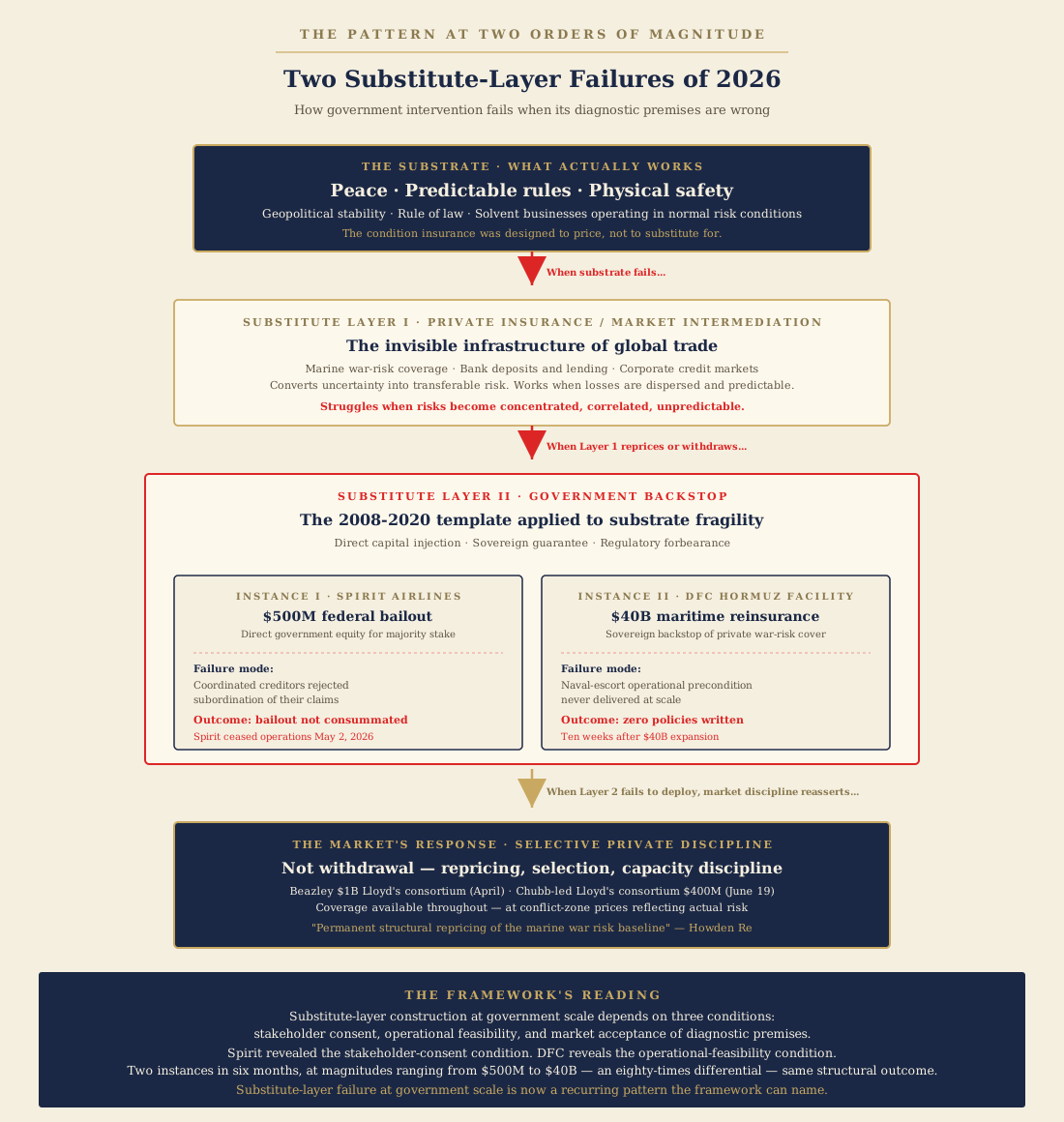
This essay is the seventeenth installment of Watching the Cracks. It reads the DFC Maritime Reinsurance Facility as the second substitute-layer failure at government scale in 2026, following the failed $500 million federal bailout of Spirit Airlines documented in Article 35 of this catalog. 1 The two events occurred within the same six-month window. They involve different institutional actors (the DFC and the U.S. Bankruptcy Court for the Southern District of New York) and different specific mechanisms (reinsurance provision and equity injection). But they share the same structural pattern: the U.S. government attempts direct intervention in an event of substrate fragility using the standard 2008-2020 template of substitute-layer construction, the market's response signals that the intervention has misdiagnosed the underlying problem, and the announced capacity remains substantially or entirely unutilized. The magnitudes differ by a factor of eighty. The mechanism is identical.
The essay proceeds in eight sections. First, the specific mechanism of the DFC facility's design and rollout, including its statutory context and the operational preconditions on which it depended. Second, why the facility failed — the diagnostic misreading of the underlying problem and the naval escort precondition that never materialized. Third, the analytical parallel to Article 35's Spirit Airlines case: two 2026 instances of substitute-layer failure at government scale.
Fourth, the DFC's institutional mission drift from emerging-markets development finance to critical-energy-chokepoint backstop as a case study in federal agency repurposing. Fifth, Chubb's simultaneous role as lead underwriter of both the failed government facility and the successful private Lloyd's consortium — a specific institutional actor voting with its capital on where insurance actually functions. Sixth, the parallel institutional architectures being constructed across multiple jurisdictions (the U.S. DFC facility, China's physical clearing architecture from Article 34, Iran's Bitcoin-backed insurance response). Seventh, the June 17 coincidence: Warsh's first FOMC meeting and the Trump-Pezeshkian Memorandum of Understanding as institutional acknowledgments arriving on the same day that prior approaches had reached their operational limits. Eighth, the framework's synthesis of what the DFC facility reveals about the broader trajectory this catalog has been documenting.
The specific mechanism
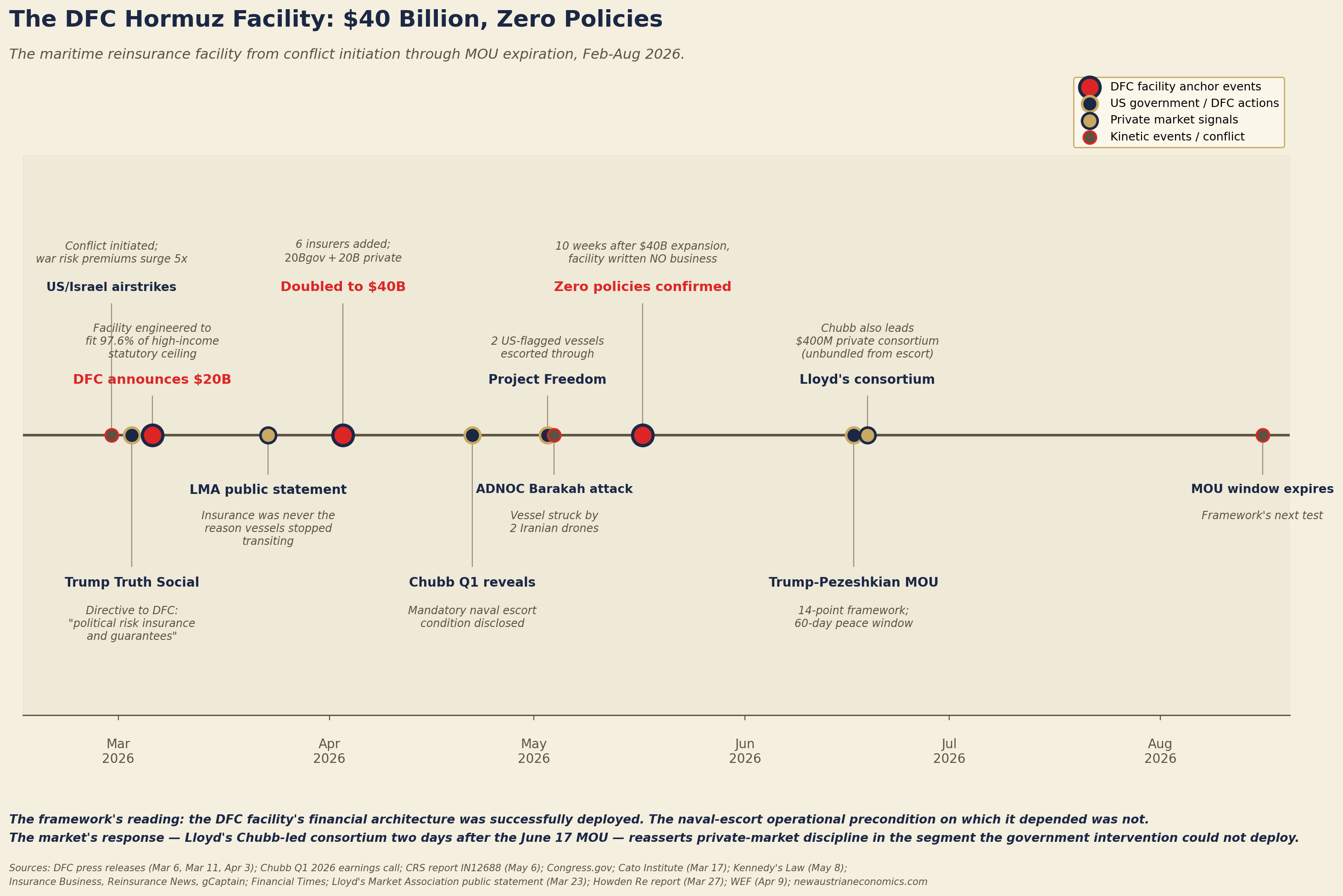
The DFC Maritime Reinsurance Facility was announced in stages across March and April 2026 through a coordinated sequence of executive directives, agency press releases, and industry participation announcements. Understanding the specific mechanism requires attention to the timeline, the statutory constraints, and the operational preconditions that were built into the facility from its inception.
The prelude — February 28 through March 5. U.S. and Israeli forces initiated military operations against Iranian targets on February 28, 2026. Iran responded within twenty-four hours with retaliatory attacks and threats against commercial shipping transiting the strait, and multiple commercial vessels were struck in the opening days; Human Rights Watch subsequently reported seventeen United Nations-confirmed incidents of damage to commercial vessels between March 1 and March 17. War-risk premiums surged roughly fivefold within forty-eight hours, from about 0.2 percent of hull value to as much as 1 percent. 7 Major marine insurers issued cancellation notices effective March 1 for vessels traveling through the Persian Gulf, Gulf of Oman, and Strait of Hormuz. The Joint War Committee of the Lloyd's Market Association redesignated the entire Arabian Gulf as a conflict zone under its listed-area framework, triggering the requirement for Additional Premium (AP) cover for any transit. Pre-conflict, a transit AP through the strait had run at approximately 0.125 to 0.25 percent of hull value. 7 By early March, premiums for Strait of Hormuz transits had risen to between 1.5 and 3 percent, with U.S., U.K., and Israeli-linked vessels paying closer to 5 percent according to Lloyd's 7 List.
For a Very Large Crude Carrier (VLCC) valued at approximately $138 million, that translated to indicative voyage premiums of between $10 million and $14 million per trip — against a pre-war baseline measured in hundreds of thousands. 5 Ship-tracking data showed tanker traffic down roughly 70 percent in the days immediately following the airstrikes — before Iran formally declared the strait closed on March 4. 8 The strait was commercially unnavigable before it was militarily dangerous.
March 3 — the directive. President Trump posted on Truth Social on March 3, 2026: "Effective IMMEDIATELY, I have ordered the United States Development Finance Corporation (DFC) to provide, at a very reasonable price, political risk insurance and guarantees for the Financial Security of ALL Maritime Trade, especially Energy, traveling through the Gulf. This will be available to all Shipping Lines. If necessary, the United States Navy will begin escorting tankers through the Strait of Hormuz, as soon as possible. No matter what, the United States will ensure the FREE FLOW of ENERGY to the WORLD. The United States' ECONOMIC and MILITARY MIGHT is the GREATEST ON EARTH — More actions to come." The directive was addressed to the DFC, an agency established under the BUILD Act of 2018 to catalyze private capital in emerging markets by consolidating the functions of the Overseas Private Investment Corporation (OPIC) and the Development Credit Authority of the U.S. Agency for International Development (USAID). The DFC had historically focused on nature conservation and economic growth projects in developing economies. Its portfolio at the end of 2025 totaled approximately $42 billion, of which approximately $1 billion was Political Risk Insurance. 9
March 6 — the announcement. Three days after the Truth Social directive, the DFC issued a formal announcement of a $20 billion maritime reinsurance facility. The Congressional Research Service noted in its subsequent May 6 analysis (DFC Shipping Reinsurance Facility: Iran Conflict and Strait of Hormuz, CRS Insight IN12688) that the $20 billion figure was "almost ten-fold larger than any active DFC commitment." The DFC's initial announcement specified that the coverage would apply only to vessels that "meet the criteria" (unspecified), would focus on Hull and Machinery and Cargo to start, and would coordinate with the U.S. Treasury and CENTCOM on implementation. The statutory context provides the explanation for the $20 billion figure. The Fiscal Year 2026 National Defense Authorization Act had raised the DFC's maximum contingent liability to $205 billion, but no more than 10 percent of that capacity could be used in high-income countries. 1 Ten percent of $205 billion equals $20.5 billion. 1 The announced facility was engineered to fit precisely within the high-income capacity ceiling — a fact that, as the Cato Institute observed in a March 17 blog post ("Trump's War Insurance Decree Meets Reality"), makes the facility look "designed to fit within that ceiling."
March 11 through March 20 — Chubb formalized. The DFC announced on March 11 that Chubb, the American-listed property and casualty insurer, would serve as lead underwriter for the facility. Chubb would set prices and terms, issue policies for eligible vessels, assume risk, and manage all claims. On March 20, Chubb issued its own press release specifying the coverage types: War Marine Risk Insurance for Hull and Liability as well as Cargo, with specific offerings for War Hull Risk Insurance, War P&I Insurance, and War Cargo Insurance. During this period, additional American insurers were identified as prospective participants, though the formal expansion would not occur for another two weeks.
April 3 — the doubling. The DFC and Chubb jointly announced the addition of six insurance partners: Travelers, Liberty Mutual, Berkshire Hathaway, AIG, Starr, and CNA. The facility capacity doubled to $40 billion on a rolling basis, with $20 billion assumed by DFC (i.e., the U.S. government) and $20 billion by the seven participating insurers. Ajit Jain, Vice Chairman of Berkshire Hathaway Insurance Operations, commented that the initiative demonstrated "how our industry can help to meet important needs as they arise." Douglas Worman of CNA framed it as demonstrating "how public and private partners can come together." Eric Andersen of AIG called the coverage "vital to supporting global commerce and stability."
April 22 — the operational precondition revealed. During Chubb's Q1 2026 earnings call on April 22, CEO and Chairman Evan Greenberg provided the operational detail that would prove decisive in explaining the facility's subsequent failure to write policies. Greenberg stated that any vessels seeking escort through the Strait of Hormuz by the U.S. Navy would be required to obtain mandatory insurance coverage through the DFC Maritime Reinsurance Facility. The facility was not standalone insurance available to any shipping line meeting the eligibility criteria. It was bundled with a U.S. government security regime — specifically, the availability of U.S. naval escort — and eligibility for the escort was conditioned on purchase of the insurance. The facility's operational logic was that vessels wanting to transit safely would need both the insurance (available exclusively through the DFC facility) and the naval escort (available only to insured vessels).
April 28 — OFAC FAQ 1249. The Office of Foreign Assets Control issued FAQ 1249 on April 28, 2026, clarifying that payments to the Government of Iran or the Islamic Revolutionary Guard Corps, directly or indirectly, for safe passage through the Strait of Hormuz would not be authorized for U.S. persons, including U.S. financial institutions and U.S.-owned or -controlled foreign entities. The FAQ further specified that such payments would create significant sanctions exposure for non-U.S. persons, including foreign financial institutions. This closed off a pathway that some shipowners had reportedly been exploring — direct payment to Iranian authorities in exchange for guaranteed transit — and further concentrated the operational choice on either DFC-covered U.S.-escorted transit or non-transit entirely.
Early May — Project Freedom. CENTCOM forces began supporting an operation designated Project Freedom on Sunday, May 3, 2026, and Admiral Brad Cooper, the CENTCOM commander, enumerated the force package on a media call the following day: guided-missile destroyers, over one hundred land- and sea-based aircraft, multi-domain unmanned platforms, and approximately fifteen thousand service members. The operation was not a close escort of individual merchantmen. Cooper described a mapped safe transit lane covered by aircraft and helicopters — "we have a much broader defensive package than you would have if you request" an escort — with commercial vessels transiting on their own bottoms. Two U.S.-flagged merchant vessels had transited as of midday on Monday, May 4. Cooper stated on that call: "We've now opened a passage through the Strait of Hormuz to allow for the free flow of commerce to proceed." The same day, the Panama-flagged, ADNOC Logistics and Services-operated tanker Barakah, in ballast, was struck by two Iranian drones off the coast of Oman; the UAE condemned the strike as an act of IRGC piracy. 8 The passage declared open on May 3 saw a commercial vessel attacked on May 4. No additional vessels have transited under Project Freedom in the subsequent weeks. The DFC facility, which was designed to insure vessels transiting under naval escort, has correspondingly written no policies — and since the facility had written none as of the mid-May confirmation, the two Project Freedom vessels cannot have been covered under it.
Mid-May — the zero-policy disclosure. Between May 15 and May 18, a coordinated series of industry reports from Insurance Business, Reinsurance News, (Re)in Asia, and the Daily Caller News Foundation confirmed that the DFC facility had written zero policies since its March 6 announcement. The DFC's official position, provided by a spokesperson to the DCNF on May 17, was: "There are no active policies at this time. DFC is in close coordination with the White House and interagency partners. If needed, DFC's Maritime Reinsurance facility will provide $40 billion of coverage to deliver on President Trump's directive to help restore maritime trade through the Strait of Hormuz." The "if needed" framing is analytically significant. Two and a half months after the initial $20 billion announcement, six weeks after the $40 billion expansion, and following the operational demonstration of Project Freedom with two transiting vessels, the DFC's own institutional posture had shifted from active provision to contingent availability.
Why the facility failed — the problem misdiagnosis
The mid-May zero-policy disclosure did not represent a program in transition, awaiting operational refinement, or facing implementation challenges that would be resolved through additional Treasury coordination. It represented a structural mismatch between the intervention's design and the actual condition it was designed to address. The market had been consistent about the nature of the mismatch since the first week of the facility's announcement. The intervention was calibrated to a diagnosis of the problem that the underwriting community, the marine broker community, and the shipping-line operational leadership had all publicly and privately rejected from the beginning.
The specific misdiagnosis is worth naming precisely. The DFC facility was designed on the premise that limited insurance capacity was the operational obstacle preventing vessels from transiting the Strait of Hormuz. If insurance capacity was the constraint, then providing additional capacity through a government-backed reinsurance facility would relieve the constraint and permit transits to resume. This diagnosis is not implausible on its face; some commercial insurance interventions in prior conflict zones (the Ukraine grain corridor arrangements of 2022-2023, the various war-risk facilities established during the Iran-Iraq war of the 1980s) had operated on similar premises with meaningful, if partial, success.
But the diagnosis was wrong in this specific case. The Lloyd's Market Association's public statement on March 23, 2026 — issued seventeen days after the initial DFC announcement, at a moment when the LMA judged that the misdiagnosis needed to be corrected in the public record — was explicit: "three weeks since the start of the hostilities in the Middle East, we are still seeing reports that suggest insurance coverage is cancelled or unaffordable and that this is the reason that vessels are not transiting the Strait of Hormuz. This is not accurate." A survey of Lloyd's marine war market participants found 88 percent retained appetite to write hull war risks and over 90 percent continued to offer cargo coverage throughout the crisis. 5 Coverage was available; it was priced at conflict-zone rates (up to 5 percent of hull value for U.S., U.K., and Israeli-linked vessels, versus 0.125 to 0.25 percent pre-conflict), which was expensive but structurally normal for the underlying risk conditions.
The actual constraint on transits was crew and vessel safety in an active kinetic conflict zone with mined waters, contested airspace, and an Iranian state actor that had demonstrated capacity and willingness to attack commercial vessels. Steve Ogullukian's characterization from the American P&I Club deserves direct quotation: "The main takeaway here is that the reduced traffic going through the Strait has nothing to do with what insurance is available or not available. It's purely just a captain or a shipowner not wanting to put their crew at risk." An insurance policy — whether provided by Lloyd's syndicates at conflict-zone rates or by the DFC-backed facility at rates determined by Chubb — does not remove the underlying risk. It transfers the financial consequences of the risk from the shipowner to the insurer. For a shipowner or ship captain considering whether to send crew through a mined and contested strait, the availability of insurance does not change the physical safety calculation. Their crew is still going through mined waters. Their vessel is still exposed to Iranian drone and missile attack. The financial reimbursement in the event of loss does not compensate for the deaths, injuries, or vessel destruction that would trigger the reimbursement.
The DFC's own operational architecture implicitly acknowledged this reality. The facility was designed to be paired with U.S. Navy escort, which would provide the physical protection that insurance cannot provide. Under the coupled design — insurance plus escort — the shipowner would receive both financial protection (through DFC coverage) and physical protection (through naval escort). The financial protection was ready from March 6. The physical protection, as of early July 2026, has been provided to two vessels under a single operational demonstration in early May and to no additional vessels since. The Chubb spokesperson's terse framing to the Financial Times captures the operational reality: "The DFC programme's purpose is to insure ships while transiting under naval escort, and there has been no escort."
This is the structural mismatch the framework must engage. The DFC facility was not a badly implemented good idea; it was a well-implemented misdiagnosis. The financial architecture worked. Chubb was named lead underwriter, six additional insurers joined the facility, the statutory ceiling was engineered to fit within DFC's high-income capacity, and the vetting process was operational. The operational precondition on which the entire architecture depended — sustained U.S. Navy escort of commercial vessels through the strait — was not something the DFC could deliver. It required decisions and resource commitments from CENTCOM, the Department of Defense, and ultimately the White House that have not been made at the scale required for the facility to function. The zero-policy outcome is the direct consequence.
The Kennedys analysis of the situation, published May 8, captured the deeper analytical point: "The original rationale of the DFC Maritime Reinsurance Facility was to provide ships navigating the Strait with a government backed insurance program to resume the flow of ships and alleviate impacts on global trade. However, this rationale incorrectly assumed that limited insurance capacity was an obstacle preventing ships from transiting the Strait of Hormuz. However, additional considerations and concerns outside the availability of insurance, such as vessel safety, physical safety of crew, additional legal hurdles of the blockade and risks of further escalation of the conflict still continue to dissuade many vessels from attempting transit of the Strait."
Insurance Business's June 26 retrospective on the war-risk market put it more bluntly still: "The problem was not that underwriters had walked away from the Strait. The problem was a war, and the DFC cannot reinsure a war into safety." The framework's reading concurs. Insurance is a mechanism for transferring the financial consequences of risk from one party to another. It is not a mechanism for eliminating risk. When the underlying risk is a state actor with anti-ship capabilities operating in a contested waterway with mined approaches, no financial mechanism — no matter how large — can substitute for the physical safety that only military escort or geopolitical resolution can provide.
The two substitute-layer failures of 2026
The DFC facility's zero-policy outcome constitutes the second instance in 2026 of what this essay will call substitute-layer failure at government scale. Article 35 of this catalog documented the first without naming it that way, reading Spirit as a substitute-layer failure at the aircraft-financing layer. The pattern deserves explicit engagement, because it now represents a repeated empirical finding rather than a discrete anomaly.
Article 35 documented the failed federal bailout of Spirit Airlines in late April 2026. The specific mechanism there: Spirit Airlines was in Chapter 11 bankruptcy protection at the time; the Trump administration offered $500 million in exchange for equity that would have given the federal government a majority stake in the post-bankruptcy Spirit; the existing creditors rejected the transaction because it would have subordinated their claims and reduced their recoveries below what they projected to obtain through court-supervised liquidation; the transaction did not consummate; and Spirit ceased operations on May 2, 2026, becoming the first major U.S. airline to shut down completely since Midway Airlines in September 2001.
Article 35 named the pattern: the standard 2008-2020 substitute-layer response — direct government equity injection in the pattern of the GM/Chrysler bailouts, the COVID-era airline Payroll Support Program, and the Fannie/Freddie conservatorship — was attempted at Spirit and did not succeed. The article recorded a specific prediction, without a stated time window: "At least one additional attempted federal bailout of a distressed major corporation encounters coordinated creditor rejection in the model of the failed Spirit transaction, with the specific sector unpredictable but the mechanism now demonstrated."
The DFC Hormuz facility is the second empirical instance of the same category of institutional failure. The specific mechanism is different — reinsurance provision rather than equity injection, statutory agency deployment rather than bankruptcy-court intervention, sovereign backstop of private insurance rather than direct capital infusion into a distressed corporation. But the underlying pattern is structurally identical. In both cases: the U.S. government identified a specific corporate or sectoral distress event; the government applied the standard 2008-2020 template of direct institutional intervention; the intervention was designed on a diagnosis that the market subsequently rejected as incorrect; the announced capacity was substantial ($500 million at Spirit, $40 billion at DFC); and the actual utilization was zero (no consummated bailout at Spirit, no written policies at DFC).
The differences between the two instances are worth naming carefully, because they reveal what generalizes about the pattern and what remains case-specific. At Spirit, the failure mode was creditor rejection: a specific class of stakeholders with legal standing to block the transaction exercised that standing because their fiduciary duty required it. At DFC, the failure mode was operational precondition non-fulfillment: the naval escort that made the insurance product useful was not provided at scale. In Article 35's Spirit case, the substitute-layer construction was attempted and immediately failed because the affected stakeholders had explicit standing to reject the terms. In the DFC case, the substitute-layer construction was constructed successfully at the financial and administrative levels, but the operational architecture on which it depended (naval escort) was not delivered by the separate government actors (DoD, CENTCOM) whose participation would have been required.
The magnitudes differ by a factor of eighty. Five hundred million dollars is a modest transaction by 2026 corporate-finance standards; $40 billion is a substantial commitment even by federal-agency standards. The scale difference matters analytically because it demonstrates that the pattern is not confined to modest-sized interventions. When the mechanism fails, it can fail at very substantial scale.
The temporal proximity is also analytically significant. Both events occurred in the first half of 2026. The DFC facility was announced March 6; the Spirit bailout was proposed in late April and rejected in late April to early May; Spirit's shutdown followed on May 2; the DFC facility's zero-policy status was confirmed in mid-May. The two substitute-layer failures thus occurred within a ten-week window. It should be said plainly that this is not a confirmed prediction: the DFC facility was announced four months before Article 35 was published and its zero-policy status was on the public record seven weeks before it, so the second instance was already available when the first was written. What the DFC case supplies is not confirmation of a forecast but a second contemporaneous observation of the same category of failure, developing in parallel to Spirit throughout the same period.
What the pattern reveals: the substitute-layer construction template that has been the default federal response to substrate fragility since 2008 depends on institutional conditions that are not always present. Article 35's specific analytical formulation deserves restatement here because it applies directly to the DFC case: "The pattern of government intervention through direct capital injection depends on a set of institutional conditions that hold in some contexts and not in others." And, from later in the same article: "When those conditions are not present — when creditors are coordinated, when their fiduciary duties require them to reject subordination, when the bankruptcy court process provides them the legal standing to enforce their preferences — the standard institutional response cannot be deployed."
The DFC case extends the analytical framework. The institutional conditions on which substitute-layer construction depends include not only stakeholder consent (as at Spirit) but also operational feasibility (as at DFC). A reinsurance facility depending on naval escort requires the naval escort to be delivered by a separate government actor whose calculations may not align with the facility's operational requirements. When the operational precondition is not delivered, the financial architecture becomes a stranded asset — capacity exists but cannot be deployed against the actual risk conditions it was designed to address.
The framework's revised generalization: substitute-layer construction at government scale depends on stakeholder consent, operational feasibility, and market acceptance of the intervention's diagnostic premises. When any of these three conditions is not present, the intervention will fail to deploy capacity regardless of the magnitude of the announced commitment. Spirit revealed the stakeholder consent condition. DFC reveals the operational feasibility condition. The market acceptance condition remains untested — meaning a future event may reveal it as a third distinct failure mode. The framework will continue documenting the pattern as it recurs.
The DFC's mission drift
The DFC Maritime Reinsurance Facility represents a particular institutional pathology that deserves separate analytical engagement: the repurposing of federal agencies far beyond their original mandates to backstop substrate fragility outside their historical operational domains. Article 4 of this catalog documented the Federal Reserve's evolution from a discount-window lender of last resort to a $9 trillion-scale open-market-operations manager of macroeconomic conditions. 10 Article 16 documented the FDIC's evolution from a bank-failure-insurance provider to a systemic-crisis manager. The DFC's evolution across March through July 2026 is the same phenomenon operating in a third federal agency in real time.
The DFC was established through the BUILD Act of 2018, signed into law by the first Trump administration with bipartisan support. Its mandate as originally constructed: consolidate the functions of the Overseas Private Investment Corporation (OPIC) and the Development Credit Authority of the U.S. Agency for International Development (USAID) into a single federal agency that would "advance U.S. foreign policy and strengthen national security by mobilizing private capital around the world." The agency's stated investment focus areas: critical minerals, modern infrastructure, and advanced technology. Its geographic focus: emerging markets and developing economies. Its financial products: equity investments, loan guarantees, direct loans, technical assistance grants, and political risk insurance.
The DFC's Political Risk Insurance offering, prior to March 2026, was a modest component of its overall portfolio. At end-2025, the agency's total portfolio exposure was approximately $42 billion, of which only about $1 billion was in PRI. The PRI product had historically focused on nature conservation projects, economic growth initiatives in developing economies, and infrastructure investments in emerging markets. It was structured for individual transactions of a few hundred million dollars in specific developing-country contexts where private insurance was not commercially available at any reasonable price. The Congressional Research Service noted in its May 6 analysis that DFC's active reinsurance projects prior to the Hormuz facility totaled approximately $75 million 11 — a small share of DFC's portfolio and orders of magnitude smaller than the announced $20 billion Hormuz commitment.
The March 6 announcement of the $20 billion facility, per CRS analysis, was "almost ten-fold larger than any active DFC commitment." The April 3 doubling brought headline capacity to $40 billion, though only half of that is DFC's: the agency's own $20 billion commitment is on the order of half its entire pre-2026 portfolio exposure, concentrated in a single geographic conflict zone. The statutory ceiling had to be specifically engineered to accommodate the facility. The FY2026 NDAA raised DFC's maximum contingent liability to $205 billion, but only 10 percent of that capacity could be used in high-income countries. 1 Ten percent of $205 billion equals $20.5 billion; CRS calculated that DFC's share of the facility could account for as much as 97.6 percent of that high-income cap. 1 As Cato observed, "no more than 10 percent of that capacity can be used in high-income countries. Ten percent of $205 billion is $20.5 billion, so the announced facility appears to be designed to fit within that ceiling." 1
The mission drift here is significant. An agency established to catalyze private capital in emerging markets was, within seven years of its founding, being deployed to provide sovereign backstop insurance for critical energy chokepoint transits in a high-income-country context. The agency's original PRI product for developing-economy nature conservation was being repurposed to backstop war-risk insurance for VLCCs carrying Saudi Aramco crude oil. The workforce had, in parallel, been reduced by 25 percent through the 2025 federal downsizing initiatives, potentially straining the agency's capacity to conduct the multi-agency vetting, sanctions screening, and eligibility determination that the Hormuz facility's operational architecture required. 11
The CRS analysis raised specific concerns about this repurposing. First, the additionality question: DFC's statutory framework requires that applicants generally seek private-sector financing first and demonstrate its inadequacy. The continued presence of the specialist private market — with 88 percent of surveyed Lloyd's marine war participants retaining hull-risk appetite and over 90 percent still offering cargo cover as of late March — undermined the additionality justification for the DFC's involvement. Second, the country-income allocation question: If DFC's $20 billion backing was deployed in full against high-income-country energy transit, it would preclude the agency from providing other support in developed markets.
Third, the statutory due diligence question: Senator Jeanne Shaheen, ranking member of the Senate Foreign Relations Committee, wrote to Ben Black on March 23 raising concerns about whether the accelerated timeline for the facility would meet the agency's statutory requirements for evaluation of financial and development criteria. 12 Fourth, the taxpayer exposure question: If the $40 billion capacity were fully deployed and losses materialized, federal fiscal exposure would be substantial. JPMorgan analysts led by Natasha Kaneva put the coverage the private market was failing to supply for Gulf-bound vessels at roughly $352 billion and DFC's remaining headroom at about $154 billion, concluding that the agency's firepower was too small for the risk. 12 Treasury Secretary Bessent called the report "terrible" and "completely irresponsible," and did offer a substantive counter — that DFC cover is needed only while a vessel is inside the high-risk zone, after which it reverts to private insurance. The Cato Institute's reading of the exchange was that "what Bessent was really objecting to was analysts taking Trump's words seriously."
The mission drift pattern is now visible across at least four federal financial institutions: the Federal Reserve (Article 4), the FDIC (Article 16), Fannie Mae and Freddie Mac (Article 8-10), and now the DFC. Each began with a specific narrowly-defined mandate. Each was repurposed under conditions of substrate fragility to serve as backstop for a broader institutional function that its original mandate had not contemplated. Each acquired the operational tools and financial commitments necessary for the expanded role through legislative accommodations, administrative reinterpretations, or executive directives. Each now operates at a scale and scope that would have been unrecognizable to its founding legislation. The DFC case is distinctive in that the drift is happening in real time, in a fully documented sequence over four months, with the outcome (zero policies written) available for direct observation. The framework's reading: this is the same pattern the catalog has documented at slower time-scales in the older agencies, now visible at a compressed time-scale in a younger agency whose repurposing is still in progress.
Chubb on both sides — the diagnostic
The most analytically distinctive institutional detail of the DFC Hormuz story is the position of Chubb, the American property and casualty insurer selected as lead underwriter for the facility. Chubb's role in the 2026 Hormuz insurance landscape provides a specific institutional actor whose commercial decisions across the March-through-June window function as a diagnostic of where insurance actually operates in the current conflict.
Chubb was named lead underwriter of the DFC Maritime Reinsurance Facility on March 11, 2026. Under the terms formalized on March 20 and expanded on April 3, Chubb would set prices and terms, issue primary policies, assume risk (with reinsurance provided by DFC and the six additional partner insurers), and manage all claims for the $40 billion facility. Evan Greenberg, Chubb's CEO and Chairman, participated in the announcements and provided the operational detail on the April 22 Q1 earnings call that vessels seeking U.S. Navy escort would need to obtain coverage through the facility. Chubb was, by all outward measures, the operational lead of the U.S. government's flagship intervention in the Hormuz crisis.
On June 19, 2026 — exactly seventy-five days after the April 3 expansion of the DFC facility to $40 billion — Lloyd's of London announced the launch of a new marine war-risk insurance consortium for vessels transiting the Strait of Hormuz. The consortium provided up to $200 million of capacity for hull and P&I risks and a further $200 million of dedicated cargo capacity, for a total of $400 million. 13 Coverage would be arranged through brokers as usual, subject to individual risk assessment. The consortium was backed by participating Lloyd's syndicates and specialist partners in the London market. The lead underwriter for the Lloyd's consortium: Chubb.
The same firm, Chubb, is simultaneously the lead underwriter of both the U.S. government's $40 billion DFC facility (which has written zero policies) and the Lloyd's private-market $400 million consortium (which is designed to write policies through the standard broker-mediated London market process). Chubb's public posture treats the two as complementary rather than competing. But the operational reality is that Chubb is deploying the same underwriting expertise, the same claims-management infrastructure, and the same firm-level capital commitment across two distinct facilities that serve overlapping potential customers under quite different institutional terms.
The framework's reading of this dual role: Chubb sees exactly where the actual insurance business operates. The DFC facility, as extensively documented in the preceding sections, depends on a naval-escort precondition that has not been delivered at scale. Chubb is Chubb; it will lead the facility because the U.S. government asked it to and because doing so aligns with U.S. foreign policy and Chubb's political-relationship interests. But Chubb also knows, from its position at the center of the underwriting workflow, that the facility is not writing policies and will not write policies at scale without the naval escort that continues not to materialize. Chubb's response has been to build a parallel private-market consortium that unbundles insurance from the government security regime.
The Lloyd's consortium's structure reveals what the DFC facility could have been if it had been designed for the actual market rather than for the misdiagnosed problem. The Lloyd's consortium does not require U.S. naval escort. It does not require the DFC's multi-agency vetting process. It does not consume DFC's high-income statutory capacity. It provides coverage on standard Lloyd's market terms — with sanctions screening and applicable regulatory requirements, but through the normal broker-mediated process that specialist marine war-risk underwriters have used for decades. A shipowner considering transit of the strait can access coverage through the Lloyd's consortium at conflict-zone rates that reflect the actual risk, without needing to arrange for U.S. naval escort or navigate the DFC's application portal. If the shipowner assesses that the risk is too high for their crew regardless of insurance availability, they can decline transit. But the insurance is not the constraint.
Beazley's parallel $1 billion Lloyd's consortium — announced in April 2026 with $500 million for hull war and $500 million for cargo war — provides additional confirmation of the pattern. The specialist London market did not retreat from Hormuz exposure. It expanded, selectively, with pricing discipline and careful risk selection. The market took advantage of the elevated pricing environment to write structurally better business at structurally better rates, in a segment that had been softly priced for years prior to the 2023-2025 Red Sea episode and the 2026 Hormuz crisis. Insurance Business's reading of the market — that Red Sea 2023-25 and Hormuz 2026 together amount to a structural, not cyclical, repricing of the marine war risk baseline — captures the underlying dynamic. The specialist private market is discovering price discipline, capacity discipline, and selection discipline that the DFC facility bypasses by providing indiscriminate reinsurance capacity at government-directed terms.
The framework's synthesis of the Chubb dual-role: the firm most centrally involved in the DFC facility is simultaneously building the private-market alternative that will handle the actual business the DFC facility was designed to handle. This is not a contradiction or a strategic hedge; it is a specific institutional signal about where marine war-risk insurance actually functions. The government facility with mandatory naval escort is not where the business is. The private consortium with broker-mediated coverage and disciplined pricing is where the business is. Chubb is on both sides because Chubb is Chubb, but the market signal from its dual position is unambiguous.
The parallel institutional architectures
The DFC Hormuz facility, read alongside Article 34's documentation of China's coordinated retreat from paper gold and construction of physical clearing architecture, reveals a broader pattern of parallel institutional architectures being constructed simultaneously by sovereign actors along geopolitical lines. The World Economic Forum's April analysis of the Hormuz insurance situation captured the framing directly: government intervention in the war-risk insurance market is "clustering risk along geopolitical lines, shaping the contours of what is insurable, and for whom." The DFC facility is the U.S. instance of this clustering; Article 34 documented the Chinese instance in the gold-clearing architecture; and Iran's response provides a third parallel instance in the sanctions-adjacent settlement architecture.
The U.S. institutional response, documented in this essay, has been to deploy the DFC as a sovereign backstop for private insurers providing war-risk coverage. Combined with the OFAC FAQ 1249 prohibition on payments to Iran for safe passage and the CENTCOM naval escort framework (whether delivered or not), the U.S. approach constructs a system in which safe transit is available exclusively through U.S.-controlled channels. Insurance is bundled with security; security requires insurance; and payments to non-U.S.-approved intermediaries are sanctionable. The system is deliberately designed to concentrate legitimate transit through U.S. institutional infrastructure.
China's institutional response, documented in Article 34, operates on a different premise. Rather than backstopping paper-derivative claims, China has been constructing physical-clearing infrastructure that operates against the underlying physical substrate. The Shanghai Gold Exchange International Board, the Hong Kong Precious Metals Central Clearing Company launching in July 2026, the Singapore Loco Singapore hub with ICBC Standard Bank as founding clearing member, and the People's Bank of China's nineteen-month gold accumulation streak reaching 2,322 tonnes 14 — all of these components construct an institutional architecture that operates outside the paper-derivative apparatus that the U.S.-anchored global financial system has built since 1971. In parallel, Chinese-linked crude has continued to move through the Strait of Hormuz for the duration of the conflict — Iranian cargoes bound for China transited even in March, and two China-linked supertankers carrying roughly four million barrels finally cleared the strait on May 20 after waiting in the Gulf for more than two months — outside the U.S.-controlled DFC and CENTCOM framework. The framework reads the persistence of those flows as evidence that Chinese-Iranian bilateral arrangements were maintained even as the U.S.-Iran military conflict proceeded, though the two-month wait is a reminder that persistence is not the same as unimpeded access.
Iran's institutional response provides a third parallel instance. Bloomberg, citing the semi-official Iranian Fars news agency, reported on May 18, 2026 that Iran had begun offering Bitcoin-backed insurance — marketed under the name Hormuz Safe — for Iranian shipping companies and cargo owners seeking to traverse the strait, with policies settled in Bitcoin. The specific mechanism has not been fully disclosed in public reporting, but the broad framing is consistent with Article 6 of this catalog's analysis of the cryptographic marketability premium and Article 25's documentation of Iranian cryptocurrency accumulation. Iran, unable to access U.S.-controlled dollar-denominated insurance markets and unwilling to accept the U.S.-controlled DFC facility's operational terms, has constructed a parallel insurance product denominated in the one asset class that operates outside the sovereign-controlled settlement architecture.
Whether the Bitcoin-backed insurance actually functions as insurance (with claims-payment capacity, actuarial pricing discipline, and reinsurance layers) or operates as a nominal financial product that provides political-signaling value without substantive risk transfer is not yet clear from the public reporting. But the announcement itself is analytically significant: Iran is constructing sanctions-adjacent settlement architecture using cryptographic instruments precisely because the sovereign-controlled settlement architecture is not available to it.
The framework's reading of the three parallel architectures: this is the same institutional fragmentation pattern that the WEF has been tracking in its Navigating Global Financial System Fragmentation initiative, now visible at the specific granularity of a single crisis event. The Strait of Hormuz is a single geographic feature approximately eighteen nautical miles wide. Around this narrow waterway, three sovereign actors (the United States, China, and Iran) are simultaneously constructing three distinct institutional architectures for facilitating safe or clandestine transit through the passage. Each architecture reflects the sovereign's institutional capacity, geopolitical positioning, and analytical premises. The U.S. architecture depends on sovereign backing of dollar-denominated private insurance combined with military escort. The Chinese architecture depends on bilateral state-to-state arrangements outside the U.S.-controlled apparatus, backed by an accumulating physical substrate. The Iranian architecture depends on cryptographic settlement instruments that operate outside the sovereign-controlled financial system.
None of these architectures is the winning solution. The U.S. architecture has written zero policies. The Chinese architecture has enabled continued Chinese oil imports but has not provided a scalable model for non-Chinese trade. The Iranian architecture has provided limited coverage for Iranian shipping but has not attracted broad international adoption. Each represents a different bet on which institutional infrastructure will function under conditions of geopolitical conflict. The next twelve to twenty-four months of the Hormuz situation will provide additional empirical evidence about which architectures prove operationally durable.
The framework's synthesis: the era of unitary global institutional infrastructure — the assumption that a single dollar-denominated insurance market, a single U.S.-anchored settlement system, and a single Western-led rule-of-law framework would govern global commerce indefinitely — is closing. What is replacing it is not a single alternative but a set of parallel architectures constructed by sovereign actors in accordance with their own geopolitical priorities. The DFC facility is one specific instance of this construction. Article 34's Chinese architecture is a second. Iran's Bitcoin-backed insurance is a third. Additional instances will accumulate across 2026, 2027, and beyond as the substrate condition of the pre-2020 global institutional infrastructure continues to deteriorate.
The June 17 coincidence
Article 32 of this catalog documented Federal Reserve Chair Kevin Warsh's first FOMC meeting on June 17, 2026. That meeting produced a 12-0 unanimous hold at 3.50-3.75%, a dot plot that had flipped from one 2026 rate cut to one 2026 rate hike, a 130-word statement that was 62% shorter than April's 341-word statement and consistent with the pre-1994 Fed communications baseline, the unprecedented decision by the sitting Chair to abstain from submitting his own dot to the Summary of Economic Projections, and the announcement of five task forces to review Fed operations including one on "the causes of inflation and how it is measured." Article 32 read the meeting as an institutional pivot — Warsh acknowledging that the post-1994 forward-guidance regime had failed to produce accurate calibration during the 2020-2026 inflation cycle and initiating a structural review of the underlying analytical apparatus. 15
On the same day, June 17, 2026, at the Palace of Versailles in France during the G7 summit, President Trump and Iranian President Masoud Pezeshkian signed a 14-point Memorandum of Understanding. The MOU established a temporary framework aimed at halting active hostilities and creating a 60-day window to negotiate a broader peace settlement. Trump signed a hard copy of the document at Versailles; Pezeshkian signed a Farsi-language version remotely from Tehran. Technical-level implementation talks, including participation from Vice President JD Vance, were scheduled to begin June 19 at the Bürgenstock resort near Lake Lucerne, Switzerland.
The temporal proximity of the two events is not coincidental in the way this catalog engages coincidence. Both are institutional acknowledgments arriving on the same day that prior approaches had reached their operational ceilings. Warsh's acknowledgment concerned the Fed's institutional apparatus and the forward-guidance regime that had governed FOMC communication for three decades. The Trump-Pezeshkian MOU acknowledged, without explicit language to that effect, that the military approach to reopening the Strait of Hormuz had not produced the outcome the administration had projected. The DFC facility with zero policies, the two-vessel Project Freedom demonstration, the continued Iranian attacks on commercial vessels, and the persistent 90-percent-plus reduction in strait traffic had made the military approach's limitations empirically visible over the preceding four months. The MOU represents a diplomatic pivot that acknowledges the military pivot had not delivered.
Two days after the June 17 events — on June 19, 2026 — Lloyd's announced the Chubb-led private-market consortium described in the previous section. The market's response to the institutional pivots was to reassert private-market discipline in the marine war-risk insurance segment that the DFC facility had been designed to backstop. The Lloyd's consortium was designed to function through standard broker-mediated processes, with pricing discipline and selection discipline, in an environment where the government-directed alternative had demonstrably failed to write policies.
The three events, when read together, provide a specific institutional-pivot pattern that the framework can name: on June 17, two arms of the U.S. government (the Fed under Warsh and the Executive under Trump) both acknowledged that prior approaches had reached institutional ceilings. Two days later, the private market (Lloyd's, led by Chubb) reasserted its own discipline in the specific segment that had been overtaken by government intervention. The framework's reading: this is the institutional recalibration that follows repeated failures of substitute-layer construction. Government scale-up ceases to be the default response. Market discipline reasserts itself in the specific segments where government intervention has proven ineffective. Government institutions acknowledge, in language and in practical operations, that their prior approaches have limits.
Whether the recalibration is durable is a question the framework cannot yet answer. The 60-day MOU window expires in mid-August 2026. The next FOMC meeting (July 28-29) will test whether Warsh's June institutional pivot was substantive or performative. Additional attempted federal bailouts in other sectors will test whether the DFC and Spirit patterns hold as generalizable institutional constraints. The catalog will continue documenting the trajectory as it unfolds.
The framework's synthesis
The DFC Hormuz facility is best read as the second empirical instance in 2026 of substitute-layer construction failing at government scale. The pattern is now demonstrated at two orders of magnitude — the $500 million Spirit Airlines federal bailout and the $40 billion DFC Maritime Reinsurance Facility. The failure mechanism differs across the two cases: creditor rejection at Spirit, operational precondition non-fulfillment at DFC. The underlying institutional pattern is identical: government intervention using the standard 2008-2020 template, market response signaling misdiagnosis, and zero effective deployment of the announced capacity.
The catalog's ongoing analytical apparatus reads the DFC facility through the specific frameworks its prior articles have established. Article 26's Hormuz lag documented the propagation of the Iran-related oil supply shock through the economy at different speeds in different channels; the airline sector cluster of Article 35 was the corporate-scale manifestation of that propagation reaching the P&L of exposed operators; the DFC facility is now visible as the institutional-scale manifestation of the same underlying substrate condition, with the U.S. government's attempted intervention having failed to write policies against the risk it was designed to address. Article 27's extend-and-pretend ceiling documented the mechanism by which accumulated substrate deterioration eventually forces recognition; the DFC facility's zero-policy outcome is the specific instance of that ceiling arriving at the insurance layer.
Article 33's Golden Triangle framework identified paper-substitute-layer construction as the persistent alternative to physical-settlement infrastructure; the DFC facility is a specific instance of paper-substitute-layer construction (sovereign backstop of private insurance) failing to substitute for the physical infrastructure (naval escort, geopolitical resolution) that would actually address the underlying risk. Article 34's parallel Chinese physical-clearing architecture is the contemporaneous alternative approach; the WEF's framing of "clustering risk along geopolitical lines" captures the broader pattern within which both the U.S. and Chinese responses operate.
The framework's meta-observation across the two 2026 substitute-layer failures: the pattern is now sufficiently well-established to justify predictions about future instances. The catalog can name specific institutional conditions under which future substitute-layer construction is likely to fail: (1) when coordinated stakeholders have legal standing to reject subordination of their claims, as at Spirit; (2) when operational preconditions require separate government actors whose calculations may not align, as at DFC; (3) when the intervention's diagnostic premises are rejected by the market it is designed to serve, as in both cases. Future substitute-layer constructions that meet one or more of these conditions are likely to encounter similar zero-utilization outcomes regardless of the announced capacity.
The framework's second meta-observation: the pattern has broader implications for the analytical apparatus of federal fiscal projections and macroeconomic modeling. If substitute-layer construction cannot be relied upon as the default response to substrate fragility — and the 2026 empirical record demonstrates that it cannot, at least in the specific cases Article 35 and this essay have documented — then the institutional response function that has been assumed since 2008 requires revision. Federal agencies may announce capacity that they cannot deploy. Announced fiscal commitments may not translate to actual fiscal expenditure. The transmission mechanism from federal balance-sheet expansion to real-economy stabilization may be weaker than the 2008-2020 empirical record suggested, because the specific conditions that permitted that empirical record are no longer reliably present.
The framework's third meta-observation: the return of private-market discipline visible in the Lloyd's consortium (June 19) and the Beazley consortium (April) represents a specific institutional signal that market participants read as strengthening. The trade press's characterization of the Red Sea 2023-25 and Hormuz 2026 episodes as a structural rather than cyclical repricing of the marine war risk baseline captures the underlying dynamic. Insurance capacity is not being withdrawn from the strait; it is being priced, selected, and disciplined in ways that the pre-2023 market did not require. The government intervention did not restore market functionality because market functionality had not been lost — it had been repriced. Private-market discipline is the actual institutional response that is functioning in the crisis. The government intervention represents institutional inertia (the continued deployment of the 2008-2020 template) rather than institutional response (the recalibration that the market participants have already accomplished).
The closing observation
The DFC Maritime Reinsurance Facility remains operationally intact as of early July 2026. The $40 billion capacity remains available on paper. The DFC continues to accept applications at its maritime@dfc.gov email address. Chubb continues to serve as lead underwriter with authority to issue policies. The seven partner insurers remain contractually engaged. But no policies have been written. No vessels have transited under the facility's protection at scale. The stated commitment to provide $40 billion in coverage "if needed" persists as an unfulfilled institutional intent.
The Trump-Pezeshkian MOU expires in mid-August 2026. The next FOMC meeting is July 28-29 (Warsh's second). Additional attempted federal bailouts, additional airline failures, additional escalations or de-escalations of the Middle East conflict, and additional institutional pivots by federal agencies whose original mandates have been quietly expanded to accommodate substrate fragility — all of these will provide the empirical data against which the framework's Article 35 and Article 36 pattern-establishment predictions will be tested over the coming months.
What can be said with confidence in early July 2026 is that the standard 2008-2020 substitute-layer response has failed at two identified instances in the current cycle, at magnitudes ranging from $500 million to $40 billion, in sectors ranging from a domestic airline to global maritime insurance. The pattern is now established as a recurring feature of the current institutional environment rather than an isolated anomaly. The framework will continue documenting subsequent instances as they arrive.
The catalog's next natural installment will engage the July FOMC meeting if it produces significant institutional developments, or the mid-August MOU expiration if the peace framework fails to produce sustained transit resumption, or any additional attempted federal bailout that follows the DFC and Spirit patterns. The work continues.
This is the seventeenth installment of "Watching the Cracks." The framework's predictions recorded here for future testing: (1) The DFC Maritime Reinsurance Facility will not write meaningful policy volume through mid-August 2026, when the Trump-Pezeshkian MOU expires; if the facility is renewed or expanded after MOU expiration, structural conditions preventing utilization are unlikely to have materially changed absent successful geopolitical resolution. (2) The Lloyd's Chubb-led consortium (announced June 19) and the Beazley consortium (announced April) will together write substantially more policy volume across the remainder of 2026 than the DFC facility. (3) Reinsurance renewals for Middle East and energy exposure at January 2027 will reflect the multi-line aggregation event that Howden Re documented in Strait of Hormuz: Market implications of an evolving risk landscape (compiled 26 March 2026) — what its business-intelligence lead Michelle To called "a multi-line, macroeconomic insurance event" — with elevated pricing sustained through 2027 and likely beyond. (4) Iran's Bitcoin-backed insurance offering will expand across 2026 as parallel sanctions-adjacent settlement architecture, with additional cryptographic financial products likely to be announced by sanctioned or sanctions-adjacent state actors during the same window. (5) At least one additional attempted federal bailout of a distressed major corporation or sector will occur across the remainder of 2026, following either the Spirit stakeholder-rejection pattern or the DFC operational-precondition-non-fulfillment pattern, with the specific sector unpredictable but the pattern now demonstrated at two distinct instances. The chart accompanying this essay documents the DFC facility timeline from the February 28, 2026 conflict initiation through the mid-August 2026 MOU expiration; the substitute-layer failure diagram presents the analytical structure of the two-tier failure pattern that Article 35 named at Spirit and this essay documents at DFC. The next installment of "Watching the Cracks" will engage subsequent developments in this trajectory as they arrive.
Sources
Footnotes
-
U.S. International Development Finance Corporation press releases. https://www.dfc.gov/media/press-releases — 6 March 2026, up to $20 billion of maritime reinsurance capacity. CEO Ben Black's sourced language: the facility offers "a level of security no other policy can provide." The $20bn initial size was 97.6% of statutory headroom, the FY2026 NDAA having raised DFC's maximum contingent liability to $205 billion with no more than 10% usable in high-income contexts. ↩ ↩2 ↩3 ↩4 ↩5 ↩6 ↩7
-
U.S. Energy Information Administration, world oil transit chokepoints. https://www.eia.gov/international/analysis/special-topics/World_Oil_Transit_Chokepoints — For the share of global oil supply and seaborne petroleum trade passing through the Strait of Hormuz. ↩
-
U.S. International Development Finance Corporation press releases. htt — doubled to $40 billion on 3 April 2026 with Travelers, Liberty Mutual, Berkshire Hathaway, AIG, Starr and CNA joining lead underwriter Chubb, named 11 March with authority to price, issue, assume risk and manage claims. ↩
-
DFC statement to the Daily Caller News Foundation, 17 May 2026: "There are no active policies at this time… If needed, DFC's Maritime Reinsurance facility will provide $40 billion of coverage." Six weeks after the 3 April expansion. ↩
-
Lloyd's Market Association, 23 March 2026. https://www.lmalloyds.com/ — "We are still seeing reports that suggest insurance coverage is cancelled or unaffordable and that this is the reason that vessels are not transiting the Strait of Hormuz. This is not accurate." A survey of the Lloyd's marine war market found 88% retained appetite for hull war risks and more than 90% for cargo. ↩ ↩2 ↩3
-
Project Freedom began Sunday 3 May 2026; Admiral Brad Cooper enumerated its assets on a 4 May media call. It ran a defended transit lane, not close escort of individual vessels. Two U.S.-flagged merchant vessels transited in the first days of May. Chubb's spokesperson told the Financial Times: "The DFC programme's purpose is to insure ships while transiting under naval escort, and there has been no escort." ↩
-
Lloyd's List war-risk premium reporting, February–March 2026. https://www.lloydslist.com/ — Pre-conflict additional premium of roughly 0.125–0.25 percent of hull value, rising to about 1 percent within forty-eight hours of the strikes and to 1.5–3 percent by early March, with U.S., U.K. and Israeli-linked vessels closer to 5 percent. ↩ ↩2 ↩3
-
Human Rights Watch and UN incident reporting, March 2026. https://www.hrw.org/ — The Panama-flagged ADNOC Logistics vessel Barakah was attacked by two Iranian drones on 4 May off Oman, in the strait, while in ballast. Human Rights Watch documents 17 UN-confirmed incidents between 1 and 17 March; tanker traffic fell about 70% before the blockade of 4 March. ↩ ↩2
-
U.S. International Development Finance Corporation, annual report and portfolio disclosures. https://www.dfc.gov/ — Portfolio of approximately $42 billion at end-2025, of which roughly $1 billion was Political Risk Insurance. ↩
-
Federal Reserve, H.4.1 factors affecting reserve balances. https://www.federalreserve.gov/releases/h41/ — For the scale of the Federal Reserve balance sheet referenced from Article 4. ↩
-
Congressional Research Service analysis of the DFC facility, 6 May 2026. https://crsreports.congress.gov/ — DFC's active reinsurance projects before the Hormuz facility totalled approximately $75 million, and the agency's workforce had been reduced by 25 percent under the 2025 federal downsizing initiatives. ↩ ↩2
-
Senator Shaheen's letter is dated 23 March 2026. Howden Re's report was compiled 26 March 2026, and the sourced phrase is Michelle To's "a multi-line, macroeconomic insurance event." JPMorgan analysts led by Natasha Kaneva put unmet Gulf coverage at roughly $352 billion against DFC headroom near $154 billion; Treasury Secretary Bessent called the report "terrible." The July FOMC met 28–29 July 2026. ↩ ↩2
-
Lloyd's of London consortium announcement, 19 June 2026. https://www.lloyds.com/ — A Lloyd's private-market consortium for Hormuz transits was announced 19 June 2026 with up to $400 million of capacity — $200m hull and P&I, $200m cargo — with Chubb leading. ↩
-
World Gold Council central bank reserve data. https://www.gold.org/goldhub/research/central-banks — For the People's Bank of China reserve tonnage. ↩
-
Federal Reserve, FOMC statement of 17 June 2026. https://www.federalreserve.gov/newsevents/pressreleases/monetary20260617a.htm — The 12–0 hold at 3.50–3.75% and the statement's compression, developed in Article 32. ↩
On the record
This essay logged 6 dated predictions
2 have since been scored, 1 of them correct; 4 remain open.
- Resolved — CorrectThe DFC Maritime Reinsurance Facility does not write meaningful policy volume through mid-August 2026, when the Trump–Pezeshkian MOU expires; if the facility is renewed or expanded after expiration, the structural conditions preventing utilization are unlikely to have materially changed absent successful geopolitical resolution.
- Partially ResolvedWarsh's first FOMC statement and the Trump–Pezeshkian Hormuz memorandum, arriving the same day, read as a single institutional pivot — two arms of one government conceding on June 17 that their prior approach had hit a ceiling.
- OpenThe Lloyd's Chubb-led consortium (announced June 19) and the Beazley consortium (announced April) together write substantially more policy volume across the remainder of 2026 than the DFC facility.
- OpenAt least one additional attempted federal bailout of a distressed major corporation or sector occurs across the remainder of 2026, following either the Spirit stakeholder-rejection pattern or the DFC operational-precondition-non-fulfillment pattern.
- OpenIran's Bitcoin-backed insurance offering expands across 2026 as parallel sanctions-adjacent settlement architecture, with additional cryptographic financial products likely to be announced by sanctioned or sanctions-adjacent state actors during the same window.
- OpenReinsurance renewals for Middle East and energy exposure at January 2027 reflect the "rare multi-line" aggregation event Howden Re documented in its March 27, 2026 analysis, with elevated pricing sustained through 2027 and likely beyond.
Related essays
The Operational Substitute Layer: A Firsthand Account from Inside the Machinery
In late 2008, the Reserve Bank of New Zealand required the country's major banks to construct residential mortgage-backed securitization infrastructure as a condition of access to central bank liquidity. I arrived at the Bank of New Zealand as a contractor at the peak of the global financial crisis to build that infrastructure. Over the following five years I watched, from inside, how one specific node of the operational substitute layer was constructed, expanded, and integrated into the central bank's standing facilities — including building software to physically back up the mortgage documentation onto external hard drives so they could be carried out of the building if the bank failed. This is the story of what the substitute layer actually looks like when you are building it.
The Dossier Economy: A Firsthand Account from Inside the Personal Data Substitute Layer
In 2024, a Florida-based data broker called National Public Data — operated by a former Florida sheriff through a company filed as Jerico Pictures, Inc. — exposed approximately 2.9 billion records containing names, dates of birth, current and past addresses, Social Security numbers, and telephone numbers of people in the United States, United Kingdom, and Canada. The company filed for bankruptcy. The California Privacy Protection Agency sought to recover a $46,000 administrative fine. New owners acquired the domain. The aggregation infrastructure continues to operate. From December 2015 through December 2020, I led the core API team at Emailage — a Phoenix-based fraud prevention company acquired by LexisNexis Risk Solutions for $480 million in a transaction that closed in 2020. My team built the technical infrastructure that connects fraud-relevant data sources into composite risk profiles, returned through a single API call typically within one to one-and-a-half seconds. This essay engages the personal data economy as the framework's most ubiquitous substitute layer, drawing on direct operational experience from inside one of its core nodes.
Why Gold Didn't Spike: A Fekete Diagnosis of the Iran War
During the 2026 Iran war, gold fell rather than rose and central banks turned net sellers in March. Standard gold-bug frameworks cannot explain this. Antal Fekete's backwardation framework predicted exactly this pattern twenty years ago.