Researched and drafted with AI assistance · reviewed and edited by Jason D. Keys
Why this essay exists
A framework that makes dated, falsifiable claims accumulates an obligation to score them, and the obligation does not lapse because the scoring is unflattering. This catalog and its companion audio series put four such claims on the record between July 30 and August 13, 2026. All four have now resolved or advanced far enough to assess.
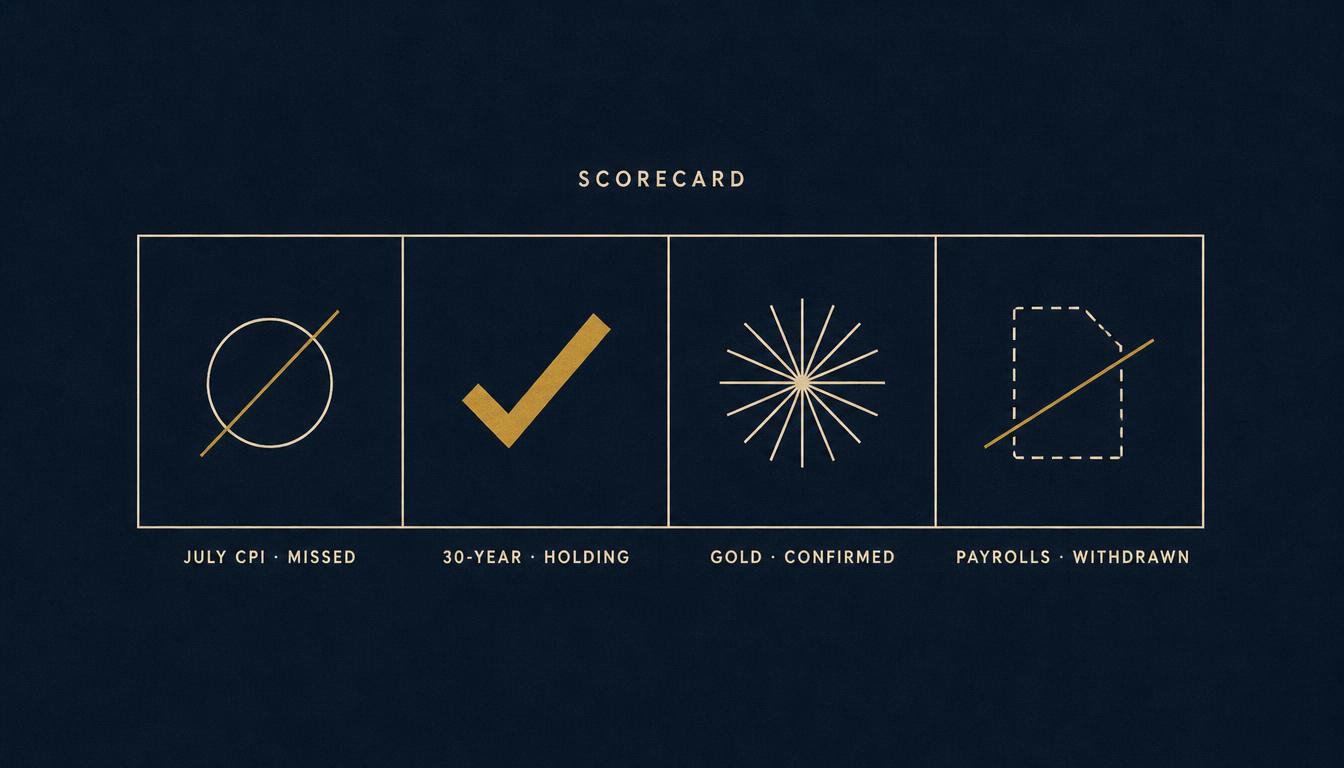
The results: one wrong on its stated terms, one holding decisively, one confirmed at a resolution the framework had not expected to get, and one rendered unscoreable by the withdrawal of the data it rested on.
This essay takes them in the order of what is most useful to learn from, which means beginning with the worst of them.
Call one: the July inflation print. Wrong, and the reason is instructive
What was said. On July 30, in the first episode of this catalog's audio series, the framework stated: "August twelfth, July's Consumer Price Index. Brent crude settled above a hundred dollars a barrel last Thursday, first time in two months, up about ten percent for that week, after the Iran framework collapsed. June's soft print described a world that no longer exists. If July comes in soft anyway, my read on energy pass-through is wrong, and you'll hear it here first."
What happened. July headline consumer prices rose 0.1 percent on the month, with the annual rate at 3.4 percent. Core rose 0.2 percent, with the annual core rate at 2.5 percent. The energy index fell 1.5 percent on the month, following a 5.7 percent decline in June. 1
By the terms stated, that is a miss, and this catalog recorded it as one in the August 13 episode.
The diagnosis, restated. The Brent move in question occurred on July 23 and 24 — the final week of the month. The Bureau of Labor Statistics collects price data throughout the reference month, so a price shock arriving in the closing days barely registers in that month's index. The test date named could not measure the thing it was named to measure. That was a design error rather than a forecasting error.
What has happened since, and why the framework will not claim it as a win. The August print, released September 11, showed headline consumer prices rising 0.4 percent on the month against July's 0.1 percent, holding the annual rate at 3.4 percent. 2 The energy index rose 2.1 percent after July's 1.5 percent decline. Gasoline rose 3.9 percent on the month after falling 2.9 percent in July, and stood 27.4 percent higher than a year earlier, up from a 24.6 percent annual increase in July. 3 The Bureau's own release notes that the gasoline index alone accounted for over one third of the monthly all-items increase. 4 Diesel prices were up 52 percent year over year. 5
The energy pass-through the framework described arrived. It arrived in the August data, exactly one month after the print the framework named, which is precisely what the collection-lag explanation predicts.
The framework stated explicitly in the August 13 episode that it was not re-running the failed call on a later date, and it is not doing so now. The call was scored as a loss on August 12 and remains a loss. What the August data establishes is narrower: the mechanism was correctly specified and the test date was chosen badly. Those are different failures, and only the second one occurred.
The operative lesson, stated then and repeated now because it is the transferable part: when naming a test date, verify that the data series can register the effect by that date.
Call two: the thirty-year threshold. Holding, and not by a narrow margin
What was said. In Episode 001 and again in Episode 002, the framework named a falsification condition for the interest-rate reversal thesis developed in Article 41: a thirty-year Treasury yield retreating below 4.50 percent within a quarter would count as evidence against the argument.
What happened. The thirty-year closed at 5.31 percent on August 17, 6 fell nine basis points to 5.19 percent following the Treasury's August 19 buyback expansion, 7 and stood at 5.211 percent on August 28 following Chairman Warsh's Jackson Hole address — a level CNBC described as near multi-decade highs. 8
The threshold is not close to being met, and the framework is not adjusting it.
Two qualifications the framework records rather than omits. First, the argument was materially revised in Episode 001: the reversal appeared to be market-driven rather than policy-driven, because the Federal Reserve held rates on July 30 and the long end rose anyway. That revision made the thesis stronger, since a rate structure rising on market conviction is more durable than one rising on committee decision. Second, Article 51 of this catalog identifies a mechanism that revision did not account for — the Treasury's own expanded purchases in the long end, which represent a large non-price-sensitive buyer leaning against the move. The thesis is holding, and it is now being actively contested by the issuer.
Call three: gold and the real-rate mechanism. Confirmed at unusual resolution
What was argued. Article 42 of this catalog established that gold's realized price path is governed not by the framework's own diagnosis of monetary unsoundness — which has been continuously true since August 1971 — but by the real interest rate, citing Erb and Harvey's measured correlation of approximately negative 0.82 between real rates and gold. The practical consequence developed there was that being correct about the diagnosis and early on the timing produces the same financial outcome as being wrong about both.
What happened in August. Gold rallied roughly 14 percent over the month — its strongest monthly gain this century — in a move attributed to the debasement trade and to the Treasury's announcement of support measures for long-duration bonds. 9 10 It broke above its hundred-day moving average at $4,387 for the first time in more than two months 11 and reached $4,696.18 on August 25, a more than three-month high. 10
Then, on August 28, Chairman Warsh said at Jackson Hole that the central bank still has "work to do" on inflation. 12 Spot gold fell 2.75 percent to $4,474.45 in the session, with December futures down 3 percent to $4,524.10. September rate-hike odds moved from 36 percent to 56 percent on the day and to 60.4 percent by Monday. 10 13
The independent analyst Tai Wong summarized the mechanism in a single sentence: "Gold is getting slapped hard as Chair Warsh affirms that inflation isn't meaningfully slowing and the Fed has 'work to do.'" 10
Why the framework counts this as confirmation rather than commentary. Article 42's argument was not that gold responds to monetary conditions in some general sense. It was the specific claim that the operative variable is the real rate — the expected return available on a yield-bearing alternative — and that gold's price therefore turns on shifts in that expectation rather than on the soundness of the currency. August delivered a controlled demonstration: no change whatsoever in the monetary architecture, a large move up on expectations of easier policy and long-duration support, and an immediate move down the moment the chairman raised the expected path of rates.
That is the mechanism operating at monthly resolution, and it is a cleaner demonstration than the twenty-year windows Article 42 was obliged to use.
Call four: the July payroll contraction. Not wrong. Withdrawn
This is the item worth the essay.
What was said. In Episode 002, recorded August 13, the framework devoted its entire second segment to the July employment report, opening: "On August seventh, the American economy lost jobs. Not gained fewer than expected. Lost." It developed the observation that payrolls had fallen by 23,000 against a consensus expecting a gain of 83,000, that May and June had been revised down by a combined 103,000, that the twelve-month average pace had fallen to 34,000, and that the unemployment rate had nonetheless declined to 4.1 percent because labor force participation had collapsed to 61.4 percent, the lowest in more than five years.
From those figures the framework argued that the labor market was weakening through the supply side rather than through technological displacement, citing the sector composition — local government education, retail, leisure and hospitality, financial activities — as inconsistent with an artificial-intelligence displacement story.
What happened. On September 4, the Bureau of Labor Statistics reported August payrolls of +162,000 against a consensus of 53,000, and revised July from −23,000 to +21,000, an upward revision of 44,000 that reversed the sign of the figure. June was revised up 11,000, from +20,000 to +31,000. Combined, June and July were revised up by 55,000. 14 15
Labor force participation rose to 61.6 percent, and the employment-population ratio to 59.1 percent. 14 The number of people working part time for economic reasons fell by 414,000 to 4.4 million. 15
How the framework scores this. Not as a wrong call, because the framework did not forecast the July figure — it analyzed a published one. The correct characterization is that the analysis was built on a number that the issuing agency subsequently withdrew and replaced with a number of the opposite sign.
The specific claims fare differently under revision:
The framing — "the American economy lost jobs" — is no longer supported by the data. July was a gain.
The supply-side argument has weakened substantially. It rested on a collapse in participation to 61.4 percent, and participation has since recovered to 61.6 percent while payrolls printed 162,000.
One claim survives intact. Average hourly earnings rose 3.1 percent over the year to August 15 against annual consumer price inflation of 3.4 percent. 2 Real earnings remain negative. The framework's argument that nominal figures conceal the household's actual position is unaffected by any of the revisions above, because it never depended on the payroll figure.
And one small data point runs the other way. CNBC's account of the August report notes that "bars and restaurants led in job creation, while information-related sectors saw a loss, possibly owing to AI investment." 16 That is a modest signal in the direction the framework argued against in the Distribution Question series, and it is recorded here for the same reason the rest of this essay exists.
What the two errors share
The inflation call and the payroll segment failed differently — one was a badly designed test, the other an analysis of data that did not survive revision — but they share a property.
Both treated a single monthly print as a settled fact about the world.
The inflation call assumed a monthly index could capture an event occurring in its final week. The payroll segment assumed a preliminary establishment-survey figure described the state of the labor market firmly enough to build a structural argument on. Neither assumption is defensible on reflection, and in both cases the framework had access to the reason before making the claim: the collection window is a documented feature of the CPI, and the revision process is a documented feature of the payroll survey — one the framework itself cited in the same segment when it noted that May and June had been revised down by 103,000.
The framework used the existence of revisions as evidence for its argument and simultaneously treated the current month's figure as though it were final. That is not a subtle error.
The operative correction, stated as a rule the framework intends to be held to: a single monthly print is an observation, not a fact. Claims built on one should be stated at the confidence a preliminary figure warrants, and where an argument requires a firm reading of the labor market or the price level, it should rest on a trailing average or on data past its revision window. This catalog takes the general form of that problem up directly in Article 49.
The board as it stands
| Call | Stated terms | Outcome |
|---|---|---|
| July CPI energy pass-through | Soft July print falsifies the read | Wrong. July +0.1%, energy −1.5%. Mechanism arrived in August. |
| Thirty-year threshold | Below 4.50% within a quarter falsifies | Holding. 5.211% on 28 August. Threshold unmoved. |
| Gold governed by real rates | Article 42 mechanism | Confirmed. +14% in August, −2.75% on hawkish Warsh. |
| July labor market analysis | Built on −23,000 payrolls | Withdrawn. Revised to +21,000. Wage claim survives. |
What remains open
The September FOMC. The framework's published item is the dissent count, not the rate. The July 29 vote was 9–3 to hold, with Hammack, Kashkari, and Logan each favoring a quarter-point increase — the first three-way unified dissent since September 2016. Markets now price a hike at roughly 70 percent following the August inflation report. 17 If the committee raises rates, the question becomes whether the dissenters have become the majority, which is a materially different institutional story from the one the framework told in July.
The October 14 inflation print, covering September. 4 The framework makes no call on it and notes only that it is the first print in some months whose energy component is not obviously predetermined by a prior oil move.
The October 2 employment report, covering September. 14 The framework's interest is in participation and in the size of revisions to August, for the reasons set out above.
Sources
Framework cross-references. Article 41 (the interest-rate reversal thesis and its falsification condition); Article 42 (real interest rates as the governing variable for gold; Erb and Harvey); Article 49 (the general problem of building analysis on preliminary data); Article 51 (Treasury long-end buybacks as a third input to the rate structure); Articles 38 through 40, the Distribution Question series (AI displacement claims); The Framework's Reading Episodes 001 (30 July 2026) and 002 (13 August 2026), where all four calls were placed on record.
Footnotes
-
U.S. Bureau of Labor Statistics, Consumer Price Index — July 2026, released 12 August 2026. Headline +0.1 percent month over month and 3.4 percent year over year; core +0.2 percent and 2.5 percent; energy index −1.5 percent following a 5.7 percent decline in June. ↩
-
U.S. Bureau of Labor Statistics, Consumer Price Index Summary — August 2026, USDL-26-1496, released 11 September 2026. https://www.bls.gov/news.release/cpi.nr0.htm — "The Consumer Price Index for All Urban Consumers (CPI-U) increased 0.4 percent on a seasonally adjusted basis in August after rising 0.1 percent in July… Over the last 12 months, the all items index increased 3.4 percent before seasonal adjustment." ↩ ↩2
-
"US CPI August 2026: Inflation Picks Up as Gas Prices Surge." US Inflation Calculator, 11 September 2026. https://www.usinflationcalculator.com/inflation/us-cpi-august-2026/100073342/ — Source for gasoline +3.9 percent month over month and +27.4 percent year over year against 24.6 percent in July; energy index +2.1 percent month over month and +16.3 percent year over year against 14.7 percent in July; shelter +0.3 percent. ↩
-
BLS, Consumer Price Index Summary — August 2026 (as 2) — "The index for gasoline rose 3.9 percent in August, accounting for over one third of the monthly all items increase." Also the source for the scheduled September 2026 CPI release date of Wednesday, 14 October 2026. ↩ ↩2
-
"No Letup in Inflation in August as CPI Rises 0.4%." U.S. News & World Report, 11 September 2026. https://www.usnews.com/news/national-news/articles/2026-09-11/no-letup-in-inflation-in-august-as-cpi-rises-0-4 — Source for overall fuel costs up 28 percent year over year and diesel up 52 percent. ↩
-
U.S. Department of the Treasury, Daily Treasury Par Yield Curve Rates, 17 August 2026. Cited in The Edge for Economic Consultancy, August 2026. https://edgeconsultancykw.com/us-treasury-long-end-buyback-increase-august-2026/ ↩
-
Cox, Jeff. "Treasury doubles debt buybacks as Bessent moves to steady bond market." CNBC, 19 August 2026. https://www.cnbc.com/2026/08/19/treasury-announces-upscaled-buyback-operation-for-longer-term-debt-sending-yields-lower.html ↩
-
"Treasury yields tread water ahead of Warsh's Jackson Hole speech." CNBC, 28 August 2026. https://www.cnbc.com/2026/08/28/treasury-yields-jackson-hole.html — Thirty-year at 5.211 percent; two-year at 4.356 percent; ten-year at 4.726 percent. ↩
-
"Jackson Hole analyst roundup: Warsh's speech sends hike chances higher, may put Fed 'at odds' with Treasury." CNBC, 31 August 2026. https://www.cnbc.com/2026/08/31/jackson-hole-fed-chair-kevin-warsh-hawkish-rate-hikes-analysts.html — Source for gold's roughly 14 percent August gain described as its strongest monthly gain this century, and for the characterization of the move as a debasement trade. ↩
-
"Gold drops as Fed's Warsh comments lift rate hike bets." CNBC, 28 August 2026. https://www.cnbc.com/2026/08/28/gold-slips-as-fed-chief-warshs-jackson-hole-speech-looms.html — Spot gold −2.75 percent to $4,474.45; December futures −3 percent to $4,524.10; three-month high of $4,696.18 on 25 August; hike odds 36 percent to 56 percent; the Tai Wong quotation; and the reference to the Treasury's announcement of support measures for long-duration bonds. ↩ ↩2 ↩3 ↩4
-
"Jackson Hole 2026: What Warsh's Speech Means for Gold." GoldSilver, August 2026. https://goldsilver.com/industry-news/goldsilver-news/gold-price-jackson-hole-warsh/ — Source for gold breaking above its hundred-day moving average at $4,387. ↩
-
Warsh, Kevin. Keynote remarks at the 2026 Jackson Hole Economic Policy Symposium. Board of Governors of the Federal Reserve System, 28 August 2026. https://www.federalreserve.gov/newsevents/speech/warsh20260828a.htm ↩
-
CNBC, 31 August 2026 (as 9) — Source for the 60.4 percent September hike probability per CME FedWatch. ↩
-
"August 2026 jobs report: U.S. adds 162,000 jobs, unemployment 4.1%." Quartz, 4 September 2026. https://qz.com/us-jobs-report-august-2026-payrolls-unemployment-090426 — Source for participation at 61.6 percent, average hourly earnings of $37.75, the average workweek at 34.4 hours, and the 2 October release date for the September report. ↩ ↩2 ↩3
-
U.S. Bureau of Labor Statistics, Employment Situation Summary — August 2026, released 4 September 2026. https://www.bls.gov/news.release/empsit.nr0.htm — "The change in total nonfarm payroll employment for June was revised up by 11,000, from +20,000 to +31,000, and the change for July was revised up by 44,000, from −23,000 to +21,000. With these revisions, employment in June and July combined is 55,000 higher than previously reported." Also the source for average hourly earnings +3.1 percent year over year and part-time for economic reasons falling 414,000 to 4.4 million. ↩ ↩2 ↩3
-
"U.S. payrolls rose 162,000 in August, much more than expected; unemployment rate at 4.1%." CNBC, 4 September 2026. https://www.cnbc.com/2026/09/04/jobs-report-august-2026.html — "Bars and restaurants led in job creation, while information-related sectors saw a loss, possibly owing to AI investment." ↩
-
"No Letup in Inflation in August" (as 5) — "Markets are predicting a nearly 70% chance the central bank will begin raising rates by a quarter point." See also Bostjancic, Kathy (Nationwide), quoted in CNBC, 11 September 2026: "Chair Warsh and others signaled that interest rates can remain on hold only if disinflation continues and today's August report did not deliver that." ↩
Related essays
Being Early Is Being Wrong: The Framework's Calibration Problem
This is the first installment of a new framework series, Stress-Testing the Framework, established to subject the catalog's own prior conclusions to the same evidentiary standard the framework has applied to UBI, CBDC, and capital destruction. The specific claim under examination in this installment: the framework's diagnosis of substrate fragility — unsound money, a substitute-layer environment substituting for the pre-1971 Golden Triangle — has been directionally true, in some meaningful sense, continuously since August 1971. A saver who took that diagnosis seriously and hedged accordingly would have been correct about the underlying condition at every point across the intervening fifty-five years. They would also, across long stretches of that same period, have been financially punished for acting on a correct diagnosis, because the specific instrument the framework identifies as the hedge — physical gold — has not appreciated continuously or even monotonically. It has moved in wide, multi-decade cycles, driven substantially by a single, well-documented, quantifiable variable — the real (inflation-adjusted) interest rate — that bears no fixed relationship to the framework's own diagnosis of substrate soundness. This essay develops the calibration problem with real numbers: five historical windows from 1971 to 2026, a worked sensitivity analysis of the actual cost of a hard-asset hedge across a range of allocation sizes during the worst of those windows (1980-2000, when gold's real value fell by roughly three-quarters), a companion analysis of the same hedge's payoff during the best of those windows, an honest test of whether disciplined rebalancing or technical analysis can reduce the calibration cost (the answer, argued carefully, is more negative than the framework has previously acknowledged), and a first attempt at treating hedge sizing as an actuarial problem — pricing the position the way an insurer prices a policy against a risk of uncertain timing — rather than as an assertion of a percentage range. It closes by naming what remains genuinely unresolved: no framework, this one included, can specify when a systemic risk will materialize, and the honest response to that limitation is disciplined position sizing bounded by tolerable worst-case cost, not false precision about timing.
Why Gold Didn't Spike: A Fekete Diagnosis of the Iran War
During the 2026 Iran war, gold fell rather than rose and central banks turned net sellers in March. Standard gold-bug frameworks cannot explain this. Antal Fekete's backwardation framework predicted exactly this pattern twenty years ago.
Monetary Power to the People
Money is a medium in McLuhan's sense — an extension of the human body that amplifies the capacity for exchange. Understanding this is the critical path to navigating the financial disruptions of the present age.