Researched and drafted with AI assistance · reviewed and edited by Jason D. Keys
Two days in August
On Monday, August 17, 2026, the official thirty-year Treasury par yield closed at 5.31 percent. 1 Long-end yields had been rising through the summer to levels one report described as not seen in nearly twenty years, and the twenty-to-thirty-year sector had experienced what CNBC characterized as a buyers' strike since late June. 2
On Wednesday, August 19, the United States Department of the Treasury announced that it would at least double the maximum size of its liquidity support buyback operations for longer-dated nominal coupon securities — specifically the ten-to-twenty-year and twenty-to-thirty-year sectors — raising the per-operation ceiling from $2 billion to at least $4 billion. The change takes effect September 9, 2026 and runs through November 4, 2026, the date of the next Quarterly Refunding, at which Treasury said it would provide further guidance on operation sizes. 3
The thirty-year closed that day at 5.19 percent, nine basis points below the prior session. The ten-year shed six basis points to 4.647 percent, and equity futures rose. 1 2
Treasury's stated rationale was liquidity. The press release explains that the increase "reflects Treasury's desire to provide greater liquidity support in longer-dated nominal sectors where there is consistent strong sponsorship from market participants, as evidenced by the significant volume of high-quality offers Treasury routinely receives in longer-dated buyback operations." 3
That explanation is internally coherent and the framework does not dispute it as a statement of intent. What this essay examines is the mechanism, which does something the stated rationale does not describe.
What a buyback actually does
A Treasury buyback is the government purchasing its own previously issued securities in the secondary market. Buybacks are not new; they have operated as a liquidity tool for some time, improving trading conditions in older, less actively traded issues. 4
The critical mechanical fact is one Treasury states plainly in its own materials: buybacks are not expected to significantly reduce privately held net marketable borrowing, because new issuance replaces the securities that are purchased. 5
Hold those two facts together. Treasury is buying long-dated securities out of the market. Treasury is replacing the borrowing by issuing new securities. And Treasury is not reducing the total amount it owes.
The net effect is therefore not a reduction in debt. It is a change in the maturity composition of the debt the public holds. Long-dated paper comes out; new issuance goes in. To the extent that the replacement issuance is shorter-dated than what was retired — and Treasury's bill share has been running near 21.7 percent of outstanding debt against a Treasury Borrowing Advisory Committee target around 20 percent, as this catalog documented in Article 45 — the operation shortens the duration of the public's holdings.
Shortening the duration of publicly held debt while leaving the total unchanged reduces the supply of long duration available to the market. Reducing the supply of long duration, all else equal, lowers long-term yields.
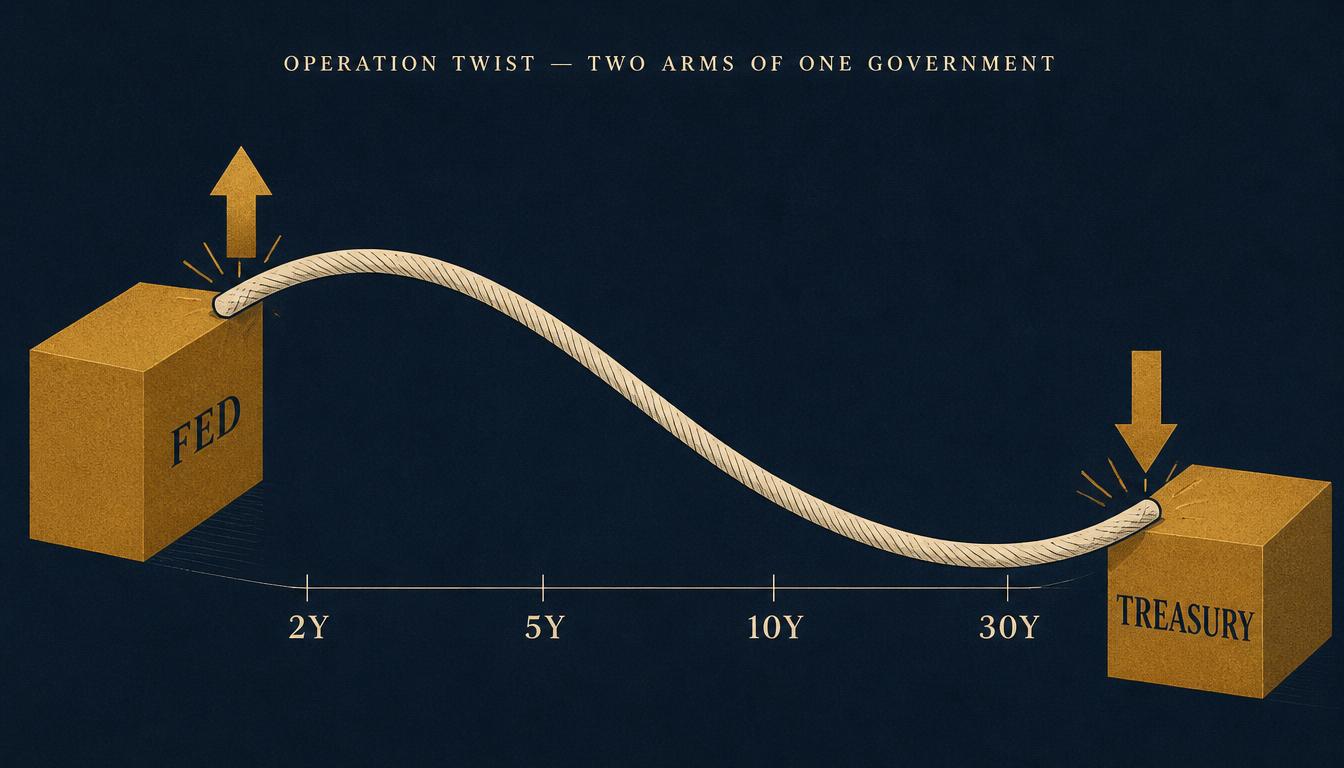
There is a name for this. From September 2011 through December 2012, the Federal Reserve conducted the Maturity Extension Program, in which it sold shorter-dated Treasury securities and purchased longer-dated securities in order to lower long-term interest rates without expanding its overall balance sheet. 4 The program is universally known as Operation Twist.
The Dutch asset manager Robeco made the comparison explicitly in its August 20 note on the announcement, placing the Operation Twist definition in a footnote directly beneath its analysis of the Treasury expansion. 4 The framework regards the comparison as apt and wishes to be precise about where it holds and where it does not.
Where it holds: both operations alter the maturity distribution of Treasury securities held by the public without changing the aggregate quantity, and both do so in the direction of suppressing long-term yields.
Where it differs, and this is the substance of this essay: Operation Twist was conducted by the Federal Reserve, under a vote of the Federal Open Market Committee, within the framework of a statutory dual mandate, and subject to the accountability that attaches to monetary policy. The August 19 expansion was announced by the Department of the Treasury, under the authority of the Secretary, as a debt-management operation. There was no FOMC vote. There is no mandate. It is not monetary policy, and everyone involved would say so.
The scale
The framework's practice is to establish whether a policy change is large enough to matter before analyzing what it means.
Robeco estimated that if operations continue at the current pace, annual purchases could amount to approximately $66 billion, which the firm noted would equate to roughly 15 percent of gross twenty-to-thirty-year Treasury supply. 4
The published schedule offers a more concrete near-term figure. The updated September 9 schedule lists seven nominal long-end operations through November 4. The first, in the ten-to-twenty-year sector, carried a maximum of $6 billion; the remaining long-end operations carry maximums of at least $4 billion each. Together the published schedule represents at least $30 billion of potential long-end purchases over the balance of the refunding quarter — scheduled capacity rather than a forecast of actual purchases, since accepted amounts may come in below announced maximums. 5
Against what? The Congressional Budget Office estimated in August a federal deficit of approximately $2.1 trillion for fiscal year 2026. 5 Set against total borrowing, $30 billion of quarterly buyback capacity is small. Set against the specific segment it targets — long-dated nominal coupons, the part of the curve that had been under sustained pressure — fifteen percent of gross supply is not small at all.
The framework's reading: this is a targeted intervention in a specific segment, not a broad monetary operation, and its significance lies in its target rather than in its aggregate size.
Why the timing invites a reading Treasury did not offer
Treasury's stated reason for the expansion is demand: strong sponsorship, high-quality offers, a desire to support liquidity where participants are already active. Nothing in the framework's analysis contradicts that as a description of the operational conditions.
But an intervention that doubles capacity in the long end, announced two days after the thirty-year closed at a near-two-decade high, in a sector that had experienced a months-long buyers' strike, and which produced a nine-basis-point single-session decline in the thirty-year — that sequence invites a question the press release does not address.
At least one research house asked it directly. Gavekal, analyzing Warsh's Jackson Hole address the following week, wrote that Warsh's reiteration that short-term interest rates should remain the dominant instrument of monetary policy implies he will continue shortening the average duration of the Federal Reserve's balance sheet, and that this "seems to put the Fed at odds with the US Treasury, which earlier in August announced that it will step up its buybacks of long-term treasury securities in an apparent attempt to prevent yields rising further at the long end." 6
The framework notes the Modelist assessment as the appropriately cautious formulation: the thirty-year's nine-basis-point decline on announcement day "does not prove the announcement caused the decline, but it shows why the timing drew attention." 5
That is the correct epistemic posture, and this essay adopts it. What follows is not a claim that Treasury is conducting covert monetary policy. It is an examination of what the operation does regardless of why it was undertaken.
The two arms
The reason this matters now, rather than as a technical footnote to debt management, is what the other arm of the government was doing in the same three weeks.
On August 28, Kevin Warsh delivered his first Jackson Hole keynote as Federal Reserve Chairman, having taken office on May 22, 2026. 7 He said the central bank still has "work to do" to bring inflation under control, and acknowledged that while the summer's PCE and CPI readings were better than expected, inflation remains elevated. 8
Markets repriced immediately and sharply. September rate-hike odds on the CME FedWatch tool rose from 35.4 percent to 57.5 percent in a single day, 8 reaching 60.4 percent by the following Monday, with roughly an 80 percent probability assigned to an increase by December. 9 10 The two-year yield, most sensitive to policy expectations, jumped more than twelve basis points to 4.356 percent. The thirty-year rose two basis points to 5.211 percent. 8
BMO's United States rates strategist Vail Hartman called it "a deliberately hawkish speech that will put to rest any concerns about the Fed's willingness to raise rates to restore price stability." 8 Deutsche Bank said the address "surprised us in its specificity about the economy and outlook and with its lean in a decidedly hawkish direction." 9
So the position as of late August: the Federal Reserve is signaling higher short rates and, per Gavekal's reading, shortening its own balance sheet duration. The Treasury is expanding purchases of long-dated securities. One institution is pushing the short end up; the other is absorbing supply at the long end.
Both institutions would describe their actions as consistent with their respective responsibilities, and both descriptions would be accurate. The framework's observation is narrower and does not require attributing conflict to either: whatever the intentions, the two operations act on opposite ends of the same curve in opposite directions.
What the framework reads from this
Article 41 of this catalog argued that the forty-year decline in the interest-rate structure from 1981 to 2020 destroyed capital through an accounting asymmetry that conventional standards do not record — that a falling rate structure raises the liquidation value of existing fixed-rate obligations, producing a real loss nobody books. It further argued that the reversal underway since 2022 should begin to repair that damage by running the same mechanism backward.
Episode 001 of this catalog's audio series, recorded July 30 after the Federal Reserve held rates while the thirty-year rose anyway, revised that argument in an important respect: the reversal appeared to be market-driven rather than policy-driven, which made it more durable, because a rate structure rising because investors independently lost confidence in the inflation target is not something a committee can vote away.
The August 19 announcement is the first significant evidence against that revision, and the framework records it as such.
A rate structure rising on market conviction is not something the FOMC can vote away. It is, however, something a sufficiently large buyer can lean against — and the issuer of the securities is the largest possible buyer, operating with no requirement to justify the action in monetary-policy terms because it is not monetary policy.
This does not falsify the Article 41 thesis. The thirty-year sat at 5.211 percent on August 28, nine days after the announcement and above where it closed on announcement day, which is not the signature of a successful suppression. The framework's published falsification condition — a retreat below 4.50 percent within a quarter — remains far from being met.
What it does is identify a mechanism the framework had not accounted for. Article 41 treated the rate structure as determined by the interaction of central bank policy and market conviction. The August 19 operation is a third input: the fiscal authority acting directly on the maturity composition of the debt, through a channel that requires no monetary-policy justification and attracts no monetary-policy scrutiny.
Who benefits from a suppressed long end
Two observations the framework regards as material and underexamined.
The issuer benefits. Article 45 of this catalog established that the interest the federal government actually pays is a weighted average of history rather than a market rate — 3.348 percent across all outstanding marketable securities as of January 2026, against 1.541 percent five years earlier — and that this average climbs mechanically as low-coupon securities mature and are refinanced at prevailing rates. Roughly $10 trillion of Treasury debt matures during 2026 alone. Any intervention that lowers the rate at which that refinancing occurs directly reduces the Treasury's own future interest expense, which was running at approximately $1.04 trillion annually and constitutes the third-largest line item in the federal budget.
A debtor with $2.1 trillion of annual new borrowing and a rolling refinancing requirement has a direct, quantifiable interest in the level of the long end. This is not an accusation of improper motive. It is an observation that the party conducting the operation is also the party whose interest expense the operation affects, and that no institutional separation exists between those two roles the way it exists at a central bank.
Holders of long duration benefit. Article 48 of this catalog examined the United States life insurance industry, which carries approximately $11.0 trillion in assets against $10.6 trillion in liabilities — an equity cushion of roughly four percent — and which holds $849 billion of the roughly $2 trillion private credit market. Life insurers are among the largest holders of long-duration assets in the financial system. A rising long end marks their bond holdings down; an intervention that contains the long end supports those marks.
The framework flagged in Article 48 that the same industry faces a liability-side exposure that statutory accounting does not capture, and that the two exposures share a trigger. Nothing in the August announcement changes that analysis. It does mean that the party most immediately relieved by a contained long end is a sector this catalog has separately identified as thinly capitalized.
What to watch
November 4 — the Quarterly Refunding, at which Treasury has said it will provide further guidance on future buyback sizes. 3 Whether the expanded capacity is extended, enlarged, or allowed to lapse at the end of the current refunding quarter is the cleanest available test of whether August 19 was a liquidity adjustment or the beginning of a standing posture.
Actual versus scheduled purchases. The published schedule represents capacity, not commitment; accepted amounts may fall below announced maximums. 5 Operations running consistently at or near the maximum would suggest Treasury is using the full facility; operations running well below would support the liquidity-support framing.
The thirty-year itself. This catalog's published threshold is a retreat below 4.50 percent within a quarter as evidence against the rate-reversal thesis. It sat at 5.211 percent on August 28. 8 That threshold stands unchanged and the framework will not move it.
Whether the two arms converge or diverge further. If the Federal Open Market Committee raises rates at its September meeting while Treasury continues expanding long-end purchases, the divergence becomes structural rather than incidental, and the question of which institution is setting the interest-rate structure becomes a live one rather than a technical one.
The framework's reading
The August 19 buyback expansion is, on its own terms, a routine debt-management adjustment of modest aggregate size, announced with a coherent operational rationale, in a program that has existed for years.
It is also an operation that alters the maturity composition of publicly held federal debt in the direction of suppressing long-term yields, conducted by the entity that issues the debt and pays the interest, at a moment when long yields had reached a near-two-decade high, without a vote, a mandate, or a monetary-policy framework — and within days of the central bank signaling movement in the opposite direction at the short end.
Both descriptions are true. This catalog has argued across forty-eight installments that the most consequential institutional changes rarely announce themselves as consequential, and that the analytically useful question is usually not what an action is called but what it does. What this one does is place a very large and non-price-sensitive buyer into the segment of the curve where the framework's own capital-repair thesis is being tested.
Sources
Framework cross-references. Article 41 (the accounting asymmetry, capital destruction from falling rates, and the post-2022 reversal); Article 45 (the weighted average interest rate on federal debt, the rollover mechanism, and the bill share against the TBAC target); Article 48 (life insurer balance sheet capacity and long-duration exposure); Episode 001 of The Framework's Reading, 30 July 2026 (the revision from a policy-driven to a market-driven reading of the rate reversal).
Footnotes
-
U.S. Department of the Treasury, Daily Treasury Par Yield Curve Rates. Thirty-year par yield closed at 5.31 percent on 17 August 2026 and 5.19 percent on 19 August 2026. Cited in The Edge for Economic Consultancy, "Treasury Doubled Its Long-End Buyback Capacity. The Thirty-Year Fell Nine Basis Points, Then Gave Some Back," August 2026. https://edgeconsultancykw.com/us-treasury-long-end-buyback-increase-august-2026/ ↩ ↩2
-
Cox, Jeff. "Treasury doubles debt buybacks as Bessent moves to steady bond market." CNBC, 19 August 2026. https://www.cnbc.com/2026/08/19/treasury-announces-upscaled-buyback-operation-for-longer-term-debt-sending-yields-lower.html — Source for the ten-year settling at 4.647 percent, the characterization of a buyers' strike in the twenty-to-thirty-year sector since late June, and yields at levels not seen in nearly twenty years. ↩ ↩2
-
U.S. Department of the Treasury. "Treasury Announces Increased Sizes of Nominal Long-End Liquidity Support Buybacks Beginning September 9." Press release sb0607, 19 August 2026. https://home.treasury.gov/news/press-releases/sb0607 — Primary source. All quoted language regarding Treasury's stated rationale is taken directly from this release. ↩ ↩2 ↩3
-
Robeco. "US Treasury steps in as long-end yields rise." 20 August 2026. https://www.robeco.com/en-int/insights/2026/08/us-treasuries-buyback-and-impact-on-the-fed-and-markets — Source for the approximately $66 billion annualized estimate, the fifteen percent of gross twenty-to-thirty-year supply figure, and the Operation Twist definition: "a Federal Reserve program conducted from 2011 to 2012 in which the Fed sold shorter-dated Treasury securities and bought longer-dated securities to lower long-term interest rates without expanding its overall balance sheet." ↩ ↩2 ↩3 ↩4
-
Modelist. "Treasury Buybacks: What Bessent's Bond Move Means." September 2026. https://www.modelist.me/post/treasury-buybacks-bessent-long-term-bonds-2026 — Source for the September 9 schedule detail (seven long-end operations through November 4, first operation at a $6 billion maximum, at least $30 billion of scheduled capacity), Treasury's statement that buybacks are not expected to significantly reduce privately held net marketable borrowing because new issuance replaces purchased securities, the Congressional Budget Office $2.1 trillion fiscal 2026 deficit estimate, and the cautionary formulation regarding causation on announcement day. ↩ ↩2 ↩3 ↩4 ↩5
-
Gavekal Research, cited in "Jackson Hole analyst roundup: Warsh's speech sends hike chances higher, may put Fed 'at odds' with Treasury." CNBC, 31 August 2026. https://www.cnbc.com/2026/08/31/jackson-hole-fed-chair-kevin-warsh-hawkish-rate-hikes-analysts.html ↩
-
Warsh, Kevin. Keynote remarks at the 2026 Jackson Hole Economic Policy Symposium. Board of Governors of the Federal Reserve System, 28 August 2026. https://www.federalreserve.gov/newsevents/speech/warsh20260828a.htm ↩
-
"Treasury yields tread water ahead of Warsh's Jackson Hole speech." CNBC, 28 August 2026. https://www.cnbc.com/2026/08/28/treasury-yields-jackson-hole.html — Source for the two-year at 4.356 percent, ten-year at 4.726 percent, thirty-year at 5.211 percent, the move in September hike odds from 35.4 percent to 57.5 percent, and the Vail Hartman quotation. ↩ ↩2 ↩3 ↩4 ↩5
-
"Jackson Hole analyst roundup." CNBC, 31 August 2026 (as 6) — Source for the 60.4 percent figure and the Deutsche Bank assessment. ↩ ↩2
-
"Gold drops as Fed's Warsh comments lift rate hike bets." CNBC, 28 August 2026. https://www.cnbc.com/2026/08/28/gold-slips-as-fed-chief-warshs-jackson-hole-speech-looms.html — Source for the roughly 80 percent probability of a December increase per CME FedWatch. ↩
Related essays