
On June 17, 2025, Robert Leroy Higgins was sentenced to sixty-five years in federal prison — the statutory maximum — for stealing at least seventy-six million dollars in customer metal from First State Depository in Wilmington, Delaware. Roughly 2,100 customers held metal there in individually labeled boxes — the segregated allocated arrangement Forum #37 recommended. When the court-appointed receiver arrived with federal marshals and auditors, the boxes were found to contain IOU slips. Perfect legal title to bars that did not exist. Forum #47 develops the analytical distinction Forum #37's Custody Depth score missed — allocated storage protects against custodian insolvency and provides zero protection against custodian fraud — and replaces the score with a corrected framework in which verification is a precondition rather than a secondary consideration. This week the framework catches itself again, and Warsh's Capitol Hill testimony puts the substitute-layer's own ceiling into institutional policy language.
Featured essay: read the full analysis →
Researched and drafted with AI assistance · reviewed and edited by Jason D. Keys
Welcome to Issue #016 of The Dispatch. Each Monday, this letter takes one situation from the week's news and reads it through the lens of Carl Menger and Antal Fekete — paired with a foundational concept, the dashboard, the framework's prediction record, and a piece from the archive. If someone forwarded this to you, subscribe here.
The Lens
On June 17, 2025, at the federal courthouse in Wilmington, Delaware, Robert Leroy Higgins was sentenced to sixty-five years in federal prison — the statutory maximum — for stealing at least $76 million in customer metal from First State Depository. Industry sources have called it the largest theft from a precious metals depository in United States history.
Roughly 2,100 customers held metal at First State in individually labeled boxes. The segregated, allocated arrangement. Serial-numbered bars. Legal title to specific pieces of metal held off the custodian's balance sheet. Many of the customers were retirees who had been persuaded to hold precious metals inside IRA and 401(k) accounts. This is the arrangement Forum #37 recommended in its July 2026 revision — allocated storage as the working defense against substrate-condition failure, with a Custody Depth score measuring the number of institutional counterparties standing between a saver and their asset.
When the court-appointed receiver arrived with federal marshals and auditors, the boxes were found to contain IOU slips. Perfect legal title to bars that did not exist.
This week the framework catches itself again. Forum #47 — the fourth installment of the Stress-Testing the Framework series — develops the analytical distinction Forum #37's Custody Depth score missed. Allocated storage protects against custodian insolvency, exactly as advertised. It provides essentially zero protection against custodian fraud. The framework's Custody Depth score measured only the first. This is the second explicit correction the Stress-Testing series has issued to prior catalog work, following the calibration revision to hedge sizing engaged in Issue #015.
Alongside the correction, two other things frame the week's reading: Fed Chair Kevin Warsh's July 14–15 semiannual monetary policy testimony to Congress — "no tolerance for persistently elevated inflation", the June CPI improvement does not amount to "mission accomplished", and — asked whether the Fed would bail out failing crypto firms — "we want to be in a position where we're not bailing out anybody, including crypto." And Forum #46 — The Derivative Arrived First — the SpaceX IPO of June 12 and the leveraged short ETF that traded via total-return swaps on the same day as the definitive empirical illustration that the derivative layer no longer merely rests atop the productive economy but now arrives first.
Lead Essay: Insolvency and Fraud Are Not the Same Risk
The First State Depository failure was not an isolated event. Forum #47 documents a twelve-year sequence of custody failures across the U.S. precious-metals industry: Tulving Company (2014); Bullion Direct (2015), whose proprietary Nucleo Exchange offered storage described in marketing as allocated and "not pool metal" while its terms of service described an undivided share of a fungible lot the company "may use or act as if it were the owner of," with the inventory in fact commingled; Northwest Territorial Mint (April 2016) with 3,000+ customers and over $25 million lost through a Ponzi-like structure that had operated since 2012; NWTM principals Hansen and Erdmann indicted 2018, convicted 2021; the CFTC filing charges against First State and Argent Asset Group under a restraining order signed September 29, 2022, initially alleging at least $7 million misappropriated from roughly 200 customers — a figure that grew by more than an order of magnitude, ending in a July 2023 consent order for $112.7 million in restitution and a $33 million civil penalty; the First State receiver closing the vault in November 2023 with the boxes-and-IOUs finding; Higgins convicted October 2024 after the jury deliberated under four hours on all nineteen counts; the June 2025 sentence at the statutory maximum with over $76 million stolen across 1,000+ customer accounts.
Two recurring features across every case. First: the storage business operated alongside a trading or leasing business run by the same principals, creating both opportunity and incentive to treat client metal as working inventory. Second: customers held documentation that no independent party had verified. Documentation and metal are different things, and confusing them requires only that no one look.
The Custody Depth score measured the wrong thing. Forum #37 introduced Custody Depth to quantify institutional distance between a saver and their asset — zero for direct personal possession, up through five for commodity-backed ETFs inside retirement wrappers. Lower scores meant fewer counterparties, meant less exposure to institutional failure. The score was calculated correctly. It was measuring the wrong risk. A First State position scored Custody Depth 1 — the saver held allocated metal in an individually labeled box at a private depository — and the score was mathematically defensible. The customers' actual position was zero metal.
The analytical distinction the framework needed to make and did not:
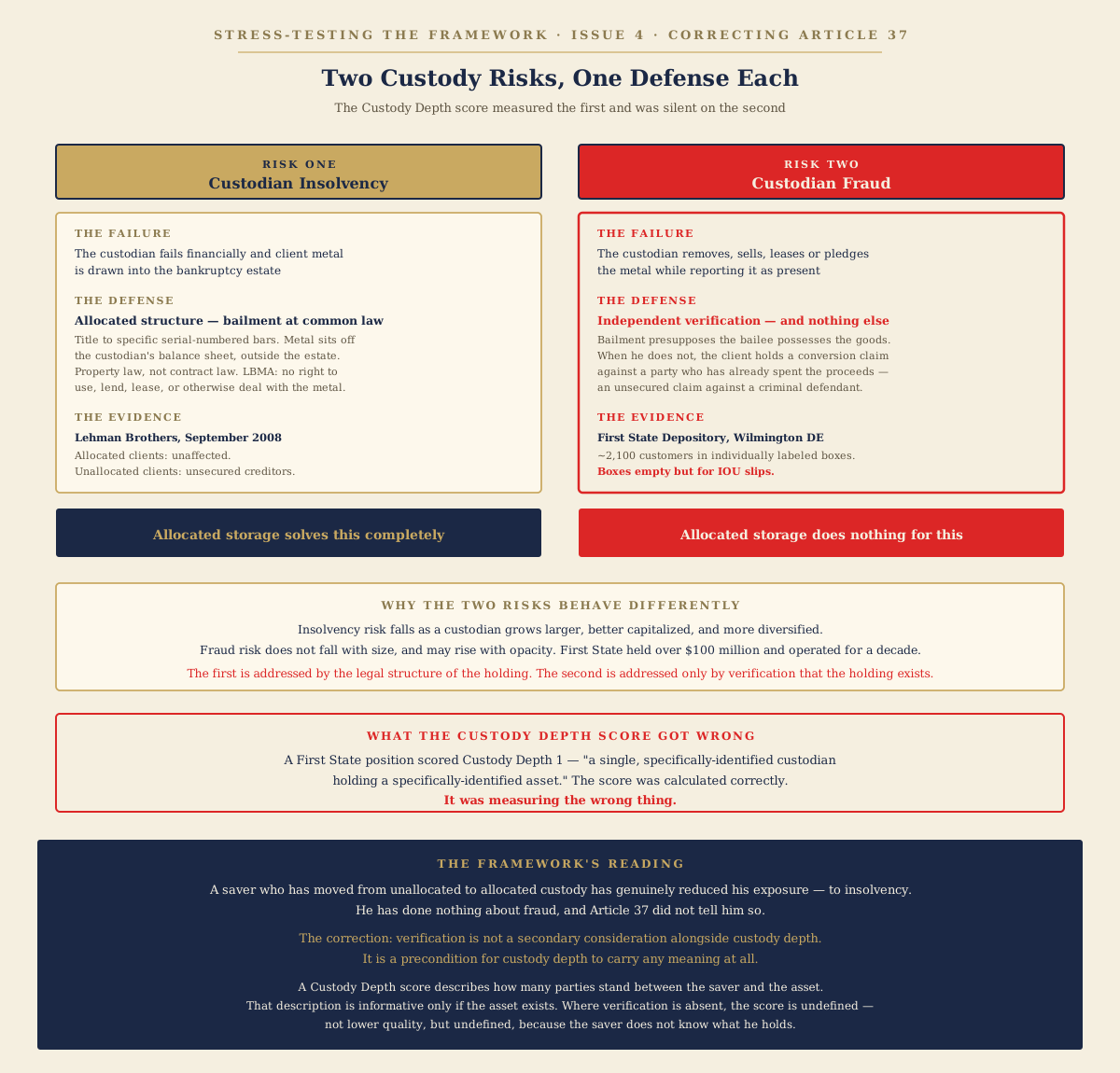
Allocated storage is a bailment structure at common law. The custodian holds specific serial-numbered bars to which the client retains legal title. The metal sits off the custodian's balance sheet. In a bankruptcy proceeding, the metal is not part of the estate. The framework's original recommendation was correct about this. Lehman Brothers in September 2008 confirmed it — allocated clients emerged unaffected while unallocated clients became unsecured creditors.
Fraud is a completely different failure mode. The bailee has spent the goods. The client holds a conversion claim against a party who has already dissipated the proceeds. Bailment presupposes the bailee possesses the assets; when he does not, the entire legal structure the framework relied on evaporates. The corrective is independent verification and nothing else — audit, bar list identifying specific serial numbers, regulator examination, segregation from any trading or leasing business run by the same principals, all-risk insurance at full replacement value from an underwriter the saver can identify.
Forum #47's revised framework introduces the Verification Gate. Before any Custody Depth score is assigned, five questions must be answered. Does an outside firm physically audit the inventory, how often, with results available to account holders? Does the saver receive a bar list identifying specific serial numbers? Is the custodian examined by a financial regulator, licensed by a futures exchange, or an SEC-reporting entity? Is the storage business operated separately from any trading or leasing business under the same ownership? Is the insurance all-risk at full replacement value, and who underwrites it? The fourth question is the specific structural warning sign common to First State, Northwest Territorial Mint, and Bullion Direct. If any answer is absent or unverifiable, the position receives a warning rather than a number. The saver does not know what he owns.
And there is a legal constraint on the tax-advantaged path. IRC 408(m)(3)(B) requires precious metals held in an IRA to be in the physical possession of a bank or approved nonbank trustee. McNulty v. Commissioner, 157 T.C. No. 10 (2021), closed the LLC home-storage structure. The court expressly declined to look through the entity, resolving instead on possession and control: Mrs. McNulty took taxable distributions when she received physical custody of the coins, because "IRA owners cannot have unfettered command over the IRA assets without tax consequences." The distribution was measured at the cost of the coins rather than the account balance, and the deficiencies were $250,558 for 2015 and $18,094 for 2016, with accuracy-related penalties under section 6662(a) and no early-distribution addition to tax at issue. Direct personal possession — Custody Depth 0 — is therefore legally unavailable inside the retirement vehicles Forum #37 recommended as the operational path to hard-asset allocation. The tax advantage and the custody control are not independently selectable.
The framework's revised principle: verification is not a secondary consideration. It is a precondition. The Custody Depth score assumed the underlying asset exists; the Verification Gate establishes that it does. A regulated, audited, exchange-licensed custodian at nominal Custody Depth 2 is safer than an unexamined private vault at Custody Depth 1. A saver who moved metal from the former to the latter would have improved his measured score while increasing his actual risk — a trade the original framework could have recommended and the revised framework forbids.
The correction stands. Forum #37's original guidance recommended allocated storage in fully-segregated custody. That recommendation, without the Verification Gate, could have placed a saver at First State.
→ Read the full analysis: Title Without Metal: What Allocated Storage Actually Protects Against — The Forum
Concept in Focus: Insolvency vs Fraud
The insolvency-versus-fraud distinction is not unique to precious-metals custody. It runs through the framework's engagement with the substitute-layer architecture more broadly. Every substitute-layer instrument the catalog has documented — agency MBS (Forum #8), extend-and-pretend CRE (Forum #27), the DFC facility (Forum #36), the failed Spirit bailout (Forum #35) — carries both risk types, and the framework's diagnostic apparatus has been better at reading the first than the second.
Insolvency risk is what balance-sheet analysis, capital ratios, credit spreads, and regulatory examinations are designed to measure. It is the risk that an institution's stated assets are insufficient to cover its stated liabilities under a plausible range of stress conditions. It falls as institutions grow larger and better capitalized (the too-big-to-fail dynamic is downstream of this). It is discoverable through the ordinary tools of financial analysis. Diversification, redundancy, and structural senior claims are the appropriate defenses.
Fraud risk is what none of those tools measure. It is the risk that the stated position and the actual position diverge — that the balance sheet, the bar list, the collateral schedule, the reserve calculation, or the counterparty attestation is false. Fraud risk does not fall with size (First State held over $100M and operated for a decade). It may rise with opacity. It is discoverable only through independent verification — audit by a party the fraudster does not control, physical inspection, regulatory examination that is actually performed, cross-referencing of stated positions against independent records. The appropriate defense is verification, and nothing else substitutes for it.
The framework's revised posture across the custody question generalizes: before applying any diagnostic score, establish that the underlying asset the score describes actually exists. For precious metals, that means the Verification Gate. For sovereign debt, it means engaging with what a Treasury coupon actually is (Forum #45's territory). For counterparty exposure in derivatives, it means understanding whether the total-return swap on the other side of your inverse ETF is backed by anything real (Forum #46's territory). The verification precondition is the framework's most important structural principle that most substitute-layer analysis omits.
The Atlas page on the Origin of Money covers Menger's saleability framework — the foundation underneath the framework's insistence that direct physical possession or verified custody is structurally distinct from paper claims on assets that may or may not exist.
The Dashboard
Snapshot from the live toolkit dashboard as of August 10, 2026.
- Gold Basis — +2.82% annualized at constant 90-day maturity, live spot $4,388.48 with the curve interpolated between the August and October contracts to a fixed horizon. Ordinary contango, close to its own average. Gold has rallied roughly 7.5% from Issue #015's $4,079 — a price move, with the curve unchanged in character. → /toolkit/gold-basis
- Silver Basis — +3.52% annualized, same construction, spot $65.72. Contango, and firmer than gold's. → /toolkit/silver-basis
- Silver/Gold Ratio — 67.77 — gold $4,479 futures, silver $66.09 (silver rallied hard from $59.75 at Issue #015 — a ~10.6% move in a week). The ratio compressed from 69.19 as silver outperformed gold. Silver breaking above $60 for the first time since early spring is worth noting. → /toolkit/silver-gold-ratio
The framework's reading of the week's movements: both metals moved sharply higher against the backdrop of Warsh's testimony that persistent inflation will not be tolerated and the sovereign-debt discussion Forum #45 develops. The move is in price, not in the curve. Both bases stayed in ordinary contango throughout the rally, which is the distinction that matters: a metal getting dearer and a metal getting scarce look identical in a price chart and different in a basis. This was the first. Whether the repricing persists is a separate question.
The Scorecard
Three framework predictions have entered resolution this week.
Forum #35 / Forum #36 substitute-layer's own ceiling — validated into institutional policy language. Warsh's July 14–15 semiannual monetary policy testimony to Congress was explicit when the bailout question was put to him directly: "we want to be in a position where we're not bailing out anybody, including crypto." He did not commit to an absolute prohibition — he framed it as a stance and a direction, not a hard-line rule — but the presumption against bailouts was named openly at the semiannual hearing. The framework's May-through-July analysis of the failed $500M Spirit bailout and the DFC facility that never wrote a policy is now characterized in similar framing by the sitting Fed Chair. The framework's recorded prediction was that the pattern would recur; Warsh's testimony puts the presumption at the top of the institutional pyramid.
Forum #16 banking diagnostics — no new failure this week; count remains at 4. The 2024–2025 baseline of two failures per year was exceeded in July with Farmers State Bank. Q2 FDIC Quarterly Banking Profile releases mid-August — the next major banking-diagnostics resolution now that the failure count has moved above baseline.
Forum #37 Custody Depth score — corrected via Forum #47. The Custody Depth score is being replaced by the Verification Gate as the initial diagnostic, with Custody Depth applied only after verification is established. The framework's original recommendation to hold allocated metal in fully-segregated private custody stands as one path — provided verification is confirmed. The unqualified original guidance has been superseded.
Next major resolutions on the ledger: the July CPI print (August 12) and the July PCE print (late August) — first major post-MOU-revocation inflation reads. The framework's Forum #26 Hormuz lag prediction was partially challenged by the June CPI compression; the July print will resolve whether June was a one-window artifact or the framework's Q3 4.5–5.5% band requires revision. Q2 FDIC Quarterly Banking Profile mid-August — next major banking-diagnostics resolution now that the failure count has moved above baseline. September 15–16 FOMC — durability test of the Warsh institutional pivot.
The Actionable
The framework's operational observations calibrated to Forum #47 and Warsh's testimony:
- Apply the Verification Gate before applying Custody Depth. For any allocated-storage arrangement, answer the five gate questions in order. If an outside firm does not physically audit the inventory with results available to account holders, if the saver does not receive a bar list with specific serial numbers, if the custodian is not examined by a financial regulator or exchange, if the storage business is operated alongside a trading or leasing business under the same ownership, or if the insurance is not all-risk at full replacement value from a named underwriter — the position receives a warning, not a score.
- The IRA constraint changes what's operationally available. IRC 408(m)(3)(B) and McNulty v. Commissioner mean that direct personal possession (Custody Depth 0) is not legally selectable inside a Traditional IRA or Solo 401(k). Savers who want direct possession must accept the tax structure that constraint implies (taxable-account holdings, or realizing tax on withdrawals to convert). The tax advantage and the custody control are not independently selectable.
- Warsh's July 14–15 testimony is worth taking seriously as forward guidance. "We want to be in a position where we're not bailing out anybody, including crypto" is not an absolute rule — Warsh explicitly did not commit to a zero-bailout regime — but the presumption against bailouts is now named at the top of the institutional pyramid. The framework's prior analysis identified two documented 2026 cases where the standard 2008–2020 substitute-layer response failed to deploy (the Spirit bailout and the DFC facility). Warsh's language treats those failures as broadly consistent with the direction of policy rather than as accidents. Household planning that assumed federal backstop responses would be available in future distress events should adjust the assumption accordingly.
- The July CPI print August 12 is the next major inflation resolution. The framework's June print engagement recorded a partial miss with a testable July prediction. The August 12 release will resolve whether the framework's Q3 band requires revision.
Educational content only — not investment advice.
From the Archive
"When gold disappears into private hoards, it is no longer available to settle international obligations. The withdrawal of gold from circulation into hoarding is the process by which the paper money system exhausts its capacity to function."
— Antal Fekete, Gold in Hoards Versus Gold on the Go
Fekete's distinction between gold held in private hoards and gold circulating as monetary reserve was a central preoccupation of his late work. His observation: as the gold basis collapses, more gold migrates from circulation to hoarding, and the migration is irreversible under the current monetary regime. The framework's Forum #47 engages a specific operational problem that Fekete's theoretical framework did not address directly: when a saver believes they are hoarding gold but the hoard has been dissipated by the custodian, they hold none of the protection Fekete described. The paper documentation says one thing; the physical reality says another. Fekete's analytical apparatus assumed the metal existed where the saver believed it existed. That assumption is not automatic under substitute-layer conditions. The Verification Gate is the framework's operational response to a problem Fekete's theoretical apparatus took as given.
→ Read the full essay in the Fekete Archive
Also This Week
- The framework's signature structural piece this week: Forum #46 — The Derivative Arrived First: SpaceX, the Inverted Pyramid, and What the Market Actually Watches. The SpaceX IPO of June 12, 2026 was the largest in the history of capital markets — $85.7 billion after the overallotment, against a previous global record of $29 billion. On the same day, the Leverage Shares 2x Short SPCX Daily ETF began trading via total return swaps that never touched an actual share. Within days there were eleven leveraged and inverse SPCX products from seven fund families, and the first earnings call was not scheduled until September. The catalog's structural argument since Article 1 — that the layer of claims built atop productive assets has not merely grown larger than the assets themselves, but now arrives first — is empirically illustrated at the cleanest possible resolution. Size hierarchy: $846 trillion in outstanding OTC derivatives notional against roughly $156 trillion in global debt securities and roughly $127 trillion in global equity market capitalization. Extends Forum #44's forced-seller framework to leveraged/inverse ETFs, which engineer forced selling into their operating mechanism.
- Forum #45 — The Exchange That Isn't: Interest, Usury, and What a Sovereign Coupon Actually Is (Series One Extension #5). Fekete's definition of interest — the price of exchanging income for wealth — applied as a test to four transactions typically grouped as "lending": retiree buying a bond, entrepreneur issuing one, household carrying a credit card, sovereign issuing Treasury debt. Applied to the $39 trillion national debt: weighted average coupon of 3.348%, ~$1 trillion in annual interest, market value $1.27 trillion below par for 45 consecutive months. Closes with citizen-versus-subject distinction.
- Warsh's July 14–15 Capitol Hill testimony: the "no tolerance for persistently elevated inflation" language and the "we want to be in a position where we're not bailing out anybody, including crypto" framing put the framework's substitute-layer-ceiling thesis into institutional policy language. See the Scorecard section above for full framework reading. Federal Reserve testimony source →
- Atlas: The Origin of Money — Menger's saleability framework underneath the verification precondition Forum #47 develops.
The Dispatch — New Austrian Economics
Get this in your inbox every Monday
Free weekly analysis through the Menger–Fekete framework. No jargon without definition.
Educational content only. Nothing in The Dispatch constitutes investment advice, financial advice, or a recommendation to buy or sell any security or asset. All analysis is provided for educational and informational purposes within the New Austrian Economics framework. Consult a qualified financial adviser before making any investment decisions.