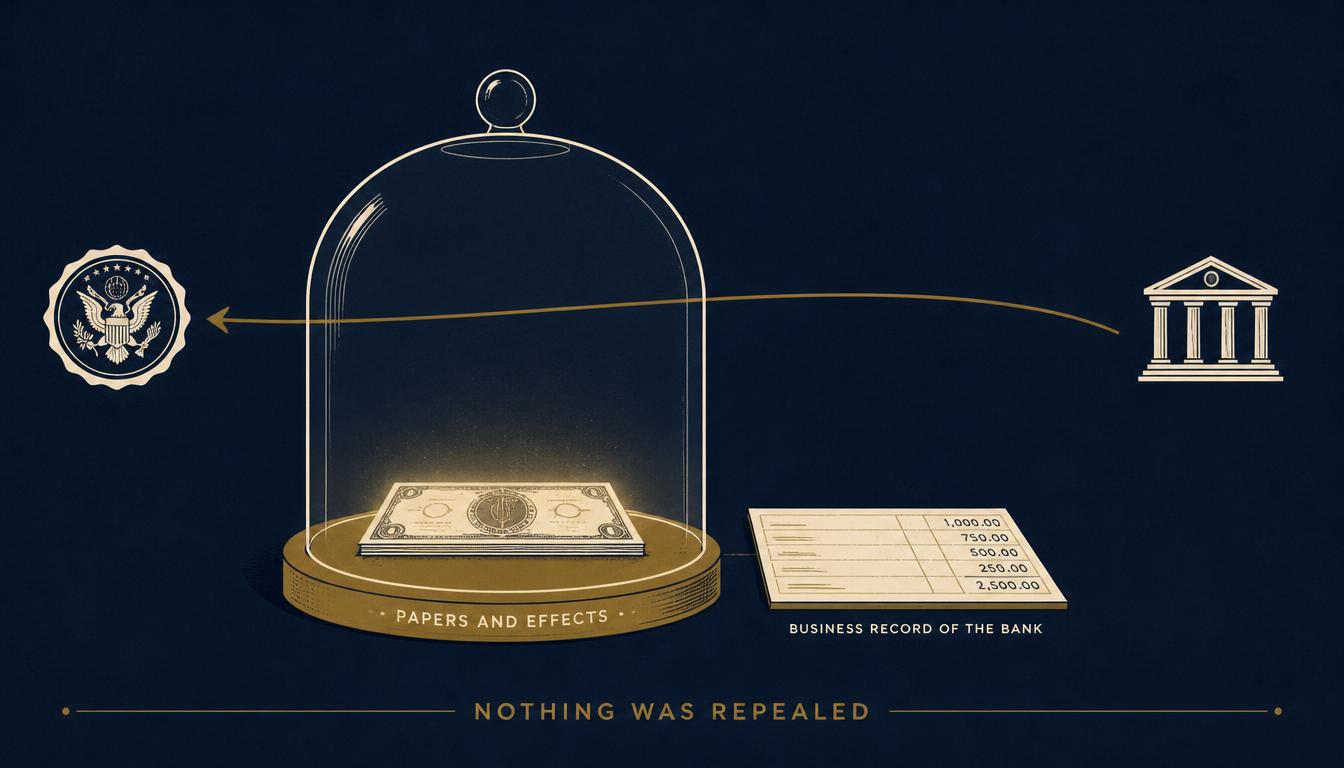
On April 21, 1976 the Supreme Court held seven to two that a bank depositor has no Fourth Amendment interest in his own financial records. The reasoning was that checks, deposit slips and account statements are the business records of the bank rather than the depositor's private papers, and that information conveyed to a third party loses constitutional protection even when revealed on the assumption it would be used only for a limited purpose. Justice Brennan dissented on the ground that it is impossible to participate in the economic life of contemporary society without maintaining a bank account, and that a conveyance one cannot avoid is not voluntary. He lost. United States v. Miller became the third-party doctrine, extended to telephone records three years later and qualified only narrowly in Carpenter. Forum #59 argues that Miller is the unexamined precondition for the architecture this catalog has documented across its work on programmable money: if intermediated financial records carry no constitutional protection, and a cashless system makes every transaction intermediated, then no financial act is constitutionally private — and no one had to repeal anything to reach that result.
Featured essay: read the full analysis →
Researched and drafted with AI assistance · reviewed and edited by Jason D. Keys
Listen
Issue #020 — Nothing Had to Be Repealed
Read in Jason Keys' synthesized voice
Narrated in the author’s synthesized voice, generated with AI from a recording of his own. The words are his; the delivery is machine-rendered.
Download (5.4 MB)Welcome to Issue #020 of The Dispatch. Each Monday, this letter takes one situation from the week's news and reads it through the lens of Carl Menger and Antal Fekete — paired with a foundational concept, the dashboard, the framework's prediction record, and a piece from the archive. If someone forwarded this to you, subscribe here.
The Lens
The constitutional question underneath programmable money was settled fifty years ago, in a case about a bootlegger's bank statements.
On April 21, 1976, the Supreme Court decided United States v. Miller seven to two. The holding: bank records are not protected by the Fourth Amendment. They are "the business records of the banks" rather than the depositor's private papers, and the depositor has no possession or control over them.
Then the sentence that did the real work:
"The Fourth Amendment does not prohibit the obtaining of information revealed to a third party and conveyed by him to Government authorities, even if the information is revealed on the assumption that it will be used only for a limited purpose and the confidence placed in the third party will not be betrayed."
The clause after the comma is worth reading twice. Protection is lost not when a person shares information carelessly, but even when he shares it on the express understanding that it will go no further.
Justice Brennan dissented, and his ground was the character of the conveyance:
"For all practical purposes, the disclosure by individuals or business firms of their financial affairs to a bank is not entirely volitional, since it is impossible to participate in the economic life of contemporary society without maintaining a bank account."
A person who must use a bank has not chosen to share his financial history. He has been required to. He lost.
Forum #59 traces the decision from the Bank Secrecy Act that manufactured the records, through California Bankers v. Shultz, Miller itself, Smith v. Maryland and the narrow qualification in Carpenter — and argues that this is the unexamined precondition for everything the catalog has documented about programmable money.
Lead Essay: The Precondition Nobody Voted For
Start with where the records came from. They existed because federal law required banks to create them. The Bank Secrecy Act of 1970 imposed recordkeeping and reporting obligations on financial institutions; the statute was challenged and upheld in California Bankers Association v. Shultz in 1974, over dissents from Douglas, Brennan and Marshall.
So the sequence runs: the government requires banks to create records of customer transactions, and then holds that customers have no constitutional interest in the records the government required to be created.
Miller's attorney made exactly that argument and the Fifth Circuit accepted it, characterizing the mechanism as the government "first requiring a third party bank to copy all of its depositors' personal checks and then, with an improper invocation of legal process," obtaining them. The Supreme Court reversed, holding that the Act's requirements do not create a Fourth Amendment interest and that it was "not a novel means designed to circumvent established Fourth Amendment rights."
The doctrine did not stay put. Three years later Smith v. Maryland applied the same reasoning to telephone numbers, and the pair became the third-party doctrine: what you convey to an intermediary, the government may obtain without a warrant. Its reach expanded exactly as fast as the economy intermediated. Carpenter v. United States (2018) qualified it five to four for extended cell-site location data — a genuine limit, which the essay credits as such — but an explicitly narrow one. It did not overrule Miller. Bank records remain where Miller put them.
Then the essay states the structural claim. Fourth Amendment protection attaches to a person's papers and effects. A banknote in a pocket is an effect: its existence, denomination and use are recorded nowhere, and learning about them requires a search. A digital balance at an intermediary is a record about a person held by someone else — and under Miller, the intermediary's business record, in which the person has no protectable interest.
In a financial system where every transaction is intermediated, no financial act is constitutionally private — and no one had to repeal anything to reach that result.
The protection does not have to be removed. It simply never attaches, because the condition that triggers it — a person's own possession of his own papers — has been designed out of the system.
And the essay's sharpest move is to show Brennan understated his case. In 1976 he argued the conveyance was involuntary because banking was a practical necessity. A person then could, with difficulty, conduct much of economic life in cash. In a system where physical currency has been retired and the unit of account exists only as a ledger entry at a supervised intermediary, the conveyance is not merely unavoidable in practice. It is unavoidable by definition — there is no form in which the asset can be held that does not involve an intermediary record.
Brennan's argument was that a forced conveyance should not forfeit constitutional protection. The majority held the voluntariness question did not control. That reasoning, whatever its merits in 1976, was never tested against a system in which the alternative does not exist.
→ Read the full analysis: The Protection That Dissolved: United States v. Miller and the Constitutional Precondition for Programmable Money — The Forum
Concept in Focus: The Third-Party Doctrine
The doctrine is usually discussed as a privacy question. The framework's interest is narrower and structural: it is a rule about where a protection attaches, and protections that attach to a form can be dissolved by changing the form rather than by changing the rule.
Fourth Amendment protection attaches to possession. Hold a thing and it is your effect; let someone else hold the record of it and it is their business record. The rule has not moved since 1976. What has moved is the proportion of economic life conducted through intermediaries, and that proportion is a design choice made by people who were not deciding a constitutional question at all.
This is the fourth consecutive issue in which the catalog has found the same shape. Forum #54 found that bail-in authority has existed for a decade and that a programmable settlement layer changes its execution latency, not the power. Forum #55 found that a credential nobody is compelled to hold becomes universal through an acceptance obligation on everyone else. Forum #56 found that a licensing scheme does not capitalize labor but carves the access premium out of the wage and turns it into a claim. Here, a constitutional protection is not repealed but rendered inapplicable.
In each case the outcome arrives without a decision that produced it. No legislature voted for any of them. Each step was narrow, defensible, and argued on grounds that had nothing to do with the result.
The Atlas page on Money vs Currency covers the distinction underneath this one: the difference between holding a good and holding a claim on an institution that holds it. Miller is what that distinction turns out to mean in constitutional terms.
The Charter
A new three-part series is live, and this week's lead essay is its third installment. The Charter traces what corporations gained and what individuals lost across the same two centuries, through the same institutional door.
- Forum #57 — The Charter That Expired. A corporation in the early republic was a grant of privilege, not a form of organization: a special act of a legislature, issued for a stated purpose, often capped at one hundred thousand dollars, and expiring after twenty or thirty or fifty years unless renewed. Brandeis documented it from the bench in 1933, noting that permission to incorporate for any lawful purpose was uncommon before 1875 and that under the old rules the holding company was impossible. The limits were not abolished by argument. They were competed away — New Jersey permitting holding companies in 1888 and removing time limits by 1896, Delaware copying the statute nearly verbatim in 1899. All seven of the largest trusts existing in 1904 were New Jersey corporations.
- Forum #58 — The Person That Emerged. No legislature voted to make corporations persons and no single decision established it. The rights accumulated case by case, and the sequence has a feature worth noticing: the first corporate rights case the Supreme Court ever heard was brought by a bank, in 1809; the case establishing corporate political speech was brought by a bank, in 1978. Between them sits the oddest episode in American constitutional law, in which Fourteenth Amendment personhood entered the United States Reports through a headnote — a reporter's summary of a remark the Chief Justice made before argument, on a question the Court then declined to decide. Later courts cited the headnote.
- Forum #59 — The Protection That Dissolved — this week's lead.
The series' argument is that the piecemeal character is the point rather than an incidental detail: an entity that acquires capacities one at a time, each justified on narrow grounds, never faces the question of what it has become.
The Dashboard
Readings from the live toolkit as of October 21, 2026.
- Gold Basis — +3.56% annualized at constant 90-day maturity, spot $4,120.34. Contango, mid-range. Priced for carry. → /toolkit/gold-basis
- Silver Basis — +3.48% annualized, spot $57.75. Contango, and firmer than last week. → /toolkit/silver-basis
- Silver / Gold Ratio — 71.25, against 73.99 a week ago. Silver has recovered part of last week's sharp decline. The move in both directions has been price, not scarcity — neither curve left contango at any point. → /toolkit/silver-gold-ratio
- Cross-Currency Basis — 19.0 bps mean absolute across four pairs. EUR/USD −8.3, GBP/USD +4.9, USD/CHF −32.7, USD/JPY −30.2. The ordinary state: synthetic dollars via the swap market cost marginally more than direct borrowing. → /toolkit/cross-currency-basis
- OTROFF (10Y On/Off-the-Run Treasury Spread) — +1.35 bps, maturity-adjusted. An unremarkable premium for the most-current issue. → /toolkit/otroff-spread
- COMEX Deliveries — 674 contracts stopped on October 20 across two contracts. → /toolkit/comex-paper-physical
The framework's reading: a second quiet week, and the silver round trip is the instructive part. The ratio ran from 67.8 to 74.0 and back to 71.3 inside a fortnight, which is a large move in the price of one metal against another. At no point did either forward curve leave ordinary contango. A scarcity event and a price swing look identical in a chart and different in a basis, and this was the second kind both going down and coming back.
That is the whole use of the instrument. Had physical silver tightened, the curve would have said so before the ratio did.
The Scorecard
Forum #55's nearest dated test is nine weeks out. December 24, 2026 is a hard obligation on all twenty-seven EU member states to provide at least one certified European Digital Identity Wallet, under Article 5a(1) of Regulation (EU) 2024/1183. Whether all twenty-seven meet it is a clean, falsifiable test of how binding a published timetable is in practice.
Forum #16 banking diagnostics — the count holds at 6. No new U.S. bank failure. Six for 2026 against two in each of 2024 and 2025.
Next major resolutions on the ledger: the EUDI Wallet deadline on December 24; the digital euro pilot development phase, running through 2027 toward a twelve-month operational pilot in the second half of that year; and the Q3 FDIC Quarterly Banking Profile.
The Actionable
The framework's operational observations calibrated to Forum #59:
- Ask where a protection attaches, not whether it exists. A right that attaches to possession survives exactly as long as possession does. The rule in Miller has not changed in fifty years; what changed is the share of economic life conducted through intermediaries. Any protection contingent on a form is only as durable as that form.
- Cash is a constitutional category, not only a payment method. A banknote is an effect in the Fourth Amendment sense. A balance is someone else's record. Whatever one concludes about convenience, those are different legal objects, and the difference is not recoverable by preference once the first is retired.
- A narrow qualification is not a reversal. Carpenter is real and the framework credits it, but it rests on the specific character of comprehensive location tracking and leaves bank records where Miller put them. Reading a limited holding as a general restoration is the most common error in this area.
- The pattern is the finding. Four consecutive essays have located a consequential outcome that no decision produced: authority that already existed, a credential nobody is compelled to hold, a premium carved out of a wage, a protection that never attaches. When a mechanism is disclosed, defensible and arrived at piecemeal, the question worth asking is not who intended it but what it is now general over.
Educational content only — not investment advice.
From the Archive
"Owners of gold coins of the realm must have the right to hoard, melt down, or export them as they see fit. In this way the power to regulate the money supply will be vested in the people, rather than in representatives or unelected bureaucrats. ... The power to create money is unlimited power. As such, it must be reserved for the people. Take it away, and you have overturned constitutional order."
— Antal Fekete, Architecture for a New World Financial System
Fekete is not making a privacy argument, and that is why the passage belongs here. His claim is that the monetary question is a constitutional question — that the ability of an individual to hold the monetary asset directly, and to do with it as he chooses, is what keeps the power to create money distributed rather than concentrated. Remove it and something constitutional has changed, whatever the statute book says.
Miller is the same proposition arriving from the opposite direction. Fekete says that taking away direct possession overturns constitutional order; the Supreme Court held, four decades earlier, that what you do not possess directly is not constitutionally yours to begin with. Neither was responding to the other. They describe the same hinge — that possession is the thing protection attaches to — and they disagree only about whether its loss is a problem.
→ Read the full essay in the Fekete Archive
Also This Week
- Forum #56 — Selling the Last Unencumbered Asset, the lead of Issue #019, is the nearest companion to this week's argument. Its finding — that a licensing scheme carves the access premium out of the wage and turns it into a claim, with the claim being the part that grows as displacement proceeds — is the same movement from a thing held to a thing owed that Miller describes in constitutional terms.
- The Divide continues under Learn, with six contested questions traced through primary texts. What Is Money? is the natural companion to this issue: Menger's account of money emerging undesigned from differential saleability, against Knapp's claim that money is a creature of law.
- Atlas: Money vs Currency — a good held against a claim on an institution that holds it, which is the distinction Miller turns into a constitutional one.
The Dispatch — New Austrian Economics
Get this in your inbox every Monday
Free weekly analysis through the Menger–Fekete framework. No jargon without definition.
Educational content only. Nothing in The Dispatch constitutes investment advice, financial advice, or a recommendation to buy or sell any security or asset. All analysis is provided for educational and informational purposes within the New Austrian Economics framework. Consult a qualified financial adviser before making any investment decisions.