
Researched and drafted with AI assistance · reviewed and edited by Jason D. Keys
In October 2025, an investor named Marc Calabria purchased a long-vacant eight-story office building at 401 South State Street in Chicago's Loop for $4.2 million. 1 The building had last traded in 2016 at $68.1 million. 1 The price decline: 94%. 2 By February 2026 Calabria had a stated plan, with the vertical-farming firm Farm Zero, to convert the building into an urban farming and food innovation campus — a use case that requires substantial physical reconfiguration of the structure but no longer requires the building to function as the Class B office property it was originally designed to be. In September 2025, an investor named Asher Luzzatto bought the two-building Denver Energy Center at 1625 and 1675 Broadway for $5.25 million. 2 The 900,000-square-foot complex, 18% occupied, had traded at $176 million in 2013. 2 The price decline: 97%. 2 In Washington DC in March 2026, Hossein Fateh's Dalian Development bought the former GSA Regional Office Building at 301 7th Street SW — 940,000 square feet, vacant since the Department of Homeland Security left in March 2025 — for $24.3 million, just over $25 per square foot. 3 In San Francisco in February 2026, an affiliate of CW Capital Asset Management acquired the bottom eight floors of 1155 Market Street at a foreclosure auction for $4 million against the $48 million CMBS loan secured by them. 4
These are not anomalous transactions. They are the visible surface of a much broader pattern that is now operationally arriving in commercial real estate after three years of "extend and pretend" — the term of art for the strategy by which lenders and borrowers cooperated to defer recognition of losses by extending maturing loans and modifying terms rather than forcing default or sale. The strategy worked, in the limited sense that it kept reported delinquency rates lower than the underlying credit quality warranted, while everyone waited for interest rates to fall and for office demand to recover. Interest rates did not fall enough. Office demand did not recover enough. By the start of 2026, the strategy was no longer viable for an increasing share of the affected loans, and the cascade now visible in the data is the institutional manifestation of that exhaustion.
This essay is the eleventh installment of Watching the Cracks. It does three things. First, it documents the specific empirical events of 2026 that demonstrate the cascade is operationally here — named properties, specific transactions, specific loan modifications. Second, it engages "extend and pretend" as a structural mechanism by showing how the practice produces directly observable distortions in the published CMBS delinquency time series. Third, it locates the cascade's downstream risk in the regional banking sector, which holds approximately 70% of U.S. 5 CRE loans against approximately 5% held by the largest banks — a concentration that means the eventual recognition of losses will flow primarily through the institutions least equipped to absorb them. 5 The framework's broader catalog has been making this argument since Article 16 (FDIC banking diagnostics) and Article 19 (the tax-plus-insurance wedge applied to housing). The 2026 data validates the prediction trajectory with the kind of specific empirical detail that has, throughout this catalog, distinguished the framework's analytical posture from the conventional discussion. 6
A note on framing before proceeding. The CRE cascade is now widely discussed in financial press. The data this essay engages is publicly available. What the framework adds is the structural reading: the connection between the visible transactions and the underlying substrate-fragility thesis the catalog has been developing across twenty-six prior essays. Reporters cover the fire sales; analysts cover the delinquency rates; what neither tends to do is connect both to the broader monetary-architectural pattern the framework has been documenting. That connection is the analytical work this essay does.
The two-mode market
The 2026 commercial office market is clearing in two operationally distinct modes simultaneously, and the distinction matters for understanding what is happening structurally.
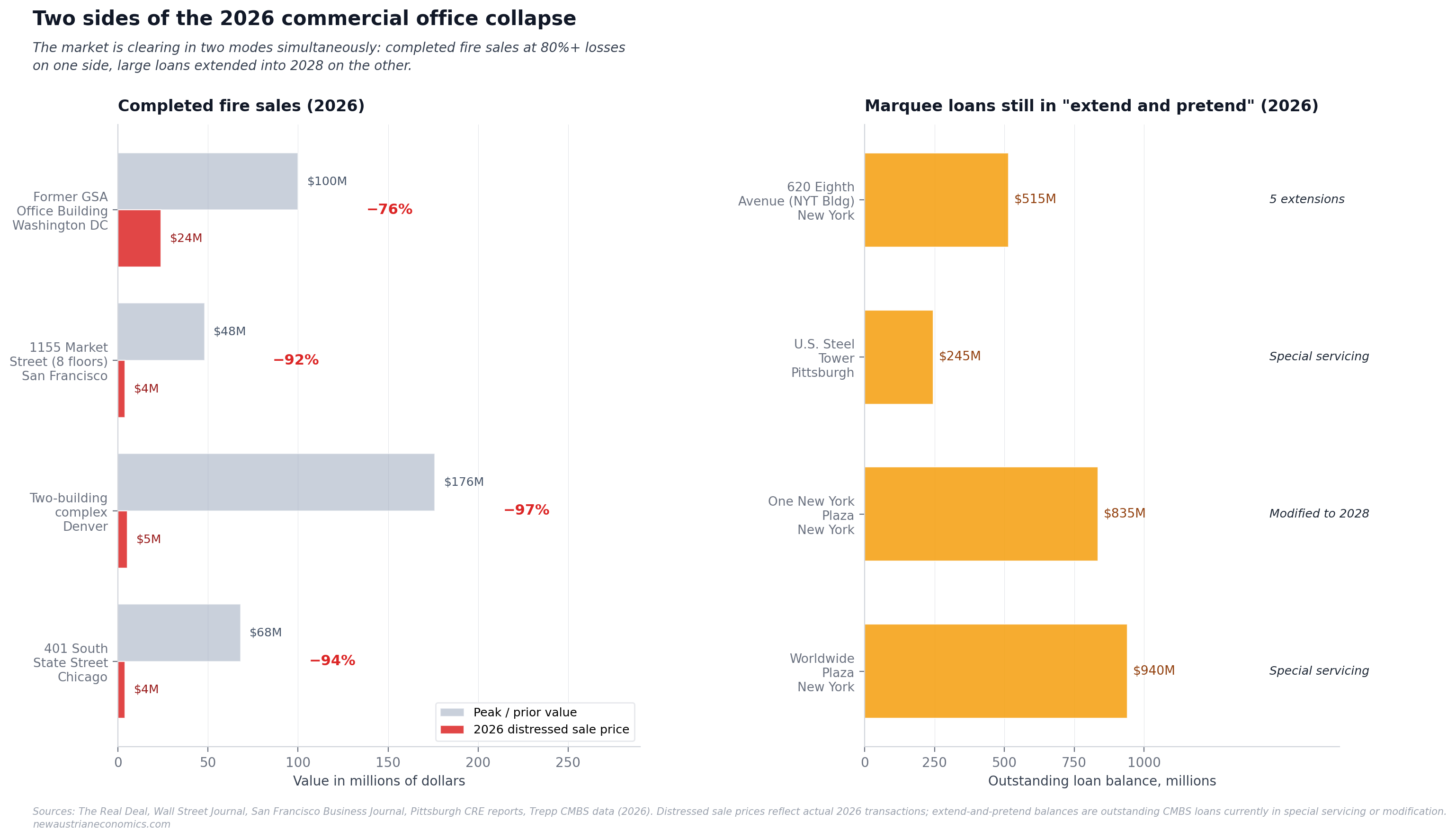
Mode one is forced clearing. Properties whose lenders have lost patience with the extend-and-pretend strategy, or whose ownership structures cannot survive further deferral, are being sold at prices that reflect the underlying credit quality of the asset rather than the carrying value on lender balance sheets. The 401 South State Street transaction in Chicago is canonical: $68.1 million in 2016, $4.2 million in October 2025, a 94% decline. 1 The Denver Energy Center: $176 million in 2013, $5.25 million in September 2025, 97%. 2 The San Francisco 1155 Market floors cleared at $4 million against the $48 million loan secured by them — a recovery of eight cents on the dollar of debt, which is a different measurement from the other two and worth keeping distinct. The Washington DC sale is different again: a federal surplus disposition rather than a distressed private trade, with no public prior appraisal to measure against, which is why the framework reports it as $25 per square foot for a 940,000-square-foot building rather than as a percentage loss. MSCI counted more than 200 distressed office sales in 2025, up from 133 in 2023 and totaling $5.2 billion; the pace accelerated further into 2026. 7
What distinguishes mode-one transactions is that the buyers do not plan to operate the buildings in their original use. Calabria's "urban farming and food innovation center" is not an unusual concept; it is the typical structure of the mode-one transaction. The buyer is acquiring the physical structure at a price that allows them to absorb the cost of converting it to a use that the current market actually wants — typically residential conversion where regulations permit, light industrial or maker-space use where the building's structural characteristics support it, or specialty uses (urban agriculture, medical, education) where the location provides an advantage. The framework's reading: mode-one transactions are the saleability discovery process operating without the substitute layer of lender forbearance. The buyer pays what the asset is worth in its physically-deliverable form, not what the prior monetary regime's pricing infrastructure said it was worth.
Mode two is continued deferral. The marquee loans, the ones whose magnitudes are large enough that institutional considerations dominate the disposition decision, remain in extend-and-pretend status. Worldwide Plaza in Manhattan ($940 million loan) has been in and out of special servicing since September 2024, was modified in March 2025, and by 2026 had drawn a $940 million foreclosure suit from its senior lenders — but has still not been resolved through sale. 8 One New York Plaza ($835 million) went to special servicing in December 2025 and was modified and extended to January 9, 2028 — kicked exactly two years down the road, against a $25 million principal paydown and a $20 million leasing reserve. 9 The U.S. Steel Tower in Pittsburgh ($245 million of total debt, $160 million of it securitized) was sent to special servicing in March 2026 ahead of a June maturity but has not been forced into sale. 10 Most notably, 620 Eighth Avenue — the former New York Times Building, whose upper portion carries a $515 million mortgage — was extended five times in twelve-month increments from an original December 2020 maturity, and in November 2025 ran out of extensions: the loan matured without payoff and went to special servicing. 11 Each extension was technically legal under the loan documentation. Each extension was also a deferral of the same loss-recognition event that the mode-one transactions are now executing, and 620 Eighth Avenue is what the end of the deferral runway looks like.
The framework's central observation: these two modes are operating on the same underlying asset class, in the same economic environment, often in the same metropolitan areas, with the disposition outcomes determined primarily by the size of the loan and the institutional considerations of the lenders involved. Smaller loans on Class B properties owned by relatively smaller borrowers get marked to market and sold at 90%+ losses. 4 Larger loans on marquee properties owned by relatively larger borrowers get modified, extended, and held at carrying values that bear no relationship to the prices the same buildings would fetch in a sale. This is not market efficiency. This is institutional dispensation operating to protect specific balance sheet positions while the broader market clears around the protected loans.
The data itself shows the mechanism
What makes the 2026 CRE situation analytically unusual is that the extend-and-pretend mechanism is directly observable in the published CMBS delinquency time series. The framework rarely gets to point at a single data series and say "the manipulation is happening in this number, you can see it" — but in this case the structure of the data is itself the evidence.
In January 2026, the Trepp CMBS overall delinquency rate hit 7.47%, with office delinquency at 12.34% — an all-time high. 12 In February 2026, the overall rate dropped 33 basis points to 7.14%, and office delinquency fell 114 basis points to 11.20%. 12 The decline was not the result of borrower performance improving. It was the result, per Trepp's own reporting, of "the execution of modifications and extensions of five large, matured office loans and four large mall loans," with office extensions ranging from "one month to almost three years." In March 2026, the overall rate increased 41 basis points to 7.55% as the same pattern continued — newly delinquent loans pushing the rate back up, while modifications and extensions pulled it back down. 12 Trepp's analysts described the dynamic explicitly: "a sideways delinquency trend as loans mature, go delinquent, cure, and become delinquent again." Roughly 40% of March's newly delinquent loans were classified as "performing matured balloon" the prior month — meaning loans that had reached maturity, been extended in some technical form to remain classified as performing, then crossed back into delinquency when the extension proved insufficient. 12
The framework reads this pattern carefully. The published delinquency rate is not a measure of how many loans are in genuine distress. It is a measure of how many loans are in distress that the special servicers have chosen not to modify within the reporting period. The same loan can cycle in and out of "delinquent" status multiple times across consecutive months as modifications are executed, then fail, then be re-modified, then fail again. The 12.34% January office delinquency reading and the 11.20% February reading do not represent improving credit conditions; they represent the same underlying pool of distressed loans being processed through different administrative classifications at different reporting dates. 12
The implication: the published delinquency rate substantially understates the actual credit stress in the CMBS office sector. Franz Hinzen, Felipe Severino and Stijn Van Nieuwerburgh, in Too-Many-to-Ignore: Regional Banks and CRE Risks (2025), built a loan-level dataset from county records and found that "reported delinquencies understate risks from undercollateralized loans by a factor of four" — the formal academic confirmation of what the time series oscillations make visible at the surface. 13 Their factor of four is measured on bank-held CRE loans, not on CMBS, and the framework does not claim the two datasets are interchangeable. But applied as the framework's own extrapolation to the published 11.20% February office CMBS delinquency rate, it implies underlying stress in the 40-45% range. 12 That is a framework estimate rather than a finding of the research, and it is offered as the rough magnitude of the office sector's problem masked by the modification machinery.
The named properties and what they tell us
The named distressed properties of 2026 are worth examining individually because each one contains structural information about the broader pattern.
Worldwide Plaza (49th Street, Manhattan). The $940 million CMBS loan first went to special servicing in September 2024, when the anchor tenant Cravath, Swaine & Moore vacated its 617,000 square feet for Brookfield's Two Manhattan West and left the tower 63% occupied. 8 A 2025 appraisal cut $1.4 billion from the building's 2017 valuation. 8 The building is approximately 1.6 million square feet of Class A office space within a two-million-square-foot complex. The framework's reading: this is a marquee Manhattan address with high-quality tenants — exactly the kind of asset that the recovery thesis ("Class A will be fine, only Class B is in trouble") said would not require special servicing. Its appearance in distress is empirical evidence that the recovery thesis is structurally incomplete.
One New York Plaza (Whitehall Street, Manhattan). The $835 million CMBS loan went to special servicing on December 18, 2025, three weeks before its January 9, 2026 maturity, and was modified with the maturity extended to January 9, 2028. Brookfield paid down $25 million of principal and funded a $20 million leasing reserve; two further one-year options require another $20 million each. The building is a 50-story, roughly 2.5-million-square-foot Class A tower in Lower Manhattan, fully occupied in 2022 and 83% occupied by late 2025. 9 The 2028 extension is the canonical mode-two transaction: kick the disposition decision two years forward into an environment that is hoped to be more favorable. The framework's prediction: the 2028 extension will not resolve the underlying credit problem, and the loan will either require further extension at that point or be sold under conditions that produce substantial losses for the lender. The extend-and-pretend timeline has shifted from "wait two years for the market to improve" to "wait another two years."
620 Eighth Avenue (former New York Times Building). The $515 million mortgage on the upper portion of the 52-story tower was extended five times in twelve-month increments from its original December 2020 maturity, reached the end of its extension options in December 2025, and went to special servicing in November 2025 ahead of that date; the restructuring under discussion covers roughly $750 million including additional debt. 11 The ownership is split — the Times owns the base through the 27th floor, and the upper floors came to Brookfield through its 2018 acquisition of Forest City, the building's original co-developer, not through a purchase from the newspaper. The Times' own sale was of floors 2 through 21, to W. P. Carey in 2009 for about $225 million, with a ten-year leaseback. 11 The framework's reading: a five-extension property is, structurally, a property the lender does not believe can be sold without producing a meaningful loss. The continued extension is the lender admitting the structural reality while declining to recognize it in their financial statements. This is the specific operational form of capital erosion that the framework's broader Fekete-derived analysis has been identifying across multiple sectors.
U.S. Steel Tower (Pittsburgh). The $245 million debt package 601W Companies used to refinance the tower in 2021 — $160 million securitized, $40 million unsecuritized subordinate, $45 million mezzanine — was sent to special servicing in March 2026, ahead of a June maturity, after four late interest payments beginning in April 2025. 10 The building is the tallest in Pittsburgh at 2.3 million square feet, and the leases of its two anchor tenants, the University of Pittsburgh Medical Center and U.S. Steel itself, expire within two years. Pittsburgh is not New York or San Francisco; the regional CRE markets in second-tier metros face structurally different dynamics, with shallower tenant pools and longer recovery timelines. The framework's reading: the appearance of the U.S. Steel Tower in special servicing is consistent with the catalog's Article 17 metro saleability analysis — second-tier metros face different stress timelines but ultimately face the same structural problem, with the institutional substitute layer (special servicing, modification, extension) operating identically across geographies.
Brookfield DTLA portfolio. Brookfield and its lenders are working to offload four office buildings totaling about 4.9 million square feet of Class A space in downtown Los Angeles — roughly 18% of the Financial District submarket's inventory, and nearly a fifth of its Class A space. 14 The framework's reading: when a single institutional owner is exiting 18% of a metro's downtown office inventory, the metro's office market is not in cyclical adjustment; it is undergoing structural reconfiguration. The buyers of these buildings will either be conversion specialists (residential, mixed-use) or will be opportunistic capital pools willing to operate at substantially reduced rents that reflect the actual demand environment rather than the pre-2020 pricing infrastructure.
The regional banking concentration
The most consequential framework observation about the CRE cascade concerns where the losses will eventually flow. The 2026 fire sales are clearing through CMBS structures, where institutional investors (pension funds, insurance companies, opportunistic credit funds) bear the losses through the securitization mechanisms. But CMBS represents only one part of the broader CRE financing picture, and the larger part is held directly by banks.
Small and mid-sized banks hold roughly 70% of bank-held U.S. 5 CRE loans — a narrower claim than 70% of all CRE debt, since banks hold only about half of the total. 5 Hinzen, Severino and Van Nieuwerburgh put almost a third of all U.S. commercial mortgage dollars on regional bank balance sheets. The concentration difference is the point: CRE runs around an eighth of the largest banks' loan books and closer to two-fifths at smaller regional banks, with banks in the $1 billion to $10 billion range carrying the largest direct CRE exposure of any size cohort. 5 Under the interagency concentration guidance, a bank whose total CRE loans exceed 300% of total risk-based capital and have grown 50% or more over the preceding 36 months is flagged for heightened supervisory analysis — a screening criterion rather than a limit, and one many regional banks meet. 15
The framework's reading: the eventual recognition of CRE losses will flow primarily through the regional banking sector, which is structurally less equipped to absorb the losses than the larger institutions that dominate financial press coverage. The Hinzen, Severino and Van Nieuwerburgh research is explicit about this: the regional banks are "already lowering lending standards to roll over distressed loans" — meaning they are extending CRE loans on increasingly aggressive terms to avoid the recognition events that would impair their capital positions. This is the same extend-and-pretend dynamic visible in the CMBS data, but operating at the bank level where the consequences flow to depositors (FDIC-insured up to $250,000) and to bank holding company shareholders. 16
The catalog's Article 16 (FDIC banking diagnostics) made three specific predictions about the Q1 2026 Quarterly Banking Profile: problem bank list at 62-66 banks, unrealized losses in the $310-340 billion range, and CRE delinquencies at or above the Q4 2025 reading on a bank-held basis, with the closing condition that "none of these readings should improve materially from Q4 2025." The release, published May 27, 2026, scored one of the three. 6
Unrealized losses on securities came in at $325.1 billion, up $19.0 billion on the quarter — inside the predicted band. 16 The other two went the other way. The problem bank list fell by six, to 54 institutions, against a prediction of 62-66 and a continuation of the 57 → 60 trend. The industry's past-due-and-nonaccrual rate declined to 1.53% from 1.56%, and the non-owner-occupied CRE rate at banks above $250 billion in assets eased to 3.40% — its sixth consecutive quarterly decline. 6 Two of the three readings improved.
The framework's intellectual discipline requires stating that plainly rather than reading the release as a validation. What the miss does and does not establish is worth being precise about. The two readings that improved are the ones most directly shaped by supervisory and accounting discretion: a problem bank list is a count of supervisory ratings, and a past-due rate is a count of loans a servicer has not yet modified. That is the same mechanism this essay has just documented in the CMBS series, operating one layer up. It is also exactly what a genuine improvement would look like from the outside, and the framework does not get to have it both ways in the same quarter. The next several quarters of Quarterly Banking Profile data will continue to test the catalog's predictions, and the framework's posture remains what it has been throughout: descriptive of the structural conditions, attentive to the specific data series that reflect them, and honest about which predictions hold versus which require revision. On this release, one held and two did not.
The urban doom loop and the fiscal dimension
The CRE collapse has fiscal consequences that extend well beyond the affected lenders and property owners. Major U.S. cities depend substantially on commercial property tax revenue to fund municipal services — police, schools, transit, infrastructure maintenance. The "urban doom loop" is Stijn Van Nieuwerburgh's coinage, from the Columbia and NYU Stern work on remote employment and office valuations he and Arpit Gupta published as "Work From Home and the Office Real Estate Apocalypse," since carried by the American Economic Review: falling office property tax assessments produce lower municipal revenue, which forces service cuts, which reduce urban quality of life, which accelerate the migration of residents and businesses to alternatives, which further depresses property values, which further reduces tax revenue.
The mechanism is partly operational, and the fiscal leg of it has moved more slowly than the mechanism implies — office vacancies and sale prices have gone where the research predicted, while the hit to city finances has so far been more muted than the loop's logic would suggest. Distressed CRE owners are increasingly filing tax assessment appeals demanding that their tax bills be lowered to match their now-impaired property values. The 401 South State Street building in Chicago, sold at $4 million in 2026, was previously assessed at a value substantially higher than its sale price; the new owner has standing to appeal the assessment downward, which they will. Cities will resist the assessment reductions because their budgets depend on the higher values; but the legal precedent for valuation-following-market-price is well-established, and the eventual resolution will produce meaningful municipal revenue losses across multiple major U.S. cities.
The framework's broader catalog has engaged this dimension through the housing analysis (Articles 17-19, particularly the tax-plus-insurance wedge work). The fiscal dimension of the CRE collapse extends the same pattern to the commercial side: the property tax assessment regime, which has historically functioned as a relatively stable revenue source for municipal governments, is now subject to revaluation pressure from both directions (commercial buildings demanding lower assessments based on sale prices; residential homeowners in stressed metros demanding the same). The framework's prediction: major U.S. cities will face budget deficits and potential credit rating downgrades through 2026-2027 as the assessment revaluations work through municipal balance sheets. Boston, New York, San Francisco, Chicago, and Los Angeles are particularly exposed because of their high prior reliance on commercial property tax revenue.
What this means for the broader monetary architecture
The framework's broader thesis throughout this catalog has been that monetary architecture in 2026 has accumulated substrate fragility visible across multiple disparate sectors when subjected to specific empirical tests. The CRE collapse is the latest sector to produce visible empirical validation, and it deserves explicit connection to the broader pattern.
The substrate that supported the post-2008 CRE expansion was the combination of low interest rates (Federal Reserve policy from 2008 through 2022) and the institutional infrastructure that translated low rates into broadly available CRE financing (CMBS securitization, regional bank lending, life insurance company allocations, commercial bank participations). When interest rates rose sharply through 2022-2024, the underlying property values supported by the prior low-rate environment became structurally inconsistent with the new financing environment. The institutional infrastructure responded by deferring recognition — extend-and-pretend — rather than forcing immediate revaluation. The deferral worked for three years. It is no longer working in 2026.
This is structurally analogous to what the catalog has documented in other sectors:
- Banking (Article 16): the FDIC failure count masking substantial underlying stress through similar deferral mechanisms
- Housing (Articles 17-19): the metro-level saleability heterogeneity hidden by national aggregates, with the tax-plus-insurance wedge breaking household budgets in specific geographies
- Precious metals (Article 24): paper-physical decoupling under stress, with the January 30 silver crash demonstrating the substrate failure operationally
- Cryptocurrency (Article 25): the Iran seizures demonstrating the substitute-layer enforcement reach extending into ostensibly decentralized instruments
- Supply chains (Article 26): the Hormuz disruption propagating through buffer-depleted reserves on calendar-time mechanics
The CRE collapse fits this pattern precisely. The substrate that supported the prior pricing structure has failed. The institutional substitute layer (extend-and-pretend, special servicing, modification) has deferred but not prevented the recognition. The cascade is now operationally visible in specific named transactions and specific bank exposure concentrations. The framework's reading: the cumulative weight of substrate-fragility evidence across sectors is now substantial enough that the broader thesis no longer requires defense; it requires only continued application as additional sectors produce additional empirical validation.
What households should take from this
The framework's specific operational observations for household readers:
Regional bank exposure deserves direct examination. Households with substantial deposits at regional banks ($1 billion to $50 billion in total assets) should examine the specific bank's CRE concentration. 16 The data is publicly available through the Federal Financial Institutions Examination Council's Call Report system. Total CRE loans above 300% of total risk-based capital, combined with 50% growth over three years, is the interagency criterion that flags a bank for closer supervisory analysis. Banks with such concentrations are not immediately at risk of failure — they are, however, structurally exposed in ways that the framework's reading suggests will produce meaningful capital pressure over the next 18-36 months. FDIC insurance covers deposits up to $250,000 per depositor per insured bank per ownership category; households whose deposits exceed the insurance threshold should consider distributing across institutions. 16
Municipal credit exposure matters for fixed-income holdings. Households holding municipal bonds from major cities with high commercial property tax dependence (Boston, New York, San Francisco, Chicago, Los Angeles) should review the specific issuers' revenue diversification and rainy-day fund positions. The urban doom loop is a multi-year process, not a single event; meaningful credit deterioration is likely over the next 24-36 months in the most exposed municipalities. The framework does not advise specific allocation decisions, but the structural exposure is worth understanding before it becomes news rather than analysis.
REIT exposure may be re-pricing for some time. Publicly traded office REITs have substantially repriced over the past several years, but the framework's reading is that the repricing has not fully absorbed the extend-and-pretend distortions visible in the underlying CMBS data. Households with REIT exposure through retirement accounts or general portfolios should understand that the office sub-sector specifically faces continued downside as the substitute-layer mechanisms exhaust further. Other CRE sub-sectors (industrial, multifamily, data centers) are operating under different supply-demand conditions and should not be evaluated as a single class with office.
The framework's broader case for taking substrate-fragility seriously continues to strengthen. The CRE collapse is the latest sector to produce visible empirical validation of the catalog's structural thesis. Households making long-term financial decisions should price the cumulative weight of the evidence accordingly. The framework's standard guidance — physical assets with direct saleability, geographic diversification of exposure, attention to specific institutional concentrations, awareness of where in the financial architecture's asymmetric support structure the household sits — continues to apply.
The closing observation
Beginning with his 1957 work on money-market changes, the economist Hyman Minsky developed what would later be called the Financial Instability Hypothesis: the observation that periods of economic stability systematically incentivize the accumulation of financial fragility, until the cumulative fragility exceeds the system's absorptive capacity and produces what Paul McCulley — not Minsky — would name a "Minsky moment" four decades later, during the 1998 Russian default: the sudden recognition that asset prices that had been sustained by leverage and short-term financing arrangements were not actually justified by underlying cash flows. The post-2008 monetary architecture was, in Minsky's vocabulary, designed to produce exactly the conditions he warned about: extended periods of low interest rates that incentivized leveraged accumulation, institutional substitute layers (the Federal Reserve's balance sheet, agency MBS, central bank standing facilities) that allowed the accumulated leverage to operate longer than market conditions would have permitted, and a regulatory framework that discouraged forced recognition of losses in favor of extended workout periods.
The CRE collapse is, in framework terms, the slow-motion Minsky moment in commercial real estate specifically. The accumulated fragility was real. The recognition is no longer fully deferrable. The transactions clearing at 76-97% losses from prior values are the market discovering what the buildings are actually worth under current financing conditions and current demand conditions. 2 The marquee loans still in extend-and-pretend are the institutions buying time for the eventual recognition events. The regional banks holding 70% of the broader CRE exposure are the substrate that will absorb the losses when the recognition events arrive. 5
None of this required a single sudden crisis to produce. It required only that the accumulated substrate fragility eventually exceed the system's absorptive capacity through the slow grind of expired extensions, exhausted patience, and individual properties whose specific economics made further deferral impossible. The transactions of 2026 are the visible early phase of that process. The framework's prediction is that 2026-2028 will see continued recognition across the CRE sector, with the cumulative magnitude of recognized losses ultimately running far above the published delinquency figures — the framework's own extrapolation from the Hinzen factor of four, not a finding of that research.
Watching the Cracks will engage the May 2026 CPI release that drops Wednesday, June 10, three days from this essay's publication, in Article 29. The framework's Article 26 made specific predictions about the Hormuz supply shock propagation timeline. The May print is the first major data point that should reflect meaningful Hormuz transmission per the framework's calendar mechanics. Whatever it shows — confirming the framework's prediction trajectory or surprising it — will be engaged honestly. The pattern of substrate-fragility validation continues to accumulate across sectors. The framework's posture continues to be what it has been throughout this catalog: descriptive of structural conditions, attentive to specific empirical signals, and honest about what the cumulative evidence reveals.
The collapse is here. The watching continues.
This is the eleventh installment of "Watching the Cracks." The framework's predictions recorded here for future testing: 2026-2028 will see continued CRE loss recognition with cumulative magnitudes far above the published delinquency figures, on the framework's own 40-45% extrapolation from the Hinzen factor of four rather than a finding of that research; regional banks past the 300%-of-risk-based-capital concentration criterion will face meaningful capital pressure through this window; major U.S. cities with high commercial property tax dependence will face budget deficits and potential credit rating downgrades through 2026-2027; the 620 Eighth Avenue / 1 NY Plaza class of extend-and-pretend loans will require further extension or produce substantial loss recognition events when their current modifications expire. The fire-sale chart at the top of this essay shows actual 2026 transactions on the left and outstanding loan balances in extend-and-pretend status on the right; sources include The Real Deal, Wall Street Journal, San Francisco Business Journal, Trepp CMBS data, and the FDIC Q1 2026 Quarterly Banking Profile.
Sources
Footnotes
-
Cook County Recorder of Deeds and contemporaneous Chicago reporting. https://www.cookcountyclerkil.gov/ — Cook County property records and contemporaneous Chicago reporting. — 401 South State Street, Chicago: sold October 2025 for $4.2 million against $68.1 million in 2016, a 93.8% decline. Buyer Marc Calabria; the vertical-farming conversion with Farm Zero was announced the following February 2026. The building is the 1891 Jenney-designed former Siegel, Cooper & Co. store. ↩ ↩2 ↩3
-
Denver Energy Center, 1625 and 1675 Broadway: September 2025, $5.25 million, 900,000 square feet at 18% occupancy, against $176 million in 2013 — a 97% decline. ↩ ↩2 ↩3 ↩4 ↩5 ↩6
-
GSA Regional Office Building, 301 7th St SW, Washington: Hossein Fateh's Dalian Development, March 2026, $24.26 million for 940,000 square feet — just over $25 a square foot, in a federal surplus sale, vacant since DHS left in March 2025. No prior appraisal exists on the public record, so no percentage decline can be stated. ↩
-
Trepp CMBS servicer data and San Francisco auction records. https://www.trepp.com/trepptalk — 1155 Market Street, San Francisco: a CW Capital affiliate took the bottom eight floors at a February 2026 foreclosure auction for $4 million against a $48 million CMBS loan — a recovery against debt rather than a decline from a prior sale price. ↩ ↩2
-
Federal Reserve, H.8 assets and liabilities of commercial banks. https://www.federalreserve.gov/releases/h8/ — Small and mid-sized banks holding roughly 70% of outstanding U.S. CRE loans against about 5% at the largest banks, and the concentration difference between them. ↩ ↩2 ↩3 ↩4 ↩5 ↩6
-
FDIC Quarterly Banking Profile. https://www.fdic.gov/analysis/quarterly-banking-profile — Q1 2026 against Article 16's recorded prediction: the problem bank list came in at 54, down six on the quarter (predicted 62–66); CRE delinquency fell, with total-loan PDNA at 1.53% from 1.56% and non-owner-occupied CRE at the largest banks at 3.40%, a sixth consecutive quarterly decline; unrealized losses at $325.1bn, up $19.0bn, inside the predicted $310–340bn range. ↩ ↩2 ↩3
-
MSCI — more than 200 distressed office sales in 2025, up from 133 in 2023, totalling $5.2 billion. ↩
-
Trepp special-servicing data and CMBS remittance reports. https://www.trepp.com/trepptalk — Worldwide Plaza went to special servicing in September 2024 when Cravath's 617,000 sq ft lease expired and the tower fell to 63% occupied; modified March 2025, a 2025 appraisal cut $1.4 billion from the 2017 value, and senior lenders filed a $940 million foreclosure suit in 2026. ↩ ↩2 ↩3
-
One New York Plaza: $835 million, special servicing 18 December 2025, three weeks before a 9 January 2026 maturity, extended to 9 January 2028 against a $25 million paydown and a $20 million leasing reserve with two further one-year options at $20 million each. Roughly 2.5 million sq ft across 50 stories; fully occupied in 2022, 83% by late 2025. ↩ ↩2
-
U.S. Steel Tower: a $245 million 2021 debt package — $160m securitized, $40m unsecuritized subordinate, $45m mezzanine — transferred to special servicing March 2026 ahead of a June 2026 maturity after four late interest payments from April 2025. 2.3 million sq ft, anchored by U.S. Steel and the University of Pittsburgh Medical Center, both leases expiring within two years. ↩ ↩2
-
Trepp special-servicing data and CMBS remittance reports. https://www.trepp.com/trepptalk — 620 Eighth Avenue: five twelve-month extensions from a December 2020 maturity, exhausted in December 2025, with the loan in special servicing from November 2025 and a restructuring covering roughly $750 million including additional debt. Brookfield came in via its 2018 acquisition of Forest City; the Times sold floors 2–21 to W. P. Carey in 2009 for about $225 million with a ten-year leaseback. ↩ ↩2 ↩3
-
Trepp. https://www.trepp.com/trepptalk — January 2026 overall 7.47% (+17bp) and office 12.34% (+103bp), an all-time high; February overall 7.14% (−33bp) and office 11.20% (−114bp); March overall 7.55% (+41bp) and office 11.71% (+51bp). Trepp attributed the February drop to modifications and extensions of five large matured office loans and four large mall loans, and described "a sideways delinquency trend as loans mature, go delinquent, cure, and become delinquent again." Roughly 40% of newly delinquent loans classified as performing matured balloon the prior month is March's figure against February. ↩ ↩2 ↩3 ↩4 ↩5 ↩6
-
Hinzen, Franz, Felipe Severino and Stijn Van Nieuwerburgh. Too-Many-to-Ignore: Regional Banks and CRE Risks — reported delinquencies "understate risks from undercollateralized loans by a factor of four," from a loan-level dataset built out of county records. ↩
-
Brookfield DTLA: four active offerings, about 4.9 million sq ft of Class A, roughly 18% of the Financial District submarket and nearly a fifth of its Class A space. ↩
-
Interagency guidance on concentrations in commercial real estate lending. https://www.federalreserve.gov/boarddocs/srletters/2007/SR0701.htm — The 300% of total capital threshold and the 50% growth trigger. ↩
-
FDIC deposit insurance limits and Quarterly Banking Profile. https://www.fdic.gov/analysis/quarterly-banking-profile — The $250,000 insured limit, and Q1 2026 unrealized securities losses of $325.1 billion, up $19.0 billion on the quarter. ↩ ↩2 ↩3 ↩4
On the record
This essay logged 3 dated predictions
None have reached their resolution window yet. They are logged with explicit criteria, and will be scored as the evidence arrives — right or wrong.
- OpenMajor U.S. cities with high commercial property tax dependence face budget deficits and potential credit rating downgrades through 2026–2027 as office reassessments work through municipal tax rolls.
- OpenCumulative CRE office-sector loss recognition through 2026–2028 approaches the Hinzen-implied "true" credit stress reading of 40–45% rather than the lower published delinquency figures.
- OpenRegional banks with CRE-to-equity ratios above 300% face meaningful capital pressure — capital raises, dividend cuts, forced mergers, or FDIC resolution — through the 2026–2028 CRE recognition window.
Related essays
The Saleability Audit of Bitcoin: What Menger Would Say in 2026
Bitcoin maximalists insist Bitcoin is the most saleable monetary good ever created. Skeptics insist it doesn't work for the African villager or the rural Chinese citizen the maximalists invoke. Both positions miss what Menger's framework actually says when applied carefully. The audit produces uncomfortable results in both directions — Bitcoin scores remarkably well on some criteria and remarkably poorly on others — and the actual ground-truth of crypto adoption in emerging markets in 2026 is something neither camp accurately describes.
The Decay Function of Marketability: Toward a Computable Menger-Fekete Framework
Menger argued that saleability is a spectrum; Fekete developed the gold basis to measure it for one commodity. This essay proposes a generalizable decay function of marketability, measurable across every modern financial instrument, that renders Menger's core insight computable for the first time.
The Paper Substitute: Agency Mortgage-Backed Securities and the Next Saleability Crisis
Fannie Mae and Freddie Mac issue $9 trillion in paper claims on an asset class — single-family housing — that has the worst saleability characteristics of any major investment available to American households. This is precisely the structure Fekete identified as the most fragile in any monetary system: a deep, liquid market in paper substitutes for an underlying that cannot itself be substituted. The 2008 collapse was the first observable failure of this architecture. The next will be larger.