
Researched and drafted with AI assistance · reviewed and edited by Jason D. Keys
Most modern advocacy for the gold standard describes a monetary regime that is not, and has never been, the gold standard.
The picture sketched in libertarian pamphlets, in Austrian-tradition advocacy, in mainstream financial commentary that engages the question at all, typically consists of paper currency backed by gold reserves held in a central bank vault, with citizens nominally able to redeem notes for gold at a fixed parity but rarely doing so. The currency circulates as paper; the gold sits in the vault as backing; the institutional discipline supposedly arises from the fact that the currency cannot expand beyond what the gold backing supports. This picture, repeated through decades of monetary commentary, has become what most participants in contemporary monetary debate assume "the gold standard" actually means.
It is not what the gold standard meant. The picture sketched above is the gold-exchange standard, a substitute system constructed at the 1922 Genoa Conference to replace the actual gold standard that the First World War had destroyed in 1914. The gold-exchange standard was a mechanism for central banks of smaller countries to hold their reserves in the currencies of larger countries (primarily the British pound and the U.S. dollar) rather than in gold itself, with only those reserve-currency-issuing central banks holding actual gold. Bank of France Governor Émile Moreau recorded the objection in his diary: "England having been the first European country to reestablish a stable and secure money has used that advantage to establish a basis for putting Europe under a veritable financial domination." He was describing a mechanism, not venting a grievance. 1 The Genoa system collapsed within a decade, contributing structurally to the Great Depression. Bretton Woods (1944-1971) restored a modified version of the same gold-exchange architecture, which collapsed in turn when Nixon ended dollar-gold convertibility on August 15, 1971. The entire span from 1914 through 1971 was the operational lifetime of one or another version of the substitute system. The system most contemporary advocacy describes as "the gold standard" is the substitute, not the original.
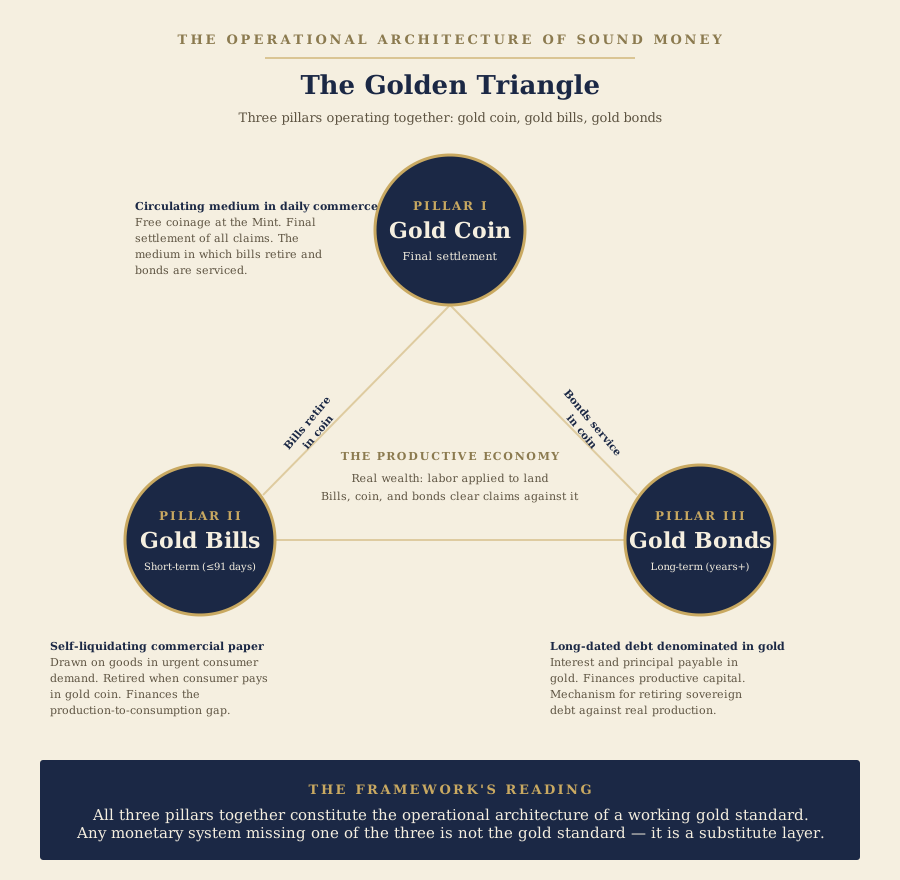
The actual gold standard — the system that produced approximately a century of price stability from the Napoleonic settlement of 1815 through the outbreak of war in 1914, the system within which the Industrial Revolution and the integration of global trade and the accumulation of broadly distributed productive prosperity all occurred — was a three-pillar operational architecture. Gold coin circulated in actual daily commerce. Gold bills — short-dated commercial paper drawn on goods in urgent consumer demand — cleared the short-term financing of production. Gold bonds — long-dated debt obligations denominated in ounces of gold — provided the long-term capital structure and, critically, the mechanism by which sovereign debt could be systematically retired. The three pillars operated together. Each was necessary; none was sufficient. The structure was not arbitrary. It was the operational form that classical political economy had identified as required for sound money to function across the full range of commercial activity, from the wage of a day laborer to the financing of a railroad.
Antal Fekete, the Hungarian-born monetary theorist who developed his analytical framework across roughly five decades of work from the late 1960s until his death, called this architecture the Golden Triangle. 2 Drawing on Adam Smith's Real Bills Doctrine (which he termed the Gold Bills Doctrine), on Carl Menger's saleability framework (which he extended into a theory of interest as the income corresponding to a unit of wealth), and on the actual historical record of how the pre-1914 system operated, Fekete spent the final decades of his life articulating in detail what the lost architecture was and what would be required to restore it. His student Rudy Fritsch, born in Hungary and shaped by his family's direct experience of the Hungarian hyperinflation that followed the Second World War, continued the work in the New Austrian School of Economics that Fekete founded. The lineage is small. It is not well-known even within Austrian-school monetary circles. It deserves to be much better known than it is.
This essay engages the Golden Triangle in full. Section one establishes what the pre-1914 system actually was, with emphasis on the specific institutional features that distinguished it from the gold-exchange substitute that replaced it. Section two examines the anatomy of a real bill — what such an instrument actually was, how it functioned, and why it was central to the operational viability of the broader architecture. Section three engages the gold bond as the long-term pillar, including the specific mechanism by which a properly designed gold bond program could systematically retire even the roughly $39.5 trillion U.S. national debt that has accumulated through 112 years of substitute-system operation. 3 Section four traces the historical destruction across the 1914-1971 period, with attention to the specific institutional decisions that progressively dismantled each pillar. Section five engages the inflationary critique of real bills advanced by Mises and Rothbard and provides Fekete's structural defense. Section six paints the picture of how the world could work under a restored Golden Triangle. Section seven synthesizes the framework's broader reading: why this architecture is not nostalgic but diagnostic, not utopian but operational.
The essay is long. The subject is foundational. The catalog's prior thirty-two essays have documented, across multiple sectors and across two years of accumulating empirical evidence, the substrate fragility that the post-1914 substitute-system architecture has produced. The Golden Triangle is the structural alternative. Understanding what the alternative actually is, rather than the misremembered version that contemporary debate engages with, is the necessary precondition for any serious discussion of monetary reform.
What the world actually looked like before 1914
The classical gold standard was not a monetary policy. It was an operational architecture with specific institutional features that, taken together, produced the price stability and productive growth the era is remembered for. The features deserve enumeration because their absence in the substitute system is precisely what distinguishes the substitute from the original.
Free coinage at the Mint. Any citizen possessing gold bullion — whether mined, inherited, traded, or otherwise acquired — could present that bullion to the United States Mint and receive in exchange standard coins of equivalent weight, minus a small seigniorage charge to cover the cost of coinage. 4 This was not a privilege granted to select institutions. It was a right available to any holder of gold. The mechanism ensured that the market price of gold bullion and the legal value of gold coin remained tied: if coin commanded a premium over bullion, citizens would bring bullion to the Mint and convert it into coin until the premium was arbitraged away; if bullion commanded a premium, citizens would melt coin into bullion until the premium was eliminated.
The Mint did not control the money supply. The Mint provided the institutional infrastructure through which the public determined how much gold should exist in coined form versus bullion form, based on what commerce actually demanded. The United States ended free coinage of silver through the Coinage Act of 1873 (denounced by its critics as "the Crime of '73"). Free coinage of gold ended in two steps: Executive Order 6102 required citizens to surrender gold coin in April 1933, and the Gold Reserve Act of January 30, 1934 ended the coinage of gold outright, directing that gold coin be withdrawn from circulation and formed into bars. Both endings were structural breaks with the classical architecture.
Gold coin in actual daily circulation. Citizens carried gold coins. They paid for groceries, rent, wages, and small purchases in gold coin. The $20 Liberty Head double eagle (issued 1850-1907) and its successor the Saint-Gaudens double eagle (1907-1933) were the standard high-denomination coins; the half-eagle ($5) and quarter-eagle ($2.50) circulated alongside, and the gold dollar had done so until its discontinuation in 1889. 5 Silver dollars and subsidiary silver coinage handled smaller denominations. The coin was the money. The bank note, where it existed, was a claim on gold coin held by the issuing bank — and the public could and did demand redemption when they wished. The classical gold standard was not "gold in the vault backing paper in your pocket." It was gold in your pocket. The gold-exchange substitute, which by design prevents citizen access to actual gold coin in daily commerce, is structurally different from this and has been from its first construction.
The London bill market as global clearing system. International trade in the classical era was not financed through gold flowing across national boundaries each time a transaction occurred — which would have been operationally impossible at the scale of nineteenth-century commerce. International trade was financed through real bills of exchange drawn on London, where the world's most developed bill market provided continuous clearing of short-term commercial paper across multiple currencies and jurisdictions.
A merchant in Calcutta who shipped tea to Boston would not wait for gold to arrive from America before paying his suppliers. He would draw a bill on a London acceptance house, which would discount the bill (advance the present value, retaining the discount as compensation for the time and risk involved), and the merchant would receive his payment in days rather than months. The bill itself would circulate, passing through multiple hands as it approached maturity, until the goods underlying it (the tea, in this example) were sold to the final consumer in Boston, at which point the gold coin paid by the consumer would work its way back through the chain to extinguish the bill at maturity.
Stable prices over decades. The general price level in the United States in 1913, the year the Federal Reserve was created, was approximately the same as the general price level in 1820, almost a century earlier. 6 The claim needs its amplitude stated, because the path was not smooth: on wholesale price indexes, prices fell roughly 37 percent from 1816 to 1849, rose about 55 percent to 1873, fell about 46 percent to 1896, and rose about 46 percent to 1913. 6 The endpoints are close and the trend across the century is approximately flat; the swings within it were large, and how close the endpoints look depends on which year one starts from. A worker who saved a dollar in 1820 could spend it in 1913 and obtain roughly the same basket of goods, having lived through two long deflations and two long inflations in between. The contemporary economic policy framework treats stable prices as an active management objective that requires constant central bank intervention. The classical gold standard achieved approximately stable prices for a century without any such management, because the institutional architecture produced the price stability as an emergent property rather than as a managed outcome.
The wages miracle. This is the institutional feature that Fekete emphasized most strongly and that mainstream discussion of the gold standard has most fully forgotten. Consider a production process that takes 13 weeks from the procurement of raw materials to the sale of finished goods to the consumer — say, the production of woolen cloth from raw wool. The workers in this process must be paid weekly. They eat, pay rent, and meet their obligations on a weekly tempo. The producer's revenue, however, arrives only at the end of the 13-week cycle when the cloth is sold. How are the wages paid?
Three logical possibilities exist. First, the producer could hold sufficient gold coin in advance to pay 13 weeks of wages — meaning the producer must accumulate substantial gold capital before production can begin, and this capital sits idle through the production cycle. Second, the producer could borrow gold coin from savers who are willing to tie up their gold for the production cycle's duration — meaning savings (which are scarce) must finance circulating capital (which is large), with the result that long-term productive investment must compete with short-term working capital for the same pool of saved gold. Third — the historical solution — the producer could draw real bills on the goods as they progress through the production chain, with banks discounting the bills (advancing the present value in gold coin or notes redeemable in gold coin) and the bills self-liquidating when the goods are sold to the final consumer.
The third solution is the one the pre-1914 system actually used. It allowed weekly wages to be paid to workers whose product would not be sold for 13 weeks, without tying up scarce savings in circulating capital, and without requiring producers to accumulate prohibitive gold reserves before commencing production. This is the miracle Fekete pointed to repeatedly in his writings: the bill market made the production tempo of weekly wage payment compatible with the consumption tempo of seasonal goods purchase, through a self-liquidating credit mechanism that expanded and contracted automatically with the actual production it financed. Without this mechanism, the gold standard would have produced exactly the contractionist tendency Keynes attributed to it — "contractionist propensities" is Fekete's phrase for the charge, not a quotation from Keynes, and the audit could not locate those words in Keynes's own writing. 7 With this mechanism, the gold standard supported productive expansion across a century of industrialization.
The pre-1914 system, in summary, was not abstract monetary discipline. It was a concrete operational architecture with specific institutional features: free coinage at the Mint, gold coin in actual circulation, the London bill market as global clearing infrastructure, stable prices over decades, and the wages miracle producing seamless coordination between production tempo and consumption tempo. The substitute systems that replaced it across the 1914-1971 period retained the name "gold standard" while progressively eliminating each of these institutional features. By 1971, when Nixon closed the gold window, the architecture had been hollowed out for half a century.
The anatomy of a real bill
A real bill, in the classical understanding articulated by Adam Smith in The Wealth of Nations (1776) and developed in detail by Fekete across his late-career writings, is a short-dated commercial paper drawn on goods in urgent consumer demand that are progressing through the final stages of production toward sale to the ultimate consumer. The instrument has specific properties that distinguish it from other forms of credit and that underlie Fekete's argument that real bills are not inflationary and cannot become so when properly understood.
The instrument's structure. A real bill is drawn by the producer of an upstream good (the drawer) on the producer of the downstream good who will purchase it (the drawee). The drawer ships the upstream good — say, flour from the miller to the baker — and draws a bill on the baker for the value of the flour, payable at a future date typically 30, 60, or 90 days hence (the maturity). The baker accepts the bill by signing it (becoming the acceptor), which transforms the bill into a legally enforceable obligation to pay the stated amount in gold coin on the stated date. The bill, once accepted, can be discounted: the drawer presents it to a bank or other holder of gold coin, who advances the present value of the bill (the face value minus a discount reflecting the time value and risk) in exchange for ownership of the bill. The bill may then circulate, passing through multiple hands as it approaches maturity, each holder discounting it to the next for a progressively smaller discount as the maturity date approaches.
The 91-day maturity. Real bills in the classical system never exceeded 91 days — which is, as Fekete pointed out, the length of a season of the year. This was not an arbitrary convention. The 91-day limit corresponded to the maximum reasonable interval between production and consumption for goods in urgent consumer demand. Goods that could not be produced and consumed within 91 days were, by the strict classical definition, not appropriate subjects for real bill financing — they required either savings (long-term capital tied up across the longer cycle) or some other form of credit instrument. The 91-day limit ensured that the bills retired automatically through actual consumption rather than being rolled over indefinitely through speculative or accommodation paper.
Self-liquidation. This is the central property of real bills and the source of Fekete's argument that they are non-inflationary. When the baker sells bread to the consumer, the consumer pays in gold coin. The baker uses the gold coin to pay the bill at maturity. The bill is extinguished. The credit that the bill represented disappears from the system simultaneously with the disappearance of the goods that the credit financed. There is no accumulation of outstanding paper claims. The bills expand when production expands, contract when production contracts, and disappear entirely when goods are consumed. As Fekete put it, in the formulation most often quoted from his Real Bills Doctrine work: "Both goods and bills disappear from circulation, as soon as the final gold paying consumer withdraws his goods from the shop."
The drain analogy. Fekete used a bathtub analogy to argue that the quantity of purchasing media in circulation does not by itself determine the price level: "Opening the tap fully will not necessarily increase the level of water in the tub. You also have to consider the condition of the drain." He deployed it chiefly against the quantity theory — to explain why monetary expansion can coincide with falling prices — but it carries the real-bills argument as well. Imagine a bathtub with a tap (sources of purchasing media) and a drain (mechanisms by which purchasing media are retired). The total water level — analogous to the price level — depends on the balance between inflow and outflow. Opening the tap (creating new bills) cannot raise the water level if the drain is fully open (each bill is being retired as its underlying goods are consumed). The drain is structurally tied to the tap: each bill carries within itself the mechanism of its own retirement, tied to the actual consumption of actual goods.
New bills can only arise when new production occurs; new production can only be consumed by new gold-paying consumers; the consumer's gold coin retires the bill that financed the production. The system is intrinsically self-balancing. Inflation, in this framework, cannot arise from the operation of real bills. It can arise only when other purchasing media are introduced — fiat currency, government bonds monetized as collateral, accommodation paper that does not correspond to actual production — that are not tied to consumption-driven retirement.
A worked example. Consider the production and consumption of bread in nineteenth-century London during a typical week. A wheat farmer harvests wheat and ships it to a miller, drawing a bill on the miller for £100 payable in 60 days. The miller accepts the bill, processes the wheat into flour, and ships the flour to a baker, drawing a bill on the baker for £130 payable in 30 days. The baker accepts the bill, processes the flour into bread, and sells the bread to consumers across multiple days, receiving gold coin in payment. At the end of the 30 days, the baker uses the accumulated gold coin from bread sales to pay the miller's bill. The miller, having received the £130 in gold coin (which is more than the £100 originally drawn on him, reflecting his £30 of value-added), uses £100 to pay the farmer's bill at its 60-day maturity (with another 30 days having elapsed). The farmer, having received the £100 in gold coin, has been paid for his wheat. The miller has been paid for his milling. The baker has been paid for his baking. The consumers have received their bread. The bills are extinguished. The wheat, flour, and bread are consumed.
At no point in this chain did any single party need to hold sufficient gold coin in advance to finance the entire production cycle. At no point did savings need to be tied up to finance circulating capital. At no point did the production stop because gold was insufficient. The bills circulated; the bills retired; the gold coin flowed through the chain as the consumer surrendered it. The architecture handled the temporal mismatch between weekly production effort and seasonal consumer purchase without requiring any institutional intervention or any expansion of the gold supply. This is what Fekete meant by "the miracle." It is also why mainstream contemporary monetary theory cannot easily see what real bills do — the theoretical apparatus inherited from the substitute-system era treats credit as an inflationary problem to be managed rather than as a structural feature of how production-to-consumption coordination occurs.
Why this is not "fractional reserve banking." Mises and Rothbard categorized any bank that holds less than 100% gold reserves against its note and deposit liabilities as engaging in inflationary credit creation. Fekete's response, articulated repeatedly across his late-career writings, is that this categorization confuses two structurally distinct operations. A commercial bank holding gold coin plus gold bills against its note and deposit liabilities is fully reserved in the sense that matters: the gold bills are not paper claims with no underlying assets but rather paper claims maturing into gold coin within 91 days as the underlying goods are consumed. Applied to a bank holding 40% gold reserves and 60% gold bills — the configuration the original Federal Reserve Act of 1913 envisaged for Federal Reserve banks, which required 40% gold against Federal Reserve notes with eligible paper behind the remainder — the label misdescribes the balance sheet. 8 Fekete's own formulation: bank liabilities in the classical system "were backed 100 percent by reserves, either in the form of gold, or the next best thing to gold: real bills maturing into gold in 91 days or less. 2 There is no sense in which the reserves of these banks could be called 'fractional.'" The bills are not fictitious paper. They are short-dated claims on physical gold that will arrive shortly. The bank's balance sheet is honest. The reserves are full.
Gold bonds — the long-term pillar
The third pillar of the Golden Triangle is the gold bond — a long-dated debt obligation denominated in ounces of gold (or, equivalently, in a fixed dollar amount that is convertible into gold at a stated parity), with interest and principal both payable in gold or gold-convertible currency. Gold bonds in the classical system financed long-term productive investment that exceeded the 91-day timeframe of real bills: railroads, harbors, factories, mining ventures, university endowments, sovereign infrastructure. They also functioned as the primary repository for long-term savings, providing a stable yield on accumulated capital in conditions of approximately flat long-run prices.
A historical example. On November 27, 1905, the President and Fellows of Harvard 9 College purchased a $5,000 gold bond. The instrument was payable in "the Gold Coin of the United States of America," which at that time meant the Liberty Head double eagle ($20 = approximately 0.97 troy ounce of gold). The $5,000 face value corresponded to approximately 241 7/8 troy ounces of gold. The bond paid 3.5% interest semiannually until its scheduled maturity on February 1, 1998 — a 92-year term. 9 Across that century, the holder of this bond was entitled to receive interest in gold coin twice each year and principal in gold coin at maturity. Such an instrument was unremarkable in the pre-1914 system. Long-term gold bonds were the standard repository for endowments, pension funds, and long-term institutional savings. What Harvard actually received tells the rest of the story: Roosevelt's abrogation of gold clauses in 1933 voided the payment term less than thirty years in, and in 1998 the bond paid $5,000 in paper — worth under 17 ounces of gold against the 241 7/8 the instrument had been written for, a real loss of roughly 93 percent. 9 Keith Weiner of Monetary Metals, who documented the instrument, uses it for exactly this purpose.
The discount-interest distinction. Fekete's theoretical work developed in detail a distinction between discount (the compensation earned on holding short-term bills against their face value) and interest (the compensation earned on holding long-term bonds against their principal). The two rates are structurally different and respond to different economic forces. The discount rate on real bills reflects the urgent consumer demand for the goods being financed and the short-term time preference of holders of gold coin willing to advance the present value. The interest rate on long-term bonds reflects the longer-term time preference of savers and the productive return expected on long-term capital investment. In a working gold-standard system, the two rates are connected (capital can flow between bills and bonds based on relative yields) but distinct.
Fekete argued that the post-1914 substitute system has progressively conflated the two, treating both as components of a single "rate of interest" that the central bank manipulates as a policy tool. This conflation, Fekete argued throughout his work, contributed substantially to the capital destruction the substitute system has produced — interest-rate manipulation by central banks distorts the price signals that should be coordinating saving with productive investment, with predictably destructive consequences.
The debt-retirement mechanism. This is the property of gold bonds most directly relevant to the present moment. The United States federal government carries roughly $39.5 trillion in gross federal debt as of mid-2026 — about $31.7 trillion of it held by the public, the remainder in intragovernmental accounts. 3 The gross figure crossed $40 trillion within weeks. 3 The debt is denominated in dollars whose purchasing power is determined by the inflation rate the Federal Reserve produces. The debt cannot be repaid in any operational sense — its real burden grows or shrinks with whatever the Fed does to the price level, and the only feasible path to "retirement" within the existing substitute system is gradual erosion of the debt's real value through sustained inflation. This is what the Federal Reserve has been doing since 1971, with accelerating intensity since 2008. The strategy works mathematically but operates at the cost of substantial real distributional harm to anyone holding dollar-denominated savings or earning dollar-denominated wages.
A properly designed gold bond program offers a structurally different path. The mechanism, articulated in detail by Fekete and elaborated by Keith Weiner of Monetary Metals and others, operates as follows. The sovereign issues new bonds denominated in ounces of gold, paying interest in gold and redeemable for gold at maturity. The bonds are sold not for dollars or directly for gold but for outstanding dollar-denominated bonds, at an exchange rate reflecting the prevailing dollar-to-gold price plus a premium reflecting market expectations of gold appreciation over the bond's term. Holders of existing dollar bonds exchange them voluntarily for gold bonds at the prevailing exchange rate. The sovereign extinguishes the dollar bonds as they are exchanged. Over time, the dollar-denominated debt is progressively replaced by gold-denominated debt, with the sovereign committed to actual gold repayment on a defined schedule.
The mechanism works because gold (the most saleable commodity in Menger's framework, the asset whose marginal utility remains most nearly constant across all conditions) can support unlimited debt provided the debt is properly structured. There is no inherent limit on the amount of gold-denominated debt that the productive economy can sustain, because gold's stability as a value reference means that the real burden of the debt is determined by the productive capacity available to service it. A debt of one million ounces is supportable by an economy producing sufficient real value to deliver one million ounces over the debt's term. The constraint is real productive capacity, not monetary capacity. This is the property that mainstream contemporary debt analysis cannot easily see — under fiat conditions, the question of debt sustainability collapses into the question of monetary policy, with the underlying productive economy treated as an exogenous variable rather than the binding constraint.
The Golden Triangle's third pillar — gold bonds — is the mechanism by which the productive constraint becomes operationally binding on sovereign debt and through which accumulated dollar-denominated obligations could be systematically replaced by gold-denominated obligations whose service is tied to actual production rather than to monetary manipulation. The path from that scale of dollar debt to a manageable gold-denominated obligation is not theoretical. It is the mechanism the classical system used, and it could be used again given the political will to construct the infrastructure.
The destruction, 1914-1971
The Golden Triangle did not collapse spontaneously. Each pillar was dismantled through specific institutional decisions over a period of approximately fifty-seven years, beginning in August 1914 and concluding in August 1971. The sequence is worth tracing because it illuminates what was destroyed and how, and because the same institutional logic that destroyed each pillar continues to operate in contemporary monetary policy.
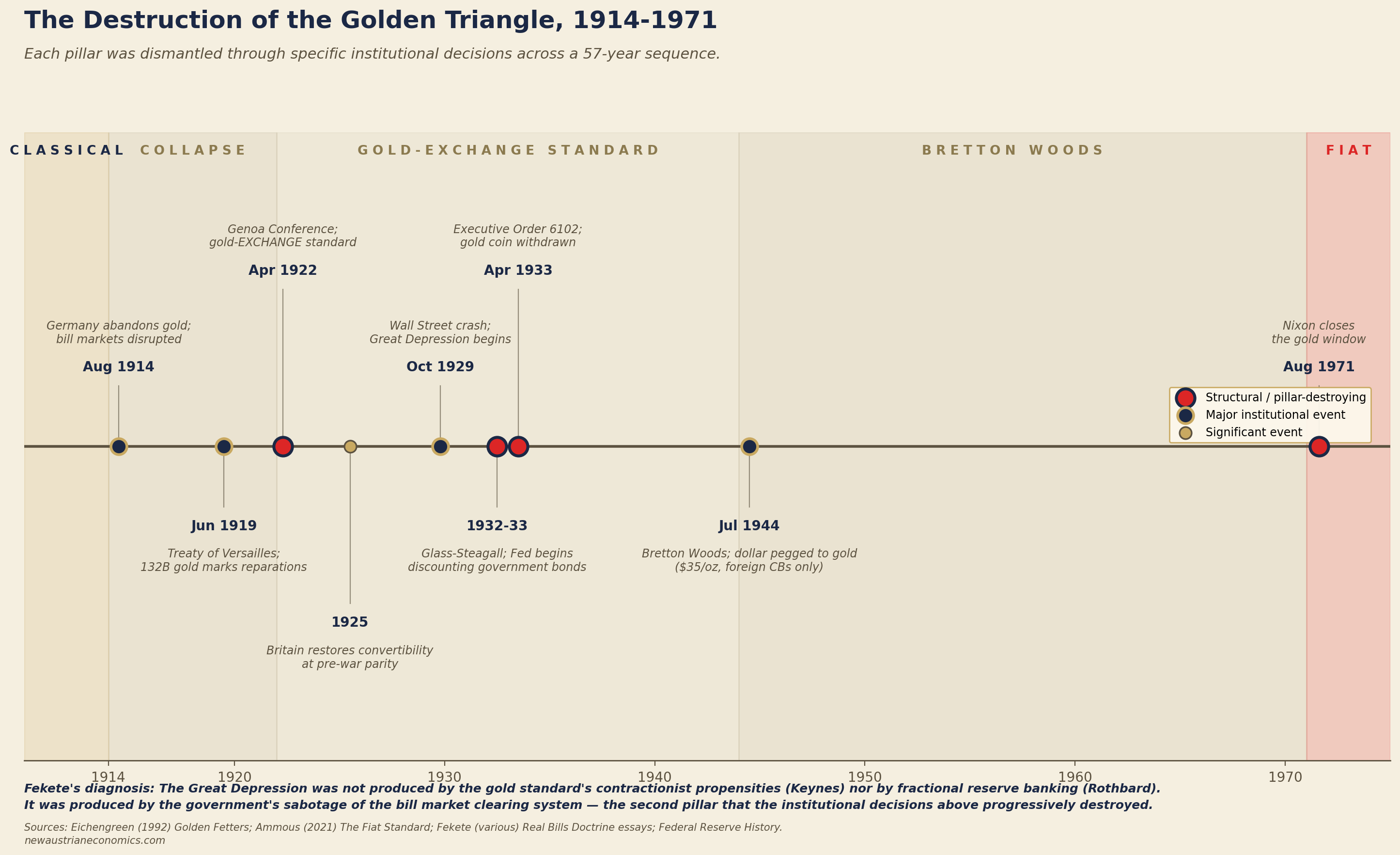
August 4, 1914: the first abandonment. On the day Britain declared war on Germany, the German Reichsbank's Banking and Currency Laws suspended the convertibility of the German mark into gold. 10 The Reichsbank began discounting Reichsschatzwechsel (Treasury bills) as collateral for currency issuance, effectively moving to a fiat currency. Similar suspensions occurred across the major combatant nations within days. Britain officially remained on gold but introduced extensive practical restrictions. France suspended convertibility. Austria-Hungary suspended convertibility. Russia suspended convertibility.
The only major economy that remained substantially on gold through the war was the United States, which did not enter the war until April 1917 and which experienced the largest gold inflows in modern history as European reserves fled to American safety. Between 1914 and 1918, total metallic reserves as a share of bank notes plus deposits collapsed catastrophically: from 63% to 1% in Austria-Hungary, from 57% to 10% in Germany, from 60% to 9% in Italy, from 64% to 17% in France, and from 40% to 33% in Britain. 8 The gold coin that had circulated in European commerce had been withdrawn, hoarded, requisitioned, or expended on war financing.
June 28, 1919: the Treaty of Versailles. The treaty signed at Versailles established German liability for reparations without fixing the sum; the figure of 132 billion gold marks was set two years later, by the Reparation Commission's London Schedule of Payments in May 1921. The treaty's financial provisions were designed to maintain payment obligations indefinitely while preventing Germany from inflating its way out of them. The treaty's specific requirement that reparations payments be made in gold-backed currency placed structural pressure on the German monetary system. The Reichsbank, attempting to acquire foreign exchange for reparations payments, began printing marks at accelerating rates throughout 1920-1922, with the result that by November 1923 the mark had collapsed to approximately one-trillionth of its 1914 value. The Weimar hyperinflation, while produced primarily by domestic monetary policy decisions, occurred in the structural context of an international system that no longer had functioning real bill markets to clear international trade through productive activity rather than through gold flows or currency depreciation.
April 1922: the Genoa Conference and the gold-exchange standard. Delegates from thirty-four nations met at Genoa in April-May 1922 to address the international monetary situation. The conference, organized at British initiative under Prime Minister David Lloyd George, produced a non-binding agreement that fundamentally restructured the post-war monetary architecture. The key resolutions: gold coin would not be reintroduced into circulation; central banks would hold their reserves not primarily in gold but in the currencies of major reserve-currency nations (the British pound and the U.S. dollar); citizens would not be able to redeem currency for gold coin, only for large gold bars unsuitable for daily commerce; the international clearing system would operate through correspondent central bank balances rather than through the bill market.
This was the construction of the gold-exchange standard — the substitute system that has been confused with the gold standard in subsequent commentary. Saifedean Ammous, in The Fiat Standard (2021, chapter 11), characterizes Genoa accurately: "As the victors of the war, and the main financial heavyweights of the world economy, Great Britain and the U.S. used the 1922 Genoa Conference to institute the gold-exchange standard, a new global monetary system in which their client states had to rely on the dollar or the pound sterling. This was unprecedented money printing and inflationism on a global scale." This is the arrangement Moreau's diary called a "veritable financial domination" of Europe — the substitution of national monetary sovereignty for dependence on the credit of the dominant reserve-currency issuers. Rothbard reproduced the passage in his account of the interwar monetary system.
The Genoa system functioned for approximately five years before beginning to break down in 1927-1928. The Bank of France, observing that British monetary policy was generating inflation that France would import through its sterling holdings, began converting its sterling reserves into gold — defying the Genoa agreement in spirit if not in letter and triggering monetary tightening that contributed to the deflationary collapse of 1929-1932. 11 The Great Depression, in Fekete's analysis, was not produced by the "contractionist propensities" of the gold standard that Keynes blamed it for. The Depression was produced by the operational dysfunction of the substitute system that had replaced the gold standard. Fekete's specific diagnosis: "The Great Depression of the 1930s was not due to the 'contractionist propensities' of the gold standard as alleged by John M. Keynes. Nor was it due to fractional reserve banking as alleged by Murray Rothbard. Rather, it was due to the government's sabotaging the clearing system of the international gold standard, the bill market."
1932-1933: the Glass-Steagall destruction of the bill market. The Banking Act of 1932 (the original Glass-Steagall Act) expanded the range of collateral that the Federal Reserve could accept against currency issuance to include government bonds. The Banking Act of 1933 (the more famous Glass-Steagall Act) separated commercial from investment banking and established federal deposit insurance. Both pieces of legislation, taken together, completed the structural elimination of the real bill market in American banking. Before 1932, Federal Reserve banks accepted real bills as the primary collateral for currency issuance, with the structural consequence that Federal Reserve note issuance was tied to actual commercial activity. After 1932, Federal Reserve banks accepted government bonds as collateral, with the structural consequence that Federal Reserve note issuance was tied to fiscal deficits. The pivot from commerce-backed to deficit-backed currency was the operational mechanism by which the Federal Reserve became, over the subsequent decades, the institution that mainstream contemporary discussion treats as a central bank in the modern sense — an institution managing monetary aggregates through securities operations rather than discounting commercial paper through interaction with productive activity.
1933: Executive Order 6102 and the end of gold coin circulation in the United States. On April 5, 1933, President Roosevelt issued Executive Order 6102, requiring all U.S. citizens to surrender their gold coin, gold bullion, and gold certificates to the government in exchange for paper currency at the rate of $20.67 per ounce. 9 Citizen possession of gold (with limited exceptions for jewelry and small numismatic holdings) became a criminal offense. The Gold Reserve Act of 1934 subsequently devalued the dollar to $35 per ounce — meaning the gold the government had collected at $20.67 was revalued upward by approximately 70%, with the gain accruing to the Treasury rather than to the citizens who had been compelled to surrender the coin. 9 The first pillar of the Golden Triangle — gold coin in actual circulation — was eliminated from American commerce by executive fiat. The institutional architecture would never recover.
1944-1971: Bretton Woods and the final pretense. The Bretton Woods agreement of July 1944 established a modified gold-exchange standard centered on the U.S. dollar, with the dollar convertible to gold at $35 per ounce for foreign central banks (but not for citizens) and other currencies pegged to the dollar within narrow trading bands. 9 The arrangement preserved the rhetorical association of the international monetary system with gold while operationally functioning as a dollar-reserve system with gold serving primarily as a settlement medium between central banks. The system functioned reasonably well through the 1950s as the U.S. ran large gold-equivalent surpluses, but began breaking down in the 1960s as American fiscal expansion (Vietnam War financing, Great Society programs) generated dollar outflows in excess of U.S. gold reserves. France under de Gaulle began systematically converting its dollar holdings to gold, draining U.S. reserves at an accelerating rate. On August 15, 1971, President Nixon ended dollar-gold convertibility, completing the fifty-seven-year process of dismantling the classical gold standard architecture.
By 1971, all three pillars of the Golden Triangle were operationally extinct. Gold coin did not circulate in any major economy. Gold bills did not exist as a meaningful institutional category in the world's banking systems. Gold bonds, while occasionally issued, were rare and treated as exotic instruments rather than as the long-term capital backbone of the financial system. The substitute system that had been progressively constructed across the half-century since 1914 had become the only system contemporary participants could remember. The Golden Triangle had not been destroyed in a single decision. It had been dismantled pillar by pillar, decade by decade, through specific institutional choices each of which had its own immediate justification and the cumulative effect of which was the complete elimination of the architecture that had produced the prior century of broadly distributed productive prosperity.
The inflationary critique and its answer
The most substantial intellectual objection to the Golden Triangle architecture comes not from Keynesian or monetarist critics but from within the Austrian tradition itself. Ludwig von Mises, in The Theory of Money and Credit (1912) and subsequent works, articulated a categorical position that the issuance of fiduciary media — bank notes and deposits not backed 100% by gold — is inflationary and that real bills, as a form of credit not backed by saved gold, fall within this prohibition. 12 Murray Rothbard, Mises's most prominent American student, elaborated the position into a categorical opposition to fractional reserve banking and an advocacy for 100% gold reserves against all bank liabilities. 13 The Mises-Rothbard position has become the dominant view within mainstream Austrian-tradition monetary commentary. Fekete's defense of real bills against this position is, to the present author's reading, the most important intellectual disagreement within twenty-first-century Austrian monetary thought.
The Mises-Rothbard objection, stated carefully, is this: when a bank issues a note or accepts a deposit that is not 100% backed by gold sitting in the vault, the bank is creating purchasing media out of nothing. The new purchasing media compete with existing purchasing media for the same finite stock of goods, with the inevitable result that prices rise. Even if the new media are nominally tied to real production (as real bills supposedly are), the timing mismatch between issuance and retirement creates a window during which the new media are in circulation alongside the existing stock, and this window is sufficient to produce inflationary pressure. The categorical solution is to require 100% gold backing for all bank liabilities, eliminating the credit-creation function of banks entirely and forcing all credit to flow through direct lending of saved gold from savers to borrowers.
Fekete's response operates on three levels. First, real bills do not create purchasing media out of nothing — they create paper claims on physical gold coin that will arrive within 91 days as the underlying goods are consumed. The "creation" is the creation of a temporary claim on something real, retired automatically as the something real reaches the consumer. The drain analogy applies: opening the tap (issuing new bills) cannot raise the water level (the price level) if the drain (consumer purchase using gold coin) is fully open and structurally tied to the tap.
Second, the goods underlying the bills already exist at the time the bills are drawn — they have been produced and are progressing through the final stages toward consumer sale. The bills do not finance the bringing-into-existence of new goods (which would be inflationary if the bills outpaced the production they financed); they finance the temporal coordination between the production of goods that already exist and the consumer's gold-coin purchase of those goods. The bills are not creating purchasing power; they are coordinating its application.
Third, the alternative Rothbard advocates — paying gold coin directly between producers at each stage of the production chain — is operationally impossible at the scale of any modern economy and was never the practice in the classical period when the gold standard was actually functioning. Fekete states the point with characteristic directness, in a 2013 interview with The Daily Bell: "Rothbard would have the producer of lower order goods pay the producer of higher order goods in gold coins. But this is absurd! No producer has ever paid a single gold coin for a semi-finished good, never ever!"
The structural argument deserves elaboration. Consider the practical question of how the production chain in the bread example (farmer → miller → baker → consumer) would actually operate under Rothbard's 100% gold reserve requirement. The farmer ships wheat to the miller. The miller must pay the farmer in gold coin before processing the wheat into flour, because the farmer cannot accept paper credit (paper credit would constitute fiduciary media, prohibited under the 100% reserve rule). The miller therefore must accumulate sufficient gold coin in advance to purchase wheat from farmers across whatever production schedule the miller operates on. The same constraint applies between miller and baker, between baker and consumer. Each link in the production chain requires gold coin held in advance by the downstream party sufficient to clear the upstream party's invoice immediately upon delivery.
At the scale of a modern (or even a nineteenth-century industrial) economy, this would require the volume of gold coin in circulation to equal approximately the total value of work-in-process plus inventory across the entire production chain, multiplied by the velocity of the production cycle. The actual stock of gold coin available to any economy is several orders of magnitude smaller than this requirement. The only way Rothbard's system could function would be either through dramatic deflation (prices falling until the existing gold coin could cover the working capital requirements) or through producers holding inventory for much longer periods between transactions (effectively tying up massive amounts of capital in stationary inventory). Both of these alternatives would generate exactly the contractionist tendency Keynes wrongly attributed to the actual gold standard. The real gold standard avoided these consequences specifically because it had a functioning bill market.
The deeper objection that Mises and Rothbard rarely engage directly: the 100% reserve system has never historically functioned at scale. The classical gold standard, which is the actual gold standard that produced the prior century of price stability, did not operate on 100% reserves. It operated on real bills. The Austrian-tradition advocacy of 100% reserves is, in a precise sense, advocacy for a monetary system that has never existed and that the historical record offers no evidence could exist at productive scale. Fekete's position, by contrast, is advocacy for the system that did exist and that did produce the documented outcomes. The dispute is not between an idealized Austrian position and a compromised real-world arrangement. It is between two Austrian-tradition positions, one of which corresponds to documented historical practice and one of which corresponds to theoretical construction that has no historical instantiation.
Fekete is careful to note that real bills can be adulterated in ways that would produce the inflationary outcomes Mises and Rothbard feared. The adulterations are specific and identifiable: bills drawn on goods not in urgent consumer demand (accommodation paper); bills rolled over rather than retired at maturity (perpetual debt masquerading as short-term credit); bills drawn on government promises rather than commercial production (Treasury bills, which Fekete distinguished sharply from real commercial bills). Each of these adulterations breaks the self-liquidation mechanism that makes real bills non-inflationary. A monetary system that accepts adulterated paper alongside genuine real bills is indeed inflationary, and this is one of the structural mechanisms by which the substitute systems of 1914-1971 produced the price-level destruction they did. But the inflationary problem is not the existence of bill credit; it is the corruption of bill credit through institutional choices that admitted non-real paper into the discount window. The Austrian-tradition critique would be analytically correct if directed at adulterated paper. Directed at genuine real bills, it misses the specific institutional features that produce the non-inflationary outcome.
Painting the picture: how the world could work
The framework's intellectual posture throughout this catalog has been descriptive rather than advocational. The catalog documents structural conditions; it does not prescribe political programs. This essay maintains that posture. What follows is not a policy proposal. It is a description of how a restored Golden Triangle would operate, drawing on the historical record of how the pre-1914 system actually functioned and on Fekete's articulation of how the architecture would translate to twenty-first-century conditions.
Prices denominated in the weight of gold. In a working Golden Triangle, prices are quoted in ounces or grams of gold, not in dollars whose purchasing power varies with monetary policy. A loaf of bread might be priced at 0.001 ounces of gold; a typical monthly residential lease at 1.5 ounces; an automobile at 25-40 ounces; a median home at 200-400 ounces. The denomination provides immediate informational clarity: a price increase reflects an actual change in the relative value of the good against the monetary standard, not a change in the monetary standard itself. The persistent illusion of contemporary economic life — that nominal price levels are meaningful indicators of value — would be replaced by a system in which the price level itself is stable because the standard against which prices are denominated is stable.
Treasury issuance of gold bonds. The federal government issues new debt denominated in ounces of gold, paying interest semiannually in gold and redeeming principal in gold at maturity. The bonds compete in the capital markets with private gold bonds (issued by railroads, manufacturers, mining companies, utilities, and other long-term capital users). The interest rate on Treasury gold bonds is determined by the market based on the perceived creditworthiness of the federal government and the prevailing real return on long-term capital. The Treasury, no longer able to monetize its deficits through Federal Reserve purchases of Treasury securities (because the Fed has been restructured to discount real bills rather than to hold government debt), must finance its expenditures through actual issuance of bonds against actual borrowing from actual savers. The discipline this imposes on fiscal policy is substantial and was, in the pre-1914 era, one of the primary mechanisms by which sovereign debt was kept within productively manageable bounds.
The existing debt retirement. The accumulated near-$40-trillion U.S. national debt, currently denominated in dollars whose purchasing power the Federal Reserve continuously erodes, is exchanged voluntarily by holders for new gold bonds. 3 The exchange occurs at the prevailing dollar-to-gold rate plus a premium reflecting market expectations of gold appreciation. Holders accept the exchange because gold bonds provide a more stable real return than dollar bonds; the Treasury accepts the exchange because gold bonds, once issued, must actually be repaid in gold rather than being inflated away. Over a period of decades — the timeframe is necessarily long given the magnitude of the existing obligations — the dollar-denominated debt is progressively replaced by gold-denominated debt. The mechanism is not painless: it requires sustained Treasury commitment to actually retire the gold bonds as they mature, which in turn requires sustained fiscal discipline that the post-1971 era has not produced. But the mechanism exists. It is operationally feasible. It has historical precedent. It does not require political consensus, only sustained policy commitment across multiple administrations.
Commercial banks specializing in real bills. Banks return to their classical function of discounting real commercial bills. The bank's portfolio consists primarily of two asset categories: gold coin or bullion held as reserves, and short-dated real bills held as earning assets. The bills mature into gold coin as the underlying consumer goods are sold, generating the bank's discount earnings while preserving the integrity of the bank's deposit liabilities. Specialization develops: some banks focus on agricultural bills, others on manufacturing bills, others on import-export bills. Acceptance houses develop as specialized institutions for evaluating the quality of bills before they enter the discount market, with reputational capital invested in distinguishing genuine real bills from adulterated paper. The institutional ecology of commercial banking returns to something like its pre-1914 form, with the bank's business model tied to the velocity of productive commerce rather than to interest-rate spreads on government securities.
Banks issuing notes backed by gold and gold bills. Where bank notes circulate (and they would, given the operational inconvenience of carrying gold coin for very large transactions), they are backed by the bank's portfolio of gold coin plus gold bills — the original configuration the Federal Reserve Act of 1913 envisaged before the post-1932 pivot to government-bond collateral. The notes are convertible into gold coin on demand at the issuing bank's office. The public can and does demand redemption; the banks must therefore maintain prudent reserve positions; the discipline is institutional rather than regulatory. Banks that issue more notes than their portfolios can support fail through bank runs; the failures provide institutional learning that disciplines subsequent practice. The system is not crisis-free, but the crises are localized, recoverable, and educational rather than systemic.
Free coinage restored at the Mint. The United States Mint accepts gold bullion from any citizen and converts it into standard gold coins, retaining only a small seigniorage charge to cover the cost of coinage. The mechanism re-ties the market price of gold bullion to the legal value of gold coin, with the public determining how much gold should exist in coined form versus bullion form based on actual commercial demand. The currency stock is not managed by any central authority. It emerges from the interaction of public demand with the institutional infrastructure of coinage.
The discount rate as market signal. The discount rate on real bills is determined by the actual market for bills — by the equilibrium between the supply of real bills generated by ongoing commercial activity and the demand for short-term gold-yielding assets from banks, acceptance houses, and other holders of gold coin. The rate fluctuates with the level of commercial activity (more bills when production is expanding, fewer when contracting) and with the time preference of holders of gold (lower rates when capital is abundant, higher when scarce). The central bank, to the extent one exists, observes the market discount rate rather than setting it. The price signals the discount rate provides are accurate informational content rather than policy-induced distortions, and the broader economy can coordinate productive investment with saving on the basis of those accurate signals.
Consumer credit through bills, not through fiat lending. Consumer purchases that exceed available gold coin are financed through bills drawn on the consumer's future income, discounted by lenders against the security of the consumer's productive capacity. The mechanism is similar to current credit cards or installment loans, but with the critical difference that the underlying credit is denominated in gold and tied to specific productive activity rather than created against fiat monetary expansion. Default risk is borne by the lender. Excess credit creation is impossible because the lender must hold gold-equivalent reserves against any credit extended. The structural overconsumption that fiat monetary expansion enables — the substitution of debt-financed consumption for production-financed consumption — does not occur because the institutional infrastructure does not support it.
The wages miracle restored. Workers in long-cycle production processes receive weekly wages through real bills drawn on their employer's downstream production, discounted by banks against the bills' eventual maturity into consumer gold-coin purchases. The temporal coordination between the production cycle and the wage cycle that the pre-1914 system achieved through real bills is restored. Wages flow continuously even when production cycles are long. Workers can be paid for their labor in real time even when the fruits of that labor will not reach consumers for weeks or months. The economy operates at its natural productive tempo rather than being constrained to the tempo of available gold coin or saved capital.
These descriptions are not utopian. They describe how the pre-1914 economy actually functioned across approximately a century of operation, applied to twenty-first-century conditions. The Golden Triangle is not a theoretical construct or a thought experiment. It is the operational architecture that historical evidence demonstrates can support broadly distributed productive prosperity. The question of whether it can be restored is a question of political will and institutional construction, not a question of theoretical viability.
The framework's synthesis
The Golden Triangle is the operational expression of Carl Menger's saleability framework. Gold, in Menger's analytical apparatus, is the most saleable commodity in the broader spectrum of goods — the commodity whose marginal utility remains most nearly constant across changes in supply and demand, the commodity whose acceptance in exchange is most reliable across the widest range of circumstances. Menger's framework establishes why gold has historically sorted into the monetary role across multiple civilizations and across millennia of commercial development. The Golden Triangle establishes how the most saleable commodity functions as the foundation of a working monetary architecture: not as inert reserves backing paper claims that proliferate without limit, but as the active medium of final settlement coordinating the temporal mismatches between production and consumption that any developed economy must somehow resolve.
The architecture is integrated by design. Gold coin provides final settlement — the medium in which consumer purchases are completed and bills are extinguished. Gold bills provide short-term financing — the medium by which production-to-consumption coordination occurs across timeframes ranging from days to ninety-one days. Gold bonds provide long-term financing — the medium by which capital is committed to productive investment across timeframes ranging from years to decades, and by which sovereign debt is structured against actual productive capacity rather than against monetary manipulation. Each pillar serves a function the other two cannot. Each pillar depends on the others for the system to operate. The integrated architecture produces the documented outcomes — stable prices over decades, productive expansion across the Industrial Revolution, broadly distributed prosperity that supported the most rapid expansion of human welfare in recorded history.
The substitute-layer architecture this catalog has been documenting across thirty-two prior essays is the structural inverse of the Golden Triangle. The agency MBS apparatus the catalog's Article 8 engaged is paper claims on illiquid housing assets, trading as monetary instruments while the underlying assets remain structurally illiquid. The dossier economy Article 30 documented is paper aggregations of personal data, trading as wealth while bearing no relation to the classical wealth definition. The COMEX paper-silver decoupling Article 24 documented is paper claims on physical silver, trading at multiples that the physical metal cannot deliver. The Federal Reserve's post-1932 portfolio of Treasury securities is paper claims on fiscal deficits, trading as monetary reserves while bearing no relation to commercial production. In each case, the substitute layer trades as if it were the underlying wealth-equivalent it represents. In each case, the underlying productive base is structurally inadequate to support the paper claims trading against it. The accumulated substitute-layer fragility is what the catalog has been making visible across sectors.
The Golden Triangle is the structural alternative — an architecture in which paper claims are tied to productive activity through self-liquidating mechanisms, in which the medium of final settlement actually circulates rather than sitting in vaults backing paper, in which long-term capital is committed against real productive capacity rather than against monetary expansion.
The framework's broader project, articulated across the catalog from Article 1 onward, has been to recover what the classical political economy tradition could see and apply it to contemporary conditions. The Golden Triangle is foundational to that project. Without the Golden Triangle as the structural alternative against which the substitute system can be evaluated, the catalog's documentation of substrate fragility becomes mere lamentation. With the Golden Triangle as the explicit alternative, the catalog's documentation becomes diagnostic: it identifies what is structurally wrong with the existing architecture by pointing to what a working architecture would look like and by showing where the existing architecture has departed from it. The path forward is not nostalgia. It is design. The historical record shows that the architecture worked. The intellectual record, primarily through Fekete and the New Austrian School, shows what the architecture required. The remaining question is whether the institutional reconstruction can be undertaken, which is a question of political economy rather than a question of monetary theory.
The closing observation
Mainstream contemporary monetary debate operates within categories the substitute system has constructed. The debate proceeds as if "gold standard" meant the gold-exchange standard, as if "fractional reserve banking" meant any bank holding less than 100% gold reserves, as if "real bills" were an exotic and inflationary form of credit creation rather than the operational backbone of the system that produced the prior century of price stability. The categories themselves are wrong. The debate proceeds on terms the substitute system has set. Until the categories are corrected, the debate cannot reach the underlying questions.
Antal Fekete spent the final decades of his life trying to correct the categories. He died in Budapest on October 14, 2020, aged 87, with most of his work still inaccessible to mainstream audiences and most of his theoretical contributions still uncited in mainstream monetary debate. His student Rudy Fritsch and the small community of New Austrian School-trained economists continue the work. The lineage is preserved but precarious. The intellectual material is rich. The audience is small.
This catalog's broader project includes the preservation and elaboration of this material as part of the framework's foundational apparatus. The Golden Triangle is not a curiosity. It is the operational architecture that the historical record demonstrates can support broadly distributed productive prosperity. The substitute system that replaced it has produced the documented substrate fragility the catalog has been engaging across two years of applied analysis. The structural alternative exists. The historical record exists. The intellectual material exists. What remains is the institutional reconstruction, which is the work of multiple decades and multiple administrations, and which depends on the broader political-economic conditions that make sustained institutional reform possible.
The framework's job, in this essay as throughout the catalog, is to make the architecture visible. The Golden Triangle is the architecture. Gold coin, gold bills, and gold bonds operating together as integrated pillars constitute the operational form of sound money. The catalog has documented the inverse — substitute-layer architecture operating where the Golden Triangle should be — across multiple sectors of contemporary economic life. The work continues.
This is the eighth essay in the New Austrian Economics catalog's Series One, the framework's foundational theoretical thread, and the second installment of the Series One Extension that reopened the originally-closed series to admit additional foundational pieces. The essay's argument draws primarily on the late-career writings of Antal Fekete (1932-2020), who taught from 2002 onward under the successive banners of the Gold Standard Institute, Gold Standard University and the New Austrian School of Economics,, including his Real Bills Doctrine articles, his "Whither Gold?" essays, his Gold Standard University Live lectures, and the Ten Pillars of Sound Money pamphlet series he produced as senior editor of the American Economic Foundation. Rudy Fritsch's "Beyond Mises" (Hypnonaissance, 2010; Kindle edition 2013) elaborated the Golden Triangle architecture for a broader Austrian-tradition audience. The historical material on the destruction sequence draws on Saifedean Ammous's "The Fiat Standard" (2021), Eichengreen's "Golden Fetters" (1992), and the Federal Reserve's own published histories of the 1932-1933 Glass-Steagall legislation. Keith Weiner's work at Monetary Metals has developed the practical mechanics of gold bond issuance in twenty-first-century conditions. The framework's First Principles definitions (newaustrianeconomics.com/definitions) provide the analytical foundation against which the Golden Triangle architecture is evaluated. The forthcoming Series One Article 9 will engage the question of what political-economic conditions would be required for the institutional reconstruction the Golden Triangle implies — Ricardo's machinery question and the labor-to-wealth pathway extended to the question of sovereign monetary reform.
Sources
Footnotes
-
Rothbard, Murray. The Case Against the Fed / A History of Money and Banking, reproducing Moreau. https://mises.org/library — Bank of France Governor Émile Moreau's diary, as reproduced by Rothbard: "England having been the first European country to reestablish a stable and secure money has used that advantage to establish a basis for putting Europe under a veritable financial domination." The subject is England's first-mover advantage, not the Genoa arrangement in the abstract. ↩
-
Fekete's Golden Triangle — gold coin in circulation, gold bills clearing short-term commercial transactions, gold bonds funding long-term capital — is developed across the Monetary Economics lecture series at https://professorfekete.com/ — His monetary work runs from the early 1980s to his death in 2020, about five decades. The bathtub analogy is his: "Opening the tap fully will not necessarily increase the level of water in the tub. ↩ ↩2
-
U.S. Treasury Fiscal Data, Debt to the Penny. https://fiscaldata.treasury.gov/datasets/debt-to-the-penny/debt-to-the-penny — Gross federal debt about $39.5 trillion at publication with roughly $31.7 trillion held by the public, crossing $40 trillion in August 2026. Fekete died 14 October 2020 aged 87 (https://goldstandardinstitute.net/2020/12/07/vale-professor-antal-e-fekete/); Rudy Fritsch's Beyond Mises was first published by Hypnonaissance, Canada, in 2010. ↩ ↩2 ↩3 ↩4
-
Executive Order 6102 (1933) compelled surrender of gold coin; the Gold Reserve Act of 1934 ended free coinage. https://www.archives.gov/founding-docs ↩
-
U.S. Mint and Treasury coinage records. https://www.usmint.gov/learn/history — The $20 Liberty Head double eagle (1850–1907), the Saint-Gaudens successor, and the smaller denominations in circulation. ↩
-
Warren, George F. and Frank A. Pearson, wholesale price index series, 1816–1913. https://fred.stlouisfed.org/ — The claim that 1913's price level was close to 1820's is base-year sensitive but broadly right. Real amplitude within it: wholesale prices fell about 37% (1816–49), rose about 55% (to 1873), fell about 46% (to 1896) and rose about 46% (to 1913). ↩ ↩2
-
Fekete, Antal E. https://professorfekete.com/ — "Contractionist propensities" is his phrase for Keynes's charge rather than Keynes's own words. ↩
-
Metallic reserves as a share of notes plus deposits, 1914 to 1918: Austria-Hungary 63% to 1%, Germany 57% to 10%, Italy 60% to 9%, France 64% to 17%, Britain 40% to 33% (Econlib). ↩ ↩2
-
Harvard University gold bond of 27 November 1905, and the effect of the 1933–34 abrogation of the gold clause on its repayment. https://www.federalreservehistory.org/essays/roosevelts-gold-program — The $20.67 surrender price and the $35 revaluation under the Gold Reserve Act of 1934. ↩ ↩2 ↩3 ↩4 ↩5 ↩6
-
Reparation Commission, London Schedule of Payments, May 1921. https://avalon.law.yale.edu/subject_menus/versailles_menu.asp — The Treaty of Versailles established liability without fixing a sum. The 132 billion gold marks figure comes from the Reparation Commission's London Schedule of Payments, May 1921. ↩
-
Banking Act of 1932 and Banking Act of 1933. https://www.federalreservehistory.org/essays/banking-act-of-1933 — The Banking Act of 1932 expanded Federal Reserve collateral to government bonds; the Banking Act of 1933 separated commercial from investment banking and created deposit insurance. ↩
-
Mises, Ludwig von. The Theory of Money and Credit, 1912. https://mises.org/library/book/theory-money-and-credit — For the treatment of fiduciary media issued beyond the metallic reserve. ↩
-
Rothbard, Murray N. The Mystery of Banking and The Case Against the Fed. https://mises.org/library/book/mystery-banking — For the categorical case for a 100 percent reserve against all bank liabilities. ↩
Related essays
AI Compute as Nascent Real Bills: A Clearing Instrument for the Machine Economy
Fekete's most misunderstood idea — the Real Bills Doctrine — described how the 18th-century commercial economy spontaneously developed a short-duration, self-liquidating clearing instrument for goods in transit to the consumer. The 21st-century compute economy is developing the same thing, and no one is calling it what it is.
Sound Money in Practice: Auckland, 2011
A week with Antal Fekete and the New Austrian School of Economics in Auckland. The three-legged gold standard, illicit interest arbitrage, gold bonds as a path out of irredeemable debt, and why the unadulterated gold standard is defined not by what it contains but by what it prohibits.
The Vanishing Gold Basis: Field Notes from Canberra, 2009
Four days with Antal Fekete and the Gold Standard Institute in Canberra, fourteen months after Lehman. The gold basis as monetary thermometer, the mechanics of permanent backwardation, and why falling interest rates destroy capital in ways that no one in the financial press was discussing.