Researched and drafted with AI assistance · reviewed and edited by Jason D. Keys
Three positions, one variable
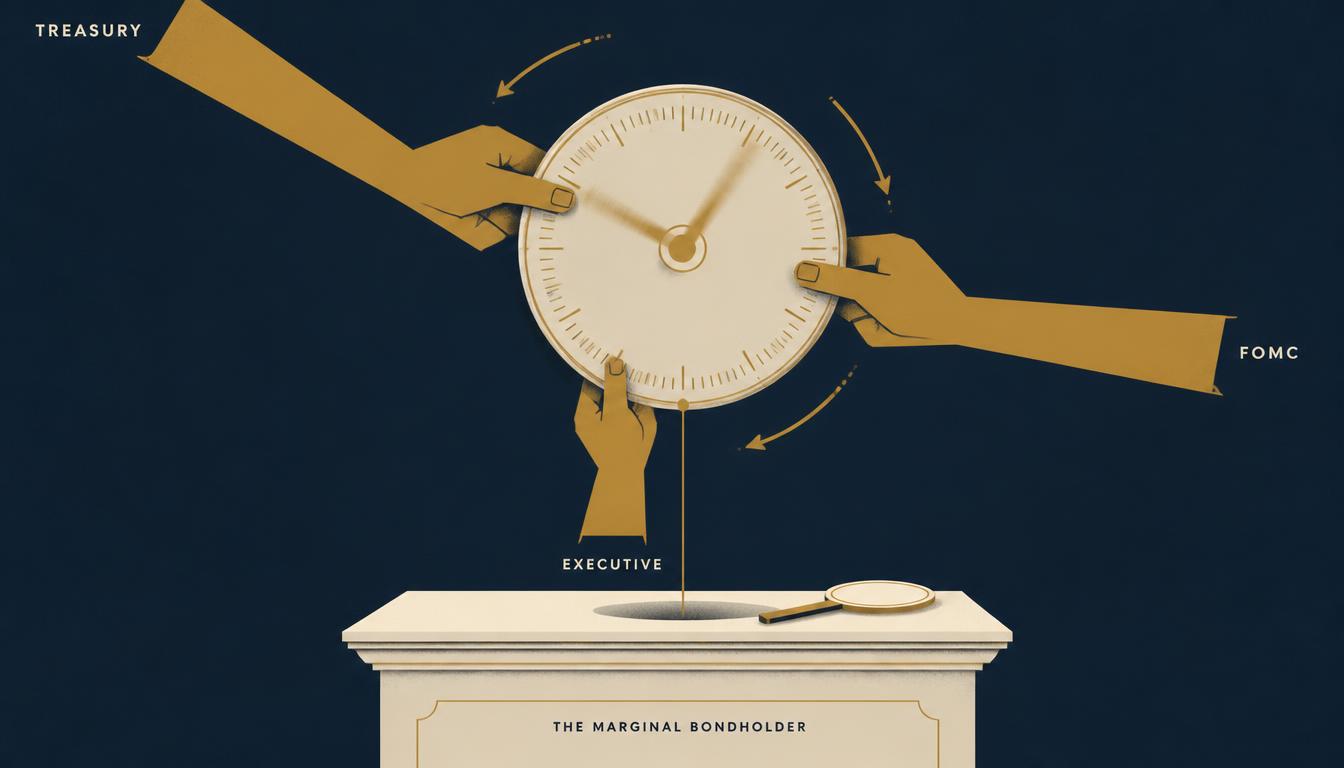
Within a span of four weeks, three institutions of the United States government took public positions on the price of credit, and the positions do not agree.
On August 19, 2026, the Department of the Treasury announced it would at least double the maximum size of its liquidity support buyback operations for longer-dated nominal coupon securities, raising the per-operation ceiling in the ten-to-twenty-year and twenty-to-thirty-year sectors from $2 billion to at least $4 billion, effective September 9. 1 This catalog examined the mechanics of that announcement in Article 51 and concluded that, whatever its stated rationale, it alters the maturity composition of publicly held federal debt in the direction of suppressing long-term yields.
On September 16, 2026, the Federal Open Market Committee raised the federal funds rate by 25 basis points to a target range of 3.75 to 4.00 percent — the first increase since July 2023 — on a unanimous 12–0 vote. 2 3 The accompanying statement ran 130 words, shorter than July's 166 and tied with June's for the shortest of Chairman Warsh's tenure. 4 Sixteen of the eighteen participants submitting projections indicated they expect at least one further increase this year. Warsh himself declined to submit a dot. 2 5
On the evening of September 16, the President of the United States told reporters that "Interest Rates in the United States should be 1%, or less," described the Federal Open Market Committee as "a bunch of politicians," and said of the chairman: "I talked to Kevin and I said, 'you might as well vote with the board because it's not going to matter.'" Asked at his press conference about presidential involvement in the decision, Warsh replied: "I've got nothing for you on a discussion with the president." 6
These are documented institutional facts and this essay treats them as such. It takes no position on which institution is correct, and the analysis that follows does not depend on any such judgment. What it examines is a structural question that is independent of the merits: what happens to a price when three parties with different mandates and no coordinating mechanism act on it simultaneously.
What a rate of interest actually is
The framework's answer to that question requires two pieces of apparatus this catalog has developed elsewhere, and restating them precisely is necessary because the conventional framing obscures what is at stake.
First, from Fekete: the rate of interest is not quoted anywhere. In the sixth lecture of his Monetary Economics 102 series, Antal Fekete observed that there is no market quoting the rate of interest directly. To learn what the going rate of interest is, one must go to the bond market, obtain a quotation for the bond price, and calculate the rate from that price. 7
This is not a technicality. It means the yield curve is not a report on the price of credit. It is the only instrument through which that price is expressed at all. A distorted curve is not a distorted measurement of an underlying rate that exists somewhere else. There is nowhere else. The curve is the thing.
Second, from Article 45 of this catalog, following Fekete: interest is the price at which income is exchanged for wealth. A retiree holds wealth and needs income; an entrepreneur generates income and needs wealth; the rate of interest is the price at which that trade clears. Fekete's formulation adds a corollary almost never quoted: interest is the measure of the improvement that indirect conversion represents over direct conversion, and in particular, zero interest means direct conversion — the abolition of the exchange, and a return to hoarding.
Third, from Menger: a price that emerges from voluntary exchange contains information that an administered number does not. Carl Menger's 1892 account of the origin of money described a process in which no authority selects the medium of exchange; individuals seeking to improve their trading position gravitate toward the more saleable commodity, and money emerges as the unintended outcome of many separate decisions. 8 The relevant property for this essay is the epistemic one. The reason a market price carries information is that it is the residue of choices made by parties with something at stake, each acting on knowledge no central observer possesses.
Put the three together and the position is this. The rate of interest is a price. It exists only as inferred from the bond market. And its informational content depends on its being the outcome of exchange rather than of administration.
Which is the frame in which three simultaneous administrative actions on the same curve become interesting.
Hand one: the committee that became unanimous
The September decision is more interesting for its vote than for its magnitude, and the reason connects to a prediction this catalog got wrong.
At the July 29 meeting, the committee held rates at 3.50 to 3.75 percent on a 9–3 vote, with Cleveland's Beth Hammack, Minneapolis's Neel Kashkari, and Dallas's Lorie Logan each preferring a quarter-point increase. 9 It was the first instance since 2016 of three dissents in the same direction on a policy change, 3 and the largest number of dissents this early in a new chairman's tenure in fifty-six years. 3 Warsh characterized the disagreement approvingly at the time, describing his preference for meetings that feature a "good family fight" where the outcome is not pre-ordained. 9
In its August 13 audio episode, this catalog stated that the metric it was watching for September was the dissent count, and that four or more dissents would indicate a chairman with a control problem.
The September vote was 12–0. Speculation before the meeting had centered on whether Governor Christopher Waller might dissent in the other direction; he did not. 4 For only the second time in ten meetings, every voting member was aligned. 3
The prediction was wrong, and the reason it was wrong is worth more than the prediction. The dissent count is not a one-directional measure of institutional control. A falling count can mean the chairman has prevailed over dissenters, or it can mean the chairman has adopted the dissenters' position and brought the remainder of the committee with him. Those are opposite institutional events that produce the identical number. What occurred in September was the second: the three July dissenters wanted a quarter-point hike, and in September they got one, unanimously.
The framework had constructed a metric that could not distinguish between a chairman consolidating authority and a chairman conceding an argument. That is a specification error, and this catalog records it as one.
Two further details establish the direction of the institution. The projections now place 2026 PCE inflation at 3.7 percent, a full percentage point above the March projection, with the return to the 2 percent target pushed out to 2029. 10 Warsh publicly declined to own that forecast at his press conference: "those aren't my forecasts." 11 And he characterized the hike itself as having "removed a dose of accommodation" — language implying he does not regard current policy as restrictive. 5
A chairman who declines to submit a dot, disowns his own committee's inflation projection, issues a 130-word statement, and takes questions for twenty-two minutes is communicating something deliberate about the role of forward guidance. Article 32 of this catalog read the first of these signals as an institutional pivot. The pivot is not stabilizing. It is deepening.
Hand two: the issuer in the long end
Treasury's August 19 announcement was framed as liquidity support. Its own materials state the mechanical consequence plainly: buybacks are not expected to significantly reduce privately held net marketable borrowing, because new issuance replaces the securities purchased. 1
The operation therefore does not reduce debt. It changes the maturity composition of what the public holds — long paper out, new issuance in. Article 51 developed the comparison to the Federal Reserve's 2011–2012 Maturity Extension Program, and the essential difference: that program was conducted by the central bank, under an FOMC vote, within a statutory mandate. This one is conducted by the department that issues the debt and pays the interest, requires no vote, and operates under no monetary-policy framework.
Robeco estimated the annualized pace at roughly $66 billion, or approximately 15 percent of gross twenty-to-thirty-year Treasury supply. 12
The direction is unambiguous: absorbing long-dated supply lowers long-term yields, all else equal. Which places it opposite the committee that, four weeks later, raised the short end and signaled more.
Hand three: the stated preference of the Executive
The third position is documented by direct quotation and the framework reports it without commentary on its merits.
The President's stated preference is for rates of "1%, or less." 6 He has characterized the committee as "a bunch of politicians" and stated that he discussed the chairman's vote with him in advance. 6 A senior deputy press secretary described the decision as "a rather unfortunate decision by the Federal Reserve" that was "not backed by a particularly compelling economic case." 6
The analytically relevant fact is not whether this position is correct. It is that a third institution with no operational control over the curve has stated a target that differs from both the Federal Reserve's actions and the Treasury's, and has done so publicly and repeatedly. KPMG read the unanimity of the September vote as "an important affirmation of the Fed's independence" 13 — a characterization that itself indicates the question was live enough to require affirmation.
For the purposes of this essay, the Executive's stated preference functions as a third input into the expectations that bond market participants form, regardless of whether it is ever acted upon.
The bondholder who did not appear
Here the framework advances what it regards as the essential observation, and it requires returning to Fekete.
Fekete held that the rate of interest is regulated by a specific agent: the marginal bondholder, performing arbitrage between the gold market and the bond market. When the rate of interest falls below his rate of time preference, he sells the overpriced bond and puts the proceeds into gold, which action makes the rate of interest turn around. 14 The rate is not administered by anyone; it is discovered, continuously, by the marginal participant's freedom to stand on either side of the trade.
Fekete was explicit that irredeemable currency closes this escape. Should the marginal bondholder accept paper currency in exchange for his gold bond, he observed, he would be taking zero in exchange for a positive income — which is no protest at all but a leap from the frying pan into the fire. 14 He faulted Mises on precisely this point, arguing that Mises came close to identifying the force driving the rate of interest but went astray because, for him, paper currency was a present good no less than the gold coin. 14
The framework accepts this analysis and observes that it is incomplete in one respect.
Fekete specified two options for the marginal bondholder: hold the bond, or exchange it for the superior present good. Under an irredeemable standard the second is foreclosed, and Fekete concluded from this that the disciplining mechanism has been disabled.
But a third option remains, and it does not require a superior asset. The marginal bondholder can decline to appear.
He need not sell his bonds. He need not flee into anything. He can simply not be the marginal bidder at the next auction — can reduce his allocation, shorten his duration, let maturing paper run off, or step aside entirely and let someone else clear the issue. This is not an arbitrage in Fekete's sense, because there is no superior asset to arbitrage into. It is a withdrawal of the bid, and it is available under any monetary standard whatsoever.
And it produces an observable signature: auctions that clear at higher yields than expected, with weaker participation.
What the signature looks like
The evidence for this has been accumulating through the summer and it is specific.
CNBC reported that the twenty-to-thirty-year sector had experienced what it described as a buyers' strike since late June, with long yields surging to levels not seen in nearly twenty years. 15
On September 23, 2026, a five-year Treasury auction priced at a clearing yield of 5.033 percent — the highest level since 2006 — more than three basis points above expectations, with what T. Rowe Price characterized as weak participation from foreign buyers. 16
A clearing yield above the expected level is a tail. Three basis points on a five-year note is not catastrophic and the framework does not present it as such. What it is, precisely, is the market declining to take the paper at the price the market itself had been indicating moments earlier. The marginal bidder required more compensation than anticipated, and the foreign bidders who have historically constituted a substantial part of that margin participated weakly.
That is the third option being exercised. Not a flight to gold — a withdrawal of the bid.
The framework notes, for completeness, that gold is separately expressing the same condition through the channel Fekete did specify. Gold rose approximately 14 percent in August, its strongest monthly gain this century, in a move contemporaneous coverage attributed to the debasement trade and to Treasury's announcement of support measures for long-duration bonds. 17 Article 42 of this catalog established that gold's price path is governed principally by real interest rates rather than by the framework's own diagnosis of monetary unsoundness, and the August move is consistent with that mechanism. Both channels — the metal and the absent bid — point the same direction.
The issuer as substitute marginal buyer
Now place the two halves together, and the structural observation follows directly.
The marginal bondholder has been withdrawing from the long end since at least late June. On August 19, the Treasury doubled its capacity to purchase long-dated securities in that same sector.
The issuer of the debt has stepped in to buy the debt that the marginal bondholder declined to buy.
The framework wishes to be careful about what this claim does and does not assert. It does not assert that Treasury's stated rationale is dishonest; the press release describes liquidity support in a segment with strong sponsorship, and that is a coherent operational description. It does not assert that the buyback caused any particular price movement; Article 51 adopted the appropriately cautious formulation that the nine-basis-point decline in the thirty-year on announcement day does not prove causation but shows why the timing drew attention.
What it asserts is narrower and, the framework believes, harder to dispute: whatever the intent, the operational effect is that the entity issuing the securities is now a scheduled, price-insensitive, non-economic participant in the market that prices them.
And this is a different condition from a central bank purchasing government debt, which this catalog has criticized at length elsewhere. A central bank is at least a separate institution with a distinct mandate, a published reaction function, and an obligation to explain itself in monetary terms. When the Treasury buys Treasuries, the buyer and the borrower are the same party, and the party whose interest expense the operation reduces is the party conducting it. Article 45 established that federal interest expense runs at approximately $1.04 trillion annually, that the weighted average rate on outstanding marketable debt has climbed from 1.541 percent five years ago to 3.348 percent as of January 2026, and that roughly $10 trillion of debt matures during 2026 alone and must be refinanced at prevailing rates.
In Fekete's framework, the marginal bondholder is the agent that makes the rate of interest a discovered quantity rather than an administered one. If that agent withdraws and the issuer takes his place, the yield that results is not a price in Menger's sense. It is the residue of an administrative decision, wearing the form of a market rate because the transaction occurs in a market.
What a contested curve does to everything priced off it
The final observation concerns scope, and it is the reason this matters beyond the Treasury market.
Article 46 of this catalog documented the size hierarchy almost nobody states plainly: approximately $846 trillion in notional over-the-counter derivatives outstanding as of June 2025, against roughly $156 trillion in global debt securities and roughly $127 trillion in global equity market capitalization. It also established that the yield on the ten-year note is the reference rate against which essentially every other asset in the economy is priced — mortgages, corporate credit, equity valuation models, and the discount rates inside the pension and insurance liabilities this catalog examined in Articles 45 and 48.
That entire structure rests on the assumption that the risk-free curve is informative. Not correct, not stable — informative. That it encodes something about the collective expectations of parties with capital at risk.
Three institutions acting on that curve with different mandates and no coordinating mechanism does not produce a compromise rate. It produces a curve whose informational content is genuinely unclear, because the observer cannot decompose the observed yield into the portion reflecting market expectations, the portion reflecting the Federal Reserve's policy path, the portion reflecting Treasury's purchase schedule, and the portion reflecting expectations about political pressure on future policy.
Article 45 argued that under Fekete's definition, what universal distribution schemes distribute is not money but currency whose marketability has degraded. The parallel claim here: what the curve currently quotes may not be the rate of interest in Fekete's sense — the price at which income is exchanged for wealth — but something closer to the net result of three administrative programs, from which market participants must then attempt to extract a signal.
That extraction problem is the practical cost, and it is paid by every institution that discounts a long-dated liability. The four percent equity cushion in the life insurance industry documented in Article 48 is computed using discount rates derived from this curve. So are corporate pension obligations under ASC 715, which Article 45 identified as the sole domain where Fekete's Law of Liabilities is actually codified.
What to watch
October auction results, particularly indirect bidder participation. The September 23 five-year tail is one observation. The framework's claim about the withdrawn bid requires a pattern, and the cleanest evidence is the share of auctions taken down by indirect bidders — the category in which foreign official demand principally appears.
November 4 — the Quarterly Refunding. Treasury said it would provide further guidance on buyback sizes at that date. 1 Whether the expanded long-end capacity is extended, enlarged, or allowed to lapse distinguishes a temporary liquidity adjustment from a standing posture.
Actual versus scheduled buyback purchases. The published schedule represents capacity rather than commitment. Operations consistently accepting at or near their announced maximums would indicate the facility is being used rather than held in reserve.
The thirty-year. This catalog's published falsification condition for the rate-reversal thesis developed in Article 41 is a retreat below 4.50 percent within a quarter. It stood at 5.39 percent on the day of the September hike. 10 The threshold stands unchanged.
Whether the three hands converge. If the Federal Reserve delivers the additional hike that sixteen of eighteen participants projected, while Treasury maintains or expands long-end purchases, the divergence becomes a standing feature of the rate structure rather than a coincidence of one quarter.
The framework's reading
The conventional account of September is that the Federal Reserve regained its footing: a unanimous vote, a clear commitment to the target, an affirmation of independence against political pressure. Each element of that account is factually supported.
The framework's reading is that this description examines only one of the three hands.
Menger's account of money describes an institution that emerges from voluntary exchange without anyone designing it, and which carries information for exactly that reason. Fekete's account of interest describes a price that exists only as inferred from bond quotations, disciplined by a marginal participant free to stand on either side. Both accounts depend on the same condition: that the price is the residue of choices by parties with something at stake.
What the record of the past six weeks documents is a price acted upon by a central bank raising its short end, an issuer purchasing its own long end, and an executive stating a target for the whole of it — while the marginal bondholder, unable under an irredeemable standard to flee into a superior asset, exercises the one form of discipline still available to him and declines to appear at the auction.
The issuer has taken his place. That is the fact this catalog regards as most worth recording, and it is not a policy disagreement.
Sources
Framework cross-references. Article 32 (the Warsh institutional pivot and the shortened FOMC statement); Article 41 (the interest-rate reversal thesis and its 4.50 percent falsification condition); Article 42 (real interest rates as the governing variable for gold); Article 45 (interest as the price of exchanging income for wealth; federal interest expense, the weighted average rate, and the 2026 refinancing requirement; ASC 715 as the sole codified implementation of the Law of Liabilities); Article 46 (the size hierarchy of derivatives, debt and equity markets, and the ten-year yield as universal reference rate); Article 48 (the life insurance equity cushion and its dependence on discount rates); Article 51 (the Treasury buyback mechanics and the Operation Twist comparison); The Framework's Reading Episode 002, 13 August 2026 (where the dissent-count metric was placed on record).
Footnotes
-
U.S. Department of the Treasury. "Treasury Announces Increased Sizes of Nominal Long-End Liquidity Support Buybacks Beginning September 9." Press release sb0607, 19 August 2026. https://home.treasury.gov/news/press-releases/sb0607 — Primary source for the increase from $2 billion to at least $4 billion per operation in the ten-to-twenty-year and twenty-to-thirty-year sectors, the September 9 effective date, and the commitment to provide further guidance at the November 4 Quarterly Refunding. Treasury's statement that buybacks are not expected to significantly reduce privately held net marketable borrowing appears in its related buyback materials, discussed in Article 51 of this catalog. ↩ ↩2 ↩3
-
Cox, Jeff. "Fed raises rates for the first time since 2023, signals another hike likely this year." CNBC, 16 September 2026. https://www.cnbc.com/2026/09/16/fed-rate-decision-september-2026.html — Source for the 25 basis point increase to 3.75–4.00 percent, the dot plot showing 16 of 18 participants expecting another increase (four seeing two more, two expecting a stop at one), the 2027 distribution of eight for another hike, six for steady and four for cuts, and the note that Warsh has chosen not to submit a dot since taking the position. ↩ ↩2
-
"I Can Almost Guarantee You Just Missed the Most Important Number in Fed Chair Kevin Warsh's and the FOMC's Interest Rate Decision." The Motley Fool, 18 September 2026. https://www.fool.com/investing/2026/09/18/guarantee-you-just-missed-most-important-number-fed-chair-kevin-warsh-fomc-interest-rate-decision/ — Source for the 12–0 vote as stated in the first line of the September 16 statement, the observation that this was only the second time in ten meetings with no dissent, the characterization of July's three dissents as the largest this early in a new chair's tenure in fifty-six years, the first three same-direction dissents since 2016 (citing Nick Timiraos), Warsh's "timelier return" language, and the market reaction. ↩ ↩2 ↩3 ↩4
-
Cox, Jeff. "Here are five key takeaways from Wednesday's Fed rate hike." CNBC, 16 September 2026. https://www.cnbc.com/2026/09/16/here-are-five-key-takeaways-from-wednesdays-fed-rate-hike.html — Source for the 130-word statement against July's 166 and June's equivalent length, the 22-minute question period in a press conference lasting barely half an hour, the pre-meeting speculation centered on Governor Christopher Waller, and the confirmation that all twelve voters agreed. ↩ ↩2
-
"Fed Hikes in 12-0 Vote, Commits to Inflation Fight." Charles Schwab, 16 September 2026. https://www.schwab.com/learn/story/fomc-meeting — Source for Warsh's "removed a dose of accommodation" characterization, the year-end 2026 rate projection rising to 4.1 percent from June's 3.8 percent and 2027 to 4.1 percent from 3.6 percent, and the odds of at least one more hike this year moving from 77 percent Wednesday morning to 87 percent after Warsh's remarks. ↩ ↩2
-
"Trump slams the Fed rate hike, says he told Warsh 'you might as well vote with the board.'" Yahoo Finance, 16 September 2026. https://finance.yahoo.com/economy/policy/article/trump-slams-the-fed-rate-hike-says-he-told-warsh-you-might-as-well-vote-with-the-board-205145796.html — Source for all quoted statements attributed to the President and to Senior Deputy Press Secretary Kush Desai, and for Warsh's response at the press conference. ↩ ↩2 ↩3 ↩4
-
Fekete, Antal E. Monetary Economics 102: Gold and Interest, Lecture 6. Professor Fekete's collected lectures, available via professorfekete.com. The specific proposition is that no market quotes the rate of interest directly and that it must be calculated from bond price quotations. ↩
-
Menger, Carl. "On the Origins of Money." Economic Journal, Vol. 2 (1892), pp. 239–255. Translated by Caroline A. Foley. The account of money emerging from the differential saleability of commodities through individual action rather than authoritative designation. ↩
-
"Fed leaves rates steady, with internal dissent." Axios, 29 July 2026. https://www.axios.com/2026/07/29/fed-warsh-rates-inflation — Source for the 9–3 July vote with Hammack, Kashkari and Logan preferring a quarter-point hike, the target range of 3.5 to 3.75 percent, Warsh's "no soft implicit target" remark, and his stated preference for meetings featuring a "good family fight." ↩ ↩2
-
"September 2026 Fed Dot Plot Sees Low 4% Fed Funds in 2027." Bondsavvy, September 2026. https://www.bondsavvy.com/fixed-income-investments-blog/fed-dot-plot — Source for the September 2026 Summary of Economic Projections showing 2026 PCE inflation at 3.7 percent, a one-point increase from the March SEP, unemployment down 30 basis points to 4.1 percent, and the two-year and thirty-year Treasury yields closing at 4.74 percent and 5.39 percent respectively on the day of the decision. ↩ ↩2
-
KPMG. "Warsh asserts Fed's independence." September 2026 FOMC analysis. https://kpmg.com/us/en/articles/2026/september-2026-fomc-meeting.html — Source for Warsh's refusal to elaborate on the projection pushing the 2 percent target to 2029, including the direct quotation "those aren't my forecasts." ↩
-
Robeco. "US Treasury steps in as long-end yields rise." 20 August 2026. https://www.robeco.com/en-int/insights/2026/08/us-treasuries-buyback-and-impact-on-the-fed-and-markets — Source for the approximately $66 billion annualized estimate and the figure of roughly 15 percent of gross twenty-to-thirty-year Treasury supply. ↩
-
KPMG, September 2026 (as 11) — "The vote was unanimous, which is an important affirmation of the Fed's independence." ↩
-
Fekete, Antal E. "Gibson's Paradox and the Gold Standard." Collected essays, professorfekete.com. Source for the marginal bondholder performing arbitrage between the gold market and the bond market, the proposition that accepting paper currency for a gold bond means taking zero in exchange for a positive income, and Fekete's criticism of Mises for treating paper currency as a present good equivalent to the gold coin. ↩ ↩2 ↩3
-
Cox, Jeff. "Treasury doubles debt buybacks as Bessent moves to steady bond market." CNBC, 19 August 2026. https://www.cnbc.com/2026/08/19/treasury-announces-upscaled-buyback-operation-for-longer-term-debt-sending-yields-lower.html — Source for the characterization of a buyers' strike in the twenty-to-thirty-year sector since late June and long yields at levels not seen in nearly twenty years. ↩
-
T. Rowe Price. "Global Markets Weekly Update." Week ending 25 September 2026. https://www.troweprice.com/personal-investing/resources/insights/global-markets-weekly-update.html — "These worries and weak participation from foreign buyers resulted in a September 23 auction of five-year U.S. Treasury bonds pricing at a clearing yield of 5.033%—the highest level since 2006 and more than 3 basis points above expectations." Also the source for reports that the administration might seek to restrict diesel exports. ↩
-
"Jackson Hole analyst roundup: Warsh's speech sends hike chances higher, may put Fed 'at odds' with Treasury." CNBC, 31 August 2026. https://www.cnbc.com/2026/08/31/jackson-hole-fed-chair-kevin-warsh-hawkish-rate-hikes-analysts.html — Source for gold's approximately 14 percent August gain described as its strongest monthly gain this century, and for the Gavekal assessment that Warsh's approach to balance sheet duration appears to put the Federal Reserve at odds with the Treasury. ↩
Related essays
The Saleability Audit of Bitcoin: What Menger Would Say in 2026
Bitcoin maximalists insist Bitcoin is the most saleable monetary good ever created. Skeptics insist it doesn't work for the African villager or the rural Chinese citizen the maximalists invoke. Both positions miss what Menger's framework actually says when applied carefully. The audit produces uncomfortable results in both directions — Bitcoin scores remarkably well on some criteria and remarkably poorly on others — and the actual ground-truth of crypto adoption in emerging markets in 2026 is something neither camp accurately describes.
The Mengerian Stress Index: From Spec to Live Dashboard
Article 3 of this series proposed a quantifiable extension of Menger's saleability spectrum. This essay turns the proposal into a working framework: each of the five marketability proxies is defined precisely, the composite Mengerian Stress Index (MSI) is motivated, and the marketability half-life is operationalized as a regime-classification tool. The specific weights and calibration that drive the live MSI dashboard are deliberately not published; current readings live on the dashboard itself.
AI Compute as Nascent Real Bills: A Clearing Instrument for the Machine Economy
Fekete's most misunderstood idea — the Real Bills Doctrine — described how the 18th-century commercial economy spontaneously developed a short-duration, self-liquidating clearing instrument for goods in transit to the consumer. The 21st-century compute economy is developing the same thing, and no one is calling it what it is.