Researched and drafted with AI assistance · reviewed and edited by Jason D. Keys
Listen
Three Answers to the Same Question: UBI, the Coasean Right, and Universal Basic Capital
Read in Jason D. Keys' synthesized voice
Narrated in the author’s synthesized voice, generated with AI from a recording of his own. The words are his; the delivery is machine-rendered.
Download (8.9 MB)The occasion
On Sunday, October 18, 2026, Anthropic announced that it would commit five percent of its shares to a new entity called the Anthropic Public Benefit Fund, described as a fund within the company. The commitment is subject to shareholder approval, and the board may at its discretion add a further two percent for every fifty percent increase in company value above a specified baseline. Combined with existing pledges, the company said roughly twenty percent of its shares are dedicated to the public good. The fund is not to be used for lobbying or political donations. 1
Elon Musk responded to that announcement with a single line: "I recommend giving the shares directly to the public," followed by "This is what I will be doing." 2
The next morning he did. "Next year, I will give one of my SpaceX shares to every kid in America. This will be the first of many." 3 With roughly seventy-three million Americans under eighteen and SpaceX closing at $146.03 the preceding Friday, the pledge carries a market value near $10.7 billion. 4 Musk provided no detail on eligibility, mechanism, or what "first of many" means. 5 He thanked Brad Gerstner — founder of Invest America and an architect of the Trump Accounts program — for "helping enable this," and both the White House and the Treasury Secretary referenced the gift as benefiting those accounts. 6
Two earlier pledges stand behind these. SpaceX President Gwynne Shotwell and her husband committed roughly two million shares to children's accounts, prioritizing lower-income households and SpaceX's home state. 4 Michael and Susan Dell pledged $6.25 billion in cash, a figure Treasury cited in the explanatory documents accompanying its stock-donation rulemaking. 7
Commentary has reached for a term to describe the pattern: universal basic capital, offered as a response to artificial intelligence displacement and attracting interest from politicians in both parties. 8
This essay treats these as announcements rather than as facts about what will occur, because that is what they presently are. The subject is not whether Musk follows through. It is what the proposal would deliver if he did, and how that compares to the two other answers this catalog has already examined.
The question all three answer
Strip the proposals to the question underneath them and it is the same in each case.
If artificial intelligence substantially reduces the share of national income accruing to labor, what should the people on the wrong side of that shift hold instead?
The framework has stated elsewhere, and repeats here, that the premise is weaker than its proponents claim. Articles 38 through 40 of this catalog examined the displacement literature and found the mass-unemployment narrative empirically thin relative to its prominence. Nothing in this essay concedes the premise.
But the question is worth answering conditionally, because three serious proposals now exist, and the differences among them are substantive rather than cosmetic.
Answer one: a periodic payment
Universal basic income. The recipient receives currency, periodically, with no conditions on use.
This catalog examined distribution proposals across the Distribution Question series and found a recurring structural defect. The recipient sits at the bottom of a delivery architecture whose first-order beneficiaries are the institutions operating it — identity verification providers, payment rails, platform operators — each capturing a fee or a gatekeeping position. The saver is a third-order beneficiary of his own benefit.
Three findings from elsewhere in the catalog bear on what the recipient of such a payment actually holds.
Article 45 established, following Fekete, that what circulates as money in daily life is frequently a creditor claim rather than money in the precise sense — a claim on an institution whose rank relative to other claims is set by statute.
Article 59 established that under United States v. Miller, a depositor holds no Fourth Amendment interest in the records of his own financial life, because those records are the bank's business records and the information was conveyed to a third party. In a system where the payment arrives as a ledger entry at a supervised intermediary, there is no form in which it can be held that does not involve such a record.
And Articles 40 and 54 established that central bank digital currency architectures permit conditions on expenditure — geographic restrictions, merchant category limits, expiration — and that resolution regimes operate on exactly the category of claim a deposit represents.
What the recipient holds under this answer: a claim, denominated in a unit the issuer controls, in a form carrying no constitutional protection, potentially subject to conditions on its use.
Answer two: a tradeable permit
The Coasean property right in labor-market access. Article 56 of this catalog examined the proposal formally advanced by Eric Weinstein in the International Labour Review in 2002 and subsequently extended by him to artificial intelligence as the free-market alternative to universal basic income. 9
The structure assigns the property right in access to a domestic labor market to the workers who constitute it, requiring employers — or AI firms — to purchase that right rather than receive it by administrative grant.
That article found the proposal genuinely Coasean, more rigorous than most of what occupies the space, and correct in its diagnosis that distributing a valuable access right for free is a subsidy rather than a market outcome.
It also found a defect the framework had not anticipated. Running Fekete's income-for-wealth test against a tradeable labor-access right produces a clean pass: the worker surrenders an income stream and receives a capital sum. And that is precisely the problem, because Articles 37 and 44 identified human capital as the one major asset standing outside the substitute layer — unconfiscatable, not fixed in nominal terms, portable across jurisdictions — and traced all three properties to a single structural source. It is a flow, inseparable from its owner.
Making access saleable converts the flow into a stock. A stock can be pledged, encumbered, securitized, and seized.
What the recipient holds under this answer: a tradeable right whose value is correlated with the labor market in the worst direction — worth most when he least needs to sell it, worth least when he most does.
Answer three: a share
Universal basic capital. The recipient holds equity in a productive enterprise.
On its face this is the strongest of the three by the framework's own criteria. A share is a residual claim on real assets and real earnings, not a claim denominated in a unit someone else issues. It is not consumed on receipt. It participates in whatever productivity gain the displacement premise assumes. If one believes capital is capturing an increasing share of national income, giving people capital addresses the mechanism directly rather than compensating around it.
The framework states that plainly because it is true, and because the proposal deserves the credit before the objections.
But "universal basic capital" currently names two structures that are not the same proposal, and Musk identified the difference himself when he declined the first in favor of the second.
Structure A: equity held by a fund
Anthropic's announced commitment is five percent of company shares to a public benefit fund within the company. 1
The framework's test is the one it applies to every instrument: who holds the claim, who controls it, and what can the beneficiary do with it?
Under this structure, no member of the public holds a share. A fund holds the shares, and the fund is an entity within the company whose governance the company establishes. The public's interest is a beneficiary interest in an entity it does not control, cannot direct, and from which it cannot withdraw.
Article 47 of this catalog developed the Custody Depth score, which counts institutional counterparties standing between a holder and unencumbered control of an asset. Physical possession scores zero. A beneficiary interest in a fund inside the issuing company, with no transferable instrument and no mechanism to compel distribution, scores poorly by that measure — not because anyone designed it to, but because that is what the structure is.
The strongest case for it, which the framework states because it is substantial: a fund can act at scale and with direction in ways that scattered individual holdings cannot. Seventy-three million individual shares produce no coordinated anything. A fund holding five percent of a large company can fund specific work, sustain commitments across years, and avoid the outcome in which recipients sell immediately and the distribution accomplishes nothing durable. If the objective is public benefit rather than individual wealth, concentrating the holding is the efficient structure.
The framework's objection is not that the structure is illegitimate. It is that this is not distribution. It is dedication — a company committing a portion of its own value to purposes it will define, through an entity it will govern. Those may be good purposes. They remain the company's purposes, and the public holds no instrument.
Structure B: shares held by individuals
Musk's stated alternative — "giving the shares directly to the public" — is categorically different. An individual holds a share. The share is his.
Or it is, depending entirely on the delivery channel, which is where this essay arrives at its substantive finding.
The channel determines what the gift is
Musk indicated the distribution may run through Trump Accounts, and the White House and Treasury Secretary treated it that way. 6 That matters more than it appears, because Treasury published rules governing exactly this three weeks before the pledge.
Temporary regulations issued September 30, 2026 — Treasury Decision 10056 — created a category called the qualified stock contribution. 10 Article 60 of this catalog examined them in detail. The operative terms:
The family cannot refuse the gift. 11
The shares cannot be sold before the earlier of five years or the end of the calendar year in which the beneficiary turns seventeen. 11 12
If sold improperly, the trustee must repurchase the same number of shares of the same class as soon as practicable — and if the price has risen in the interval, the resulting cost falls on the child's account. 11
Carolyn Schenck, an attorney and former national fraud counsel at the Internal Revenue Service, located what is unusual about it. In the broader world of charitable giving, donors can typically express preferences about how their gifts are managed while the receiving organization or trustee retains final authority. Under these rules, she said, it is "the donor that's dictating the terms of the gift." 11
Adam Michel of the Cato Institute put the recipient's side of it: giving families more ability to hold the assets they judge best for their children would be a good thing, "but this is not really that, because you have no choice in the asset that is being deposited into your child's account, and then you also have no ability to sell it for the five-year holding period." 11
The regulation says the same thing in its own terms: "the stock may not be sold before the earlier of (i) the date that is 5 years after the qualified stock contribution to the account, and (ii) the end of the growth period for the account beneficiary." 10
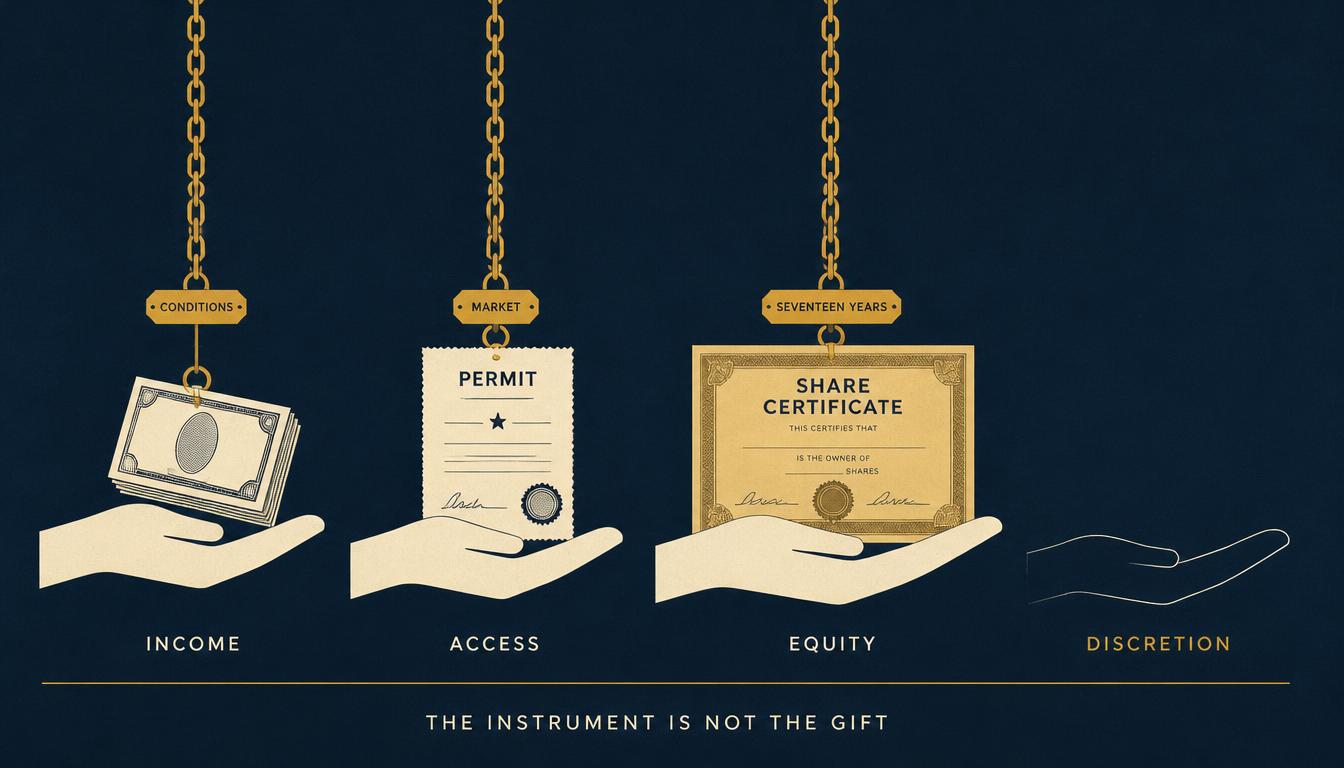
So the structure that appeared to give an individual a thing rather than a claim delivers, in its contemplated form, a security the holder cannot refuse, cannot sell, and cannot direct, for up to seventeen years.
The framework does not claim the holding period is unreasonable. There is an obvious and defensible rationale: a gift intended to build long-horizon wealth is defeated if recipients liquidate on day one, and the restriction is the mechanism that makes the gift durable.
What the framework observes is narrower and follows from its own prior work. Article 60 identified this as a compelled holder — the inverse of the forced seller Article 44 developed. Same removal of discretion, pointed the other way. And discretion is the variable this catalog has repeatedly identified as the thing that distinguishes a price from a number, an owner from a beneficiary, and a thing from a claim.
The convergence
Place the three answers side by side and a pattern appears that none of the three proposals intends.
| What is received | What the recipient controls | |
|---|---|---|
| Universal basic income | Currency | Use, subject to programmability; no constitutional protection in the record of it |
| Coasean labor-access right | A tradeable permit | Sale timing — exercised under forced-seller conditions |
| UBC, fund structure | A beneficiary interest | Nothing; no instrument is held |
| UBC, individual shares via statutory channel | Equity | Nothing for up to seventeen years; cannot refuse, cannot sell |
Three proposals, advanced by people who disagree with each other, converge on giving the recipient something he does not direct.
This is not the result of coordination and the framework asserts none. Each proposal arrives at the outcome for its own reason. Universal basic income delivers currency because currency is the general-purpose instrument, and currency has become a claim at an intermediary. The Coasean right converts a flow into a stock because that is what a property right is, and stocks can be taken in ways flows cannot. Universal basic capital restricts disposition because unrestricted disposition defeats the purpose of the gift.
Each reason is sound in isolation. The composite is what this catalog has documented across more than fifty installments: the substitute layer does not have to be imposed. Instruments designed independently, each for a defensible reason, keep arriving at the same structure.
One documented feedback loop
A narrower observation, offered as fact rather than as argument.
Treasury's explanatory documents for the stock-donation rules cited the Dell pledge and "similar donations," while acknowledging uncertainty about whether that level of giving would continue — "It is unclear whether this level of giving can be sustained in the long run or whether it is concentrated as Trump accounts are launching." 11 The rules written in response make such gifts stickier by requiring retention.
Three weeks later, a donor announced the largest such pledge yet and thanked one of the program's architects for helping enable it. 6
This is how rulemaking works and the framework does not suggest otherwise. It notes only that the terms attached to these gifts were shaped in contemplation of the gifts being made, by parties in communication with the people making them — and that the party whose discretion those terms remove was not among them.
What would falsify this
If Musk's distribution occurs outside Trump Accounts with transferable shares. He has not confirmed the channel, and a distribution placing freely transferable shares in individual hands would defeat the central objection in this essay. The framework would report that.
If the temporary regulations are revised. They are open for public comment and expire September 30, 2029. Jane Ditelberg, chief tax strategist at Northern Trust, has argued that mandated retention of individual shares is itself an investment decision and therefore may contradict the statute, an argument that carries more weight following the overturning of Chevron deference: "I can't tell you how a court would rule, but I could say there's room for a challenge here." 13 If the retention requirement falls, the analysis above changes materially.
If the Anthropic fund publishes a governance structure giving beneficiaries enforceable claims. The objection in this essay is that the public holds no instrument. A structure in which identifiable beneficiaries hold enforceable rights against the fund would answer it.
And the premise itself. All three proposals assume AI displacement at a scale the Distribution Question series found unsupported. If that premise fails, the right answer to the question is that it was the wrong question.
The framework's reading
Something genuinely unusual happened in the third week of October 2026. Two of the most valuable private companies in the world committed, within twenty-four hours, to transferring portions of their equity toward the public — one through a fund it will govern, one through a pledge of individual shares. Whatever one concludes about the structures, the impulse is not nothing, and treating it cynically would be a failure of analysis rather than a demonstration of rigor.
The framework's finding concerns structure rather than motive.
A person's economic position is determined less by what he is given than by what he may do with it. Across three proposals advanced by people who disagree with one another, designed independently, justified on grounds that are individually sound, the recipient ends up holding an instrument whose disposition someone else controls — by programmability, by market conditions, by governance, or by regulation.
This catalog has argued that the essential discipline is distinguishing a claim from the thing it names. Equity in a productive enterprise is the closest thing to a thing on offer here. Delivered through a channel that removes the holder's discretion over it for seventeen years, it becomes a claim on a future he does not control.
That is not an argument against giving people capital. It is an observation that the instrument is not the gift. The discretion is.
Sources
A note on status. The pledges described here are announcements. Musk has specified neither eligibility nor mechanism, the Anthropic fund's governance has not been published, and the Treasury regulations governing stock contributions are temporary, open for public comment, and scheduled to expire 30 September 2029. This essay analyzes the structures as described and makes no prediction about what will be implemented.
Framework cross-references. Articles 38 through 40, the Distribution Question series (AI displacement claims and the third-order beneficiary structure of universal distribution proposals); Article 40 (CBDC programmability); Article 44 (forced-seller conditions); Article 45 (money as creditor claim; Fekete's income-for-wealth test); Article 47 (the Custody Depth score); Article 54 (resolution authority operating on claims); Article 56 (the Coasean labor-access right and the capitalization of human capital); Article 59 (United States v. Miller and the absence of Fourth Amendment protection for intermediated financial records); Article 60 (Trump Accounts, the mandated bid, and Treasury Decision 10056).
Footnotes
-
"AI giant Anthropic commits 5% of shares to 'public benefit' fund." Al Jazeera, 19 October 2026. https://www.aljazeera.com/economy/2026/10/19/anthropic-says-it-will-commit-5-of-shares-to-public-benefit-fund— for the announcement on Sunday, 18 October 2026 of the Anthropic Public Benefit Fund; for the commitment being subject to shareholder approval, after which "the board may, at its discretion, add an additional 2% for every 50% increase in company value above a specified baseline"; for the statement that combined with existing pledges roughly 20 percent of the company's shares are dedicated to the public good; and for the undertaking that the fund will not be used for lobbying or political donations in the United States or overseas. See also "Musk pledges to give a share of his SpaceX company to 'every kid in America' next year," PBS NewsHour, 20 October 2026, https://www.pbs.org/newshour/nation/musk-pledges-to-give-a-share-of-his-spacex-company-to-every-kid-in-america-next-year ↩ ↩2
-
Axios, "Musk pledges 1 SpaceX share for every child in America," 19 October 2026. https://www.axios.com/2026/10/19/elon-musk-spacex-shares-kids — Source for Musk's responses to the Anthropic announcement — "I recommend giving the shares directly to the public," later adding "This is what I will be doing" — and for the characterization of the Anthropic fund as potentially worth $100 billion or more. ↩
-
Musk, Elon, post to X, 19 October 2026: "Next year, I will give one of my SpaceX shares to every kid in America. This will be the first of many." Quoted in Axios (as 2) and in "Elon Musk says he will give a SpaceX share to 'every kid in America,'" CNN, 19 October 2026, https://www.cnn.com/2026/10/19/business/elon-musk-children-spacex-shares-x-post-intl ↩
-
CNN, 19 October 2026 (as 3) — Source for the approximately 73 million Americans under 18 per Census Bureau data, the resulting pledge value of approximately $10.7 billion at SpaceX's share price, and for the earlier pledge by SpaceX President Gwynne Shotwell and her husband of one SpaceX share to each of roughly two million children already signed up to accounts, prioritizing lower-income households and SpaceX's home state of Texas. See also CNBC, "Elon Musk says he'll give a SpaceX share to every child in America next year," 19 October 2026, https://www.cnbc.com/2026/10/19/elon-musk-spacex-shares-giveaway-kids.html, for the Friday closing price of $146.03 and a valuation of approximately $10.5 billion. ↩ ↩2
-
Axios (as 2) — "He did not specify if 'kid' meant all minors under 18 or some other status, nor did he elaborate on what 'first of many' meant." See also CNN (as 3): "Musk's proposal was thin on detail. It is not clear how those shares would be distributed to the tens of millions of American children or whether all of them would even be eligible." ↩
-
Cuccinello, Hayley. "If Elon Musk gifts SpaceX stock through Trump Accounts, it will come with a catch." CNBC, published 20 October 2026, 1:10 PM EDT, updated 3:11 PM EDT. https://www.cnbc.com/2026/10/20/musk-spacex-trump-account-stock-rules.html — Source for Musk thanking Brad Gerstner, "an architect of the program," for "helping enable this" in a comment on X, and for posts from the White House and Treasury Secretary Scott Bessent referencing the gift as benefiting Trump Accounts. On Gerstner as founder of Invest America and his suggestion that the shares be distributed via Trump Accounts, see CNBC, 19 October 2026 (as 4). ↩ ↩2 ↩3
-
CNBC, 20 October 2026 (as 6) — Source for Treasury's citation of Michael and Susan Dell's $6.25 billion cash pledge in the documents explaining the temporary rules. ↩
-
Durkee, Alison. "Elon Musk Giving Out SpaceX Shares As 'Universal Basic Income' Becomes A Major Proposal To Tackle AI." Forbes, 19 October 2026. https://www.forbes.com/sites/alisondurkee/2026/10/19/elon-musk-giving-out-spacex-shares-as-universal-basic-income-becomes-a-major-proposal-to-tackle-ai/ — Source for the framing of the pledge as a step toward "universal basic capital," described as a proposal attracting momentum from politicians on both sides of the aisle as a response to the rise of artificial intelligence, and for the observation that widespread implementation "may be a long way off." ↩
-
Weinstein, Eric R. "Migration for the benefit of all: Towards a new paradigm for economic immigration." International Labour Review, Vol. 141 (2002). International Labour Organization. The formal statement of the Coasean market solution subsequently extended by its author to artificial intelligence and labor. Examined at length in Article 56 of this catalog. ↩
-
Treasury Decision 10056, RIN 1545-BS27, "Trump Accounts," temporary regulations under 26 CFR §§ 1.530A-1T and 1.530A-7T, published in the Federal Register 30 September 2026. Primary text: https://public-inspection.federalregister.gov/2026-20026.pdf — The minimum holding period: "the stock may not be sold before the earlier of (i) the date that is 5 years after the qualified stock contribution to the account, and (ii) the end of the growth period for the account beneficiary of that account." Donor eligibility is limited to "a State (or political subdivision thereof), the United States, the District of Columbia, an Indian Tribal government, or a section 501(c)(3) tax-exempt organization," distributing to an approved class defined at § 1.530A-7T(b)(1) as "not less than 5,000 account beneficiaries" — parents excluded. Technical analysis at https://www.currentfederaltaxdevelopments.com/blog/2026/9/29/technical-analysis-of-treasury-decision-10056-and-proposed-regulations-cc-00226466-26-the-new-regulatory-framework-for-trump-accounts ↩ ↩2
-
CNBC, 20 October 2026 (as 6) — Carolyn Schenck, an attorney and former national fraud counsel at the IRS, now at Caplin & Drysdale: in ordinary charitable giving "donors can typically express preferences about how their gifts are managed, but the receiving organization or trustee retains final authority," whereas under the new rules it is "the donor that's dictating the terms of the gift." Adam Michel, director of tax policy studies at the Cato Institute: "Giving families more choices and more ability to hold the assets that they think are best for them and their kids' future … would be a good thing. But this is not really that, because you have no choice in the asset that is being deposited into your child's account, and then you also have no ability to sell it for the five-year holding period." Also the source for the provisions that families cannot refuse gifted stock and generally cannot sell before the earlier of five years or the end of the calendar year in which the beneficiary turns 17 (independently verified against the regulation at 10); for Schenck's observation that the repurchase requirement increases the beneficiary's risk of loss if the price rises before repurchase; and for Treasury's acknowledgment that "It is unclear whether this level of giving can be sustained in the long run or whether it is concentrated as Trump accounts are launching." ↩ ↩2 ↩3 ↩4 ↩5 ↩6
-
T.D. 10056 (as 10) — Source for the trustee repurchase obligation: "If the qualified stock is disposed of in violation of the minimum holding period requirement, the trustee must repurchase the same number of shares of the same class of qualified stock that were sold or otherwise disposed of as soon as practicable." The enumerated permitted dispositions during the holding period appear at § 1.530A-7T(d). ↩
-
CNBC, 20 October 2026 (as 6) — Jane Ditelberg, chief tax strategist at Northern Trust, on the legal exposure: "These accounts are going to have to stay invested in those stocks, and the question is whether that's directly contradicting the terms of the statute. I can't tell you how a court would rule, but I could say there's room for a challenge here." The reporting notes the argument may carry more weight after the Supreme Court's overturning of Chevron deference, since courts no longer defer to agency interpretations of unclear statutory language. Ditelberg further observed that state law grants a right to disclaim an asset and that it is unclear how the donation procedures would accommodate it. Schenck's counterpoint, from the same piece: Treasury has broad authority to set the terms of these accounts, and it is Treasury rather than the donor that formally requires the shares to be held. ↩
Related essays
Selling the Last Unencumbered Asset: Coase, AI, and a Property Right in Labor-Market Access
In 2002 the mathematician and economist Eric Weinstein published a proposal in the International Labour Review constructing what he called a canonical Coasean market solution to economic immigration — recognizing native workers as the holders of a right of preferential access to their own labor market, and requiring employers who wish to hire outside it to license that right for a fair price rather than receive it by administrative grant. Native workers keep working at a lower wage and receive licensing income on top of it; on Weinstein's account their blended income rises. He has since extended the proposal to artificial intelligence, treating AI as one more supplier of labor that workers license, and framing it as the free-market alternative to universal basic income. The proposal is genuinely Coasean and it is more rigorous than most of what occupies that space. This essay takes it seriously on those terms and then subjects it to the framework's own apparatus. Fekete's test finds no exchange of income for wealth on the worker's side: the worker does not sell the capacity to work, and the human capital stays where it was. What the proposal does is quieter. It splits the wage in two — a return to skill, which remains human capital, and a premium for access to the market, which becomes a licensing payment routed through government and worker representatives, confined to one jurisdiction and one sector. Human capital is unconfiscatable, not fixed in nominal terms, and portable; the licensing claim has none of those properties. In the immigration case the claim is a supplement. In the AI case it is the growing share, and at full displacement it is the whole. The proposal does not capitalize labor. It replaces it, by degrees, with a claim.
The Cryptographic Marketability Premium: How Frontier AI Labs Became the De Facto Issuers of the Digital Trust Layer
The saleability of every digital financial claim in 2026 depends on a cryptographic substrate that is approaching two simultaneous threats: the arrival of cryptographically relevant quantum computing, and the asymmetric deployment of frontier AI for vulnerability discovery. The institutions that control the solution have become a new kind of monetary authority — operating entirely outside the Federal Reserve Act framework, and largely without the awareness of those they effectively govern.
The Account Your Child Did Not Open: Trump Accounts, Mandated Bids, and Choosing Among Constraints
Section 70204 of the One Big Beautiful Bill Act created a new Internal Revenue Code section 530A, establishing what the statute calls Trump Accounts. Every United States citizen born between January 1, 2025 and December 31, 2028 is eligible for a one-time federal contribution of one thousand dollars. Families may add up to five thousand dollars a year. The money cannot be withdrawn until the child turns eighteen. And it must be invested in a mutual fund or exchange traded fund tracking the S&P 500 or a comparable broad index of primarily United States equities, with fees capped at one tenth of one percent, no leverage, no sector funds, no individual securities, and no self-directed alternative of any kind. That last provision is the subject of this essay. Article 53 of this catalog argued that the enormous price-insensitive bid in American equity markets requires no conspiracy because it is produced by mandates — public, uncoordinated, disclosed, and larger than any concealed scheme could be. Trump Accounts are that argument written into statute and applied to newborns. The essay works through the mechanics, estimates the scale of the flow, sets the program against the alternatives available to a self-employed parent, examines the 529 plan against the actual enrollment data rather than the rhetoric, and arrives at a position the framework states plainly: there is no unconstrained vehicle, the choice is among constraints, and the right method is to name the threat model before selecting the instrument.