Researched and drafted with AI assistance · reviewed and edited by Jason D. Keys
Listen
Selling the Last Unencumbered Asset: Coase, AI, and a Property Right in Labor-Market Access
Read in Jason D. Keys' synthesized voice
Narrated in the author’s synthesized voice, generated with AI from a recording of his own. The words are his; the delivery is machine-rendered.
Download (10.6 MB)The proposal
In 2002 the International Labour Review published a paper by Eric Weinstein titled "Migration for the benefit of all: Towards a new paradigm for economic immigration." Its stated object is an argument "for new market-based MWPs that seek to align the support and interests of native workers, employers, consumers, governments, and the interests of migrants" — migrant worker programs restructured around the licensing of tradeable work permits. 1 Weinstein describes the paper as having "called for and constructed a canonical Coasian market solution to problems of immigration." 1
The structure is this. The main reason a native worker earns more than a prospective migrant, the paper argues, is a right of preferential access to the domestic labor market, held by native workers within the nation's social contract. That right is exactly what is transferred whenever a migrant program is opened or expanded. Under current arrangements it is transferred without payment, through visa quotas and work authorizations that employers lobby to expand. Weinstein's move is to require that the transfer be priced: "a true market for tradeable work permits must be a licensed one, with the employers the canonical licensees and the native workers the canonical licensors." 1
The mechanism follows from that. Employers in a sector buy work permits. The government deducts the costs of hosting migrants and pays the remainder to the native workers of that sector as licensing fees, which representative worker groups distribute. The permits, not the natives' entitlement, then trade on a secondary market among employers. 1
The worker in this arrangement does not stop working. The paper's premise is that native workers "should be expected to accept lower wages if, and only if, their total compensation increases," and its model gives them exactly that: a wage reduced by the added labor supply and a new licensing fee that more than offsets it. 1 Weinstein states it plainly in conversation. If an employer licenses the right to hire from abroad, "my wage income will go down, my licensing income will go up, and my blended income will increase." 2
The argument's edge is directed at employers rather than at migrants. If access to a labor market is valuable — and employers' lobbying demonstrates that it is — then distributing it for free is a subsidy, and calling that subsidy a free-market policy is a category error. A genuine market solution would price it.
Weinstein has since extended the proposal to artificial intelligence, and the extension is what makes it current. In public writing he describes it as "potentially the most important idea for labor surviving, coexisting and thriving with AI," states that "UBI is a crude dehumanizing welfare tool which should be abandoned in favor of a Coasian free market solution," and observes that the proposal is unpopular with the people one might expect: "Coasian economics gives them an option to live their stated free market dream but where workers can now get wealthy. And, as you might fear, CEOs and VCs hate it." 3 The mechanism carries over directly. In this model, as he put it in a recent interview, AI becomes just another supplier of labor, and the workers license it. 2
This catalog examined distribution proposals across the Distribution Question series and found the dominant ones defective. Weinstein's is a genuine alternative to those, it is more rigorous than most of what occupies that space, and the framework takes it seriously for the length of this essay before arriving somewhere its author would not.
What Coase actually said
The proposal invokes Coase, so the invocation deserves checking.
The Nature of the Firm (1937). Coase asked a question that mainstream price theory had not: if markets allocate resources efficiently, why does so much economic activity occur inside firms, where allocation is accomplished by direction rather than by price? 4 His answer is transaction costs — the costs of discovering what the relevant prices are, of negotiating and concluding separate contracts for each transaction, of enforcing them. A firm exists where organizing an activity internally costs less than contracting for it in the market, and its boundary sits where those two costs equalize.
The Federal Communications Commission (1959). Coase applied the framework to radio spectrum, then allocated by administrative assignment. His proposal was to define property rights in frequencies and permit them to be traded, on the grounds that the allocation problem was not interference but ill-defined rights. 5 This is the closest historical analogue to the policy problem Weinstein addresses: a resource currently distributed by administrative grant, with a right to be defined in it and priced.
The Problem of Social Cost (1960). The paper that produced what Stigler named the Coase Theorem: where transaction costs are zero and property rights are well defined, bargaining produces an efficient allocation regardless of which party holds the initial right. 6 It is the paper Weinstein's article cites, and his illustration is in its spirit: a citizenry's right to forbid pollution, converted into a right to license a tolerable level of it in exchange for compensating fees. 1
That last point requires a correction that bears directly on this essay, because the theorem is routinely misread. Coase did not regard the zero-transaction-cost world as descriptive. He constructed it as a benchmark that does not exist, precisely in order to direct attention to the cases where transaction costs are positive — which is all of them. As one survey puts it, Coase's purpose "was to establish a benchmark that does not exist, precisely to bring our attention to bear on the importance of assigning property rights." 7
So the invocation is sound. Weinstein is not misusing Coase; he is doing what Coase did with spectrum and with pollution, applied to a different resource.
Why the proposal is better than its reception
Three things in its favor, stated before the framework's objection.
It identifies a genuine subsidy. Employer lobbying for expanded work authorization is evidence that access has value. A policy that transfers something valuable without payment is a transfer, whatever it is called. Weinstein's claim that employer-favored open-border arrangements are not in fact free-market outcomes is correct on its own terms, and it is a claim that discomforts both conventional political positions.
It keeps the recipient in the market. Article 40 examined universal distribution proposals and found a recurring defect: the recipient sits at the bottom of a structure whose first-order beneficiaries are the institutions administering it. Weinstein's design does not abolish the administrative layer — the paper routes payment through the government and through worker representatives — but it changes what the recipient is. In the paper's model the licensing schedule is set by the active workers of a sector, and a worker who leaves the sector relinquishes the licensing income. 1 A universal transfer pays people for being outside the labor market. This pays them for being inside it.
It is honest about what AI displacement would mean. The Distribution Question series documented that the mass-displacement narrative is empirically weaker than its proponents claim. But if displacement does occur at scale, the question of what the displaced hold is real, and most answers to it are evasions. Weinstein's is not.
Running the framework's test
Article 45 of this catalog developed a test from Fekete's definition of interest. If interest is the price at which income is exchanged for wealth, then any transaction bearing that name can be examined against a question: is such an exchange actually occurring?
The test discriminates. A merchant borrowing to finance a shipment receives wealth and pledges future income; both sides are present. A household borrowing to finance consumption pledges future income and receives goods that are consumed, leaving nothing on its side of the ledger. Identical legal form, categorically different transactions.
Apply it to the worker's side of a licensed labor market.
What does the worker surrender? Not the capacity to work. The worker keeps the job and keeps the skill. What the worker gives up is part of the wage — the part that the added labor supply competes away.
What does the worker receive? A licensing payment. Weinstein's own description is income for income: wage income down, licensing income up, blended income higher. 2
The test returns no. No income is exchanged for wealth on the worker's side, and the human capital that this catalog has treated as the dominant asset of a working life is not sold. Whatever the proposal does, it does not alienate labor.
But the test is useful even when it returns no, because it forces the question of what kind of thing each side of the ledger is. The worker's total income is not merely larger after the license. It is made of two different things.
What the test reveals
Articles 37 and 44 of this catalog identified human capital as the dominant asset across most of a working life, and identified three properties that distinguish it from every instrument in the substitute layer.
It is unconfiscatable. A state can seize gold, freeze an account, and pesify a deposit. It cannot seize a person's capacity to work, because that capacity is not separable from the person.
It is not fixed in nominal terms. An annuity, a bond, and a pension obligation are denominated in currency and are destroyed by its debasement. Wages reprice, imperfectly and with lag, but they reprice.
It is portable across jurisdictions. Article 43 established that in the threat model of sudden, undocumented flight, portability dominates every other consideration. Skills cross borders. Deposits do not.
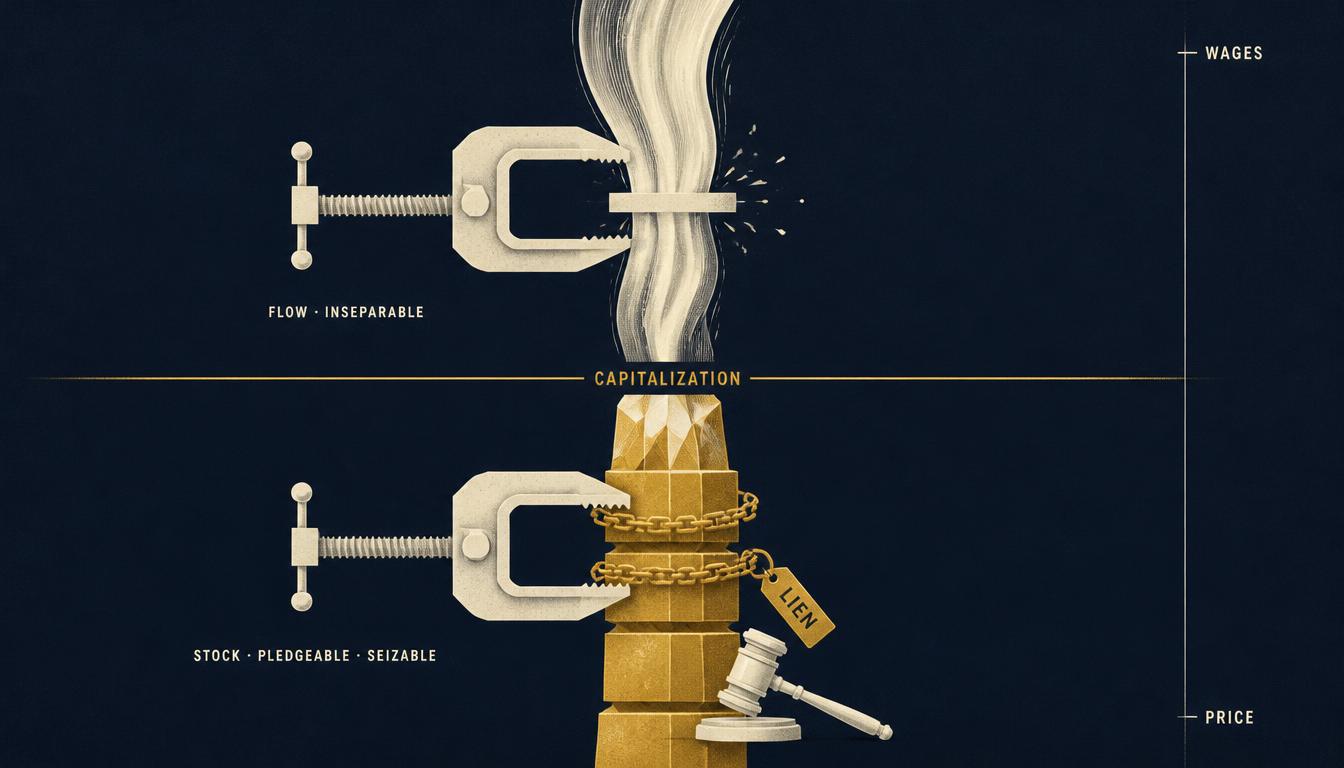
Those three properties have a single structural source: human capital is a flow, not a stock, and it is inseparable from its owner.
The proposal leaves that source intact for one part of the worker's income and removes it from the other. After the license, the worker is paid two ways.
The wage is the return to the worker's own skill and effort in a market that now has more suppliers in it. It is smaller, and it is still human capital. It keeps all three properties.
The licensing fee is the premium for access to the market, taken out of the wage and paid separately. It has none of them.
It is not unconfiscatable. It is a payment the government makes after deducting its own costs, distributed by representative bodies, on a schedule set through a negotiation — or, in the paper's second-best design, imputed by a government agency. 1 What a schedule sets, a schedule can reset. It is a claim on an institutional arrangement, and it is reachable by everything that reaches claims, including the kind of resolution regime Article 54 documented.
It is fixed by schedule rather than by the holder. A wage reprices because the worker can bargain, quit, or move. A licensing fee reprices when the institution that sets it decides to.
It is not portable. It is a right in one national labor market and, in the paper's design, one sector of it. A worker who leaves the sector relinquishes it. 1 A worker who leaves the country takes the skill and leaves the license behind.
The framework's finding, stated as the essay's central one: the proposal does not capitalize labor. It carves the access premium out of the wage and turns it into a claim — and the claim sits inside the substitute layer, where the wage did not.
In the immigration case the paper models, that is a modest exposure. The licensing fee is a supplement to a wage that remains the larger part of the worker's income. The case that makes the proposal current is the one where it is not.
The ratio is the variable
The AI extension changes one quantity, and it is the one that matters.
In the 2002 model the number of migrants is bounded: set by employer demand, by the government's cost schedule, and by the hosting capacity of the country. 1 The wage falls, but within limits, and the licensing fee is a top-up.
In Weinstein's AI version, AI is another supplier of labor and the workers license it. 2 Grant the premise the proposal is built on — that AI displaces labor at scale — and nothing bounds the supply in the same way. The wage component falls toward the value of whatever AI cannot do. The licensing component rises to fill the gap. On Weinstein's account the blended income can still increase. Its composition shifts steadily from the asset outside the substitute layer to a claim inside it.
At full displacement in a given occupation, the worker holds no wage in it. What remains is a licensing claim on fees paid by a small number of AI firms, collected through the state, and distributed by a representative body.
The paper's own design then forces a choice. Its licensing schedule is set by the active workers of a sector, and leaving the sector means relinquishing the income. 1 When the work is done by AI, either that condition is kept, in which case a displaced worker loses the licensing income at the moment the wage disappears, or it is dropped, in which case the payment is no longer tied to work at all. A payment to former workers, collected by the state from the firms that displaced them and distributed by an administrative body, is a transfer. It may be a better-grounded one than universal basic income, because the entitlement rests on a prior right rather than on need. But it occupies the same position in the structure that Article 40 examined.
Menger, and the saleability of the claim
Menger's apparatus supplies a second reading.
Menger's account of money rests on differential saleability — the degree to which a good can be disposed of without loss of value. 8 This catalog has used that measure as a continuous scale applicable to any asset, and has argued that the decay of marketability is the signature of an instrument's degradation.
In the 2002 paper, the native worker's licensing entitlement is not saleable at all. The permits trade, among employers; the natives' share is a collective entitlement distributed by their representatives. 1 That has a protective consequence: an entitlement that cannot be sold cannot be sold badly, and the forced-seller condition Article 44 documented cannot arise. It also means the worker holds a membership claim rather than an asset under the worker's own control.
Weinstein's public framing points somewhere further. He has called for access to the labor market to be made into "a saleable property right," and argues that the proposal lets workers "get wealthy." 2 3 If the individual entitlement were made tradeable — which the paper does not specify — then Fekete's test would return a different answer for that transaction. A worker selling the licensing stream for a lump sum would be exchanging income for wealth in exactly Fekete's sense, with the worker in the retiree's position.
And the forced-seller conditions would then apply in full. A right to licensing income from a labor market is worth most when that market is strong — which is when the holder least needs to sell. It is worth least when the market is weak, which is when the holder most needs to. A displaced worker would face an urgent liquidity need, an asset whose value has fallen for the same reason the wage fell, and, if the right had been borrowed against, leverage as well. Article 44 documented the empirical magnitude of what displacement already costs, including a persistent earnings loss of roughly twenty-five percent for displaced workers. A saleable right would add a second channel through which that loss is realized, at the bottom, once.
That exposure would fall on the access claim, not on the worker's skill. The skill stays with the worker in every version of the proposal.
Where the framework may be wrong
The framework states the objections to its own position.
The proposal may be better than the status quo even if the objection holds. A worker with a claim exposed to institutional risk is arguably better off than one with nothing. The framework's analysis establishes a cost, not that the cost exceeds the benefit, and Weinstein's comparison is to universal basic income rather than to an idealized alternative.
The access premium was never fully human capital. The premium that the proposal carves out of the wage exists because of border policy — Weinstein's paper calls it a right held "within the structure of a sovereign nation's social contracts." 1 A government can already destroy it by changing immigration policy, without paying anyone. On this reading the proposal does not move part of the wage into the substitute layer; it makes visible a part that was always a political rent, and pays for it when it is taken. That is a strong objection, and the framework accepts most of it.
The framework's answer, which it offers as a distinction rather than a refutation: an implicit premium embedded in a wage is paid by the employer to the worker directly, reprices with the wage, and cannot be reached separately from it. An explicit licensing claim is a ledger entry held by an institution on the worker's behalf. It can be assigned, offset, garnished, means-tested against other benefits, or repriced by schedule, and none of that requires touching the worker. Making the rent explicit and paying for it is an improvement in fairness. It is also a change in what can be done to it. A reader may find the distinction too fine to bear the weight placed on it.
The Austrian critique of Coase cuts at the foundation and the framework does not fully endorse it. Within the Austrian tradition, Coase's framework has been attacked at the root. Gary North, writing in the Journal of Libertarian Studies, argued that Coase's essay "undermines the very concept of private property rights" by treating the right to inflict harm as symmetric with the right to be free from it, and by making the allocation of entitlements a matter of efficiency rather than of prior right. 9 If that critique holds, Weinstein's proposal inherits the defect: it treats labor-market access as an entitlement to be assigned efficiently rather than as something already belonging to someone.
The framework does not fully endorse North's critique — it has used Coasean reasoning elsewhere and finds the transaction-cost apparatus genuinely illuminating. But a reader should know that the most serious objection to this proposal from within the tradition this catalog occupies is not the one developed above. It is an objection to Coase himself.
The firm, and what AI does to it
One further observation, which is not an objection and which the framework regards as the most interesting unexplored consequence.
Coase's 1937 insight was that the firm's boundary is set by transaction costs. Where contracting in the market is expensive — discovering prices, negotiating terms, monitoring performance — activity moves inside the firm.
Artificial intelligence is, among other things, a transaction-cost technology. It reduces the cost of search, of drafting and evaluating contracts, of monitoring performance against specification. The Coasean prediction follows mechanically: as transaction costs fall, firms should dissolve toward markets.
That prediction cuts against the concentration this catalog has documented elsewhere. Article 46 established that the largest technology companies and their suppliers constitute roughly thirty percent of a major equity index, and Article 48 traced the capital flows sustaining that concentration. If AI genuinely collapses transaction costs, Coase's framework predicts the opposite of what is being capitalized.
The framework does not resolve this. It notes that one of two things must be true: either the transaction-cost reduction is smaller than claimed, or the current concentration reflects something other than productive organization. Both readings are available in this catalog's prior work, and the framework has not determined which it holds.
The framework's reading
Weinstein's proposal is serious, correctly Coasean, and identifies a real defect in the alternatives. Its diagnosis of employer-favored open-border policy as a subsidy rather than a market outcome is sound. Its insistence that workers be paid for what is taken from them, rather than granted a transfer for what they have lost, is one this catalog's Distribution Question series has reason to respect.
The framework's finding is narrower than a rejection and more specific than a caveat.
Across fifty-five prior installments this catalog has argued that the substitute layer interposes claims between savers and the things those claims name, that the essential discipline is distinguishing a claim from a thing, and that human capital is the one major asset standing outside the layer — not because anyone protected it, but because a flow inseparable from its owner cannot be pledged, encumbered, securitized, or seized.
The proposal leaves the worker's labor where it was. It leaves the worker working. What it does is divide the worker's income into the part that comes from the worker and the part that comes from the market's border, and hand the second part to an institution to collect and pay out. In the case the paper was written for, that is a fair price for a real transfer. In the case it is now offered for, the second part is the one that grows, and the first is the one that AI is displacing.
The last unencumbered asset is not sold under this proposal. It is substituted, one licensing payment at a time, by a claim — and the substitution is done in the name of protecting it.
Sources
Framework cross-references. Article 31 (the classical definitions of labor, land, and capital, and Ricardo's machinery question); Articles 38 through 40, the Distribution Question series (AI displacement claims and the third-order beneficiary structure of universal distribution proposals); Article 43 (threat models, and the protective property of portability under sudden displacement); Article 44 (human capital as the dominant asset; the forced-seller conditions and the displaced-worker earnings literature); Article 45 (Fekete's income-for-wealth test and its discriminating application); Article 46 (index concentration and claim layering); Article 48 (the securitization chain from premium to data center); Article 54 (resolution regimes operating on claims).
Footnotes
-
Weinstein, Eric R. "Migration for the benefit of all: Towards a new paradigm for economic immigration." International Labour Review, Vol. 141, No. 3 (2002), pp. 225–252. https://researchrepository.ilo.org/esploro/outputs/journalArticle/Migration-for-the-benefit-of-all/995274442302676 (DOI https://doi.org/10.1111/j.1564-913X.2002.tb00238.x) — for the abstract; the right of preferential labor-market access and the licensor/licensee structure (p. 240); acceptance of lower wages if and only if total compensation rises (p. 240); the Coasean pollution-licensing illustration (pp. 242–243); bounded migrant numbers and the sectoral licensing schedule (pp. 238, 241–243); government deduction of costs, distribution through worker groups, the employer secondary market in permits, and relinquished licensing income on leaving a sector (p. 244); the second-best imputed schedule (p. 246); reduced native wages offset by licensing fees (pp. 250–252). Weinstein's description of the paper as a "canonical Coasian market solution" is from his Institute for New Economic Thinking biography, https://www.ineteconomics.org/research/experts/eweinstein. ↩ ↩2 ↩3 ↩4 ↩5 ↩6 ↩7 ↩8 ↩9 ↩10 ↩11 ↩12 ↩13
-
Weinstein, Eric R., interviewed by Steven Bartlett. "UFO Cover-Up Analyst: The Secret Alien Programs Nobody Is Talking About!" The Diary of a CEO, October 12, 2026. https://www.youtube.com/watch?v=IkhmdTqSvJw — for wage income falling while licensing and blended income rise (about 22:30), access to the labor market as "a saleable property right" (about 21:30), and AI as another supplier of labor that workers license (about 25:00). ↩ ↩2 ↩3 ↩4 ↩5
-
Weinstein, Eric R., public post, November 2024. https://x.com/ericweinstein/status/1856026921659969705 — for the extension to AI and the quoted remarks on UBI and on CEOs and VCs. The post is reproduced as transcribed; no archived copy was located, and the formal argument remains the 2002 paper at 1. ↩ ↩2
-
Coase, Ronald H. "The Nature of the Firm." Economica, New Series, Vol. 4, No. 16 (November 1937), pp. 386–405. Summarized in L. Lynne Kiesling, The Essential Ronald Coase, Fraser Institute, https://www.essentialscholars.org/sites/default/files/2023-01/essential-ronald-coase.pdf — for transaction costs as the boundary of the firm. ↩
-
Coase, Ronald H. "The Federal Communications Commission." Journal of Law and Economics, Vol. 2 (October 1959), pp. 1–40. Discussed in Thomas W. Merrill and Henry E. Smith, "Making Coasean Property More Coasean," https://scholarship.law.columbia.edu/cgi/viewcontent.cgi?article=3259&context=faculty_scholarship — for tradeable property rights in spectrum in place of administrative assignment. ↩
-
Coase, Ronald H. "The Problem of Social Cost." Journal of Law and Economics, Vol. 3 (October 1960), pp. 1–44. https://www.law.uchicago.edu/sites/default/files/file/coase-problem.pdf — for the bargaining result under zero transaction costs and well-defined rights. ↩
-
Alston, Lee J. and Bernardo Mueller. "Property Rights in Historical Political Economy: When Do Wedges Wither?" NBER Working Paper 29991, April 2022. https://www.nber.org/system/files/working_papers/w29991/w29991.pdf — for the quoted reading of the zero-transaction-cost world as a benchmark. ↩
-
Menger, Carl. "On the Origins of Money." Economic Journal, Vol. 2 (1892), pp. 239–255. Translated by Caroline A. Foley. https://mises.org/library/book/origins-money — for differential saleability. ↩
-
North, Gary. "Undermining Property Rights: Coase and Becker." Journal of Libertarian Studies, Vol. 16, No. 4 (Fall 2002), pp. 75–100. https://cdn.mises.org/16_4_5.pdf — for the quoted Austrian critique of Coase. ↩
Related essays
Three Answers to the Same Question: UBI, the Coasean Right, and Universal Basic Capital
On October 18, 2026, Anthropic announced it would commit five percent of its equity to a new public benefit fund held within the company. The following morning Elon Musk, who had responded to that announcement by writing that he would instead recommend giving shares directly to the public, pledged one of his SpaceX shares to every child in America. Four such pledges now stand, and commentary has reached for a label: universal basic capital. This essay sets that proposal alongside the two others this catalog has already examined — universal basic income, analyzed across the Distribution Question series, and the Coasean property right in labor-market access, examined in Article 56 — and asks the question none of the coverage asks, which is what the recipient actually ends up holding. The framework's answer is that all three converge on the same structure from different directions. Under universal basic income the recipient holds currency, which this catalog has established is a creditor claim carrying no Fourth Amendment protection and subject to programmable conditions and resolution authority. Under the Coasean right he holds a tradeable permit, which capitalizes the one asset that previously stood outside the substitute layer. And under universal basic capital delivered through the statutory channel now being discussed, he holds equity he cannot refuse, cannot sell for up to seventeen years, and cannot direct. Three proposals, three constituencies, and the same result: the recipient receives something he does not control.
The Janus-Face of Marketability: What Menger and Fekete Reveal About Universal Distribution
This essay is the theoretical core of *The Distribution Question* series. [Article 38](/forum/38-rhetoric-reality-2026-distribution-debate) established the descriptive terrain — the seven variants of universal distribution being proposed in 2026 (UBI, UHI, UBC, UBW, UBO, UBCapital, tokenized UBI), their proponents, their proposed funding mechanisms, and the substantial gap between the mass-unemployment rhetoric that justifies them and the empirical labor market data. This installment develops the framework's theoretical apparatus for reading those proposals structurally. The central analytical apparatus is Antal Fekete's concept of the Janus-Face of marketability — the observation that marketability (Menger's *Absatzfähigkeit*) has two distinct faces that must both function for a monetary system to serve its purpose. Marketability in the large refers to the capacity of a monetary asset to settle large payments, preserve value across long time horizons, and function as a store of wealth. Marketability in the small refers to the capacity of a monetary asset to settle daily transactions, pay wages, and function as a circulating medium of exchange for small purchases. Gold historically optimized for marketability in the large; silver optimized for marketability in the small; a functioning monetary system required both. This essay applies the Janus-Face framework to the universal distribution proposals: what is being distributed is not money in the framework's precise sense but currency whose marketability has been degraded on both faces. The essay also engages the Quantity Theory of Money critique — the standard gold-bug objection that UBI will produce hyperinflation depends on assumptions about money velocity that Fekete demonstrated to be unreliable. The framework's specific reading: the problems with universal distribution are not primarily inflationary; they are about power concentration, substrate dependency, and the failure of currency distribution to substitute for money ownership. The essay closes by reading Sam Altman's evolution from UBI to universal basic compute to universal basic wealth as unintentional rediscovery of the framework's insight that ownership beats distribution — an insight Altman still gets partially wrong because his proposed ownership vehicles route through single institutional intermediaries.
The Rhetoric and the Reality: Reading the 2026 Distribution Debate
Elon Musk has endorsed 'universal high income' as the appropriate response to AI-driven displacement, putting eighty percent odds on the benign scenario in which nobody works. In May 2024 Sam Altman had already proposed 'universal basic compute' as a superior alternative to universal basic income; by August 2025 he had moved further, advocating 'universal basic wealth' and then 'universal extreme wealth for everybody.' In October 2025, the Guaranteed Income Pilot Program Act of 2025 (H.R. 5830) was introduced in the U.S. House, authorizing $495 million annually through fiscal 2030 for a three-year federal pilot. More than 150 U.S. cities now run guaranteed income programs of some kind. The rhetoric has expanded to include Peter Diamandis's 'universal basic ownership,' Mark Garman's 'universal basic capital,' 'tokenized UBI' delivered through programmable rails, and Altman's proposal to distribute one billion AI-generated tokens per person from a projected twenty quintillion annual output. The empirical picture of the displacement these proposals address is substantially more modest than the rhetoric: Goldman Sachs Research estimates 2.5 percent displacement risk in its base case and 6-7 percent under widespread adoption, resolving within about two years; the Federal Reserve projects 4.4 percent unemployment by end 2026 with no AI-driven spike; Harvard Business Review finds most AI-attributed layoffs are anticipatory, made on expected rather than demonstrated capability; and Oxford Economics finds AI cited for roughly 4.5 percent of reported job losses against four times as many attributed to ordinary market conditions. This essay is the first installment of a new framework series titled The Distribution Question. It reads the 2026 distribution debate as a specific institutional and rhetorical phenomenon: what is actually being proposed, by whom, on what empirical basis, and what the gap between the rhetoric and the reality reveals about the institutional interests that the proposals serve. Subsequent installments engage the theoretical apparatus ([Article 39](/forum/39-janus-face-marketability-distribution), on the Janus-Face of marketability) and the institutional analysis of delivery mechanisms and constructive alternatives ([Article 40](/forum/40-delivery-mechanism-positive-alternative-distribution)).